国家安全概念泛化

Search documents
外交部回应美国将大疆无人机列入“受管制清单”
Yang Shi Xin Wen· 2025-12-23 07:30
Core Viewpoint - The U.S. Federal Communications Commission has added DJI, a Chinese drone manufacturer, to a list of companies deemed to pose an "unacceptable risk" to U.S. national security, leading to a ban on the approval of new drone models for import or sale in the U.S. [1] Group 1 - The Chinese government firmly opposes the U.S. for broadening the concept of national security and creating a discriminatory blacklist that unjustly suppresses Chinese companies [1] - The U.S. is urged to correct its erroneous practices and provide a fair, just, and non-discriminatory environment for Chinese enterprises to operate [1]
荷兰明抢安世半导体后,英国又传来新消息,中资芯片工厂或被勒令强制出售!
Sou Hu Cai Jing· 2025-12-20 11:47
Group 1 - The increasing pressure from Western countries on Chinese semiconductor companies is raising concerns about the politicization of business rules and the concept of "national security" [1][5][6] - The acquisition of FTDI by Jian Guang Asset for $414 million in December 2021 aimed to address China's technological shortcomings in high-performance analog chips, which are critical for various industries [3][5] - The UK government has mandated Jian Guang Asset to sell its entire stake in FTDI by the end of December 2025, citing vague "national security" reasons, similar to the previous incident involving Nexperia [5][6] Group 2 - The actions taken by the UK and the Netherlands reflect a broader trend of Western nations using the concept of "national security" to unfairly target Chinese enterprises, undermining the principles of free market economics [6][9] - The sale of FTDI is seen as part of a political strategy rather than a genuine concern for supply chain security, as FTDI's products are not classified as sensitive or irreplaceable [6][9] - The recent announcement by Dongfang Precision to sell its subsidiary for €774 million (approximately 640 million RMB) indicates a shift in Chinese companies' attitudes towards the European market, possibly due to risk aversion [7] Group 3 - The incidents involving Nexperia and FTDI have escalated into a national struggle for technological sovereignty, highlighting the double standards in Western policies towards free market principles [9] - Chinese companies are encouraged to accelerate their innovation efforts and maintain an open stance towards international cooperation, particularly in regions with significant demand like the Middle East and Africa [11] - The establishment of a "dual circulation" system is crucial for Chinese enterprises to mitigate the impacts of declining external demand and to strengthen domestic market positioning [13][14]


外交部:中方一贯反对泛化国家安全概念、将经贸问题政治化的做法
Huan Qiu Wang· 2025-10-23 09:38
Core Viewpoint - The Chinese government supports its enterprises in conducting international cooperation based on mutual benefit and market principles, while also emphasizing the importance of investment security [1]. Group 1: Investment Plans - Mingyang Smart Energy, a Chinese wind turbine manufacturer, plans to invest £1.5 billion (approximately $1.8 billion) in building a wind turbine factory in Scotland [1]. - The investment has raised concerns in the UK regarding potential threats to national security [1]. Group 2: Political Context - The Chinese government has noted that there have been numerous instances where normal economic projects in the UK have been politicized and subjected to security concerns [1]. - Since the introduction of the UK's National Security and Investment Act in 2022, the UK government has prohibited or conditionally approved over ten investments from Chinese companies [1]. Group 3: Reactions to Security Concerns - The Chinese spokesperson criticized the broadening of the national security concept and the politicization of economic issues, labeling the "China threat" narrative as absurd and lacking basic common sense [1]. - The spokesperson warned that if such sentiments continue to proliferate, it could severely impact Chinese companies' assessments of the investment environment in the UK and lead to more cautious decision-making [1].

外交部:中方反对英国泛化国家安全概念,将经贸问题政治化
Xin Lang Cai Jing· 2025-10-23 07:50
Core Viewpoint - The Chinese government supports its enterprises in international cooperation based on mutual benefit and market principles, while also emphasizing the importance of investment security [1] Group 1: Investment Plans - Mingyang Smart Energy, a Chinese wind turbine manufacturer, plans to invest £1.5 billion in a wind turbine factory in Scotland [1] - The investment has raised concerns in the UK regarding potential threats to national security [1] Group 2: Political Context - The UK has seen a trend of politicizing economic projects, particularly those involving Chinese investments, since the introduction of the National Security and Investment Act in 2022 [1] - The UK government has prohibited or conditionally approved over ten Chinese investment projects, including taking control of a Chinese-owned steel company and requiring the sale of shares in a Chinese-acquired semiconductor firm [1] Group 3: Response to Concerns - The Chinese government opposes the broadening of the national security concept and the politicization of economic issues [1] - There are concerns that ongoing negative narratives about China could adversely affect Chinese companies' assessments of the UK investment environment [1]
安世中国发布致全体员工公开信
中国基金报· 2025-10-19 07:13
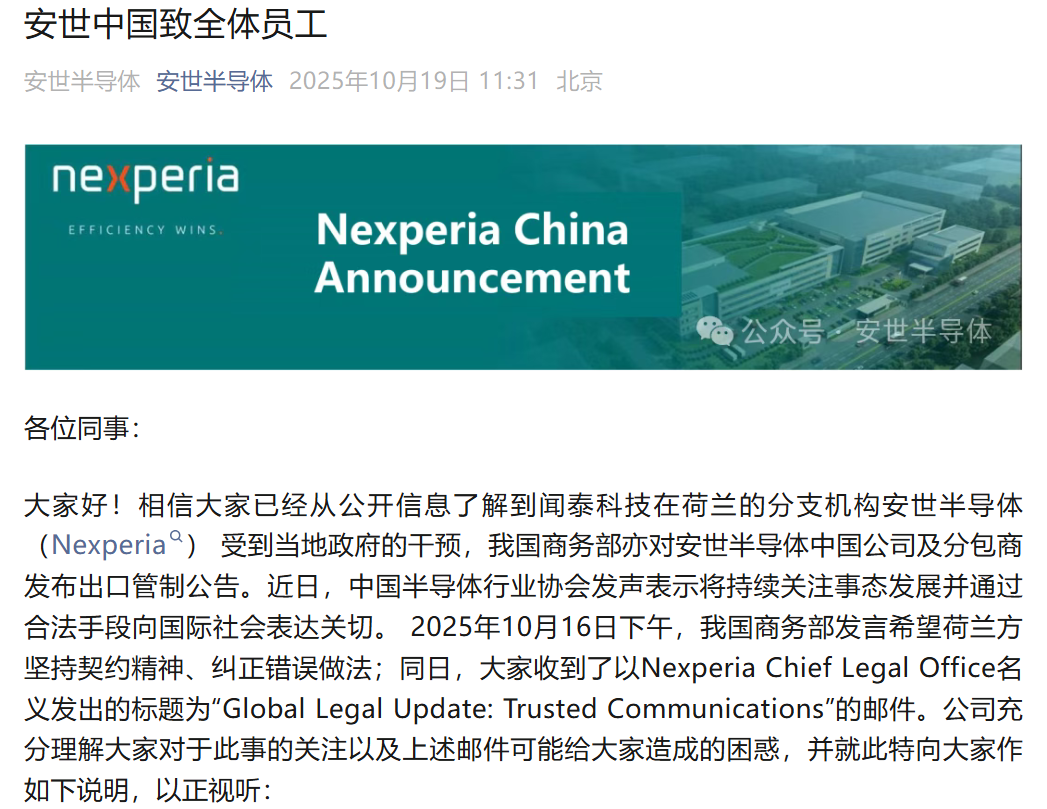
Core Viewpoint - Anshi China reassures employees that all domestic operations and employee salaries and benefits are normal, emphasizing compliance with Chinese laws and independent decision-making [2][4][5]. Group 1: Company Operations - Anshi China operates as an independent Chinese enterprise, adhering to local laws and regulations, with the legal representative authorized to make operational decisions [4]. - The company confirms that all domestic operations, including production and employee compensation, are functioning normally, and external influences will not affect operations or employee rights [5]. Group 2: Employee Relations - Employees are required to follow company directives and can refuse external instructions not authorized by the legal representative without violating work discipline [5]. - Anshi China expresses gratitude to employees for their contributions and encourages them to maintain a united front during challenging times [5]. Group 3: External Challenges - Recent announcements indicate that Anshi Semiconductor and its subsidiaries are under a global operational freeze imposed by the Dutch government, citing national security concerns, which has been criticized as discriminatory against Chinese enterprises [6][7]. - The Chinese government and semiconductor industry associations have voiced strong opposition to the Dutch government's actions, advocating for fair treatment and adherence to market principles [7][8].


安世中国发布致全体员工公开信
Zhong Guo Ji Jin Bao· 2025-10-19 06:41
Core Viewpoint - Anxin Semiconductor China reassures employees that all domestic operations and employee salaries and benefits are normal, emphasizing compliance with Chinese laws and independent decision-making [1][3][4] Group 1: Company Operations - Anxin Semiconductor China operates as a Chinese enterprise with a global strategy, adhering to Chinese laws and regulations [3] - The company confirms that all domestic operations, including employee salaries and benefits, are functioning normally [3][4] - The management is committed to ensuring the company's normal operations and protecting employee interests from external influences [3][4] Group 2: Employee Relations - Employees are required to follow company directives and can refuse external instructions not authorized by the company's legal representative without violating work discipline [3] - The company expresses gratitude to employees for their contributions and encourages them to maintain a unified front during challenging times [4] Group 3: External Challenges - Recent announcements indicate that Anxin Semiconductor and its subsidiaries are facing operational freezes imposed by the Dutch government, citing national security concerns [4][5] - The parent company, Wentai Technology, strongly protests against what it perceives as discriminatory treatment of Chinese enterprises and is pursuing legal and diplomatic avenues to challenge the Dutch government's actions [5][6] - The Chinese government and semiconductor industry associations have voiced opposition to the Dutch government's actions, emphasizing the need to uphold market principles and protect the rights of Chinese enterprises [5][6]
荷兰政府对中企旗下安世半导体公司妄加干预,中国行业协会发声反对
Huan Qiu Shi Bao· 2025-10-14 22:51
Core Points - The Dutch government has intervened in the operations of Nexperia, a subsidiary of China's Wingtech Technology, citing risks to economic security in the Netherlands and Europe [1][2] - The Chinese Semiconductor Industry Association has expressed strong support for Nexperia, opposing the misuse of national security concepts and discriminatory restrictions against Chinese companies [1] - Nexperia is a key supplier of mature process chips for the automotive and consumer electronics industries, and the Dutch government has taken control to ensure the supply of semiconductors [1][2] Group 1 - The Dutch government claims that Nexperia has shown "serious governance deficiencies" and that there are urgent signals threatening the continuity of critical technology in the Netherlands and Europe [1] - The intervention is based on the Material Supply Act, which was established over 70 years ago during the Cold War to secure access to critical products in emergencies [1] - Nexperia can continue production, but the Dutch government now has the authority to block or overturn its decisions [1] Group 2 - Wingtech Technology has announced that the Dutch government's actions are excessive interventions based on geopolitical bias rather than factual risk assessments [2] - The company is pursuing all legal and diplomatic avenues to demand the immediate withdrawal of the Dutch government's directive and to stop systemic discrimination against Chinese enterprises [2] - Concerns have been raised that such actions could lead to other countries following suit, potentially impacting the European automotive and electronics industries if Chinese companies are pressured to prioritize domestic supply [2]
中半协严正声明!
国芯网· 2025-10-14 04:44
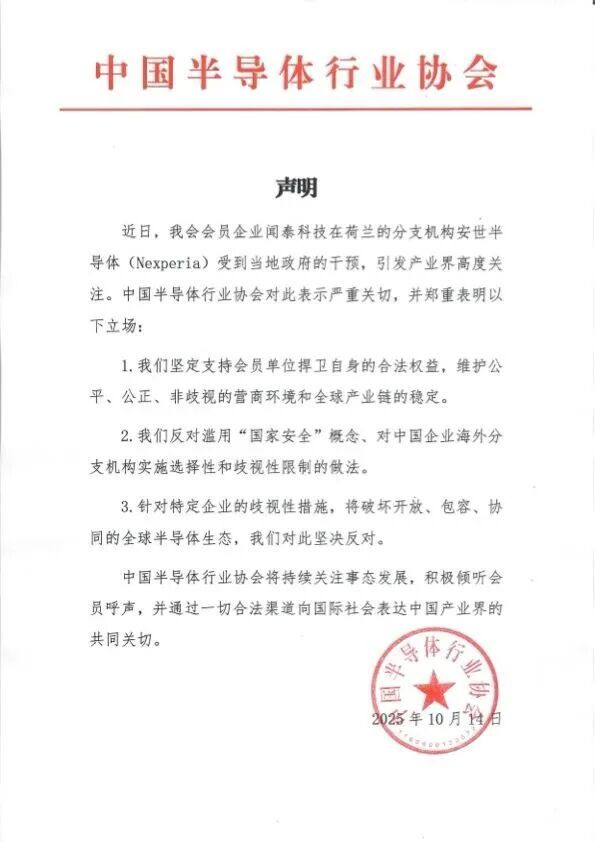
Core Viewpoint - The article discusses the recent intervention by the Dutch government against the subsidiary of Wentech Technology, Anshi Semiconductor, raising concerns within the semiconductor industry regarding discrimination against Chinese enterprises and the politicization of business issues [2][4]. Group 1: Industry Response - The China Semiconductor Industry Association expresses strong concern over the intervention and supports its member companies in defending their legal rights and maintaining a fair and non-discriminatory business environment [2]. - The association opposes the misuse of "national security" concepts to impose selective and discriminatory restrictions on Chinese enterprises operating abroad [2]. - The association emphasizes that discriminatory measures against specific companies will undermine the open and collaborative global semiconductor ecosystem [2]. Group 2: Government Statements - During a press conference, a spokesperson from the Chinese Foreign Ministry reiterated China's opposition to the broad application of national security concepts and discriminatory practices against specific national enterprises [4]. - The spokesperson urged relevant countries to adhere to market principles and avoid politicizing trade issues, affirming China's determination to protect its legitimate rights and interests [4]. - Wentech Technology issued a statement opposing the Dutch government's actions, arguing that the use of "national security" as a justification for operational freezes is based on geopolitical bias rather than factual risk assessment [4].
中国半导体行业协会郑重声明
Bei Jing Ri Bao Ke Hu Duan· 2025-10-14 02:52
Core Points - The China Semiconductor Industry Association expressed serious concern over the intervention by the Dutch government regarding Nexperia, a subsidiary of Wentech Technology [1][3] - The association firmly supports its member companies in defending their legitimate rights and maintaining a fair and non-discriminatory business environment [1] - The association opposes the misuse of the "national security" concept to impose selective and discriminatory restrictions on Chinese companies' overseas branches [1] - Discriminatory measures against specific companies are seen as detrimental to the open and collaborative global semiconductor ecosystem [1] Company Responses - Wentech Technology issued a strong statement opposing the politicalization of commercial issues, criticizing the Dutch government's actions as excessive intervention based on geopolitical bias rather than factual risk assessment [3] - The company highlighted that the Dutch government's global operational freeze on Nexperia, justified by unfounded "national security" concerns, contradicts the EU's principles of market economy and fair competition [3]
连续两日跌停,中国半导体行业协会声明
Zheng Quan Shi Bao· 2025-10-14 02:31
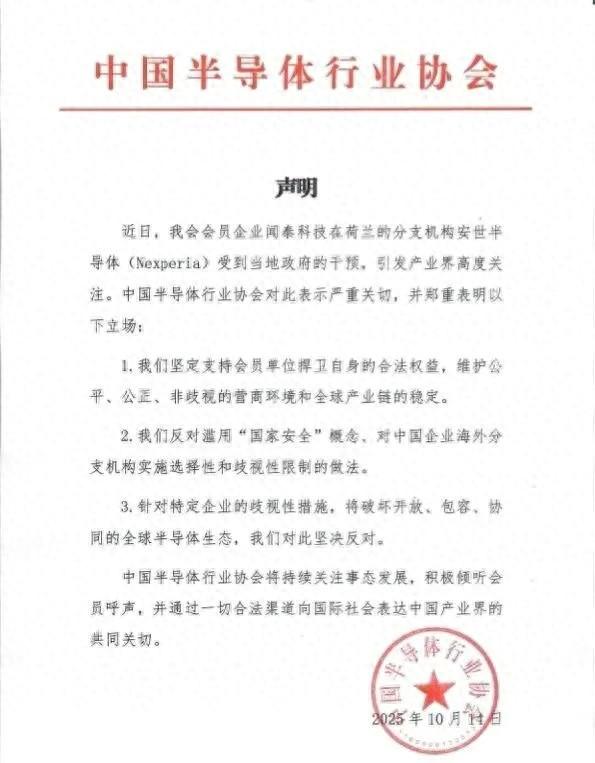
Core Viewpoint - The China Semiconductor Industry Association expresses serious concern over the Dutch government's intervention affecting its member company, Nexperia, and emphasizes the need for a fair and non-discriminatory business environment [1][2][4]. Group 1: Association's Position - The association firmly supports its member companies in defending their legitimate rights and maintaining a stable global supply chain [1]. - It opposes the misuse of "national security" concepts to impose selective and discriminatory restrictions on Chinese companies' overseas branches [2]. - The association condemns discriminatory measures against specific enterprises, stating that such actions undermine an open and collaborative global semiconductor ecosystem [3]. Group 2: Impact on Company - On October 12, 2023, Wentech Technology disclosed that its core semiconductor asset, Nexperia, faced dual restrictions from the Dutch government and courts, leading to a one-year freeze on its assets, intellectual property, and operations [6]. - Following the restrictions, Wentech's stock price experienced a limit down on October 13, 2023, and opened again with a limit down on the following trading day [6]. - Wentech issued a strong statement against the Dutch government's actions, labeling them as excessive intervention based on geopolitical bias rather than factual risk assessment [6]. Group 3: Government Response - The Chinese Ministry of Foreign Affairs reiterated its opposition to the broad application of national security concepts and discriminatory practices against specific national enterprises [8].