
差异化定价

Search documents
拟控股康录生物 透景生命溢价豪赌
Bei Jing Shang Bao· 2025-08-05 16:36
Core Viewpoint - The company, Transgen Life, is planning a phased acquisition of 82% of Wuhan Kanglu Biological Technology Co., Ltd. for 328 million yuan, aiming to enhance its diagnostic capabilities in oncology through a "flow cytometry + PCR + FISH" integrated approach, despite facing challenges from high valuation premiums and accounts receivable issues [1][3][9]. Acquisition Strategy - The acquisition will occur in three steps, starting with the purchase of approximately 72.86% of Kanglu Biological for 291 million yuan, followed by additional purchases in 2026 and 2027, contingent on performance conditions [3][4]. - This phased approach is designed to mitigate cash flow pressures and allow for performance verification of Kanglu Biological before finalizing the acquisition [4][9]. Financial Performance and Commitments - Kanglu Biological has committed to achieving a total net profit of no less than 91.5 million yuan over three years, with annual targets of 22 million, 31.5 million, and 38 million yuan for 2025, 2026, and 2027 respectively [9][10]. - The company has faced declining revenues and profits over the past three years, with reported revenues of 716 million yuan, 543 million yuan, and 437 million yuan, and net profits of 125 million yuan, 89 million yuan, and 35 million yuan respectively [10][11]. Valuation and Pricing Strategy - The acquisition employs a differentiated pricing strategy, with significant variations in share prices paid to different sellers, reflecting market segmentation and risk-return considerations [8][9]. - The valuation of Kanglu Biological shows a substantial increase, with a reported asset value of 400 million yuan and a valuation increase of 226.53% due to its strong market position and growth potential in the oncology diagnostics sector [7][8]. Market Position and Product Synergy - Transgen Life aims to enhance its product portfolio by integrating Kanglu Biological's FISH technology, which is crucial for high-value diagnostic applications, thereby creating a comprehensive solution for cancer diagnosis [5][6]. - The combined sales channels of both companies will cover 31 provinces in China, enhancing market reach and customer retention [5][6].


拟“三步走”控股康录生物,透景生命溢价豪赌
Bei Jing Shang Bao· 2025-08-05 12:12
Core Viewpoint - The company, TuoJing Life, is undertaking a phased acquisition of 82% of the shares of Wuhan Kanglu Biological Technology Co., Ltd. for a total of 328 million yuan, aiming to enhance its capabilities in tumor molecular pathology testing amidst declining performance over the past three years [1][4][10]. Acquisition Strategy - The acquisition will occur in three steps, starting with the purchase of approximately 72.86% of Kanglu's shares for 291 million yuan, followed by additional purchases in 2026 and 2027 if certain conditions are met [4][5]. - This phased approach is designed to mitigate cash flow pressure and liquidity risks while binding the performance commitments of the target company to the acquisition [5][10]. Financial Metrics - The total valuation of Kanglu Biological is set at 400 million yuan, with a significant appraisal premium of 226.53% over its book value, reflecting its strong market position and growth potential in the pathology diagnostics sector [8][9]. - The performance commitment requires Kanglu to achieve a net profit of no less than 9.15 million yuan over three years, with annual targets of 2.2 million, 3.15 million, and 3.8 million yuan [10][11]. Market Position and Product Synergy - TuoJing Life focuses on high-throughput flow fluorescence technology and fluorescence PCR, while Kanglu specializes in FISH technology, which is crucial for high-value diagnostic applications [5][6]. - The acquisition is expected to create a comprehensive diagnostic solution from early screening to companion diagnostics, enhancing customer loyalty and market competitiveness [6][10]. Risk Factors - Kanglu's high accounts receivable, amounting to 44.8 million yuan as of May 2024, poses a challenge for the acquisition, necessitating commitments to manage and recover these receivables effectively [11]. - The company's declining performance, with net profits dropping from 1.25 billion yuan in 2022 to 350 million yuan in 2024, raises concerns about the feasibility of achieving the performance commitments set for Kanglu [11][12].
惠民保变革:差异化定价众口难调 衔接商保创新药目录有“时差”
Sou Hu Cai Jing· 2025-08-03 17:28
Core Viewpoint - The article discusses the challenges and opportunities facing the "惠民保" (Huimin Bao) insurance product, which serves as a bridge between social insurance and commercial health insurance, particularly in light of new regulatory guidance aimed at promoting high-quality development in urban commercial medical insurance [1][2]. Group 1: Regulatory Changes and Market Dynamics - The National Financial Supervision Administration issued a notice emphasizing the need for urban commercial medical insurance to incorporate new medical technologies and adhere to differentiated pricing principles, avoiding low-price competition and monopolistic practices [1][6]. - The notice aims to clarify the distinction between commercial insurance and social insurance, promoting a reasonable expectation of coverage among the public [1][4]. - Experts indicate that while the market for Huimin Bao is estimated at 150 to 200 billion yuan, interest from insurance companies remains low due to the product's unique design that does not align well with traditional commercial insurance logic [3][4]. Group 2: Differentiated Pricing and Product Design - Some regions are experimenting with differentiated pricing for Huimin Bao, with premiums varying based on age and health status, which aligns with regulatory expectations [3][4]. - The concept of differentiated pricing is seen as a potential breakthrough for the market, allowing for higher premiums for higher-risk groups while still being competitive compared to other health insurance products [3][4]. - However, there is caution among some cities regarding the implementation of differentiated pricing, as they view Huimin Bao as a basic layer of commercial insurance that should not overly complicate the product design [4][6]. Group 3: Integration with Innovative Drug Coverage - The upcoming commercial insurance innovative drug directory, expected to be released in November, is anticipated to be integrated into local Huimin Bao products, focusing on high-value innovative drugs that exceed basic insurance coverage [8][10]. - The overlap between the special drug coverage of Huimin Bao and the basic medical insurance directory is currently high, necessitating further refinement of the product design [9][10]. - The successful integration of innovative drugs into Huimin Bao is seen as crucial for alleviating the financial burden on patients for high-cost medications, aligning with government objectives [8][10].
惠民保变革:差异化定价众口难调
Di Yi Cai Jing Zi Xun· 2025-08-03 13:26
Core Viewpoint - The article discusses the evolving landscape of "Hui Min Bao," a special type of commercial health insurance in China, amid new regulatory guidelines aimed at promoting high-quality development in urban commercial medical insurance [2][3]. Regulatory Developments - The National Financial Supervision Administration issued a notice emphasizing the need for urban customized commercial medical insurance to incorporate new medical technologies, drugs, and devices into its coverage [2]. - The notice also calls for adherence to the principle of risk pricing, differentiation in pricing, and avoidance of low-price, disorderly competition [2][3]. Market Positioning and Challenges - Experts express concerns about the future positioning of Hui Min Bao, particularly regarding its alignment with the principles of differentiated pricing and its ability to maintain its inclusive nature [3][4]. - There are questions about how to define "monopolistic sales" in a market where many Hui Min Bao products have merged, leading to a "one city, one insurance" model [3][7]. Pricing Strategies - Some regions are experimenting with differentiated pricing for Hui Min Bao, with premiums adjusted based on age and health status [4]. - The approach aims to balance risk and affordability, ensuring that the overall insurance burden on families does not increase [4][5]. Product Design and Market Interest - Hui Min Bao products are primarily designed for individuals with pre-existing conditions, using a model of relaxed underwriting combined with reduced compensation ratios [5]. - Despite an estimated market potential of 150 to 200 billion yuan, interest from insurance companies remains limited due to the unique nature of Hui Min Bao products [5][6]. Policy Support and Implementation - Effective policy support is deemed crucial for achieving the inclusive nature of Hui Min Bao, with recent initiatives from the healthcare department aimed at enhancing its operational framework [6][8]. - The upcoming commercial insurance innovation drug directory is expected to be integrated into local Hui Min Bao products, enhancing their coverage of innovative drugs [10][12]. Overlap with Basic Medical Insurance - There is a significant overlap between the special drug lists of Hui Min Bao and basic medical insurance, with a reported 40% similarity [10][11]. - This overlap is attributed to timing discrepancies in the adjustments of the two insurance categories, which may complicate the integration of new drugs into Hui Min Bao [11][12]. Future Considerations - The article highlights the need for a clear understanding of how innovative drugs will be incorporated into Hui Min Bao and the implications for patient access and insurance coverage [10][13]. - The potential for increased claims due to the inclusion of innovative drugs is considered low, as Hui Min Bao products are designed to be flexible in terms of premium and coverage adjustments [13].
惠民保变革:差异化定价众口难调
第一财经· 2025-08-03 13:15
Core Viewpoint - The article discusses the current state and future direction of "Hui Min Bao," a type of commercial health insurance that serves as a bridge between social security and commercial insurance, highlighting the recent regulatory changes and their implications for the industry [3][4]. Summary by Sections Regulatory Changes - The National Financial Supervision Administration issued a notice promoting the high-quality development of urban commercial medical insurance, emphasizing the inclusion of new medical technologies, drugs, and devices in coverage [3][4]. - The notice aims to clarify the distinction between commercial insurance and social insurance, encouraging a reasonable expectation of protection among the public [3][4]. Market Dynamics - There are concerns regarding the future positioning of Hui Min Bao, especially with the implementation of differentiated pricing, which may affect its affordability and accessibility [4][5]. - The article notes that the market for Hui Min Bao is estimated to be between 150 billion to 200 billion yuan, but interest from insurance companies remains low due to the unique nature of these products [7]. Differentiated Pricing - Some regions have begun experimenting with differentiated pricing for Hui Min Bao, which could lead to higher premiums for higher-risk groups while still being competitive compared to other health insurance products [5][6]. - The concept of differentiated pricing is seen as a potential breakthrough for the market, although there are concerns about its impact on participation rates [7][9]. Integration with Innovative Drugs - The upcoming commercial insurance innovative drug directory, expected to be released in November, is anticipated to be integrated into local Hui Min Bao products, enhancing their coverage of innovative treatments [12][14]. - The overlap between the special drug directory of Hui Min Bao and the basic medical insurance directory is currently high, necessitating further refinement of product offerings [12][13]. Challenges and Concerns - There are significant challenges in defining "monopolistic" sales practices within the Hui Min Bao market, particularly as multiple products compete in the same region [9][11]. - The article highlights the need for effective policy support to ensure the inclusivity and fairness of Hui Min Bao, as inconsistent positioning among various stakeholders could hinder implementation [7][10]. Future Outlook - The article suggests that the successful integration of innovative drugs into Hui Min Bao will depend on the alignment of local policies and the ability of insurance companies to adapt their product offerings accordingly [15][16]. - The potential for increased claims due to the inclusion of innovative drugs is mitigated by the relatively low percentage of special drug claims in overall product operations [15][16].
惠民保变革:差异化定价众口难调,衔接商保创新药目录有“时差”
Di Yi Cai Jing Zi Xun· 2025-08-03 10:04
Core Viewpoint - The recent notification from the National Financial Supervision Administration emphasizes the need for high-quality development of urban commercial medical insurance, particularly focusing on the "Hui Min Bao" insurance, which serves as a bridge between social security and commercial insurance [1][2]. Group 1: Regulatory Changes - The notification outlines that urban customized commercial medical insurance should incorporate new medical technologies, drugs, and devices into its coverage [1][8]. - It stresses the importance of differentiating between commercial insurance and social insurance to avoid confusion and promote reasonable expectations for social security [1][2]. Group 2: Market Dynamics - Experts express concerns about the positioning of "Hui Min Bao" following the implementation of differentiated pricing, questioning whether it will still meet the needs of the public [2][5]. - The notification aims to prevent low-price, chaotic competition and monopolistic sales practices in the market [6][7]. Group 3: Pricing Strategies - Some regions are experimenting with differentiated pricing for "Hui Min Bao," with premiums set at 69 yuan for individuals aged 0-22, 99 yuan for those aged 23-50, and 149 yuan for individuals over 50 or with pre-existing conditions [2][3]. - The concept of differentiated pricing is seen as a way to balance risk and affordability, potentially stabilizing the market [3][4]. Group 4: Product Integration and Innovation - The upcoming commercial insurance innovation drug directory is expected to be integrated into "Hui Min Bao," enhancing its coverage of innovative drugs [1][9]. - The directory aims to include high-innovation, clinically valuable drugs that exceed basic medical insurance coverage, with a focus on reducing patient costs for expensive treatments [9][10]. Group 5: Challenges and Concerns - There are concerns regarding the effective implementation of the notification's requirements, particularly in terms of achieving consensus among various stakeholders [2][5]. - The high overlap of coverage between "Hui Min Bao" and basic medical insurance, estimated at 40%, indicates a need for better alignment and design of insurance products [10][11].
新规下“惠民保”迎差异化定价变革,业内聚焦竞争格局调整与突破
Di Yi Cai Jing· 2025-08-01 15:13
Core Viewpoint - The development pattern of "Hui Min Bao" products, as an important carrier for multi-level payment of innovative drugs and medical devices in China, is set to undergo significant adjustments [1][2]. Group 1: Regulatory Changes - The National Financial Supervision Administration issued a notice on July 31 to further standardize the business model of urban customized commercial health insurance, emphasizing scientific premium setting and differentiated pricing principles [2]. - Insurance companies are required to base premium rates on reliable historical data regarding disease incidence, payout rates, and cost rates, ensuring fairness and adaptability in products and services [2]. Group 2: Market Trends - The scale of medical insurance premiums has been growing, with the scale surpassing critical illness insurance in 2024, indicating a significant boost from "Hui Min Bao" for insurance companies in the medical sector [3]. - In 2024, there were 173 "Hui Min Bao" products operating across 30 provinces, with an average operational time of 3.6 years, and the premium scale reached 20 billion yuan [3]. Group 3: Industry Collaboration and Product Development - There is a need for better collaboration between pharmaceutical companies and insurance providers to develop specialized insurance products for innovative drugs and medical devices [5]. - The establishment of a selection mechanism for innovative drugs based on clinical value is essential, along with exploring innovative payment methods linked to clinical outcomes [5]. Group 4: Future Directions - The focus will be on designing insurance products for individuals with pre-existing conditions and enhancing patient service experiences [3][4]. - The integration of innovative drugs into insurance product directories should not lead to price competition but rather promote a fair distribution of benefits among stakeholders [4].
监管要求“惠民保”基于年龄等定价,穗岁康未来费率会分层吗
Nan Fang Du Shi Bao· 2025-08-01 11:00
Core Viewpoint - The recent notice from the National Financial Supervision Administration emphasizes the need for high-quality development of urban commercial medical insurance, particularly focusing on product management and precise pricing strategies [2][6]. Group 1: Market Overview - Urban commercial medical insurance, known as "惠民保," serves as a supplementary insurance for individuals with basic medical insurance, covering large medical expenses not reimbursed by basic insurance [3]. - The market for "惠民保" has seen a slowdown in growth over the past two years, with the number of operational products decreasing from 211 to 199 compared to 2023 [3]. Group 2: Regulatory Changes - The notice outlines six key requirements, including the need for differentiated pricing based on factors such as age, gender, and health status, moving away from the current uniform pricing model [2][8]. - The notice reinforces the commercial nature of "惠民保," urging insurance companies to operate independently and ensuring that consumers voluntarily choose to participate [6][12]. Group 3: Pricing and Product Management - The notice mandates that insurance companies utilize reliable historical data to determine insurance rates and implement differentiated pricing to enhance fairness and adaptability of products [8][9]. - Currently, many "惠民保" products use a uniform rate model, which may lead to issues such as adverse selection and imbalance in risk sharing [9]. Group 4: Market Conduct and Competition - The notice prohibits low-price, disorderly competition and emphasizes fair competition principles, ensuring that insurance companies do not engage in monopolistic practices [10][11]. - There is a growing concern regarding the sustainability and quality of "惠民保" products due to low pricing and similar coverage, prompting some regions to introduce upgraded versions with higher premiums [11]. Group 5: Future Directions - The notice encourages the exploration of differentiated pricing mechanisms, which could lead to improved product sustainability and better alignment with the needs of different demographic groups [9][12]. - It also highlights the importance of distinguishing between commercial insurance and social insurance to clarify responsibilities and optimize the insurance structure [12].

金融监管总局出手,规范行业发展!
Jin Rong Shi Bao· 2025-08-01 07:52
Core Viewpoint - The urban commercial health insurance sector is entering a new phase of regulated development, aimed at achieving sustainable growth and protecting consumer rights through comprehensive guidelines issued by the financial regulatory authority [1][3]. Group 1: Regulatory Framework - The financial regulatory authority has issued a notification to promote high-quality development of urban commercial health insurance, focusing on six dimensions: inclusive positioning, adherence to commercial attributes, precise pricing, enhanced service capabilities, ecosystem collaboration, and coordinated planning [1][3]. - The notification responds to industry concerns regarding the sustainability risks faced by urban commercial health insurance, which has seen rapid growth in recent years [3][4]. Group 2: Market Characteristics - Urban commercial health insurance, often referred to as "benefit insurance," is characterized by low entry barriers, low premiums, and high coverage, meeting diverse health protection needs of the population [3][4]. - The number of participants in urban commercial health insurance has grown significantly, from 40 million in 2020 to 168 million in 2023, reflecting a 6% year-on-year increase [3]. Group 3: Development Guidelines - The notification emphasizes the need for urban commercial health insurance to maintain its commercial nature while ensuring it meets public needs, advocating for a balance between inclusivity and commercial viability [5][6]. - Insurance companies are encouraged to adopt market-driven principles, ensuring that premium collection aligns with the level of coverage provided, and to enhance consumer satisfaction through regulated operations and honest service [5][6]. Group 4: Pricing and Competition - The notification mandates precise pricing based on risk assessment, requiring differentiation in pricing according to factors such as age, gender, and health status to improve fairness and adaptability of products [6]. - Companies are instructed to avoid chaotic price competition and to maintain fair competition principles, prohibiting practices such as setting predetermined payout rates or adjusting contract terms retroactively [6].
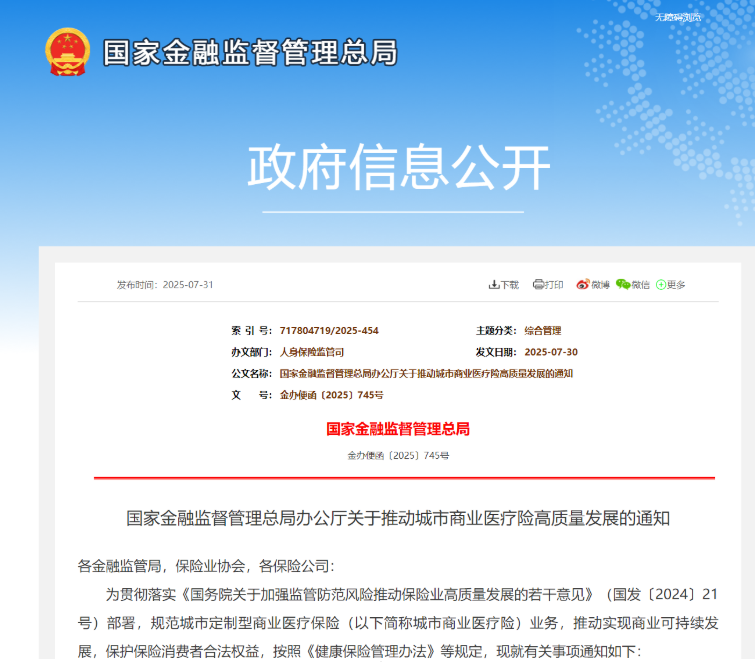
鼓励差异化定价、不搞“内卷” 惠民保高质量发展新规来了
Bei Jing Shang Bao· 2025-08-01 03:12
Core Viewpoint - The new regulatory guidelines emphasize the importance of balancing the inclusive nature and commercial attributes of urban commercial health insurance (惠民保), aiming for sustainable development while adhering to market principles [1][5]. Group 1: Regulatory Guidelines - The Financial Regulatory Bureau issued a notification on July 31, requiring urban commercial health insurance to focus on inclusivity while maintaining its commercial nature [1]. - The notification mandates that insurance companies optimize product offerings to meet diverse health protection needs, ensuring broad coverage and reasonable premiums [2][5]. - Insurance companies are instructed to base pricing on reliable historical data, ensuring fair and differentiated pricing according to factors like age, gender, and health status [3][5]. Group 2: Market Competition - The notification prohibits "involution-style" competition, urging insurance companies to avoid chaotic price wars and maintain fair competition [4][5]. - Companies must enhance product diversity and adhere to internal control management during product development, sales, and claims processes [4]. - Sales practices must be transparent, with clear communication of product functions and obligations to prevent misleading information [4][5]. Group 3: Long-term Development - Experts believe the guidelines aim to curb unhealthy competition and ensure service quality, promoting the long-term health of 惠民保 [5]. - The focus is on transitioning from short-term expansion to long-term value creation, supporting a multi-tiered medical insurance system [5].