
第三代半导体材料

Search documents
一个碳化硅巨人的非自然死亡
远川研究所· 2025-06-24 13:00
Core Viewpoint - The article discusses the rise and fall of Wolfspeed, a company specializing in silicon carbide (SiC) technology, highlighting the challenges and market dynamics in the semiconductor industry, particularly in the context of electric vehicles (EVs) and the competition in SiC production. Group 1: Company Background and Transition - CREE, founded in 1987, initially struggled in the semiconductor industry but gained prominence with the rise of electric vehicles, particularly Tesla's Model 3, which utilized SiC technology [3][4] - CREE held 60% of the global SiC wafer production capacity, leading to a strategic pivot to focus entirely on SiC by rebranding as Wolfspeed [6][24] - The transition was marked by a significant increase in the semiconductor business's revenue share, from 10% in 2017 to 53% in 2021, following the sale of its LED business [24][20] Group 2: Market Dynamics and Challenges - The demand for SiC in EVs surged, with each vehicle requiring approximately 100-150 SiC chips, leading to increased competition as other manufacturers entered the market [29][31] - Wolfspeed faced a critical decision between expanding 6-inch wafer production or investing in 8-inch wafer technology, which promised higher profit margins but posed greater technical challenges [31][32] - The company invested $1.5 billion in the Mohawk Valley factory for 8-inch wafer production, but faced significant operational challenges and low utilization rates, leading to financial difficulties [39][42] Group 3: Financial Performance and Market Position - In 2024, Wolfspeed's revenue declined by 12%, and its stock price fell by 84.7%, marking it as one of the worst-performing tech stocks of the year [42][44] - The company's heavy debt burden from the 8-inch investment contrasted with the more efficient production strategies of Chinese competitors, who focused on 6-inch production [46][44] - As the EV market growth slowed in 2023, Wolfspeed's reliance on this sector became a critical vulnerability, ultimately leading to its bankruptcy filing [47][44]


研判2025!中国半导体二极管行业产业链、市场规模及进出口分析:行业市场规模持续扩大,下游应用需求强劲驱动产业升级[图]
Chan Ye Xin Xi Wang· 2025-06-09 02:02
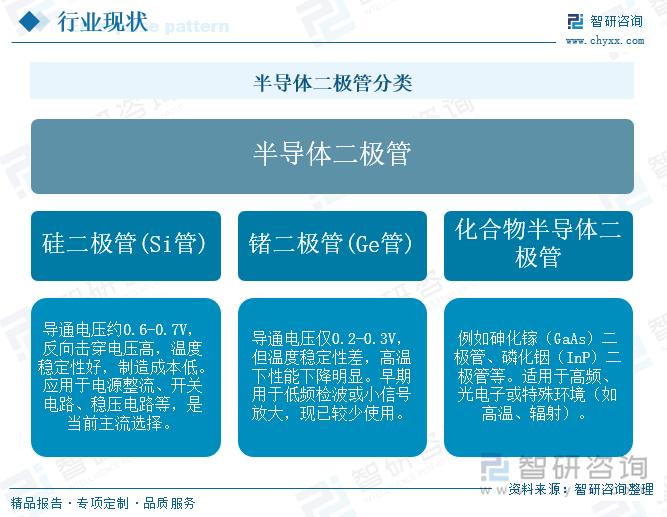
Core Insights - The Chinese semiconductor diode industry is experiencing rapid development and transformation, with a projected market size of $2.257 billion in 2024, reflecting a year-on-year growth of 15.33% driven by strong demand from sectors such as electric vehicles, 5G communications, and industrial control [1][10] - Domestic companies are accelerating breakthroughs in technology, focusing on the application of third-generation semiconductor materials like silicon carbide (SiC) and gallium nitride (GaN), which are pushing diodes towards high frequency, high efficiency, and high voltage capabilities [1][10] - Innovations in optoelectronic integration have emerged, such as a three-electrode optoelectronic diode structure proposed by the University of Science and Technology of China, which enhances optical communication bandwidth by 60% [1][10] Industry Overview - Semiconductor diodes are electronic devices made from semiconductor materials (like silicon and germanium) with a core PN junction structure, enabling unidirectional conductivity essential for various electronic functions [2] - The industry has evolved through four main stages: initial development (1956-1960s), exploration and challenges (1970s-1980s), technology introduction and catch-up (1980s-1990s), and rapid development and independent innovation (2000s-present) [4][6][7] Market Dynamics - The upstream of the semiconductor diode industry includes raw materials, production equipment, and R&D, while the downstream applications span consumer electronics, communications, automotive electronics, industrial control, and new energy sectors [9] - In the first four months of 2025, China imported 160.8 billion semiconductor devices, marking a 2.16% increase in quantity but a 0.81% decrease in value, indicating persistent domestic demand despite reliance on imports for certain categories [12] Key Companies - Leading companies such as Huazhong Microelectronics, Yangjie Technology, and Suzhou Good Drive dominate the market due to their technological accumulation and production capacity [14] - Yangjie Technology reported a revenue of 1.579 billion yuan in Q1 2025, up 18.90% year-on-year, with a net profit increase of 51.22% [16] - Suzhou Good Drive, one of the largest diode manufacturers globally, produced 250 million units monthly, holding an 8%-9% market share [18] Industry Trends - The industry is moving towards high-end technology, with third-generation semiconductor materials becoming a core driver for advancements [20] - There is a surge in demand from downstream sectors, particularly in electric vehicles and 5G communications, leading to increased applications of diodes in battery management and motor drive systems [21][22] - The industry is witnessing enhanced collaboration across the supply chain, with domestic companies integrating resources to improve high-end manufacturing capabilities and reduce reliance on imports [23]





天岳先进:市场份额稳步增长 加速碳化硅AR眼镜等新领域应用落地
Zheng Quan Shi Bao Wang· 2025-04-30 05:17
Core Viewpoint - Tianyue Advanced (688234) reported a revenue of 410 million yuan for Q1 2025, maintaining its industry-leading position despite a slight decline in net profit due to increased R&D expenses and decreased product prices [1] Group 1: Company Performance - The company achieved a revenue of 410 million yuan, showing a slight year-on-year decline in revenue while steadily increasing market share [1] - R&D expenses increased by 101.67% year-on-year to 44.94 million yuan, focusing on product matrix improvement, emerging application markets, and optimization of product quality and costs [2] - The product shipment volume continued to grow, indicating robust operational strategies centered on high-quality products [2] Group 2: Industry Trends - The demand for third-generation semiconductor materials, particularly silicon carbide (SiC), is driven by the rapid development of renewable energy and AI technologies, making SiC a key material for high-power semiconductor devices [1] - SiC is becoming essential in applications such as electric vehicle (EV) inverters, onboard chargers, and DC/DC converters, especially with the adoption of 800V high-voltage platforms in EVs [2] - The company is expanding into new application areas, including AR glasses, leveraging the high refractive index of SiC to enhance visual performance and reduce lens thickness [2] Group 3: Technological Advancements - Tianyue Advanced launched 12-inch conductive substrates at Semicon Europe in November 2024 and showcased a full range of SiC substrates at Semicon China in March 2025, marking the entry into the "12-inch era" for the SiC industry [3] - The company has achieved breakthroughs across the entire technology chain, including crystal growth, defect control, processing detection, and component self-manufacturing [3] - Future R&D investments will focus on large-size products and new application fields, providing strong momentum for performance growth [3]
