财政贴息政策

Search documents
财政贴息,“贴一贴”换来发展“好消息”
Sou Hu Cai Jing· 2025-11-09 23:12
Core Insights - Jiangsu province is implementing a financial interest subsidy policy starting in 2024 to support small and micro enterprises, enhancing the quality and efficiency of the real economy [1][6] - By September 30, 2023, various interest subsidy products have issued loans totaling 1,434.05 billion yuan, with over 1 billion yuan in subsidies benefiting 5,212 enterprises [1] Manufacturing Sector Support - The manufacturing sector, identified as a cornerstone of Jiangsu's economy, has received the most substantial support, with loans amounting to 1,015.29 billion yuan, accounting for approximately 70% of the total issued loans [1] - Companies like Zhongcai Lithium Membrane (Nanjing) Co., Ltd. have benefited significantly from these policies, receiving 880 million yuan in loans to accelerate project implementation [1] Financial Collaboration - The construction of large-scale projects often requires significant financing, leading to collaborations among banks, such as the joint efforts of China Construction Bank, the National Development Bank, and the Transportation Bank to form external syndicates [2] - Since the launch of the manufacturing loan interest subsidy policy in June 2024, 450 million yuan in subsidies have been allocated, benefiting 2,027 enterprises [2] Urban Renewal Financing - The "Chengxin Loan" has issued 179.13 billion yuan, focusing on urban renewal projects, including the renovation of old neighborhoods and infrastructure upgrades [3] - By September 30, 2023, the "Chengxin Loan" has allocated 329 million yuan in subsidies, benefiting 183 enterprises [3] Broad Coverage of Subsidies - The "Su Quality Loan" has issued 131.92 billion yuan, benefiting the highest number of enterprises at 2,203, despite not being the largest in total funding [4][5] - Other loans such as "Jiaoyun Loan" and "Technology Innovation First Loan" have also contributed significantly, with respective amounts of 73.9 billion yuan and 31.19 billion yuan issued [5] Policy Effectiveness and Long-term Strategy - Jiangsu has introduced over 10 special interest subsidy policies since last year, streamlining the application process to enhance accessibility for enterprises [6][7] - The policies aim to address the challenges of traditional industries facing equipment aging and technological lag, ensuring financial support reaches critical areas [6][7] - The province's approach reflects a proactive stance in response to external and internal economic challenges, aiming to stimulate investment in key sectors [7]
江苏支持海洋产业项目建设
Sou Hu Cai Jing· 2025-10-24 00:56
Core Points - Jiangsu Province has introduced a financial interest subsidy policy to support marine industry projects, with an initial allocation of 60 million yuan for 2025 [1] - The policy aims to leverage this funding to encourage banks to issue loans amounting to nearly 10 billion yuan, facilitating an investment of 17.72 billion yuan in the marine industry by 2025 [1] Summary by Sections Financial Support - The Jiangsu Provincial Finance Department and the Development and Reform Commission have issued a plan for financial interest subsidies for marine industry projects from 2025 to 2027 [1] - Eligible projects can receive a subsidy of 1.5 percentage points from provincial finances, with a maximum annual subsidy of 5 million yuan per project [1] Implementation Details - The total subsidy for 2025 is capped at 60 million yuan, and funds will be allocated on a first-come, first-served basis until the limit is reached [1] - The subsidy scale for 2026 and 2027 will be determined based on the provincial finance department's assessment [1]
江苏预拨5000万元贴息资金为生产性服务业注入金融“活水”
Xin Hua Ri Bao· 2025-10-18 23:29
Core Viewpoint - Jiangsu Province has introduced a financial subsidy policy to support the productive service industry, aiming to stimulate investment and enhance the integration of modern services and advanced manufacturing [1] Summary by Relevant Categories Policy Implementation - The Jiangsu Provincial Finance and Development and Reform Commission issued the "Implementation Plan for Financial Subsidies on Loans for Productive Service Industry Projects (2025-2027)" in July [1] - A total of 50 million yuan has been allocated to 14 partner banks as advance payment for the financial subsidy [1] Financial Support Details - The subsidy applies to five key areas: information services, technology services, modern logistics, financial services, and business services [1] - The provincial finance will provide a 1% subsidy on project loans for equipment and software purchases, infrastructure construction, and R&D investments, with a maximum annual subsidy of 2 million yuan per project [1] Expected Economic Impact - The advance funds are expected to leverage bank loans amounting to 5 billion yuan and drive annual investment in the productive service industry to 31 billion yuan [1] - This initiative is designed to inject policy dividends into the deep integration of modern services and advanced manufacturing [1]
【贴息】一图读懂消费贷款“国补”
中国建设银行· 2025-09-25 08:14
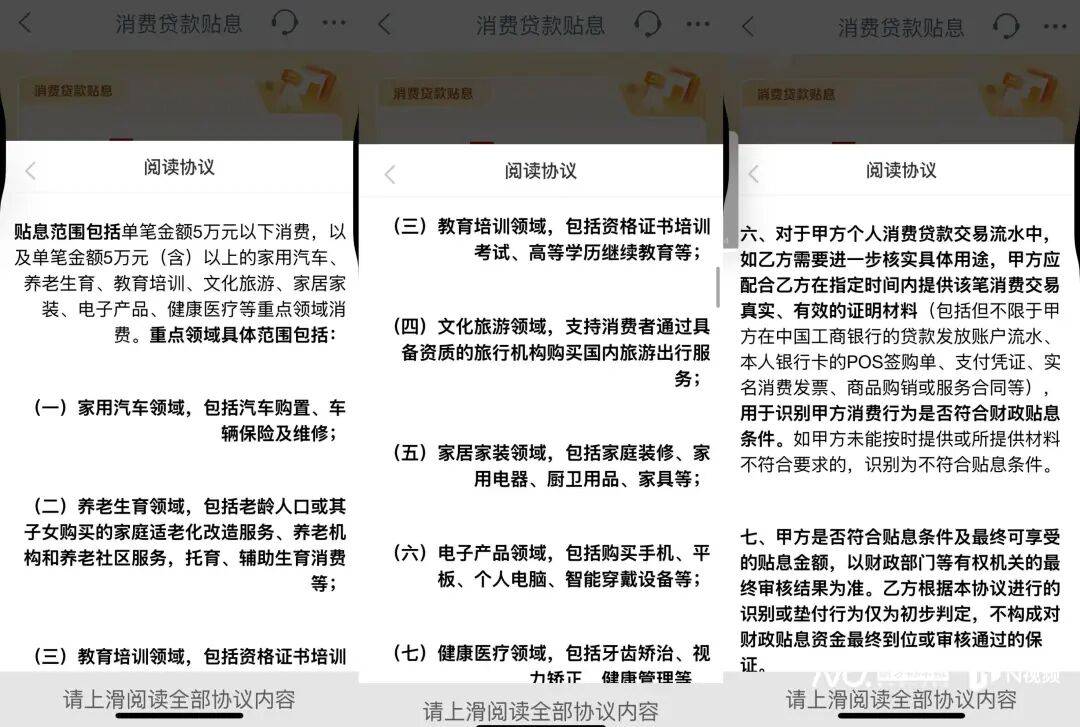
Core Viewpoint - The article discusses the new personal consumption loan interest subsidy policy implemented by the Ministry of Finance, the People's Bank of China, and the financial regulatory authority, aimed at reducing residents' financial burdens and encouraging consumption [2][4]. Policy Implementation - The policy will be effective from September 1, 2025, to August 31, 2026 [3]. Eligible Consumption - The subsidy applies to personal consumption loans used for various types of consumption, including goods and services [4]. - Specific consumption categories include daily expenses, home appliances, education, cultural tourism, home decoration, health care, and elderly care services [5][6]. Subsidy Standards - The annual subsidy rate is set at 1 percentage point, with a maximum limit of 50% of the loan contract interest rate [7]. - For eligible cumulative consumption of 30,000 yuan, the maximum subsidy is 3,000 yuan, while for 100,000 yuan, the maximum subsidy is 1,000 yuan [8]. Case Example - An example illustrates that if a consumer takes a personal consumption loan of 200,000 yuan at a 3% interest rate, without the subsidy, they would pay 6,000 yuan in interest annually. With the subsidy, they could reduce their interest payment by 2,000 yuan, effectively receiving a one-third interest rebate [10][12]. Implementation by Bank - China Construction Bank will act as the implementing institution for the subsidy policy, providing a streamlined process for eligible personal consumption loan customers starting from September 1, 2025 [14]. - The bank emphasizes that it will not charge any additional service fees and all transactions will be conducted through official channels to prevent fraud [16].



贴息红包已到账 广发银行助力市民“能消费、敢消费、愿消费”
Sou Hu Cai Jing· 2025-09-18 09:45
Core Viewpoint - Consumer spending is becoming a crucial support for improving people's livelihoods and an important engine for economic development, with financial policies aimed at stimulating domestic demand [1] Group 1: Implementation of Financial Policies - Guangfa Bank has launched a personal consumption loan interest subsidy service on September 1, 2025, to lower consumer credit costs and stimulate market consumption potential [1] - The implementation aligns with the central government's directive to boost consumption and expand domestic demand [1] Group 2: Targeted Consumer Credit Services - Guangfa Bank focuses on seven key consumption areas: household vehicles, elderly care and childbirth, education and training, cultural tourism, home decoration, electronic products, and health care [2] - The bank aims to enhance consumer experience through innovative financial services, such as home decoration loans and health care loans, addressing core needs in various life scenarios [2] - In the household vehicle sector, Guangfa Bank promotes its "Car E Loan" product, offering features like zero down payment and flexible repayment options to reduce the financial burden on consumers [2] Group 3: Enhancing Consumer Experience - The subsidy policy aims to guide credit resources to consumption sectors, lowering financing costs and improving livelihoods [3] - Guangfa Bank has established a streamlined process for consumers to access benefits, allowing automatic recognition of eligible transactions for interest subsidies [3] - The bank plans to further optimize consumer credit products and services, enhancing the effectiveness of the subsidy policy and contributing to economic development [3]
消费贷“国补”启动首日
Jing Ji Wang· 2025-09-03 01:20
Core Viewpoint - The implementation of the personal consumption loan interest subsidy policy aims to reduce borrowing costs for consumers, stimulate consumption, and support economic growth through a collaboration between fiscal and financial mechanisms [1][5]. Group 1: Policy Implementation - The personal consumption loan interest subsidy policy was officially implemented on September 1, with participation from six major state-owned banks, twelve national joint-stock commercial banks, and five larger consumer finance companies [1]. - Many banks have completed preparations to ensure consumers can benefit from the new subsidy policy promptly [1][2]. Group 2: Loan Details and Subsidy Structure - The subsidy covers two types of consumption scenarios: daily consumption loans under 50,000 yuan and key area consumption loans of 50,000 yuan or more, including categories like home appliances, education, and healthcare [2]. - The subsidy standard is set at an annual interest rate reduction of 1 percentage point, with a maximum subsidy of 1,000 yuan for loans under 50,000 yuan and 3,000 yuan for loans above that amount [2][3]. Group 3: Application Process - Consumers can apply for the subsidy through regular loan processes, with banks automatically deducting the subsidy from the interest owed once eligibility is confirmed [3]. - If consumers believe they qualify for the subsidy but do not see it reflected, they can appeal at bank branches with supporting documents [3][4]. Group 4: Compliance and Risk Management - The subsidy is only applicable to the portion of loans that are actually used for consumption, and any misuse of funds for investment or real estate will result in penalties [4][6]. - Banks are advised to implement strict risk controls and compliance measures to ensure that funds are used appropriately and to prevent fraudulent activities [6]. Group 5: Impact on Banking Sector - The subsidy policy is expected to positively impact banks' consumer credit business, encouraging them to enhance service quality and operational efficiency [5][7]. - Banks are focusing on simplifying the subsidy process and improving customer experience to better align with consumer needs and government policy objectives [7].


消费贷“国补”落地
Jing Ji Wang· 2025-09-03 01:20
Group 1 - The personal consumption loan interest subsidy policy officially implemented on September 1 aims to provide financial support to consumers, allowing them to benefit from interest subsidies on loans taken for consumption purposes [1][2] - The policy is the first of its kind from the central government, running from September 1, 2023, to August 31, 2024, with eligible consumers able to receive up to 3,000 yuan in subsidies [1][2] - Banks have prepared for the implementation of this policy, ensuring that systems are in place to automatically identify eligible consumption transactions and apply the subsidies during the repayment process [2][3] Group 2 - The implementation of the subsidy policy requires banks to conduct extensive system testing to ensure accurate identification of loan usage, which includes analyzing large volumes of transaction data [2] - The policy is designed to support genuine consumption behavior, with eligibility limited to personal consumption loans from 18 designated banks and institutions, necessitating a supplementary agreement for transaction information access [2][3] - The policy is expected to lower borrowing costs for consumers and businesses, thereby stimulating growth in personal consumption loans and enhancing the overall consumer market [3]
头部消费金融公司:业绩分化 前景可期
Jin Rong Shi Bao· 2025-09-02 23:47
Core Viewpoint - The performance of major consumer finance companies in China shows a mixed trend, with some experiencing significant growth while others face declines. The newly implemented personal consumption loan subsidy policy is expected to provide new growth opportunities for these institutions. Group 1: Company Performance - Ant Consumer Finance reported a revenue of 10.041 billion yuan and a net profit of 1.460 billion yuan for the first half of 2025, marking year-on-year increases of 67.77% and 57.84% respectively, with total assets reaching 306.47 billion yuan by the end of June [1] - Industrial Bank Consumer Finance achieved a net profit of 868 million yuan in the first half of 2025, a remarkable year-on-year growth of 213.43% [2] - Bank of China Consumer Finance reported a revenue of 3.681 billion yuan and a net profit of 150 million yuan for the first half of 2025, showing a year-on-year revenue increase of 2.8% and a turnaround from a net loss of 306 million yuan in the previous year [2][3] - China United Network Communications' subsidiary, China United Consumer Finance, saw a decline in revenue and net profit, with figures of 7.899 billion yuan and 1.504 billion yuan respectively, representing year-on-year decreases of 14.77% and 13.34% [3] Group 2: Policy Impact - The Ministry of Finance, the People's Bank of China, and the financial regulatory authority jointly issued a personal consumption loan subsidy policy, which aims to stimulate consumption and support economic growth [4] - The four major consumer finance companies, including Ant Consumer Finance, China United Consumer Finance, Industrial Bank Consumer Finance, and Bank of China Consumer Finance, are included as eligible institutions for the subsidy, which is expected to enhance their business development momentum [4][5] - Experts believe that the subsidy policy will work in conjunction with other consumption-boosting measures to invigorate market activity and unleash consumer potential [5]
浦发银行长春分行积极落实财政贴息政策 激发车贷业务新活力
Zhong Guo Jin Rong Xin Xi Wang· 2025-09-02 05:42
Core Insights - The article discusses the implementation of a financial subsidy policy for personal consumption loans by SPD Bank's Changchun branch to stimulate automotive consumption and support market recovery [1][2] Group 1: Policy Implementation - SPD Bank's Changchun branch quickly responded to the financial regulatory authority's subsidy policy by launching a specialized service for automotive consumption loans [1] - The bank conducted one-on-one policy briefings for car dealerships to clarify key information such as application conditions and repayment methods [1] Group 2: Service Optimization - The bank simplified the loan application process using digital technology, allowing for a fully online application for the automotive consumption loan subsidy [1] - Eligible customers will have the subsidy automatically deducted from their loan amount without needing to apply separately [1] Group 3: Efficiency and Customer Feedback - The first customer to apply for the subsidy received their loan on September 1, the same day the policy took effect, indicating a quick turnaround and high customer satisfaction [1] - SPD Bank aims to continue enhancing consumer finance services to contribute to the prosperity of the automotive market and economic recovery [2]

消费贷“国补”,今天启动!
Sou Hu Cai Jing· 2025-09-02 04:29
Core Viewpoint - The implementation of the "financial national subsidy" policy for personal consumption loans is expected to significantly boost consumer spending, with a 1% interest subsidy potentially unlocking trillions in consumption potential [1][6]. Summary by Relevant Sections Policy Overview - The "Personal Consumption Loan Fiscal Subsidy Policy" officially started on September 1, 2023, and will last until August 31, 2026, marking the first time the central government provides interest subsidies for personal consumption loans [1][3]. - The policy covers various sectors including automobiles, home appliances, renovations, tourism, and healthcare [1]. Financial Impact - The subsidy is designed to have a leverage effect, where every 1 yuan of fiscal spending can stimulate approximately 100 yuan in credit, potentially leading to a consumption increase in the trillions [1][6]. - Consumers can save up to 3,000 yuan in total interest subsidies, with a maximum of 1,000 yuan for individual loans under 50,000 yuan [2][4]. Targeted Consumer Segments - The policy focuses on three main consumption areas: daily life consumption, large-ticket item purchases, and service consumption [4]. - Specific categories include daily expenses, home renovations, education, cultural tourism, and healthcare, with a particular emphasis on household automobiles and electronic products [4][5]. Implementation Mechanism - The policy adopts an "enjoy without application" model, allowing eligible consumers to receive subsidies directly from lending institutions without additional applications [4]. - A total of 23 financial institutions, including major state-owned and national commercial banks, are participating to ensure broad access to the policy [4]. Economic Coordination - The policy aims to coordinate fiscal and monetary policies to alleviate financial market pressures and reduce borrowing costs, thereby stimulating consumer spending [6][7]. - According to research from Guangfa Securities, the expected annual increase in consumer loans is approximately 11,118 billion yuan, with a year-on-year increase of about 3,200 billion yuan [7].