量子传感

Search documents
45亿砸向量子!欧盟放大招,中国企业悄悄入局?
Xin Lang Cai Jing· 2025-08-02 22:19
Group 1 - The European Union has committed €4.5 billion to quantum technology, significantly increasing its investment from the initial €1 billion launched in 2018, indicating a strong urgency to remain competitive in the global tech landscape [3][4][6] - Quantum technology is seen as essential for future survival, with quantum computers potentially able to outperform current supercomputers, posing risks to existing encryption and security systems [4][5][6] - The EU's investment is not just for research but is viewed as a "ticket" to avoid being left behind in the quantum era, highlighting the high stakes involved in technological competition [3][4][5] Group 2 - Chinese companies are now involved in the standard-setting process for quantum technology, which is crucial as it allows them to influence future industry rules and gain a competitive edge [6][7][8] - The collaboration between the EU and Chinese firms is driven by the recognition that global technology supply chains are interconnected, making it impractical to exclude China from the quantum technology landscape [7][8][11] - By participating in standard-setting, Chinese companies can strategically position themselves in the future quantum technology market, avoiding past pitfalls of being dependent on foreign standards [7][8][11] Group 3 - Quantum technology is not just theoretical; it has practical implications for everyday life, including secure communications and advancements in fields like drug discovery and weather forecasting [8][9][10] - The potential applications of quantum computing could revolutionize various industries, enabling faster drug development and more accurate weather predictions, although widespread commercial use may still be years away [9][10][11] - Quantum sensors could lead to breakthroughs in medical diagnostics and geological exploration, showcasing the transformative potential of quantum technology [10][11] Group 4 - The global race for quantum technology involves multiple countries, each bringing unique strengths, indicating that collaboration may be more beneficial than competition [11][12] - The complexity of quantum technology development necessitates international cooperation, as no single nation can dominate all aspects of the field [11][12] - The ultimate goal of quantum technology development is to improve human life, emphasizing the importance of collective progress rather than individual victories [12][14]


环境监测五十载 美丽陕西有我在 ——陕西生态环境监测50年发展纪实
Zhong Guo Huan Jing Bao· 2025-07-17 01:36
Core Viewpoint - The development of ecological environment monitoring in Shaanxi Province over the past 50 years has transformed from basic manual methods to a sophisticated, integrated monitoring network that utilizes advanced technology and data analysis to ensure environmental protection and improvement [5][9][27]. Group 1: Historical Development - The Shaanxi Provincial Environmental Protection Monitoring Station was established in 1975, starting with over 40 personnel and basic equipment, evolving into a comprehensive monitoring network covering the entire province [5][9]. - By 2024, the province has developed a three-tiered ecological environment monitoring system with 116 monitoring institutions and a workforce of 2,254, equipped with 11,100 advanced instruments [9][12]. Group 2: Technological Advancements - The monitoring capabilities have expanded from basic parameters like pH and dissolved oxygen to 1,320 parameters across 11 categories, including water, air, soil, and noise [9][17]. - The establishment of a "super station" in 2017 equipped with over 30 advanced monitoring devices has strengthened the data foundation for air quality monitoring [16][14]. Group 3: Environmental Achievements - As of 2024, all 46 national control sections of water quality in the Yangtze River Basin within Shaanxi meet Class II standards, with 8 sections achieving Class I [18]. - The PM2.5 concentration in Shaanxi decreased from 51 µg/m³ in 2016 to 35 µg/m³ in 2024, a reduction of 31.3%, with the number of good air quality days increasing from 270.5 to 294.6 [25][26]. Group 4: Future Outlook - By 2035, Shaanxi aims to establish an "Ecological Environment Monitoring Brain" for intelligent pollution tracing, risk warning, and assessment [30]. - The province plans to leverage new technologies such as artificial intelligence and blockchain to enhance ecological monitoring capabilities [27].
量子光芯片,全球首颗
半导体行业观察· 2025-07-15 01:04
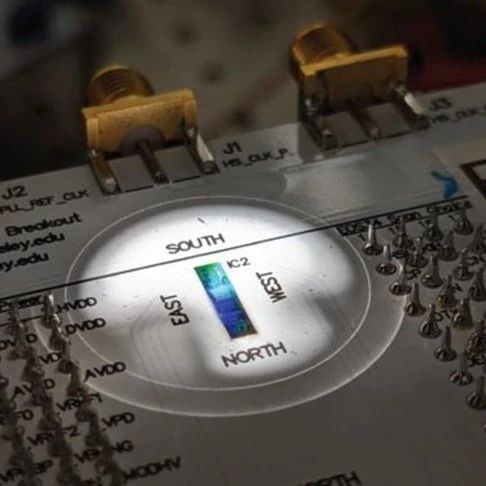
Core Viewpoint - The article discusses the development of the world's first integrated electronic-photonic-quantum chip by researchers from Boston University, UC Berkeley, and Northwestern University, marking a significant step towards practical quantum systems [2][4]. Group 1: Chip Development - The chip utilizes standard 45-nanometer semiconductor technology to integrate quantum light sources with stable electronic devices on a single platform [3][11]. - Each chip contains twelve independent quantum light sources, each less than one square millimeter in size, driven by lasers and utilizing micro-ring resonators to generate photon pairs [7][10]. Group 2: Technical Innovations - The team embedded a real-time control system directly into the chip to address the sensitivity of resonators to temperature changes and manufacturing variations, ensuring stable quantum processes [9][10]. - The integration of photonic devices with classical electronic technology posed significant challenges, requiring a rethinking of how these technologies coexist on the chip [11][12]. Group 3: Collaborative Efforts - The project involved collaboration across various fields, demonstrating that complex quantum photonic systems can be constructed and stabilized entirely within CMOS chips [12]. - Several student researchers from the project have transitioned to the industry, continuing work in silicon photonics and quantum computing at companies like PsiQuantum, Ayar Labs, and Google X [12]. Group 4: Support and Funding - The research received support from the National Science Foundation, Packard Fellowship, and GlobalFoundries, highlighting the importance of funding in advancing quantum technology [13].
【省生态环境厅】环境监测五十载 美丽陕西有我在
Shan Xi Ri Bao· 2025-05-25 22:29
Core Viewpoint - The development of ecological environment monitoring in Shaanxi over the past 50 years has transformed from basic manual methods to a sophisticated, integrated monitoring network, showcasing significant advancements in technology and methodology [1][5][17]. Group 1: Historical Development - The establishment of the Shaanxi Provincial Environmental Monitoring Station in 1975 marked the beginning of environmental monitoring in the province, evolving from a small team with basic equipment to a comprehensive monitoring network [1][2]. - By 2024, Shaanxi has developed a three-tier monitoring system with 116 monitoring institutions and a workforce of 2,254, equipped with 11,100 advanced instruments [2][4]. Group 2: Technological Advancements - The monitoring capabilities have expanded from basic parameters like pH and dissolved oxygen to a comprehensive system covering 11 categories and 1,320 parameters [2][8]. - The introduction of "super stations" equipped with advanced monitoring technology has enhanced the ability to detect over 150 pollutants in the air [6][7]. Group 3: Water and Soil Monitoring - Water monitoring has progressed from manual sampling to automated systems, with 277 manual monitoring sites and 143 automatic monitoring stations, achieving a comprehensive water quality monitoring network [8][9]. - Soil monitoring has evolved from background investigations to risk assessment, with a network of 527 basic points and advanced technologies for pollution detection [10]. Group 4: Noise and Rural Monitoring - Noise monitoring has transitioned from manual methods to automated systems, with 108 functional area monitoring sites established [11]. - Rural monitoring has expanded significantly, with 120 villages achieving a drinking water quality compliance rate of 94.36% [12]. Group 5: Ecological Monitoring - Ecological monitoring has improved with the establishment of national-level monitoring stations and the use of high-resolution satellite data, achieving a precision rate of 98.22% [13]. - The application of environmental DNA technology has facilitated the monitoring of rare species, contributing to biodiversity conservation [13]. Group 6: Future Outlook - The future vision for Shaanxi's ecological monitoring includes the integration of advanced technologies such as AI and blockchain to enhance monitoring capabilities and achieve intelligent pollution management by 2035 [17][18].
量子传感新技术“攻克”退相干难题
news flash· 2025-04-29 22:21
Core Insights - A new quantum sensing technology developed by researchers at the University of Southern California addresses the issue of quantum decoherence, significantly outperforming traditional methods [1] Group 1: Technology Overview - The new quantum sensing technology utilizes a novel coherence-stabilizing protocol to combat quantum decoherence, which has historically limited the performance of quantum sensors [1] - Quantum sensing involves using quantum systems such as atoms, photons, or qubits as sensors to measure physical quantities with extreme precision, often surpassing the limits of classical sensors [1] Group 2: Implications and Applications - The advancements in quantum sensing technology are expected to drive progress in various fields, including medical imaging and fundamental physics research [1] - Decoherence, caused by environmental noise, leads to unpredictable behavior in quantum systems, which can obscure quantum sensing signals [1]
量子传感器,新突破!
半导体行业观察· 2025-04-05 02:35
Core Viewpoint - Quantum sensors are expected to significantly benefit multiple industries due to their enhanced sensitivity and new sensing capabilities compared to traditional sensors [2] Group 1: Quantum Sensor Innovations - Quantum sensors, including atomic clocks, quantum magnetometers, and quantum gyroscopes, are anticipated to revolutionize various sectors [2] - The transition from laboratory prototypes to commercial products requires optimization of size, weight, power, and cost (SWaP-C) [2] - The most effective method for achieving this is through scalable semiconductor manufacturing processes [2] Group 2: Manufacturing Techniques - Glass vapor cells are essential for quantum sensors, enabling interaction between lasers and atomic gas samples [5] - Traditional glassblowing techniques limit the miniaturization of vapor cells, while wafer-level semiconductor manufacturing can produce highly uniform vapor cells for mass production [5] - Innovations in manufacturing techniques, including alternative glass materials and various etching and bonding technologies, are crucial for enhancing performance [5] Group 3: Laser Technology - Lasers are a critical component in quantum sensors, with VCSELs (Vertical-Cavity Surface-Emitting Lasers) being particularly important for their scalability and integration [7][8] - The demand for VCSELs has surged due to their applications in smartphones, automotive infrared cameras, and data center interconnects [7] - VCSELs must meet specific requirements for atomic quantum sensors, including wavelength stability and narrow linewidth [7] Group 4: Market Challenges - The high production costs of quantum sensor components limit their target markets, creating a cycle that restricts scaling and cost reduction [9] - Current manufacturing processes for vapor cells are complex and expensive, necessitating collaboration between academia and industry to support semiconductor manufacturing for emerging quantum technologies [9] Group 5: Future Market Outlook - Innovations in vapor cell and VCSEL manufacturing have enabled the miniaturization of atomic clocks, providing a blueprint for transitioning other quantum sensors to mass production [10] - Semiconductor foundries are positioned to become key players in the quantum sensor value chain, with investments aimed at reducing manufacturing costs opening up larger market opportunities [10] - The demand for improved sensing solutions in timing, magnetic field sensing, and inertial sensing will drive the growth of quantum sensors [10]