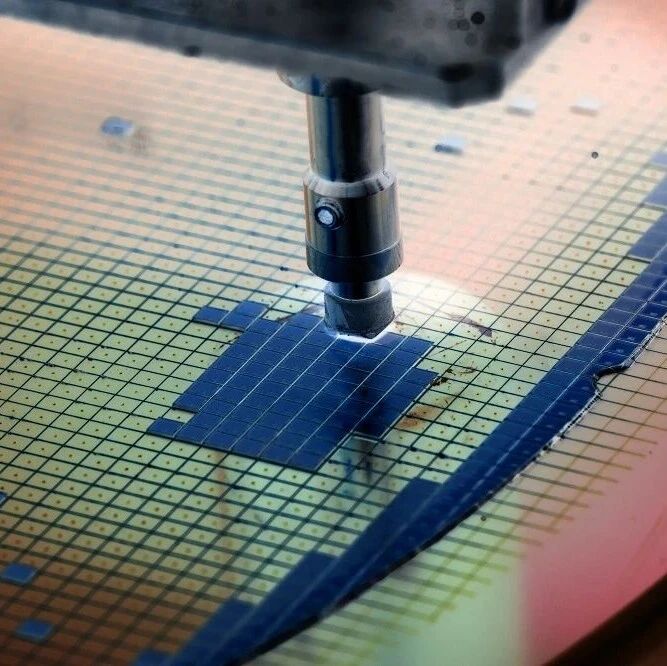
半导体制造

Search documents
十个月连涨在望,白银被推上贸易避险“C位”
Jin Shi Shu Ju· 2026-02-26 03:20
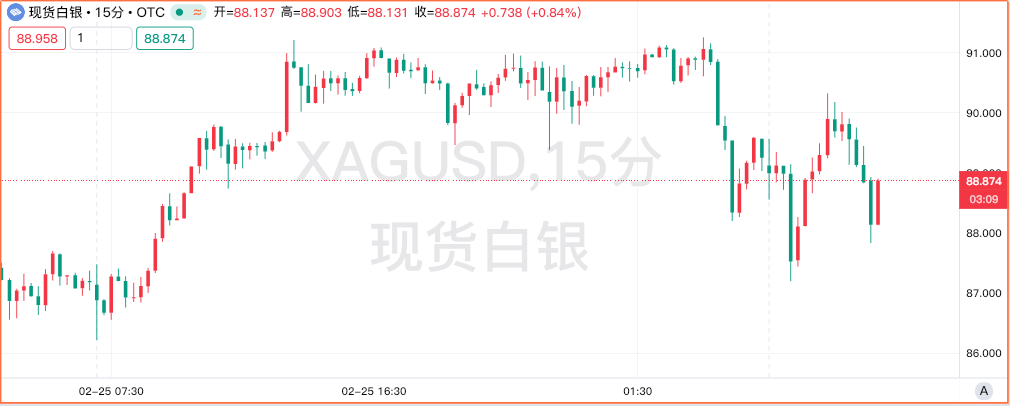
Core Viewpoint - Silver continues to outperform gold this year, becoming a preferred "hedge asset" for investors, with prices expected to record a consecutive 10-month increase, marking the longest monthly gain on record [2] Group 1: Market Performance - As of Thursday, spot silver is hovering around $88.90 per ounce, with a cumulative increase of approximately 4.3% this month [4] - The silver market is experiencing a supply deficit, projected to reach 67 million ounces by 2026, marking the sixth consecutive year of deficit [7] Group 2: Influencing Factors - Trade tensions are reigniting investor demand for hedge assets amid global economic slowdown and geopolitical polarization [5] - Ongoing tensions in Eastern Europe and security concerns in Mexico are enhancing the appeal of precious metals [6] Group 3: Market Dynamics - Silver is characterized as a "dual-purpose metal" with both investment and industrial uses, making it more sensitive to economic cycles compared to gold [5] - The market is transitioning from being news-driven to being fundamentally driven, influenced by monetary policy, inflation expectations, and dollar dynamics [7][8] - Current expectations indicate that the Federal Reserve will maintain interest rates in March, with a potential for approximately 60 basis points of rate cuts for the remainder of the year, making the monetary environment more favorable for precious metals [7] Group 4: Speculative Behavior - Speculative behavior from Asian traders is contributing to extreme volatility in precious metals, highlighting the role of short-term liquidity in amplifying price fluctuations [7] - The current market is not experiencing a price bubble but is undergoing a "speculative cycle" amid ongoing supply shortages and rising industrial demand [8]

白银狂潮2.0?世界银行与白银协会罕见一致:2026年或迎来最后狂欢
Sou Hu Cai Jing· 2026-02-22 21:37
Group 1 - The core viewpoint of the article highlights the unprecedented rise in silver prices, which have recently surpassed $100 per ounce, driven by record gold prices and dual demand from industrial use and geopolitical hedging [1][3] - The World Bank predicts that silver prices will average $41 per ounce in 2026, indicating significant upside potential compared to current levels, with financial institutions supporting this optimistic outlook due to expected convergence in the gold-silver ratio [3][5] - The demand for silver is expected to rise steadily, fueled by its critical role in the "green economy," particularly in renewable energy and semiconductor manufacturing, despite potential reductions in silver usage in the solar industry [5][6] Group 2 - The silver market is projected to face a structural supply shortage for the sixth consecutive year in 2026, with a deficit of 67 million ounces anticipated, highlighting the imbalance between dwindling mining output and increasing industrial consumption [6][7] - Investment in physical silver is expected to rebound in 2026, with a projected 20% increase, reaching the highest level in three years, driven by tight supply conditions and geopolitical uncertainties [6][9] - The World Bank warns that 2026 may mark the peak of the current precious metals bull market, with silver prices potentially declining to an average of $37 per ounce in 2027, reflecting a nearly 10% drop due to high prices suppressing demand and potential shifts in monetary policy [9][11] Group 3 - The article emphasizes the critical supply-demand dynamics in the silver market, suggesting that while there may be short-term volatility, the significant supply gap of 67 million ounces serves as a strong support for prices [11] - The ongoing industrial consumption driven by sectors like photovoltaics, AI, and data centers is expected to sustain silver demand, making 2026 a pivotal year for investors in the precious metals cycle [11]
亚舍立科技2025财年业绩公布:营收8.39亿美元,净利1.2亿美元
Jing Ji Guan Cha Wang· 2026-02-19 16:46
Financial Performance - For the fiscal year 2025, the company achieved a revenue of $839 million and a net profit attributable to shareholders of $120 million, resulting in a net profit margin of 14.33% [1] - In the fourth quarter of fiscal year 2025, the company reported a quarterly revenue of $238 million and a net profit of $34.3 million, with basic earnings per share of $1.11 [1] Profitability Metrics - The gross margin for fiscal year 2025 was 44.91%, the operating profit margin was 14.22%, and the return on equity (ROE) was 11.75% [1] Business Focus - The company specializes in the research, development, manufacturing, and servicing of ion implantation and dry etching equipment used in semiconductor manufacturing, primarily serving leading global semiconductor chip manufacturers [1]
JX金属指引明确行业景气度,靶材成为半导体金铲子
Zhong Guo Neng Yuan Wang· 2026-02-14 01:30
Group 1 - The global semiconductor sputtering target market is expected to reach 25.1 billion by 2027, with a CAGR of approximately 14.4% from 2023 to 2027 [1][4] - JX Metals holds over 50% market share in the semiconductor target materials sector, focusing on various bulk and rare metals [2] - JX Metals reported a revenue of 614.5 billion yen for the first three quarters of FY2025, a year-on-year increase of 19%, with semiconductor materials revenue at 130.2 billion yen, up 17% [3] Group 2 - The demand for semiconductor targets is expected to remain strong due to advancements in manufacturing processes and increased usage of materials [4] - JX Metals has revised its FY2025 revenue guidance upwards to 820 billion yen, reflecting a 4% increase, with semiconductor materials expected to reach 180 billion yen, a 6% increase [3] - The company anticipates a significant increase in operating profit, projecting a 33.3% year-on-year growth to 150 billion yen for FY2025 [3] Group 3 - Investment recommendations include focusing on Jiangfeng Electronics, with beneficiaries being Youyan New Materials, Ashi Chuang, Olay New Materials, and Longhua Technology [5]
刻蚀机行业前景:竞争格局高度集中且激烈,中国企业将扮演越来越重要的角色
Xin Lang Cai Jing· 2026-02-11 10:33
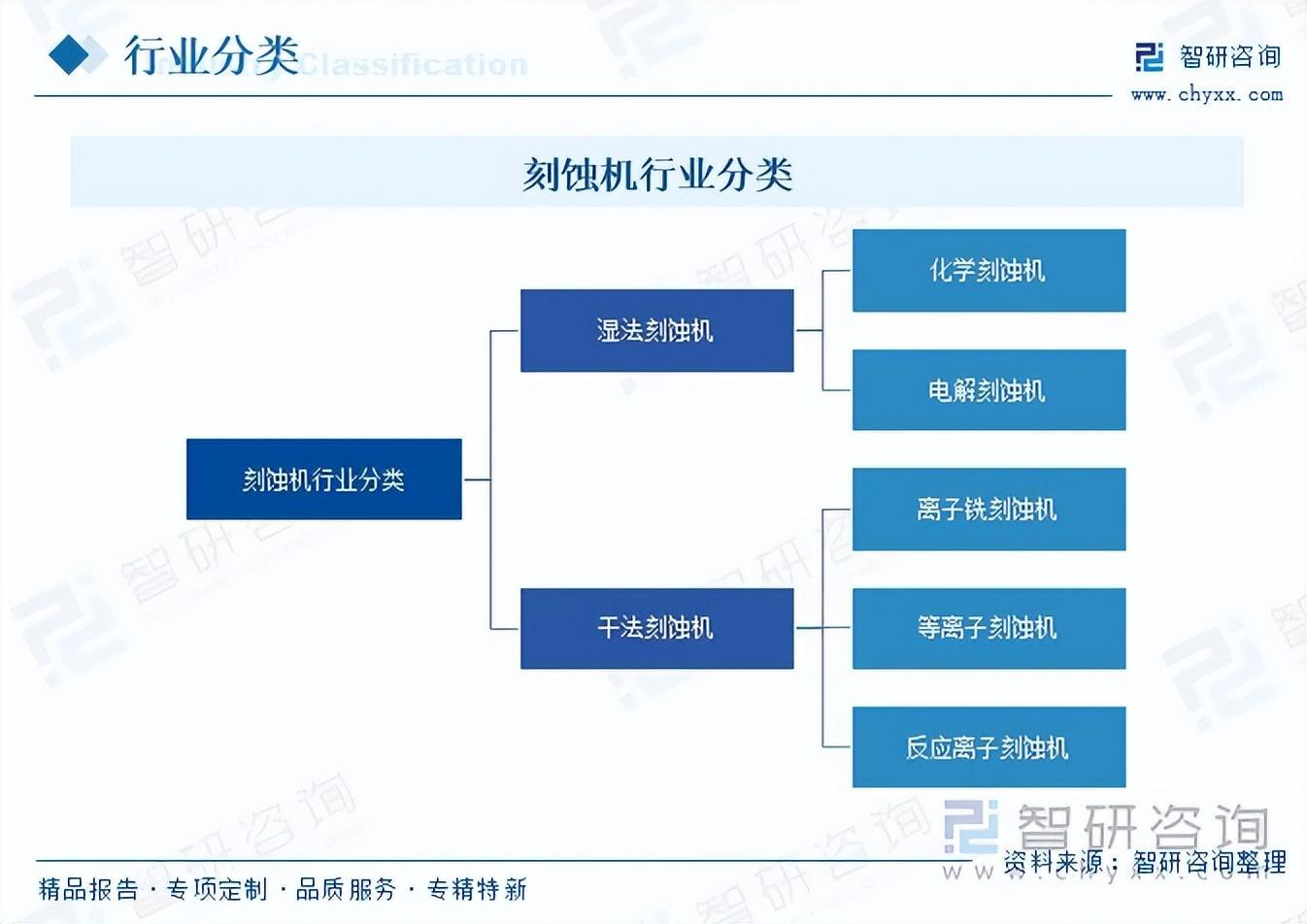
Core Insights - The global etching machine market is experiencing growth, with a market size of approximately $14.82 billion in 2023, representing a year-on-year increase of 5.93%. The market is projected to reach $15.65 billion in 2024 and $16.48 billion in 2025 [3][23][20]. Etching Machine Industry Definition and Classification - Etching machines are essential tools in semiconductor manufacturing, utilizing chemical reactants and physical energy to remove material from surfaces to create fine structures. They are primarily classified into wet etching machines and dry etching machines, with wet etching further divided into chemical and electrochemical etching, and dry etching into ion milling, plasma etching, and reactive ion etching [20][23]. Current Development Status of the Etching Machine Industry - The etching machine industry is crucial for manufacturing semiconductor devices, photovoltaic cells, and micro-mechanical systems. The market has shown a consistent upward trend in recent years, with significant growth expected in the coming years [3][23]. Etching Machine Industry Supply Chain - The supply chain for the etching machine industry consists of upstream components such as pre-vacuum chambers, etching chambers, gas supply systems, and vacuum systems. The midstream involves the manufacturing and system integration of etching machines, while the downstream applications include micro-electromechanical systems (MEMS), advanced packaging, and nanotechnology in semiconductor, optical, and electronic industries [5][25]. Development Environment and Relevant Policies - The etching machine industry is supported by various government policies aimed at enhancing the semiconductor manufacturing sector. Recent policies include initiatives to promote the development of high-end semiconductor manufacturing materials and equipment, as well as plans to strengthen the domestic semiconductor supply chain [7][27]. Industry Barriers - The etching machine industry has high entry barriers, primarily due to technological complexity, significant capital requirements, and the need for customer recognition. These barriers make it challenging for new entrants to compete effectively [11][31]. Competitive Landscape of the Etching Machine Industry - The etching machine market is characterized by high concentration and intense competition. Major global players include Lam Research, TEL, and AMAT, which dominate the market with advanced technologies and extensive product lines. Domestic companies such as Northern Huachuang, Zhongwei Company, and Yitang Semiconductor are emerging as leaders in the industry, leveraging their R&D capabilities [11][31][34].


印度芯片,究竟如何?
半导体行业观察· 2026-02-06 01:33
Core Viewpoint - The Indian government is making significant investments in semiconductor manufacturing projects across various states, with a total expected investment of approximately 1.6 trillion rupees in ten approved projects, including two wafer fabs and eight packaging facilities [11]. Group 1: Major Semiconductor Projects - Micron Technology is investing 225.16 billion rupees to build a semiconductor manufacturing plant in Gujarat, which will have an assembly and testing capacity for DRAM and NAND products, with a weekly output of approximately 14 million units [2]. - Tata Electronics Limited (TEPL) is investing 915.26 billion rupees in a semiconductor manufacturing plant in Gujarat, in collaboration with Taiwan's PSMC, with a monthly capacity of about 50,000 wafers [3]. - TEPL is also investing 271.2 billion rupees in Assam to establish a semiconductor manufacturing facility that will utilize local packaging technology, with a daily output of 48 million units [4]. - CG Power and Industrial Solutions Limited is investing 75.84 billion rupees in Gujarat to build a semiconductor manufacturing plant in partnership with Renesas Electronics America Inc. and STARS Microelectronic, with a daily output of approximately 15.07 million units [5]. - Kaynes Technology India Limited is investing 33.07 billion rupees in Gujarat to establish a semiconductor manufacturing plant for lead bonding interconnect and substrate packaging devices, with a daily output exceeding 6.33 million chips [6]. - Vama Sundari Investments is investing 37.06 billion rupees in Uttar Pradesh to build a semiconductor manufacturing plant for display driver ICs using gold bump technology, with a capacity of 20,000 wafers per month and up to 36 million chips [7]. - 3DGlass Solutions Inc. is investing 19.43 billion rupees in Odisha to establish a semiconductor manufacturing plant focused on packaging products, with a monthly capacity of approximately 5,800 glass panels and 4.2 million components [8]. - SiCSem Private Limited is investing 20.66 billion rupees in Odisha to build a semiconductor manufacturing plant in collaboration with Clas-SiC Wafer Fab Ltd. and Continental Device India Pvt. Ltd., with a monthly wafer capacity of 5,000 and packaging capacity of 8 million units [9]. - Continental Device India Private Limited (CDIL) is expanding its semiconductor manufacturing facility in Punjab with an investment of 1.17 billion rupees, producing high-power discrete semiconductor devices with an annual capacity of approximately 158.38 million units [10]. - Advanced System Packaging Technology Private Limited (ASIP) is investing 4.8 billion rupees in Andhra Pradesh to build a semiconductor manufacturing plant in collaboration with Korea's APACT, with an annual capacity of about 96 million units [11]. Group 2: Government Support and Initiatives - The Indian government has supported 24 chip design projects through startups, with 16 projects completing chip tape-outs and 13 projects receiving venture capital funding [11].

未知机构:海外AICAPEX高景气持续看好洁净室龙头亚翔集成圣晖集成近-20260204
未知机构· 2026-02-04 02:05
Summary of Conference Call Records Industry Overview - The focus is on the cleanroom industry, particularly companies like Yaxing Integration and Shenghui Integration, which are leaders in this sector [1][2]. Key Insights and Arguments - **AI Demand and Capital Expenditure**: Recent financial reports from several overseas leaders have exceeded expectations, confirming the robust demand for AI and indicating that AI capital expenditures are entering an expansion phase. Cleanrooms, as a front-end infrastructure segment, are expected to see a corresponding increase in demand [1]. - **U.S. Semiconductor Investments**: The U.S. has significantly increased investments in the semiconductor manufacturing chain, attracting major companies like TSMC and Samsung to establish factories in the U.S. By the end of 2024, TSMC is expected to have invested $65 billion in the U.S. and announced an additional $100 billion investment in March 2025. Recent "tariff-for-investment" policies have led TSMC and other Taiwanese companies to commit to at least $250 billion in direct investments in the U.S., which is likely to drive rapid growth in regional cleanroom demand [1]. - **Southeast Asia Developments**: - **Singapore**: The RIE2030 initiative plans to invest SGD 37 billion over the next five years in key economic sectors like semiconductors, aiming to double the output of the semiconductor and related manufacturing industries by 2030. This initiative is attracting major players such as UMC, World Advanced, and Micron to establish factories [2]. - **Vietnam and Thailand**: These countries are leveraging labor cost advantages and industrial cluster benefits to accelerate the transfer of precision manufacturing (PCB) and other supply chains, leading to robust regional capital expenditures [2]. Supply Side Dynamics - Cleanroom production capacity is primarily concentrated in mainland China and Taiwan, with the top five companies holding nearly 40% of the market share. Mainland leaders like Shenzhen Sanda A are actively pursuing overseas expansion. However, there are potential restrictions on mainland capacity moving to the U.S., leading to a significant mismatch in supply and demand in the U.S. market. It is anticipated that there will be an accelerated introduction of Taiwanese cleanroom leaders to the U.S. market, with project profit margins expected to exceed expectations, contributing significantly to performance growth. Continuous recommendations are made for Yaxing Integration (a Taiwanese cleanroom leader securing multiple large contracts in Singapore) and Shenghui Integration (which has established a U.S. subsidiary and is expected to benefit from TSMC's orders) [2]. Risk Factors - Potential risks include a downturn in semiconductor capital expenditures, increased competition within the industry, and the possibility that expansion efforts in the U.S. may not meet expectations [3].

研判2026!中国刻蚀机行业政策、行业壁垒、产业链、市场规模、竞争格局及发展趋势分析:竞争格局高度集中且激烈,中国企业将扮演越来越重要的角色[图]
Chan Ye Xin Xi Wang· 2026-02-02 01:22
Core Viewpoint - The global etching machine market is experiencing growth, with a projected market size of approximately $14.82 billion in 2023, a year-on-year increase of 5.93%, and expected to reach $16.48 billion by 2025 [1][2]. Group 1: Industry Definition and Classification - Etching machines are essential tools in semiconductor manufacturing, combining chemical reactants and physical energy to remove material from surfaces to create microstructures [2]. - The etching machines are categorized into wet etching machines (chemical and electrochemical) and dry etching machines (ion milling, plasma etching, and reactive ion etching) [2]. Group 2: Industry Development Status - The etching machine market is primarily used for manufacturing semiconductor devices, photovoltaic cells, and micro-mechanical systems, showing a consistent growth trend [2][3]. - The market size is projected to be approximately $15.65 billion in 2024 and $16.48 billion in 2025 [1][2]. Group 3: Industry Chain - The upstream of the etching machine industry includes semiconductor materials and components such as pre-vacuum chambers, etching chambers, gas supply systems, and vacuum systems [3]. - The midstream involves the manufacturing and system integration of etching machines, while the downstream applications include micro-electromechanical systems (MEMS), advanced packaging, and nanotechnology in semiconductor, optical, and electronic industries [3]. Group 4: Industry Development Environment - Related Policies - The government places significant emphasis on the development of the etching machine industry, implementing various supportive policies to enhance its growth [4]. Group 5: Industry Barriers - The etching machine industry has high entry barriers, primarily due to technological, financial, and customer recognition challenges [5]. Group 6: Industry Competitive Landscape - The etching machine market is characterized by high concentration and intense competition, dominated by international companies such as Lam Research, TEL, and AMAT [6]. - Domestic companies like North Huachuang, Zhongwei Company, and Yitang Semiconductor are emerging as leaders in the etching machine sector, leveraging their R&D and innovation capabilities [6][8]. Group 7: Industry Development Trends - As a core process in semiconductor manufacturing, etching technology is crucial for transferring patterns onto wafer surfaces, with the market evolving towards platform-based and atomic-level manufacturing [9]. - The Chinese etching machine industry is experiencing explosive growth, supported by national policies, and is diversifying and making significant progress in various segments [9].

Skywater,官宣卖身
半导体芯闻· 2026-01-27 10:19
Core Viewpoint - IonQ Inc has announced an acquisition agreement with SkyWater Technology, valuing the deal at approximately $1.8 billion, marking a significant step in IonQ's strategy to build a fully integrated quantum platform [1][2]. Group 1: Acquisition Details - The acquisition involves a cash and stock transaction, with an offer of $35 per share, consisting of $15 in cash and $20 in stock, representing a 38% premium over SkyWater's average stock price over the past 30 days [1]. - The deal has been approved by both companies' boards and is expected to close in the second or third quarter of 2026, pending regulatory approvals and shareholder votes [1]. Group 2: Strategic Implications - This acquisition is the largest in IonQ's recent strategic initiatives, aiming to integrate its quantum architecture with SkyWater's semiconductor manufacturing capabilities, creating a closed-loop process from quantum chip design to production [1]. - SkyWater, identified as the largest domestic chip foundry in the U.S., will maintain its brand and operations as a wholly-owned subsidiary of IonQ, continuing to serve its existing clients in defense, aerospace, and commercial sectors [2]. Group 3: Market Reactions - Following the announcement, SkyWater's stock rose by 9% intraday, closing up 3.29%, while IonQ's stock initially rose but ultimately closed down 8.21%, with a post-market rebound of 2.37% [2].



做马桶的TOTO,进军芯片行业,大挣
半导体行业观察· 2026-01-23 01:37
Core Viewpoint - The unexpected connection between Toto, a Japanese bathroom manufacturer known for its high-tech toilets, and the semiconductor supply chain has led to a significant increase in its stock price, driven by the rising demand for components used in AI systems and electronic products [1][2]. Group 1: Toto's Business and Market Position - Toto's stock price rose nearly 10% on January 2, attributed to its involvement in semiconductor manufacturing through components like electrostatic chucks, which are essential for AI and electronic product production [1]. - The company has established itself as a key player in the semiconductor manufacturing sector since the 1980s, with its electrostatic chucks becoming indispensable tools in modern semiconductor fabrication [2]. - Toto's ceramic materials used in electrostatic chucks must possess strength and crack resistance, leveraging the company's long-standing expertise in ceramic production [4]. Group 2: Financial Projections and Growth - Toto's ceramic business is projected to achieve an operating profit of 20 billion yen (approximately 130 million USD) in the fiscal year 2024, with a profit margin close to 40%, significantly higher than the company's previous overall profit margin forecast of 7% [5]. - By the fiscal year 2026, Toto aims to increase this profit figure to 25 billion yen, expanding its product range in the process [5]. Group 3: Industry Trends and Future Directions - The demand for electrostatic chucks is expected to grow alongside the increasing use of extreme ultraviolet (EUV) lithography in semiconductor manufacturing, which requires precise wafer positioning [4]. - Toto is also exploring downstream processes such as cutting and packaging, with ceramics anticipated to play a more significant role in new substrate technologies for three-dimensional chip stacking [6]. - The semiconductor industry is expected to continue its exponential growth despite fluctuations, as stated by Toto's president [6].