
金融资产投资公司(AIC)

Search documents
股份行第三家!招行宣布:获准!
中国基金报· 2025-07-03 12:11
Core Viewpoint - China Merchants Bank has received approval to establish a financial asset investment company, which will enhance its capabilities in market-oriented debt-to-equity swaps and equity investment pilot projects, thereby providing comprehensive financing support to enterprises and promoting high-quality development [1][3]. Group 1: Establishment of the Investment Company - China Merchants Bank announced the approval for the establishment of China Merchants Financial Asset Investment Co., Ltd. (referred to as "Zhaoyin Jintou") with a registered capital of 15 billion RMB, making it a wholly-owned subsidiary of the bank [3]. - The establishment of Zhaoyin Jintou is part of the bank's initiative to align with national development strategies and enhance its comprehensive operational capabilities [3][4]. - Following this approval, China Merchants Bank becomes the third commercial bank this year to receive approval for setting up an AIC, after Industrial Bank and CITIC Bank [4]. Group 2: Expansion of AIC Companies - The regulatory authorities have been actively promoting the expansion of AIC companies, with the pilot scope for bank AIC companies being extended from Shanghai to 18 cities, including Beijing, Tianjin, and Chongqing [6]. - As of now, there are five AICs established by major banks, including Industrial Bank, Agricultural Bank, Bank of China, China Construction Bank, and Bank of Communications, all set up in 2017 [4][6]. - The recent expansion of AIC companies is expected to enhance the development of technology finance and improve the efficiency of financial resource allocation [6][7]. Group 3: Industry Implications - Analysts believe that the expansion of AIC companies will provide more opportunities for smaller banks with flexible mechanisms to participate, which is beneficial for the healthy development of the industry and the transformation of banks towards lighter capital structures [7].


技术再好,银行不认也是白搭
Jin Rong Shi Bao· 2025-05-19 11:14
Group 1: Challenges Faced by Small and Micro Enterprises - Small and micro enterprises are experiencing difficulties in financing due to prolonged cash flow cycles and reduced sales revenue, making it hard to secure loans from banks [1] - The average annual growth rate of loans to private enterprises has exceeded that of all loans by 1.1 percentage points over the past five years, indicating a growing support for these businesses [1] Group 2: Policy Initiatives and Financial Support - The recent passage of the "Private Economy Promotion Law" emphasizes financial support for the private sector, with specific measures aimed at improving the accessibility and convenience of financial services [2] - Financial regulatory authorities are establishing mechanisms to facilitate low-cost funding directly to enterprises, optimizing policies like non-repayment renewal loans to reduce capital turnover costs [3][4] Group 3: Financial Coordination and Risk Management - A comprehensive financial service approach is necessary, integrating credit, insurance, and equity financing to enhance the overall effectiveness of financial support for small and micro enterprises [6] - Government-backed financing guarantees are crucial for alleviating the financing difficulties faced by small and micro enterprises, with a reported balance of 1.88 trillion yuan in direct financing guarantees [8] Group 4: Future Goals and Strategies - The goal for 2025 is to ensure that the growth rate of loans to small and micro enterprises is not less than that of all loans, with a focus on improving the quality and structure of financial services [7] - The establishment of financial asset investment companies (AIC) is seen as a new model to promote direct financing through indirect financing methods, with several banks already moving to set up AICs [7]


AIC再扩容,影响几何?
HTSC· 2025-05-13 05:45
Investment Rating - The report maintains an "Overweight" rating for the banking sector [6] Core Insights - The expansion of Asset Investment Companies (AIC) is seen as a significant development, with the approval of new licenses for banks to establish AICs, marking a shift in the banking sector's approach to equity investment [11][12] - AICs are positioned to support technology innovation by providing long-term capital, with the potential to attract additional social funds [22][24] - The regulatory environment has been increasingly favorable, with policies expanding the scope and conditions for AIC equity investments [2][15] Summary by Sections Introduction - The report discusses the recent approval for Industrial Bank to establish an AIC, making it the first joint-stock bank to enter this space, alongside announcements from other banks like China Merchants Bank and CITIC [11][12] Historical Context - AICs were established in 2016 as part of supply-side reforms to address non-performing loans in the banking sector, evolving to include equity investment since 2020 [3][18] Business Opportunities and Challenges - AICs are expected to enhance banks' growth potential by diversifying their business models and improving profitability, although they face challenges related to liquidity management and capital consumption [4][14] - The contribution of AICs to the overall profitability of major banks remains small, with an average contribution of 1.4% to net profit and 0.3% to total assets in 2024 [4][12] Policy Developments - Recent policy changes have expanded the investment scope for AICs, allowing for a higher percentage of total assets to be allocated to equity investments, increasing from 4% to 10% [2][15] - The number of cities eligible for AIC equity investment has expanded to 18, enhancing the operational landscape for banks [2][15] Comparative Analysis - AICs are compared to Asset Management Companies (AMCs) and market-oriented private equity/venture capital firms, highlighting their unique advantages in leveraging bank resources while maintaining a cautious investment approach [26]


这一板块,直线拉升!
天天基金网· 2025-05-09 05:33
Market Overview - On May 9, A-shares experienced fluctuations with the Shanghai Composite Index down by 0.18%, Shenzhen Component Index down by 0.56%, and ChiNext Index down by 0.63% [1] - The banking sector showed resilience, with notable gains in banks such as China Construction Bank reaching a historical high, and Qingdao Bank, Chongqing Bank, and Industrial Bank rising over 2% [10][11] Sector Performance - The banking sector performed well against the market trend, while sectors like aerospace, robotics, and semiconductor chips faced declines [2][9] - The textile and apparel sector was active, with companies like Wanshili hitting the daily limit up and Huafang Co. achieving a four-day consecutive rise [7][8] Notable Stocks - Honghua Semiconductor saw a significant drop of over 11%, while SMIC fell by more than 6%, and JD Health decreased by over 3% [3][6] - In the textile sector, several stocks experienced substantial gains, including Lishili with a rise of 20.03% and Huafang Co. with a 10.06% increase [8] Regulatory Developments - The Ministry of Industry and Information Technology and the Ministry of Commerce announced a campaign to enhance the quality of textile and apparel supply, aiming to drive industry upgrades through improved product quality and brand creation [8] - Recent announcements from banks like China Merchants Bank and CITIC Bank indicated plans to establish financial asset investment companies with significant capital contributions [10][12] Market Sentiment - High-priced stocks faced significant declines, with Zhongyida hitting a daily limit down and other stocks like Jinlong Electric and Qide New Materials dropping over 9% and 7% respectively [13][14] - Zhongyida's stock price had surged by 226.55% since March 10, prompting concerns about market overheating and potential corrections due to a lack of fundamental changes [15]


银行板块逆市走强!两万亿龙头创新高,股份行设立AIC会带来哪些效益?
Zhong Guo Zheng Quan Bao· 2025-05-09 05:25
Group 1 - High dividend assets rebounded today, with the banking sector leading the gains, and sectors like electricity and highway transportation also performing actively [1] - The People's Bank of China announced a package of policy measures on May 7, including a 0.1 percentage point cut in policy interest rates, a 0.5 percentage point reduction in the reserve requirement ratio, and the establishment of a 500 billion yuan "service consumption and pension relending" program [1] - Financial incremental policies, combined with proactive fiscal policies, are expected to strengthen bank credit supply and maintain relatively stable credit growth, while asset quality is anticipated to continue consolidating under policy support [1] Group 2 - The establishment of Asset Investment Companies (AIC) by joint-stock banks is expected to bring comprehensive benefits beyond direct project returns from debt-to-equity swaps and equity investments [2] - AICs provide effective means for commercial banks to better meet the financing needs of technology enterprises, aligning with the focus on technology finance as one of the "five major articles" [2] - AICs can leverage other comprehensive benefits, such as enhanced cooperation with technology companies leading to transaction settlements and payroll services, thereby achieving low-cost deposit accumulation and creating fee income opportunities [2]

股份行加速布局AIC:招行、中信银行拟设金融资产投资公司
Nan Fang Du Shi Bao· 2025-05-08 13:30
Core Viewpoint - Two major joint-stock banks, China Merchants Bank and CITIC Bank, have announced plans to establish financial asset investment companies (AICs), following the lead of Industrial Bank, indicating a growing trend in the banking sector to enhance financial services and support for the real economy [2][3][4]. Group 1: Company Announcements - China Merchants Bank plans to invest 15 billion yuan to establish a wholly-owned financial asset investment company, which will enhance its integrated financial services capabilities [3]. - CITIC Bank intends to invest 10 billion yuan to set up a wholly-owned subsidiary, CITIC Financial Asset Investment Co., Ltd., focusing on market-oriented debt-to-equity swaps and other supportive businesses [3][4]. Group 2: Regulatory Context - The establishment of AICs aligns with the recent policy signals from the National Financial Regulatory Administration, which encourages commercial banks to set up AICs to support technology innovation and private enterprises [5][6]. - The approval for the establishment of AICs marks a significant shift in the banking sector, as the first five AICs were established by state-owned banks in 2017, focusing primarily on debt-to-equity swaps [7]. Group 3: Industry Implications - The establishment of AICs is expected to enhance the banks' ability to provide diversified financial services, particularly to technology and innovation-driven enterprises, thereby facilitating a stronger connection between investment and lending [7]. - AICs are evolving from being solely debt-to-equity tools to comprehensive investment platforms, expanding their roles to include mergers and acquisitions and hybrid investments, which will further support the integration of finance and industry [7].

招商、中信火速跟进官宣!股份制银行叩开AIC大门,影响几何
Bei Jing Shang Bao· 2025-05-08 13:27
Core Viewpoint - The recent approval for the establishment of financial asset investment companies (AICs) by major commercial banks marks a significant shift in the AIC landscape, previously dominated by state-owned banks, indicating a new era of competition and innovation in financial services aimed at supporting the real economy [1][2][4]. Group 1: Expansion of AICs - The approval of the establishment of AICs by major commercial banks such as Industrial Bank, China Merchants Bank, and CITIC Bank signifies the entry of joint-stock banks into the AIC sector, breaking the previous monopoly of state-owned banks [1][2][4]. - The Financial Regulatory Authority has announced plans to support qualified national commercial banks in establishing AICs, with approvals expected to be granted in succession [2][4]. Group 2: Capital and Business Strategy - Industrial Bank's AIC, with a registered capital of 10 billion yuan, aims to enhance support for innovative enterprises and reduce corporate leverage through professional and market-oriented operations [3][4]. - China Merchants Bank plans to invest up to 15 billion yuan to establish its AIC, which will enhance its integrated banking operations and improve its capacity to serve the real economy [4]. - CITIC Bank intends to set up its AIC with a capital of 10 billion yuan, aligning with its strategic goals of expanding its financial services [4]. Group 3: Performance and Market Dynamics - The five existing AICs reported a combined profit of 18.354 billion yuan in the past year, reflecting a year-on-year growth of 1.04%, with Industrial Bank's AIC leading in profitability [6][7]. - The profitability growth rates varied among the AICs, with China Merchants Bank's AIC showing a significant increase of 35.74% in net profit, while others experienced slower growth or declines [7]. - The entry of joint-stock banks into the AIC market is expected to enhance competition and innovation, potentially leading to new financial service pathways that leverage their capital and customer resources [5][8]. Group 4: Future Directions and Recommendations - Experts suggest that the expansion of AICs should include support for smaller banks with strong management and innovation capabilities to better serve technology-driven enterprises [8]. - Recommendations include enhancing the risk assessment and management capabilities of AICs, as well as modifying financial regulations to better accommodate equity investments by commercial banks [8].
官宣!股份行首家!
Zhong Guo Ji Jin Bao· 2025-05-07 13:38
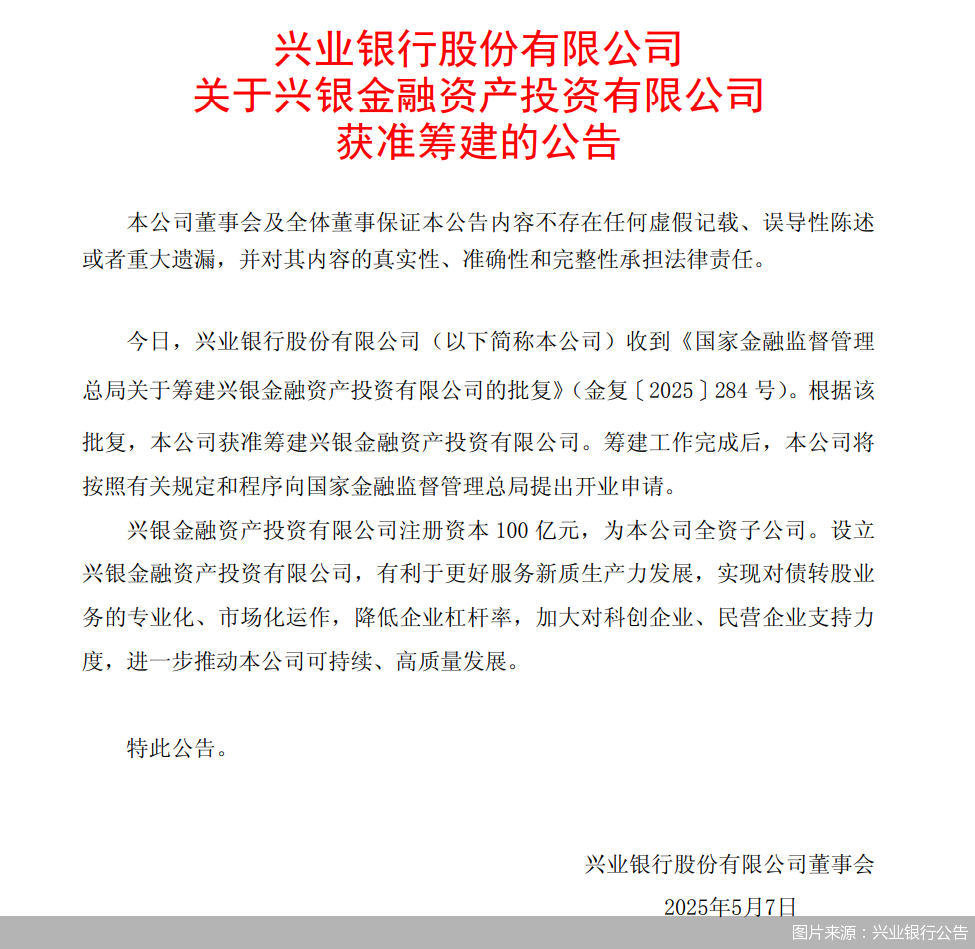
Core Viewpoint - Industrial Bank has been approved to establish Xingyin Financial Asset Investment Co., becoming the first joint-stock bank to receive such a license after five state-owned banks [2][4]. Group 1: Approval and Establishment - The approval for the establishment was granted on May 6, with a requirement to complete the setup within six months under the supervision of the financial regulatory authority [4]. - The establishment of the AIC is part of a broader initiative to support qualified national commercial banks in setting up financial asset investment companies [2][4]. Group 2: Regulatory Support and Expansion - The regulatory authority has been actively promoting the establishment of AICs, with a focus on expanding direct equity investment trials [5]. - As of May 7, the signed intention amount for AIC equity investment trials has exceeded 380 billion yuan [5]. - The expansion of AICs is expected to enhance the professional alignment of equity investments with the funding needs of technological innovation, thereby addressing the challenges of indirect financing [5].

直击兴业银行业绩会:“内外兼修”做好市值管理,“正在积极准备”设立AIC
Zheng Quan Ri Bao Wang· 2025-03-28 11:40
Core Viewpoint - The performance report of Industrial Bank for 2024 shows a slight increase in both operating income and net profit, indicating stable growth despite challenges in the banking sector [1] Financial Performance - In 2024, Industrial Bank reported operating income of RMB 212.23 billion, a year-on-year increase of 0.66% - The net profit attributable to shareholders reached RMB 77.21 billion, up 0.12% year-on-year - Total assets grew by 3.44% year-on-year to RMB 10.51 trillion, with a non-performing loan ratio of 1.07%, remaining stable compared to the previous year [1] Market Value Management - The bank emphasizes the importance of both internal and external factors in managing market value, with a focus on improving asset-liability structure and risk management [2] - The bank is actively working on optimizing its equity structure to mitigate market volatility impacts [2] Net Interest Margin Outlook - The net interest margin for 2024 decreased by 0.11 percentage points to 1.82%, which is better than the average decline in the commercial banking sector - The bank anticipates a potential further decline of 10 basis points in net interest margin due to falling asset yields, while maintaining a focus on effective management strategies [3] Dividend Policy - Industrial Bank's cash dividend payout ratio exceeded 30% for the first time in 2024, with a total cash dividend of RMB 22.02 billion, representing 30.17% of the net profit attributable to shareholders [3] - The bank aims to steadily increase its dividend payout ratio as a key objective to reward investors [4] Technological Financial Development - The bank is positioning technology finance as its "fourth brand," alongside green banking, wealth management, and investment banking - By the end of 2024, technology finance loans accounted for 16.89% of total loans, with a focus on enhancing service capabilities through a structured management system [6] - The bank is preparing for the establishment of a financial asset investment company (AIC), which could further boost its technology finance initiatives [6]