Large Language Model (LLM)

Search documents
Transformer作者重磅预言:AI无寒冬,推理革命引爆万亿市场
3 6 Ke· 2025-11-14 11:51
Core Insights - The article discusses the ongoing debate in the AI industry regarding the future of large language models (LLMs) and the emergence of reasoning models, highlighting differing opinions among experts [1][4][11]. Group 1: AI Development and Trends - The introduction of reasoning models is seen as a significant breakthrough following the Transformer architecture, which has been influential in AI development since 2017 [3][4]. - Łukasz Kaiser predicts that the next one to two years will see rapid advancements in AI, driven by improvements in GPU and energy resources rather than algorithms [1][17]. - The AI industry is currently engaged in a multi-trillion dollar race towards achieving artificial general intelligence (AGI), with many believing that the combination of LLMs, data, GPUs, and energy will lead to its realization [4][11]. Group 2: Criticism of LLMs - Richard Sutton and Yann LeCun express skepticism about the future of LLMs, suggesting that they have reached a dead end and have not learned from past mistakes [11][13]. - Critics argue that LLMs have inherent limitations in their improvement capabilities, which may be closer than previously thought [13][15]. - François Chollet has initiated the ARC Prize to redirect focus towards more promising paths to AGI, indicating a belief that LLMs are not the right approach [15]. Group 3: Advancements in Reasoning Models - Kaiser counters the notion that LLMs are a dead end, emphasizing that reasoning models require significantly less training data and can accelerate research processes [17][19]. - Reasoning models are capable of self-reflection, dynamic resource allocation, and generating multiple reasoning paths, marking a shift from traditional LLMs [19][23]. - The first reasoning model, o1, has already shown superior performance in reasoning-intensive tasks compared to the strongest general model, GPT-4o [21]. Group 4: Future Directions and Challenges - Kaiser believes that while AI capabilities will continue to grow, there will still be areas where human involvement is irreplaceable, particularly in physical world tasks [27]. - The focus should be on the transformative potential of reasoning models, which can handle specific job tasks effectively and improve overall efficiency [28][30]. - The development of multi-modal training methods is underway, which could significantly enhance AI's understanding of both abstract and physical worlds [40][42].


别被骗了,AI Coding可没那么神,22名软件开发者道出了这些弊端
3 6 Ke· 2025-11-14 03:23
Core Insights - The rapid advancement of software output speed is significantly influenced by large language models (LLMs) like ChatGPT and GitHub Copilot, which are reshaping the way software developers work [1][2] - While LLMs have increased developer efficiency by 26%, they raise questions about the essence of software development and the potential dilution of creativity and critical thinking [1][2] Research Findings - LLMs enhance developer productivity, maintain development processes, and promote entrepreneurship, but they also pose risks such as damaging developer reputation, fostering laziness, and hindering skill development [2][11] - The research utilized a social technical grounded theory (STGT) approach, involving interviews with 22 software practitioners across three rounds to gather and analyze data [3][5] Usage Statistics - Most participants have used various LLM tools, with ChatGPT being the most frequently used. Approximately 59% of participants interact with LLMs at least six times daily [5][6] Benefits of LLMs - **Individual Level**: LLMs effectively enhance developers' efficiency and learning capabilities by automating code generation, fixing syntax errors, and providing instant feedback, thus helping maintain a "flow" state [7][9] - **Team Level**: LLMs reduce collaboration interference and communication costs, allowing junior developers to resolve issues independently before seeking help from colleagues [9] - **Organizational Level**: LLMs save time and costs for software companies, particularly benefiting small and medium-sized enterprises by enabling them to accomplish more tasks with fewer resources [9] - **Societal Level**: LLMs foster innovation and entrepreneurship by allowing developers to quickly prototype and learn business and technical knowledge, thus lowering the barriers to starting new ventures [9] Drawbacks of LLMs - LLMs can generate erroneous code or suggestions, which may slow down progress and require additional time for validation. Over-reliance on LLMs can weaken developers' code comprehension and motivation to learn [11][13] - Concerns about copyright and licensing issues have led some companies to prohibit the use of LLMs, while the cost of frequent LLM usage can increase operational burdens [13][14] Recommendations for Developers - Developers are encouraged to experiment with different LLMs to find the best fit for their needs, recognizing that LLMs are statistical tools rather than intelligent agents [14][15] - Maintaining a balanced relationship with LLMs is crucial, where developers trust their capabilities while keeping a rational distance to avoid dependency [14][15]

港中文中稿ICCV'25的自驾自适应快慢双系工作统AdaDrive
自动驾驶之心· 2025-11-12 00:04
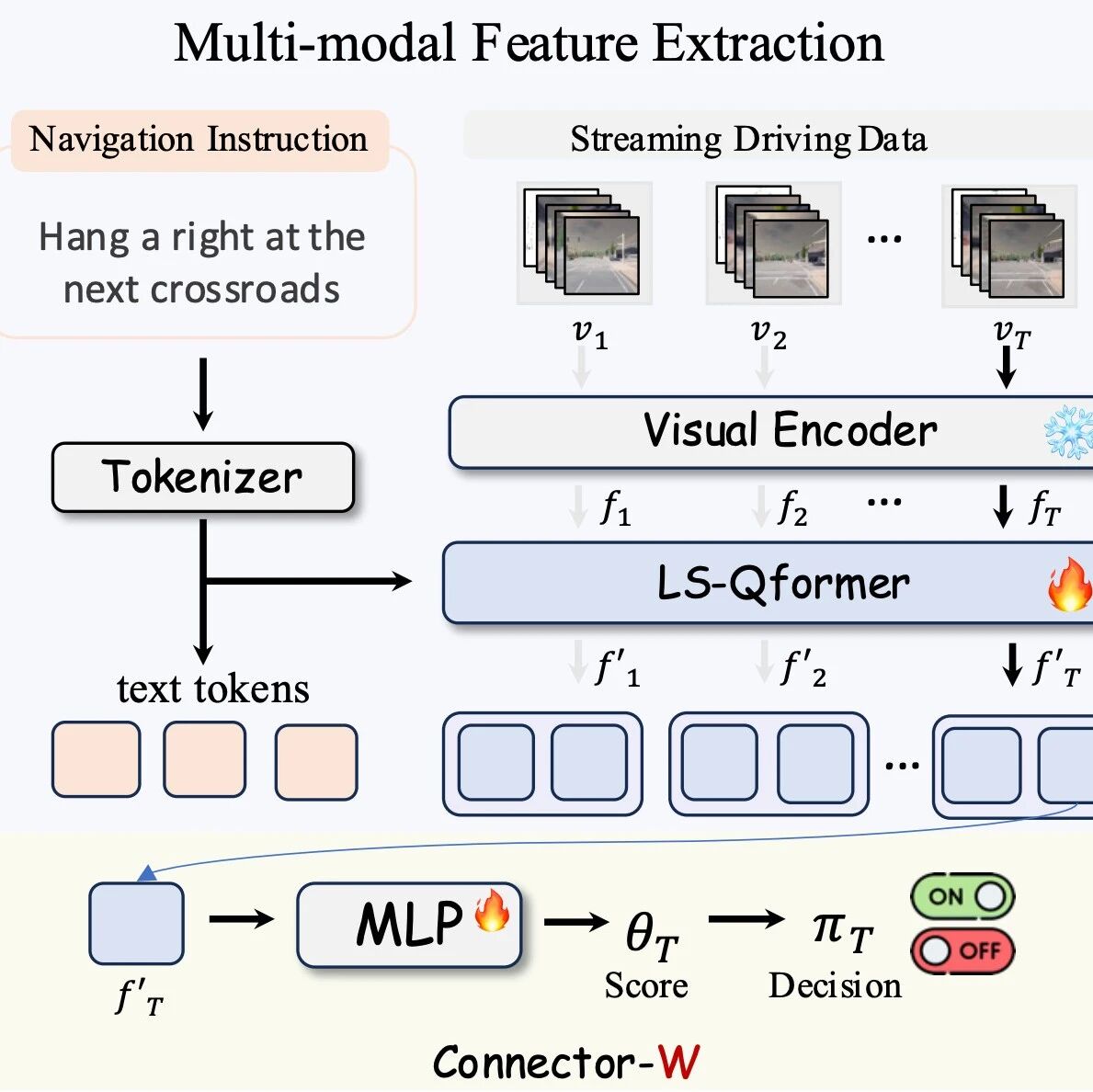
Core Viewpoint - The article discusses the introduction of AdaDrive, an adaptive slow-fast framework for integrating large language models (LLMs) into autonomous driving systems, aiming to balance high reasoning capabilities with real-time performance [2][3][4]. Background Review - Autonomous driving has been a research focus in academia and industry, with the emergence of LLMs enhancing cognitive reasoning and decision-making capabilities in driving systems. Early methods like LMDrive and AD-H faced challenges with memory overhead and latency, particularly in dynamic driving environments [4][7]. AdaDrive Algorithm Overview - AdaDrive is proposed as a next-generation framework that employs a fast-slow system paradigm, balancing high-frequency low-latency tasks with low-frequency high-reasoning tasks. It dynamically determines when to activate LLMs and adjusts their contribution based on scene complexity and prediction confidence [8][10][15]. Key Innovations - The framework introduces two key innovations: adaptive LLM activation, which learns the optimal activation timing through a novel loss function, and dynamic LLM contribution adjustment, which uses confidence-driven strategies to modulate LLM influence [8][9][21]. Experimental Results - AdaDrive demonstrated superior performance in the LangAuto benchmark, achieving driving scores of 80.9% and 70.6% in short-distance tasks, significantly outperforming the second-best method by 12.9% and 16.3% respectively [31][32]. - The method also showed advantages in inference time and memory costs due to its adaptive architecture and custom memory buffer, reducing computational overhead while enhancing driving performance [33]. Conclusion - The research highlights the potential of LLM-based language-guided autonomous driving technology, focusing on optimal activation timing and effective utilization strategies. AdaDrive's adaptive architecture and efficient memory management strategies significantly improve both effectiveness and efficiency compared to existing methods [43].
扩散不死,BERT永生,Karpathy凌晨反思:自回归时代该终结了?
3 6 Ke· 2025-11-05 04:44
Core Insights - The article discusses Nathan Barry's innovative approach to transforming BERT into a generative model using a diffusion process, suggesting that BERT's masked language modeling can be viewed as a specific case of text diffusion [1][5][26]. Group 1: Model Transformation - Nathan Barry's research indicates that BERT can be adapted for text generation by modifying its training objectives, specifically through a dynamic masking rate that evolves from 0% to 100% [13][27]. - The concept of using diffusion models, initially successful in image generation, is applied to text by introducing noise and then iteratively denoising it, which aligns with the principles of masked language modeling [8][11]. Group 2: Experimental Validation - Barry conducted a validation experiment using RoBERTa, a refined version of BERT, to demonstrate that it can generate coherent text after being fine-tuned with a diffusion approach [17][21]. - The results showed that even without optimization, the RoBERTa Diffusion model produced surprisingly coherent outputs, indicating the potential for further enhancements [24][25]. Group 3: Industry Implications - The article highlights the potential for diffusion models to challenge existing generative models like GPT, suggesting a shift in the landscape of language modeling and AI [30][32]. - The discussion emphasizes that the generative capabilities of language models can be significantly improved through innovative training techniques, opening avenues for future research and development in the field [28][30].

SK hynix Presents Next Generation NAND Storage Product Strategy at OCP 2025
Prnewswire· 2025-10-26 23:46
Core Insights - SK hynix presented its next-generation NAND storage product strategy at the 2025 OCP Global Summit, focusing on the increasing demand for NAND storage products driven by the rapid growth of the AI inference market [1][2]. Product Strategy - The company introduced the 'AIN (AI-NAND) Family' lineup, which includes three optimized solutions: AIN P (Performance), AIN D (Density), and AIN B (Bandwidth) [2][8]. - AIN P is designed to efficiently process large volumes of data generated by AI workloads, enhancing processing speed and energy efficiency by minimizing bottlenecks between storage and AI operations [3]. - AIN D targets high-density storage with low power consumption, aiming to increase storage density to petabyte (PB) levels from the current terabyte (TB) levels of QLC-based SSDs [4]. - AIN B leverages HBF technology to expand bandwidth by vertically stacking multiple NANDs, addressing the memory capacity gap driven by AI inference and large language models (LLMs) [5][6]. Collaboration and Ecosystem Development - SK hynix hosted 'HBF Night' in collaboration with Sandisk to expand the HBF product ecosystem, emphasizing the importance of partnerships in advancing NAND storage technology [7][8]. - The company aims to collaborate closely with customers and partners to establish itself as a key player in the next-generation NAND storage market [9].


1000 行 Java 代码手搓 OpenAI gpt-oss 推理引擎
AI前线· 2025-10-24 04:07
Core Insights - OpenAI released gpt-oss in August 2025, providing two reasoning models: 120b and 20b, which gained support from major cloud providers and inference engines [3] - The model architecture follows mainstream designs, utilizing tiktoken for tokenization, MoE architecture, and various optimizations for efficiency [5][9] - The Java port of gpt-oss achieved a high-performance CPU inference engine with approximately 1000 lines of code, demonstrating the feasibility of running LLMs on CPU [3][37] Model Architecture Overview - gpt-oss retains a conventional model architecture, employing techniques like Grouped Query Attention and MoE to balance model capability and inference efficiency [5] - The 20b model is structured with 24 layers, each containing 32 experts, activating only 4 experts per forward pass to reduce computational load [5] - The model file size for the 20b version is approximately 13GB due to mxfp4 quantization [5] Implementation Process - The Java porting process involved replicating the original PyTorch model structure, focusing on key implementations and performance optimizations [9][10] - The model's MLP layer parameters are quantized using mxfp4, optimizing memory requirements during inference [12] Performance Optimization - Initial performance on AWS EC2 was 0.04 tokens/sec, but optimizations improved this to approximately 7 tokens/sec for decoding and 10 tokens/sec for prefill [23][34] - Matrix multiplication optimizations included cache optimization, vectorization, and parallel processing, achieving significant performance gains [24][28] - The final implementation on AWS EC2 reached 61.4 GFLOPS, representing 42% of the machine's peak performance [27] Memory Management - The project utilized Java Foreign Memory API for memory mapping, allowing the model to run with only 16GB of memory [29] - Memory copy reductions were achieved by pre-allocating intermediate data and using mmap for MLP weights [30] Conclusion - The project demonstrated the potential of Java for high-performance LLM inference, with ongoing improvements in Java's performance capabilities [38] - The experience highlighted the importance of engineering optimizations in LLM inference, distinguishing it from pre-training and post-training processes [37]

SecureLend Targets Community Banks With AI Lending Platform
Crowdfund Insider· 2025-10-20 19:55
Core Insights - SecureLend has launched an AI-powered lending platform that enhances loan origination speed by up to 10 times and reduces costs by 60% for community banks and alternative lenders [1] - The platform features a large language model-agnostic architecture, allowing institutions to utilize various AI models without vendor lock-in [1] Industry Context - Community banks are under increasing pressure from digital-first competitors, with their share of banking assets halving over decades [2] - Digital challengers capture 30-50% of new small business lending annually, indicating a significant shift in the market [2] - Without modernization, community banks could face double-digit declines in their lending business each year [2] Cost Efficiency - A study by Freddie Mac estimates that manual mortgage origination costs approximately $11,600 per loan, primarily due to document verification and underwriting processes [3] - SecureLend automates the entire workflow from borrower communication to credit memo generation, significantly reducing costs and speeding up processing times [3] Innovation in Lending - The founder of SecureLend emphasizes that the company is not merely digitizing existing workflows but is reimagining lending processes for the AI era [4] - The platform allows banks to utilize a mix of AI models for different tasks, enhancing operational efficiency through a single orchestration layer [4]

手撕大模型,KVCache 原理及代码解析
自动驾驶之心· 2025-10-20 06:30
Core Insights - The article discusses the importance of KV Cache in enhancing the efficiency of large language models (LLMs) during autoregressive inference, particularly in the context of the Transformer architecture [1][20]. Group 1: Need for KV Cache - KV Cache is essential for storing intermediate computation results, which significantly improves the model's operational efficiency during text generation tasks [1][20]. - In standard Transformer decoding, each new token generation requires attention calculations that involve all previous tokens, leading to high computational complexity [2][6]. Group 2: Working Principle of KV Cache - The core idea of KV Cache is to cache the historical Key (K) and Value (V) matrices, thus avoiding redundant calculations and reducing time complexity from O(n²) to O(n) [4][7]. - The process involves calculating the new Query (Q) matrix and performing attention calculations with the cached K and V matrices, allowing for efficient token generation [4][10]. Group 3: Technical Details of KV Cache - KV Cache typically maintains independent caches for each attention head, with the cache structure dynamically growing until it reaches the model's maximum sequence length [11]. - While KV Cache improves speed, it requires additional memory, with models like GPT-3 consuming approximately 20KB of memory per token, leading to significant memory usage during batch processing [12]. Group 4: Optimization Strategies for KV Cache - Strategies such as Paged KV Cache, dynamic cache management, quantization, and selective caching are employed to enhance the efficiency of KV Cache while managing memory usage [22][18]. Group 5: Code Implementation - The article provides a code example demonstrating the implementation of KV Cache in self-attention mechanisms using PyTorch, highlighting the modifications needed to incorporate caching [14][17]. Group 6: Conclusion - Understanding the workings of KV Cache is crucial for optimizing inference performance in large models and addressing challenges in practical deployment [20].

100美元、仅8000行代码,复现ChatGPT,Karpathy:这是我写过的最疯狂的项目
Founder Park· 2025-10-14 04:18
Core Insights - The article discusses the launch of "nanochat," an open-source project by Andrej Karpathy, which allows users to build a ChatGPT-like model with minimal resources [3][10]. - The project aims to democratize access to large language model (LLM) research, enabling anyone to train their own models easily [12][22]. Project Overview - "nanochat" is described as a complete training framework for creating a ChatGPT-like model from scratch, consisting of approximately 8000 lines of clean code [6][26]. - The entire system can be set up on a single GPU machine, requiring only about 4 hours of training time and costing around $100 [10][13]. - The project includes all stages of model development, from data preparation to fine-tuning and deployment [6][12]. Performance Metrics - A model trained for about 12 hours can surpass the core metrics of GPT-2, while a 24-hour training session can achieve performance comparable to GPT-3 Small [11][13]. - Specific performance metrics include scores on various benchmarks such as MMLU and GSM8K, indicating the model's capabilities in reasoning and code generation [11][27]. Development Philosophy - Karpathy emphasizes a philosophy of making LLM research accessible and reproducible, similar to his previous work with nanoGPT [12][22]. - The project is seen as a potential baseline for future research and experimentation within the open-source community [8][16]. Community Engagement - The article mentions a growing community around AI products, with over 15,000 members in the "AI Product Marketplace" group, highlighting the interest in AI applications [9].

100美元、8000行代码手搓ChatGPT,Karpathy最新开源项目爆火,一夜近5k star
3 6 Ke· 2025-10-14 02:25
Core Insights - Andrej Karpathy has released a new open-source project called nanochat, which allows users to build a ChatGPT-like model from scratch for approximately $100 [2][5] - The project consists of around 8,000 lines of code and was quickly adopted by the community, gaining over 4,500 stars on GitHub within 12 hours [2][5] - nanochat provides a complete training and inference pipeline for large language models (LLMs), differing from Karpathy's previous project, nanoGPT, which only covered the pre-training phase [2][5] Project Details - Users can train their own LLM by running a script on a cloud GPU machine, achieving a functional model in about 4 hours [2][3] - The project includes features such as a new Rust-based tokenizer, a high-efficiency inference engine, and automatic generation of Markdown scorecards summarizing the training process [3][5] - Karpathy estimates that with a budget of $1,000 and 41.6 hours of training, users can achieve significant improvements in model coherence and performance on various tasks [4][5] Performance Metrics - Initial CORE scores for the model were recorded at 0.2219, with improvements noted during different training phases [7] - The model's performance on specific benchmarks includes scores such as 40+ on MMLU and 70+ on ARC-Easy after sufficient training [4][7] Community and Future Development - Karpathy envisions nanochat evolving into a research platform or standard benchmark, similar to nanoGPT, and encourages community collaboration for further improvements [5][8] - Despite its capabilities, Karpathy cautions that nanochat is not suitable for personalized applications without significant additional work and data preparation [9][10]