
Passive Investment

Search documents
「2025资管年会」八月启幕报名通道已开启
2 1 Shi Ji Jing Ji Bao Dao· 2025-07-22 12:49
Core Viewpoint - The 2025 Asset Management Annual Conference is set to take place on August 16, 2025, in Shanghai, focusing on the core issues, latest dynamics, and cutting-edge development trends in the asset management industry, under the theme "Breaking the Deadlock and Restructuring - Rebuilding Competitiveness in Asset Management" [1] Group 1: Event Overview - The conference, initiated in 2007, has become one of the most influential events in China's asset management industry [1] - The event will feature a main forum, two parallel thematic forums, an "ESG Innovation" forum, and a closed-door seminar, with a total expected attendance of over a thousand participants [1][2] Group 2: Agenda Highlights - The main forum will run from 08:30 to 12:30, focusing on the theme of rebuilding competitiveness in asset management [2] - The thematic forums will cover topics such as multi-asset allocation strategies and the development of passive investment in wealth management, scheduled from 13:30 to 17:30 [2] - A closed-door seminar will discuss strategies for asset management institutions amid stock-bond rotation [2] Group 3: Registration Information - The registration channel for the 2025 Asset Management Annual Conference is now open, inviting industry professionals and interested parties to sign up [1] - Registration is subject to review, and selected participants will receive entry tickets, with a limit on available seats [1]
1 No-Brainer Vanguard ETF to Invest $1,000 Into This July
The Motley Fool· 2025-07-20 13:10
Core Viewpoint - The Vanguard S&P 500 ETF is presented as a strong investment option for passive investors, providing exposure to the performance of the S&P 500 and benefiting from the growth of large U.S. companies [4][5][6]. Group 1: ETF Overview - The Vanguard S&P 500 ETF (VOO) tracks the S&P 500, which includes 500 large and profitable U.S. businesses, serving as a benchmark for market performance [4]. - The ETF offers immediate diversification across all sectors of the economy, with a significant concentration in the largest companies, including Nvidia, Microsoft, Apple, Amazon, and Meta Platforms, which together account for 27.2% of the asset base [6]. Group 2: Performance Metrics - Over the past decade, the Vanguard S&P 500 ETF has achieved a total return of 254%, meaning a $1,000 investment would have grown to $3,540 by July 15 [7]. - Key factors driving past gains include low interest rates, increased capital inflow into passive investment vehicles, and the rise of powerful technology companies [8]. Group 3: Investment Strategy - The ETF is characterized by a low expense ratio of 0.03%, making it a cost-effective option for investors looking to grow their savings without extensive research [9]. - Despite market volatility, the S&P 500 is trading at record levels as of July 15, and the article emphasizes the importance of investing early and consistently rather than trying to time the market [10][12].


公募上半年分红飙涨37.5%:QDII暴增1163%,前十大分走42%蛋糕,华泰柏瑞新晋“分红王”
Hua Xia Shi Bao· 2025-07-04 11:31
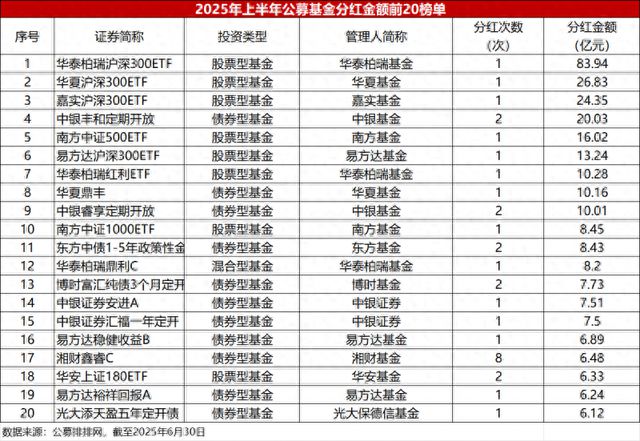
Core Viewpoint - The public fund dividend market experienced significant growth in the first half of 2025, with total dividends exceeding 127.5 billion yuan, marking a 37.53% increase compared to the same period last year [1][4]. Summary by Category Overall Market Performance - The total number of dividends distributed by public funds reached 3,533, with a total amount of 1,275.11 billion yuan, up from 927.16 billion yuan in the previous year [4][5]. - Bond funds accounted for 74.48% of the total dividend amount, demonstrating their dominant role in the market [2][4]. Fund Types - QDII funds saw an extraordinary increase, with their dividend amount rising from 0.64 million yuan to 7.94 million yuan, a growth of 1163.94% [2][5]. - Equity funds also performed well, with dividends increasing by 229.62% to 225.32 million yuan, representing 17.67% of the total [5][6]. - Mixed funds experienced a 76.94% increase in dividends, totaling 46.01 million yuan, which is 3.61% of the overall market [5]. ETF Performance - ETFs demonstrated strong capital attraction, with 13 out of 30 funds that distributed over 500 million yuan being ETFs [2][7]. - The top dividend fund was the Huatai-PB CSI 300 ETF, distributing 8.394 billion yuan, followed by the Huaxia CSI 300 ETF and the Harvest CSI 300 ETF, both exceeding 2 billion yuan [2][7]. Industry Trends - The shift from a "scale-oriented" to a "return-oriented" approach in the public fund industry is evident, driven by policy encouragement and improved market conditions [3][4]. - The increasing focus on dividends reflects a growing investor preference for realizing returns [3][5]. - The head effect in the industry is pronounced, with the top 10 fund companies accounting for 42.17% of total dividends, highlighting a trend towards market concentration [11]. Future Outlook - Market experts anticipate that the dividend trend will continue, with ETFs expected to maintain significant dividend potential as investor strategies evolve [11][12].
摩根大通:新兴市场资金流向_被动投资持续流入,主动投资远离
摩根· 2025-07-01 00:40
Investment Rating - The report indicates a neutral outlook on emerging markets (EM) equities, with a focus on the contrasting performance between ETFs and non-ETFs [1][9]. Core Insights - Emerging market equity inflows have significantly slowed to +$680 million from +$4.1 billion the previous week, primarily driven by ETF subscriptions of +$2.2 billion, while non-ETFs experienced a sell-off of -$1.5 billion [1][9]. - Year-to-date (YTD) flows for EM equities stand at -$13.6 billion, with non-ETF flows at -$33.2 billion, contrasting with ETF inflows of +$19.5 billion [1][9]. - Regional fund flows show that GEMs attracted +$1.5 billion, while Asia ex-Japan saw outflows of -$881 million, indicating regional disparities in investment trends [1][4]. Summary by Sections Overall EM Equity Flows - Total EM equity flows for the week were +$680 million, with YTD flows at -$13.6 billion [1][4]. - ETFs contributed +$2.2 billion, while non-ETFs saw a decline of -$1.5 billion [1][9]. Regional Performance - GEMs experienced inflows of +$1.5 billion, while Asia ex-Japan faced outflows of -$881 million [1][4]. - EMEA and LatAm saw marginal inflows of +$31 million and +$22 million respectively, while EM ex-China recorded redemptions of -$241 million [1][4]. Market Specifics - Taiwan attracted moderate inflows of +$1.5 billion, while India saw small inflows of +$514 million [2][4]. - South Africa and Turkey reported significant outflows of -$706 million and -$109 million respectively [2][4].
“接盘侠”没了?标普500指数季调维持成分股不变,Robinhood、Applovin应声大跌
Hua Er Jie Jian Wen· 2025-06-07 01:43
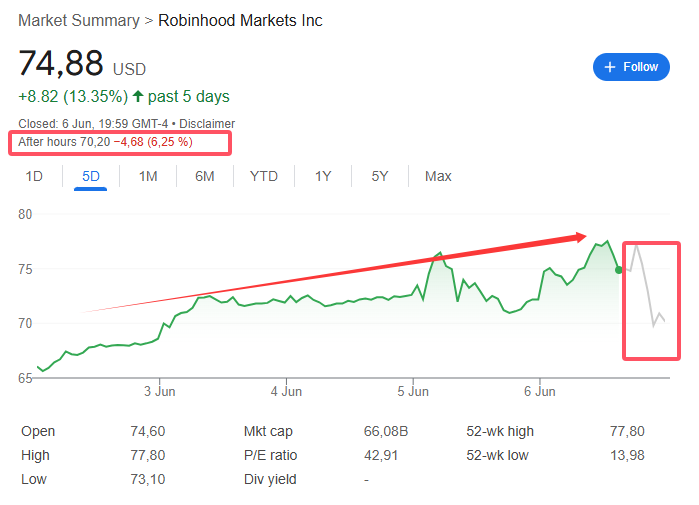
Core Viewpoint - The S&P 500 index constituents remain unchanged, disappointing investors who anticipated new additions, particularly Robinhood Markets and Applovin, which saw significant stock price fluctuations following the announcement [1][3]. Group 1: S&P 500 Index Adjustments - The S&P Dow Jones Indices announced that the S&P 500 index constituents would not change, contradicting Wall Street analysts' predictions [1]. - Robinhood Markets, a leading candidate for inclusion, experienced a 13% increase in stock price prior to the announcement but fell over 6% in after-hours trading following the news [1]. - Applovin also saw a cumulative increase of 6.52% during the week due to expectations of being added to the index, but subsequently dropped over 5% after the announcement [3]. Group 2: Inclusion Criteria and Financial Performance - Companies must meet a minimum market capitalization threshold of $20.5 billion and demonstrate profitability, liquidity, and free float requirements to qualify for inclusion in the S&P 500 [5]. - Applovin leads the list of candidates with a market cap of $135 billion, followed by Interactive Brokers at $87 billion, Robinhood at $63 billion, and Cheniere at $54 billion [6]. - Notably, MicroStrategy, with a market cap of $105 billion, may be viewed as a closed-end fund rather than an operating company, which affects its eligibility [6]. - Companies like Snowflake and Roblox, with market caps exceeding $70 billion and $61 billion respectively, were excluded due to not achieving profitability under GAAP standards [6]. Group 3: Impact of Passive Investment - Inclusion in the S&P 500 is highly attractive for company management due to the associated reputational benefits and the influx of passive investment from index funds [7]. - Index funds hold over 25% of the shares of S&P 500 constituents, making adjustments to the index increasingly significant as the size of passive investment funds grows [8]. - Recent successful additions to the S&P 500 include DoorDash, Williams-Sonoma, TKO Group Holdings, and Expand Energy, with DoorDash having a market cap of $90 billion [8]. - The smallest five S&P 500 constituents, including Caesars Entertainment and Enphase Energy, face the highest risk of being removed from the index [8].
全球视角下主动权益逆袭案例分析:份额之争:先发优势与逆袭经验
Guoxin Securities· 2025-05-25 11:49
Group 1 - The report highlights the increasing trend of passive investment globally, with passive fund management size surpassing active funds by the end of 2023, and this gap is expected to widen in 2024 [1][13][14] - In developed markets like the US, Japan, Europe, and Australia, the proportion of active funds outperforming their respective indices is generally below 40%, with long-term success rates even lower [1][14] - The report identifies key strategies for leading firms in the US, emphasizing reliance on large-cap growth and mixed funds, overall product performance, and the ability of top products to outperform market averages [1][20][44] Group 2 - In Europe, the trend of passive investment has led to a diversification of leading firms, with some actively seeking change to break through, while others see their advantages diminish [2][10] - Successful firms in Europe have demonstrated that high-quality flagship products yield better long-term returns, and the issuance of active ESG products has been beneficial [2][10] - The report notes that during bull markets, firms like Nordea have significantly outperformed, and timely strategy adjustments can help recover from short-term scale fluctuations [2][10] Group 3 - In Australia, the report indicates a clear trend of diversification in active equity, with new leading platforms like Mercer and Magellan Group emerging [3][11] - The growth of firms like Macquarie and Pendal is attributed to their focus on local and global large-cap growth strategies, with stable overall performance [3][11] - The report highlights that Magellan Group has rapidly scaled through currency-hedged products and global infrastructure strategies, while Mercer has a first-mover advantage in strategies facing scale bottlenecks [3][11] Group 4 - The report discusses Japan's unique situation where the expansion of active equity is largely driven by the growth of foreign active products, which is a distinctive feature of the Japanese market [4][12] - It attributes the success of firms like Alliance Bernstein to their alignment with local investor preferences and the performance of domestic products [4][12] - The report emphasizes that companies with better performance in local products can capture market share more effectively, with Daiwa and Sumitomo showing significant annualized returns compared to competitors [4][12]
全球ETF 狂揽 1.7 万亿美元,外资借ETF/指数基金增加中国股市投资
Morningstar晨星· 2025-03-12 09:39
2024 年全球金融市场动荡不断:主要发达市场的货币政策发生重大转向,技术革新催生新的投资 热潮,特朗普胜选、韩国政坛动荡等政治事件也在持续影响投资者信心和市场波动…… 尽管面临诸多挑战,全球投资者的热情却未因此减退,依然借道基金积极寻找着新的投资机会、 对家庭资产进行配置。 晨星最新发布的 《晨星全球公募基金及中国主题基金资金流观察》 报告显示, 2024年全球共同 基金与ETF共吸引了近2.98万亿美元的净流入资金,推动全球公募基金管理规模突破60万亿美 元,较2015年翻倍增长。 与此同时,全球基金市场的格局正随着投资者偏好的转变而悄然重塑。 2024年,ETF不仅在中国市场备受追捧,全球范围内也迎来了 "史诗级"胜利——全年净流入资金 高达1.7万亿美元,创下历史新高。 使用低成本、高透明度工具进行投资和配置,已经渐渐成为 全球投资者的共识。 在经历了连续三年遭遇净赎回后,主动基金也在 2024 年重新获得投资者的喜爱,全年获得681亿 美元的净流入。 尽管如此,从市场份额的变化来看,被动基金势不可挡,主动基金依然面临着日益严峻的挑战。 从全球的维度来看,被动基金的市场份额从 2015 年的 23% ...