新发展格局

Search documents
政协委员翟美卿:“十五五”规划为企业发展提供了历史性机遇
Nan Fang Du Shi Bao· 2025-10-23 13:40
Core Insights - The 20th Central Committee's Fourth Plenary Session outlined a development blueprint for the 15th Five-Year Plan, emphasizing the importance of economic and social development in China [1][3] Group 1: Achievements and Confidence - The summary of achievements during the 14th Five-Year Plan period has instilled confidence in businesses, highlighting China's economic resilience and potential amid complex international conditions [3][4] - The session emphasized the need to strengthen the domestic market and accelerate the construction of a new development pattern, focusing on expanding domestic demand and enhancing the interaction between consumption and investment [3][4] Group 2: Strategic Opportunities - The strategic deployment for the 15th Five-Year Plan period presents historical opportunities for businesses, particularly in focusing on the real economy and modern industrial systems [4] - The emphasis on intelligent, green, and integrated industrial directions provides clear guidance for businesses to transform and upgrade, encouraging increased R&D investment and collaboration [4] Group 3: Business Environment and Responsibilities - The session's focus on stimulating the vitality of various business entities and expanding high-level opening-up is expected to improve the business environment, making it more stable, fair, and transparent [4] - Companies are encouraged to align their development with national strategies, promote common prosperity, and engage in green development while fulfilling social responsibilities [4]


中共第二十届中央委员会第四次全体会议公报
Xin Hua She· 2025-10-23 13:04
新华社北京10月23日电 中国共产党第二十届中央委员会第四次全体会议公报 (2025年10月23日中国共产党第二十届中央委员会第四次全体会议通过) 中国共产党第二十届中央委员会第四次全体会议,于2025年10月20日至23日在北京举行。 全会强调,"十五五"时期经济社会发展,必须坚持马克思列宁主义、毛泽东思想、邓小平理论、"三个 代表"重要思想、科学发展观,全面贯彻习近平新时代中国特色社会主义思想,深入贯彻党的二十大和 二十届历次全会精神,围绕全面建成社会主义现代化强国、实现第二个百年奋斗目标,以中国式现代化 全面推进中华民族伟大复兴,统筹推进"五位一体"总体布局,协调推进"四个全面"战略布局,统筹国内 国际两个大局,完整准确全面贯彻新发展理念,加快构建新发展格局,坚持稳中求进工作总基调,坚持 以经济建设为中心,以推动高质量发展为主题,以改革创新为根本动力,以满足人民日益增长的美好生 活需要为根本目的,以全面从严治党为根本保障,推动经济实现质的有效提升和量的合理增长,推动人 的全面发展、全体人民共同富裕迈出坚实步伐,确保基本实现社会主义现代化取得决定性进展。 全会指出,"十五五"时期经济社会发展必须遵循以下原 ...
“十五五”,这么干
中国基金报· 2025-10-23 11:07
Core Views - The "15th Five-Year Plan" period is crucial for achieving socialist modernization and serves as a transitional phase [3] - The main goals for the "15th Five-Year Plan" period include adherence to the Party's leadership, prioritizing the people, promoting high-quality development, and deepening reforms [4] Economic and Social Development Principles - Economic and social development during the "15th Five-Year Plan" must follow several principles, including effective market and proactive government collaboration, and balancing development with security [4] Achievements and Future Goals - Significant progress has been made in high-quality development, technological self-reliance, social civilization, and improving people's living standards, with a goal to elevate economic and technological strength by 2035 [5] Key Initiatives Proposed - Establish a modern industrial system to strengthen the foundation of the real economy - Accelerate high-level technological self-reliance to lead new productive forces - Build a strong domestic market and create a new development pattern - Enhance the socialist market economy system to boost high-quality development - Expand high-level opening up to foster win-win cooperation - Promote agricultural modernization and rural revitalization - Optimize regional economic layout for coordinated development - Stimulate cultural innovation and development of socialist culture - Increase efforts to improve people's livelihoods and promote common prosperity - Advance comprehensive green transformation for a beautiful China - Modernize national security systems and capabilities for a safer China - Achieve the centenary goals of the military and advance defense modernization [6]
中国共产党第二十届中央委员会第四次全体会议公报
国家能源局· 2025-10-23 09:37
Core Viewpoint - The Fourth Plenary Session of the 20th Central Committee of the Communist Party of China emphasizes the importance of achieving socialist modernization and outlines the strategic goals and principles for the upcoming "15th Five-Year Plan" period, focusing on high-quality development, technological self-reliance, and comprehensive reforms [4][6][8]. Summary by Sections Achievements and Challenges - The session acknowledges significant achievements during the "14th Five-Year Plan" period, highlighting resilience against international challenges and the COVID-19 pandemic, leading to new major accomplishments in national development [5]. - It recognizes the complex and changing environment for development, balancing strategic opportunities with risks and uncertainties [6]. Strategic Goals for the "15th Five-Year Plan" - The main goals include achieving high-quality development, enhancing technological independence, and improving social civilization and living standards by 2035 [8]. - The plan aims for a significant increase in economic, technological, and national defense strength, with a target of reaching the income levels of moderately developed countries [8]. Economic Development Principles - The session emphasizes principles such as the Party's leadership, prioritizing people, high-quality development, comprehensive reforms, and balancing development with security [7]. - It stresses the importance of a modern industrial system, focusing on the real economy and promoting intelligent, green, and integrated development [8][9]. Technological and Market Development - Accelerating technological self-reliance is highlighted as crucial for leading new productive forces, with a focus on innovation and integration of education, technology, and talent [9]. - The session calls for building a strong domestic market and enhancing the socialist market economy to support high-quality development [9][10]. Rural and Regional Development - The importance of modernizing agriculture and rural areas is emphasized, with a focus on urban-rural integration and improving living conditions in rural areas [10]. - The session advocates for optimizing regional economic layouts to promote coordinated development across regions [10]. Cultural and Social Development - The need to stimulate cultural innovation and improve the quality of life for citizens is stressed, with a commitment to common prosperity and enhancing public services [11][12]. - Environmental sustainability is prioritized, with goals for green transformation and ecological safety [12]. National Security and Governance - The session underscores the modernization of the national security system and the importance of maintaining social stability and public safety [12][15]. - It emphasizes the need for effective governance and the Party's self-reform to ensure robust economic and social development [14]. Conclusion - The session concludes with a call for unity among the Party and the people to achieve the goals set forth in the "15th Five-Year Plan," reinforcing the commitment to socialist modernization and national rejuvenation [16].
中国共产党第二十届中央委员会第四次全体会议公报:加快建设新型能源体系
中关村储能产业技术联盟· 2025-10-23 09:27
文 | 新华社 中国共产党第二十届中央委员会第四次全体会议公报 (2025年10月23日中国共产党第二十届中央委员会第四次全体会议通过) 中国共产党第二十届中央委员会第四次全体会议,于2025年10月20日至23日在北京举行。 出席这次全会的有,中央委员168人,候补中央委员147人。中央纪律检查委员会常务委员会委员和有关方面负责同志列席会议。党的二十大代表中 部分基层同志和专家学者也列席了会议。 全会由中央政治局主持。中央委员会总书记习近平作了重要讲话。 全会听取和讨论了习近平受中央政治局委托所作的工作报告, 审议通过了《中共中央关于制定国民经济和社会发展第十五个五年规划的建议》。 习 近平就《建议(讨论稿)》向全会作了说明。 全会充分肯定党的二十届三中全会以来中央政治局的工作。一致认为,中央政治局认真落实党的二十大和二十届历次全会精神,坚持稳中求进工作 总基调,完整准确全面贯彻新发展理念,统筹推进"五位一体"总体布局,协调推进"四个全面"战略布局,统筹国内国际两个大局,统筹发展和安 全,进一步全面深化改革,扎实推动高质量发展,推进社会主义民主法治建设,加强宣传思想文化工作,切实抓好民生保障和生态环境保护, ...
二十届四中全会公报
中国基金报· 2025-10-23 09:16
来源:新华社 中国共产党第二十届中央委员会第四次全体会议公报 量办好自己的事,续写经济快速发展和社会长期稳定两大奇迹新篇章,奋力开创中国式现代化建设新局 面。 全会强调,"十五五"时期经济社会发展,必须坚持马克思列宁主义、毛泽东思想、邓小平理论、"三个 代表"重要思想、科学发展观,全面贯彻习近平新时代中国特色社会主义思想,深入贯彻党的二十大和 二十届历次全会精神,围绕全面建成社会主义现代化强国、实现第二个百年奋斗目标,以中国式现代化 全面推进中华民族伟大复兴,统筹推进"五位一体"总体布局,协调推进"四个全面"战略布局,统筹国内 国际两个大局,完整准确全面贯彻新发展理念,加快构建新发展格局,坚持稳中求进工作总基调,坚持 以经济建设为中心,以推动高质量发展为主题,以改革创新为根本动力,以满足人民日益增长的美好生 活需要为根本目的,以全面从严治党为根本保障,推动经济实现质的有效提升和量的合理增长,推动人 的全面发展、全体人民共同富裕迈出坚实步伐,确保基本实现社会主义现代化取得决定性进展。 全会指出,"十五五"时期经济社会发展必须遵循以下原则,坚持党的全面领导,坚持人民至上,坚持高 质量发展,坚持全面深化改革,坚持有 ...

加快建设新型能源体系!二十届四中全会公报发布
Xin Hua She· 2025-10-23 09:15
Core Points - The Fourth Plenary Session of the 20th Central Committee of the Communist Party of China was held from October 20 to 23, 2025, in Beijing, focusing on the development of the 15th Five-Year Plan [1] - The session emphasized the importance of achieving high-quality development and the need for continuous efforts to realize socialist modernization [4][5] Group 1: Achievements and Goals - The session recognized significant achievements during the 14th Five-Year Plan period, highlighting the resilience of the economy and advancements in various sectors despite global challenges [3] - The main goals for the 15th Five-Year Plan include substantial improvements in high-quality development, technological self-reliance, and social progress by 2035 [6] Group 2: Economic and Social Development Strategies - The session outlined strategies for economic and social development, emphasizing the need for a modern industrial system and the importance of the real economy [6][7] - It called for the acceleration of high-level technological self-reliance and the construction of a strong domestic market to enhance economic resilience [7][8] Group 3: Governance and Policy Framework - The session stressed the importance of adhering to Marxist principles and the need for comprehensive reforms to ensure effective governance and high-quality development [5][12] - It highlighted the necessity of maintaining party leadership and enhancing the party's capacity to lead economic and social development [11][12] Group 4: Social Welfare and Environmental Sustainability - The session emphasized improving people's livelihoods and promoting common prosperity as key objectives, alongside enhancing public services and social security systems [9][12] - It also focused on green transformation and ecological protection, aiming for a sustainable development model that balances economic growth with environmental stewardship [9][10]
受权发布|中国共产党第二十届中央委员会第四次全体会议公报
Xin Hua She· 2025-10-23 09:07
Core Points - The Fourth Plenary Session of the 20th Central Committee of the Communist Party of China was held from October 20 to 23, 2025, in Beijing, focusing on the development goals and strategies for the upcoming "15th Five-Year Plan" period [1][2] Group 1: Economic Development - The session emphasized the importance of achieving high-quality development and enhancing self-reliance in technology during the "15th Five-Year Plan" period [6][7] - It highlighted the need to build a modern industrial system, focusing on strengthening the real economy and promoting advanced manufacturing [6] - The session called for the expansion of domestic demand and the construction of a new development pattern, emphasizing the interaction between supply and demand [7][8] Group 2: Social and Cultural Development - The meeting stressed the importance of cultural innovation and the development of socialist culture, aiming to enhance the influence of Chinese civilization [9] - It underscored the need to improve people's livelihoods and promote common prosperity, addressing urgent social issues and enhancing public services [9][12] Group 3: National Security and Governance - The session called for the modernization of the national security system and capabilities, ensuring social stability and public safety [10][13] - It emphasized the importance of effective governance and the need for a strong party leadership to ensure economic and social development [11][12] Group 4: Environmental Sustainability - The meeting highlighted the necessity of a comprehensive green transformation in economic and social development, aiming for ecological security and sustainable growth [9][12]
受权发布丨中国共产党第二十届中央委员会第四次全体会议公报
Xin Hua Wang· 2025-10-23 09:05
Core Points - The Fourth Plenary Session of the 20th Central Committee of the Communist Party of China was held from October 20 to 23, 2025, in Beijing, with 168 Central Committee members and 147 alternate members in attendance [1] - General Secretary Xi Jinping delivered an important speech, emphasizing the need for high-quality development and the implementation of the 15th Five-Year Plan [2][5] - The session highlighted significant achievements during the 14th Five-Year period, noting the resilience of the economy and the progress towards modernization [3][4] Economic Development - The 15th Five-Year period is deemed crucial for solidifying the foundation for socialist modernization, with a focus on high-quality development and addressing complex domestic and international challenges [4][6] - The session outlined principles for economic development, including the importance of the Party's leadership, prioritizing people, and ensuring high-quality growth [6][7] - Major goals for the 15th Five-Year period include significant improvements in high-quality development, technological self-reliance, and enhanced social welfare [6][8] Innovation and Market Development - Emphasis was placed on accelerating technological self-reliance and innovation, integrating education, technology, and talent development [7][8] - The session called for the construction of a strong domestic market and the promotion of a new development pattern, focusing on expanding domestic demand and enhancing supply [7][8] Social and Cultural Development - The session stressed the importance of cultural innovation and the promotion of socialist culture, aiming to enhance the influence of Chinese civilization [9] - It highlighted the need for improving people's livelihoods and promoting common prosperity, addressing urgent social issues and enhancing public services [9][10] Environmental and Security Measures - The session underscored the necessity of a green transformation in economic and social development, aiming for ecological safety and sustainable growth [10] - It emphasized the modernization of the national security system and the importance of maintaining social stability and safety [10][13] Party Leadership and Governance - The session reiterated the importance of the Party's self-revolution and strict governance to ensure effective leadership in economic and social development [11][12] - It called for unity among the Party and the people to achieve the goals set for the 15th Five-Year Plan, emphasizing the need for comprehensive governance and stability [11][12]
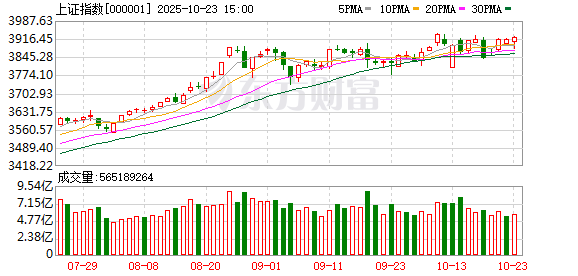
资金蜂拥进场 A股尾盘突然强劲拉升!发生了什么?
Mei Ri Jing Ji Xin Wen· 2025-10-23 08:29
Market Overview - The A-share market opened lower but rebounded strongly in the afternoon, with all three major indices closing higher. The Shanghai Composite Index rose by 0.22%, the Shenzhen Component Index increased by 0.22%, and the ChiNext Index gained 0.09% [2][4] - Nearly 3,000 stocks rose, with over 70 stocks hitting the daily limit up. Sectors such as coal, energy, cultural media, shipping ports, chemical fiber, and diversified finance saw significant gains, while engineering machinery, mining, non-metallic materials, and biological products experienced declines [2] Sector Performance - The technology sector showed strong performance, particularly with new and recently listed stocks acting as a barometer for market sentiment. Notable performers included Jianfa Zhixin, which hit the daily limit up, and other stocks like Haocreator and Yunhan Xincheng, which rose over 10% [6] - Yunhan Xincheng, a leading B2B online marketplace for electronic components, saw its stock price double since its listing on September 30, from an initial price of 27 CNY to a closing price of 116.8 CNY on its first day, and further increased to 237.11 CNY [6][7] Coal Sector Insights - The coal sector experienced a surge, with several stocks hitting the daily limit up, including Shanxi Coking Coal and Yunnan Coal Energy. The recent tightening of supply and rising demand due to cooler weather contributed to this trend [12] - As of October 17, 2025, the price of Q5500 thermal coal at Qinhuangdao Port reached 748 CNY per ton, a week-on-week increase of 43 CNY. Analysts expect coal prices to rise further, with a target price adjustment to 750-800 CNY per ton due to limited supply and increased demand for heating [12] - Investment opportunities in the coal sector are viewed positively for the fourth quarter, with expectations of limited supply growth and potential price recovery as demand increases [12]