
乡村全面振兴

Search documents
中华全国供销合作社第八次代表大会召开
Ren Min Ri Bao· 2025-11-24 22:31
Core Points - The conference of the All-China Federation of Supply and Marketing Cooperatives emphasized the importance of implementing Xi Jinping's directives and the resolutions from the 20th Central Committee, focusing on the development of supply and marketing cooperatives [1] - Liu Guozhong highlighted the contributions of the supply and marketing cooperative system in ensuring national food security, consolidating poverty alleviation achievements, and promoting urban-rural integration since the last representative conference [1] - The "14th Five-Year Plan" period presents higher demands and broader opportunities for the modernization of agriculture and rural areas, necessitating enhanced service capabilities for farmers [1] Group 1 - The conference was attended by key officials, including the Vice Chairman of the National People's Congress and the Vice Chairman of the National Committee of the Chinese People's Political Consultative Conference [2] Group 2 - Liu Guozhong called for strengthening the Party's leadership and ensuring the fundamental purpose of serving farmers, while promoting comprehensive reforms and self-improvement within the cooperatives [1]
中华全国供销合作社第八次代表大会召开 刘国中出席会议并讲话
Xin Hua She· 2025-11-24 12:02
Core Points - The National Cooperative Federation of China held its eighth representative conference, emphasizing the importance of implementing Xi Jinping's directives on cooperative work and the resolutions from the 20th Central Committee [1] - Liu Guozhong highlighted the contributions of the cooperative system in ensuring national food security, consolidating poverty alleviation achievements, and promoting urban-rural integration [1] Group 1 - The conference focused on deepening comprehensive reforms to enhance vitality and promote high-quality development in the cooperative sector [1] - Liu Guozhong called for adherence to the Party's leadership and emphasized the need to improve services for farmers, aligning with the goal of building an agricultural powerhouse [1] - The "14th Five-Year Plan" period presents higher demands and broader opportunities for agricultural modernization and rural revitalization [1] Group 2 - The cooperative system has effectively utilized its unique advantages and played a significant role in various national initiatives since the seventh representative conference [1] - There is a call for problem-oriented approaches and tailored guidance to ensure the depth and effectiveness of reforms [1] - Strengthening organizational leadership and increasing policy support are essential for creating a favorable environment for the development of cooperatives [1]
力求一把钥匙开一把锁
Jing Ji Ri Bao· 2025-11-24 00:08
Core Insights - The importance of village planning in promoting comprehensive rural revitalization is increasingly highlighted, emphasizing strategic layout and scientific integration of resources rather than mere infrastructure development [1][2] - Effective planning should be based on a deep understanding of the village's strengths and weaknesses, clearly defining its industrial direction, functional positioning, and development path to achieve sustainable growth [1][2] Group 1 - Village planning must be tailored to local conditions, avoiding a one-size-fits-all approach to prevent loss of regional, resource, and cultural characteristics [1][2] - The phenomenon of "planning conflicts" often arises from a lack of accurate understanding of the village's actual situation, leading to ineffective strategies [1][2] Group 2 - Conducting in-depth research and precise positioning is crucial for effective village planning, requiring planners to engage with the community and understand local attributes, industry status, population structure, cultural heritage, and challenges [2] - The principle of "people first, co-construction and sharing" should guide rural revitalization efforts, ensuring that planning reflects the needs and aspirations of farmers to foster strong collaborative implementation [2]
美丽乡村“一张蓝图绘到底”
Jing Ji Ri Bao· 2025-11-23 22:00
Core Viewpoint - The article emphasizes the importance of tailored village planning in rural revitalization, highlighting Chongqing's innovative approach to classify and optimize village planning to address diverse rural needs and enhance overall development [1][2]. Group 1: Village Planning Reform - Chongqing has initiated a classification governance reform for village planning, moving from a broad "one-size-fits-all" approach to a more precise and tailored strategy [1][3]. - The reform focuses on four key directions: practicality, uniqueness, collaboration, and sharing, which have significantly improved the effectiveness of village planning [1][3]. - The city has categorized all administrative villages and agricultural communities into four types: key planning, characteristic planning, stable development, and natural shrinkage, to better align planning with local conditions [3][4]. Group 2: Implementation and Outcomes - The implementation of comprehensive village planning has led to tangible improvements in villages like Shengtian, where infrastructure and economic activities have been revitalized, resulting in increased collective income and tourism [2][3]. - In Longhu Village, the establishment of a hot spring resort has generated significant tourism revenue, demonstrating the economic potential of well-planned rural projects [5][6]. - The integration of village planning with land policies has enhanced resource allocation and project implementation, as seen in the successful expansion of infrastructure in villages like Jiangjun [6][7]. Group 3: Cross-Boundary Planning - Chongqing has adopted cross-boundary planning strategies to overcome fragmentation in rural development, allowing for resource sharing and collaborative growth among neighboring villages [9][10]. - The implementation of a regional planning approach has improved land use efficiency and increased the overall value of rural areas, as evidenced by the significant reduction in land fragmentation and improved accessibility [10][11]. Group 4: Digital Empowerment - The integration of digital technologies in village planning has improved the transparency and effectiveness of the planning process, enabling better community engagement and participation [12][13]. - Tools such as 3D visualization and mobile applications have facilitated easier access to planning information for villagers, enhancing their involvement in the planning and governance processes [13][14].
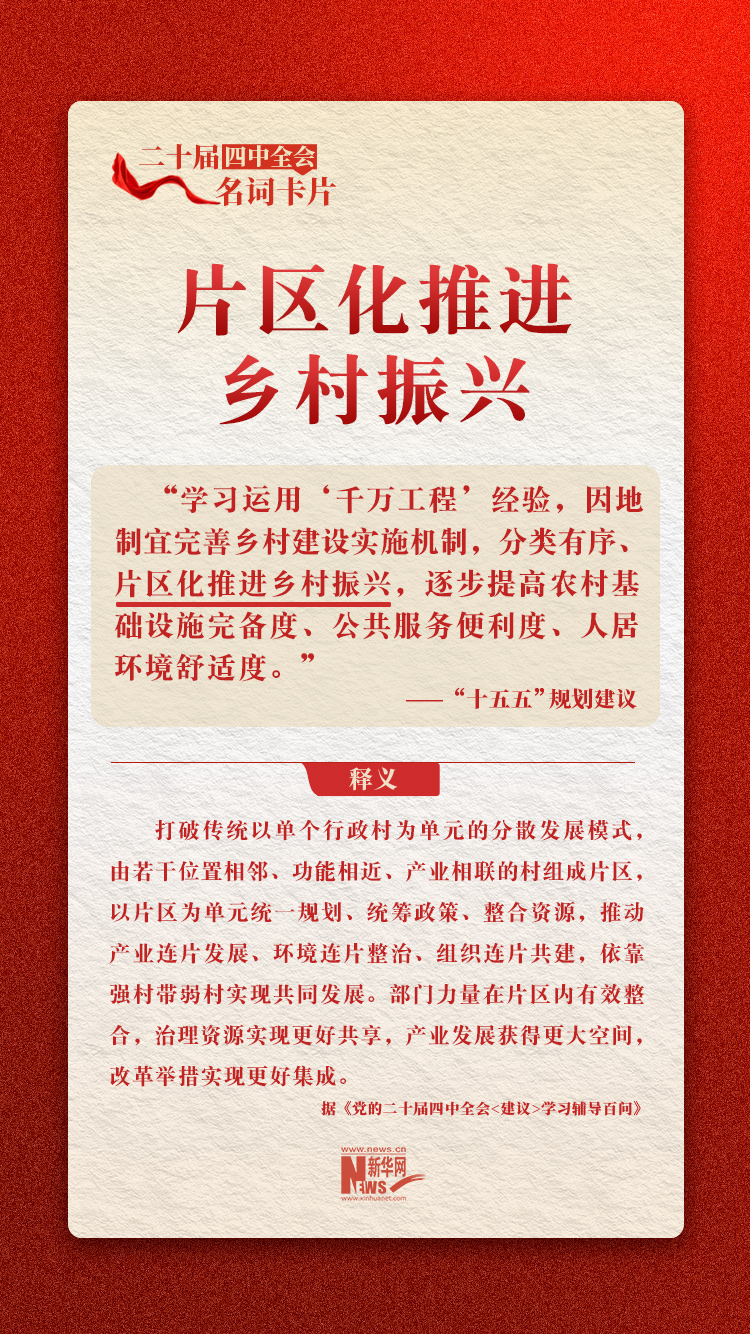
二十届四中全会名词卡片:片区化推进乡村振兴
Xin Hua Wang· 2025-11-23 13:54
Group 1 - The core idea of the article emphasizes the need for a systematic and categorized approach to rural revitalization, moving away from the traditional model of isolated village development to a more integrated, area-based strategy [2][3][6]. - The "14th Five-Year Plan" suggests leveraging the "Ten Million Project" experience to enhance rural infrastructure, public services, and living environments through orderly and categorized advancement [2][6]. - The article outlines a classification system for villages, focusing on different development strategies based on their characteristics, such as enhancing industrial development in clustered villages and promoting urban-rural integration in suburban villages [6][7]. Group 2 - The area-based approach to rural revitalization involves grouping adjacent villages with similar functions and industries to promote coordinated planning, resource integration, and collective development [3][7]. - It is crucial to respect farmers' opinions and ensure their rights are protected while implementing area-based strategies, avoiding a one-size-fits-all approach [7]. - The article stresses the importance of practical effectiveness and the role of market mechanisms in the area-based advancement of rural revitalization, advocating for a gradual and thoughtful implementation process [7].

服务“农创客”贵在精准
Jing Ji Ri Bao· 2025-11-22 21:57
Core Viewpoint - The recent rural investment promotion meeting in Hangzhou's Yuhang District effectively connected local rural areas with "agricultural entrepreneurs," addressing their needs and fostering innovation in rural entrepreneurship [1][2]. Group 1: Agricultural Entrepreneurs - "Agricultural entrepreneurs" are defined as young talents under 45 years old who have graduated from university and are starting businesses in rural areas, characterized by high education, youth, and innovation [1]. - Various regions have implemented policy support and organized innovation and entrepreneurship competitions to attract "agricultural entrepreneurs," but challenges such as lack of local adaptation and sustainability of projects remain [1]. Group 2: Solutions and Strategies - To address the issues faced by "agricultural entrepreneurs," it is essential to align with local characteristics and promote the integration of entrepreneurial talent with rural industries, thereby stimulating innovation and entrepreneurship in rural areas [1]. - Precise matching of supply and demand is crucial, as many rural areas possess abundant industrial resources. Solutions include enhancing communication, clarifying local specialties, and creating interactive platforms for better resource matching [1]. - A comprehensive service system is necessary to support "agricultural entrepreneurs," including financial support, technical assistance, and establishing partnerships with educational institutions to tackle industry challenges [2]. Group 3: Rural Revitalization - The overall revitalization of rural areas calls for innovative talent, with an emphasis on tailored support to ensure that development opportunities take root and flourish in the countryside [2].
王小洪在陕西宁夏调研时强调深入学习贯彻党的二十届四中全会精神坚决实现全年经济社会发展目标
Shan Xi Ri Bao· 2025-11-22 00:41
Core Points - The emphasis on implementing the spirit of the 20th Central Committee's Fourth Plenary Session and ensuring the achievement of annual economic and social development goals [1][2] Group 1 - The focus on deepening reforms and implementing the policies of the Central Government to promote the development of the western region [2] - The commitment to expand institutional openness and enhance the construction of the Western Land-Sea New Corridor [2] - The importance of technological innovation and the transformation of traditional industries while actively developing emerging industries [2] Group 2 - The need for strict legal measures against violations of enterprises' legal rights and the enhancement of intellectual property protection [2] - The promotion of rural revitalization through the cultivation of characteristic rural industries to ensure stable income for farmers [2] - The integration of development and security, emphasizing the importance of national security and social governance [2]
王小洪在陕西宁夏调研时强调 深入学习贯彻党的二十届四中全会精神 坚决实现全年经济社会发展目标
Xin Hua She· 2025-11-21 11:33
Group 1 - The core message emphasizes the importance of implementing the decisions made by the Central Committee and the State Council, maintaining strategic determination, and ensuring the achievement of economic and social development goals for the year [1] Group 2 - The focus is on the need for comprehensive reform and the implementation of policies related to the Western Development strategy, aiming for breakthroughs in deepening reforms [2] - There is a strong emphasis on expanding institutional openness and promoting the construction of the Western Land-Sea New Corridor, as well as high-quality participation in the Belt and Road Initiative [2] - The strategy includes leading with technological innovation, supporting the transformation of traditional industries, and actively developing emerging industries while laying out future industries [2] - There is a commitment to protecting the legal rights of enterprises and enhancing intellectual property rights protection to create a law-based business environment [2] - The initiative aims to cultivate and expand rural characteristic industries to ensure stable income growth for farmers and promote comprehensive rural revitalization [2] - The approach stresses the importance of balancing development and security, enhancing risk prevention capabilities, and improving social governance and public safety [2]
持续深入学习运用“千万工程”经验
Qi Huo Ri Bao Wang· 2025-11-20 01:03
Core Points - The meeting emphasized the importance of learning and applying the "Ten Million Project" experience to promote comprehensive rural revitalization [1] - Liu Guozhong highlighted the need to respect the primary role of farmers and focus on practical, beneficial projects that align with public sentiment [1] - The strategy includes improving village planning quality, enhancing rural governance, and ensuring stable income growth for farmers [1] Summary by Categories Policy Implementation - The meeting aimed to implement Xi Jinping's important discussions and directives regarding "Three Rural Issues" and the resolutions from the 20th Central Committee [1] - The "Ten Million Project" serves as a guiding framework for accelerating agricultural modernization and advancing rural revitalization [1] Strategic Focus - Emphasis on tailored, precise policies that avoid performance-driven or superficial projects [1] - The need for a coordinated approach to enhance rural industries, construction, and governance, promoting the "Five Revitalizations" [1] Agricultural Development - A call to improve grain production capacity and the quality and efficiency of specialty industries to solidify the foundation for rural revitalization [1] - The importance of regular, targeted assistance to prevent large-scale poverty and ensure sustainable income for farmers [1] On-Site Investigation - Liu Guozhong conducted an on-site investigation of the "Ten Million Project" implementation in Jiaxing City during the meeting [2]
突出重点扎实推进乡村全面振兴
Jing Ji Ri Bao· 2025-11-20 00:41
Core Viewpoint - The implementation of the rural revitalization strategy is a significant decision made by the Central Committee of the Communist Party of China, focusing on modernizing agriculture and rural areas to better promote Chinese-style modernization [1] Group 1: Agricultural Supply and Security - The central government emphasizes enhancing the supply guarantee capacity for grain and important agricultural products, with a projected grain output of over 1.4 trillion jin in 2024, achieving a per capita grain availability of 500 kg, surpassing the international safety line of 400 kg [1] - The government aims to ensure basic self-sufficiency in grains and absolute safety in staple food amidst various challenges, including international dynamics and resource constraints [1] Group 2: Agricultural Technology and Productivity - Focus on improving seed and arable land management, promoting collaboration between research and application to enhance breeding results and land quality [2] - The agricultural labor productivity is significantly lower than non-agricultural sectors, with the primary industry accounting for 22.2% of employment but only 6.8% of GDP in 2024, indicating a need for reform and modernization [3] Group 3: Rural Development and Integration - The strategy emphasizes urban-rural integration to address the imbalance in development, with a focus on enhancing public services and infrastructure in rural areas [5][6] - Establishing a regular assistance mechanism for low-income rural populations and underdeveloped regions to prevent large-scale poverty [6][7] Group 4: Resource Allocation and Talent Development - The need for systematic thinking in resource allocation to enhance the efficiency of financial resources and ensure land use for key projects [7][8] - Emphasis on cultivating rural talent and attracting skilled individuals to support the revitalization efforts, highlighting the importance of human resources in rural development [8]