
全社会用电量

Search documents
国家能源局:截至10月底全国累计发电装机容量37.5亿千瓦
Zhong Guo Zheng Quan Bao· 2025-11-25 00:03
Core Insights - The National Energy Administration reported that as of October 2023, the total installed power generation capacity in China reached 3.75 billion kilowatts, marking a year-on-year increase of 17.3% [1] - Solar power generation capacity reached 1.14 billion kilowatts, with a significant year-on-year growth of 43.8%, while wind power capacity reached 590 million kilowatts, growing by 21.4% [1] - Total electricity consumption in China for the first ten months of 2023 was 86,246 billion kilowatt-hours, reflecting a year-on-year increase of 5.1% [1] Installed Capacity - Total installed power generation capacity: 3.75 billion kilowatts, up 17.3% year-on-year [1] - Solar power capacity: 1.14 billion kilowatts, up 43.8% year-on-year [1] - Wind power capacity: 590 million kilowatts, up 21.4% year-on-year [1] Electricity Consumption - Total electricity consumption: 86,246 billion kilowatt-hours, up 5.1% year-on-year [1] - Electricity consumption by primary industry: 1,262 billion kilowatt-hours, up 10.5% year-on-year [1] - Electricity consumption by secondary industry: 54,781 billion kilowatt-hours, up 3.7% year-on-year, with industrial electricity consumption increasing by 3.9% [1] - Electricity consumption by tertiary industry: 16,671 billion kilowatt-hours, up 8.4% year-on-year, with rapid growth in electric vehicle charging services and information technology services [1] Sector-Specific Insights - The third industry continues to show strong growth in electricity consumption, particularly in the electric vehicle charging sector [2] - Internet data services within the information transmission and software sector saw a year-on-year increase in electricity consumption of 43.2% [2] - The wholesale and retail sector's electric vehicle charging services experienced a year-on-year growth of 47.0% [2]
国家能源局数据显示 截至10月底全国累计发电装机容量37.5亿千瓦
Zhong Guo Zheng Quan Bao· 2025-11-24 20:16
Core Insights - The National Energy Administration reported that as of the end of October, the total installed power generation capacity in China reached 3.75 billion kilowatts, representing a year-on-year growth of 17.3% [1] - Solar power generation capacity reached 1.14 billion kilowatts, with a significant year-on-year increase of 43.8%, while wind power capacity reached 590 million kilowatts, growing by 21.4% [1] - Total electricity consumption in China for the first ten months was 86,246 billion kilowatt-hours, reflecting a year-on-year increase of 5.1% [1] Installed Capacity - Total installed power generation capacity: 3.75 billion kilowatts, up 17.3% year-on-year [1] - Solar power capacity: 1.14 billion kilowatts, up 43.8% year-on-year [1] - Wind power capacity: 590 million kilowatts, up 21.4% year-on-year [1] Electricity Consumption - Total electricity consumption: 86,246 billion kilowatt-hours, up 5.1% year-on-year [1] - Electricity consumption by the primary industry: 1,262 billion kilowatt-hours, up 10.5% year-on-year [1] - Electricity consumption by the secondary industry: 54,781 billion kilowatt-hours, up 3.7% year-on-year, with industrial electricity consumption increasing by 3.9% [1] - Electricity consumption by the tertiary industry: 16,671 billion kilowatt-hours, up 8.4% year-on-year, with rapid growth in the charging and swapping service industry and information transmission, software, and IT services [1] Sector-Specific Insights - The charging and swapping service industry experienced a significant increase in electricity consumption, with the internet data service sector growing by 43.2% year-on-year [2] - The wholesale and retail sector's charging and swapping service industry saw a year-on-year increase of 47.0% in electricity consumption [2]
翻倍牛股,实控人筹划重大事项
Zhong Guo Zheng Quan Bao· 2025-11-22 00:21
Group 1: Government Policies and Regulations - The Ministry of Finance announced that starting from June 2026, personal pension savings bonds (electronic) will be included in the range of personal pension products, allowing pension investors to purchase these bonds through designated institutions [1] - The China Securities Regulatory Commission (CSRC) stated that H-share accounting firms will undergo comprehensive evaluations annually, and those failing to meet basic requirements will have their recommendations withdrawn [1] Group 2: Company News - Chaozhuo Aerospace announced that due to significant matters being planned by its controlling shareholders, the company's stock will be suspended from trading starting November 24, with an expected suspension period of no more than two trading days [3] - Shandong Road and Bridge announced plans for its subsidiaries to participate in the bidding for a highway construction project with an estimated contract value of 10.2 billion yuan, with a maximum investment commitment of 1.457 billion yuan from its subsidiaries [3] - Hesheng New Materials disclosed a share transfer agreement where its controlling shareholders will transfer 44.66 million shares (18% of total shares) to Shanghai Moer Zhixin at a price of 33.71 yuan per share, resulting in a change of control [4] - *ST Zhongzhuang announced a restructuring plan involving a capital increase of approximately 990 million shares, with 740 million shares allocated for introducing restructuring investors and 250 million shares for debt repayment [5] - *ST Sansheng received court approval for its restructuring plan, which will enter the execution phase, potentially improving its financial structure and operational sustainability [5] - Tiandi Online decided to terminate its asset acquisition and fundraising plans due to market conditions, ensuring no significant adverse impact on its main business [6] - Saiwei Electronics reported abnormal stock trading due to a cumulative price increase exceeding 30% over three trading days, linked to a proposed acquisition of shares in Beijing Xindonglai Semiconductor Technology [6][7] - Dajin Heavy Industry announced a contract worth approximately 1.339 billion yuan for exclusive supply related to an offshore wind farm project, representing 35.41% of its audited revenue for 2024 [8]
10月全社会用电量同比增长10.4% 创今年月度增速新高
Ren Min Ri Bao· 2025-11-21 22:24
Core Insights - In October, the total electricity consumption reached 857.2 billion kilowatt-hours, marking a year-on-year growth of 10.4%, the highest monthly growth rate this year [1] Industry Breakdown - The primary industry consumed 12 billion kilowatt-hours, with a year-on-year increase of 13.2% [1] - The secondary industry consumed 568.8 billion kilowatt-hours, showing a year-on-year growth of 6.2%, with industrial electricity consumption increasing by 6.4% [1] - The tertiary industry consumed 160.9 billion kilowatt-hours, reflecting a year-on-year growth of 17.1% [1] - Urban and rural residential electricity consumption reached 115.5 billion kilowatt-hours, with a significant year-on-year increase of 23.9% [1] Sector Highlights - Within the secondary industry, high-tech and equipment manufacturing saw a year-on-year electricity consumption increase of 11.0% [1] - In the tertiary industry, the wholesale and retail sector, as well as the information transmission/software and IT services sector, experienced year-on-year growth rates of 24.4% and 21.0%, respectively [1] Year-to-Date Performance - From January to October, total electricity consumption accumulated to 8,624.6 billion kilowatt-hours, with a year-on-year growth of 5.1% [1] - By industry, the primary, secondary, and tertiary sectors saw year-on-year growth rates of 10.5%, 3.7%, and 8.4%, respectively, while urban and rural residential electricity consumption grew by 6.9% [1]
10月全社会用电量同比增长10.4%
Ren Min Ri Bao· 2025-11-21 22:12
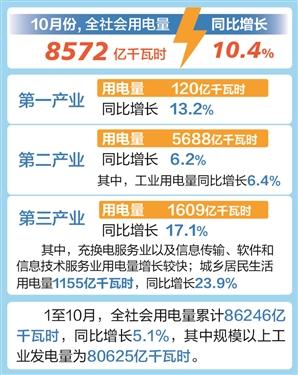
Core Insights - In October, the total electricity consumption in China reached 8,572 billion kilowatt-hours, marking a year-on-year growth of 10.4%, the highest monthly growth rate of the year [1] Industry Breakdown - The primary industry consumed 120 billion kilowatt-hours, with a year-on-year increase of 13.2% [1] - The secondary industry consumed 5,688 billion kilowatt-hours, showing a year-on-year growth of 6.2%, with industrial electricity consumption increasing by 6.4% [1] - The tertiary industry consumed 1,609 billion kilowatt-hours, reflecting a year-on-year growth of 17.1% [1] - Urban and rural residential electricity consumption reached 1,155 billion kilowatt-hours, with a significant year-on-year increase of 23.9% [1] Sector Highlights - Within the secondary industry, high-tech and equipment manufacturing saw a year-on-year electricity consumption increase of 11.0% [1] - In the tertiary industry, the wholesale and retail sector, as well as the information transmission/software and IT services sector, experienced year-on-year growth rates of 24.4% and 21.0%, respectively [1] Cumulative Data - From January to October, the total electricity consumption accumulated to 86,246 billion kilowatt-hours, representing a year-on-year growth of 5.1% [1] - By industry, the first, second, and third industries saw year-on-year growth rates of 10.5%, 3.7%, and 8.4%, respectively, while urban and rural residential electricity consumption grew by 6.9% [1]
时报数说 | 10月份全社会用电量同比增长10.4%
Zheng Quan Shi Bao· 2025-11-21 16:38
Core Viewpoint - The article discusses the recent trends and developments in the investment banking sector, highlighting key financial metrics and market dynamics that could influence future investment opportunities and risks [2] Group 1: Financial Performance - The investment banking sector has seen a significant increase in revenue, with a year-over-year growth of 15% in Q3 2023, reaching a total of $30 billion [2] - Mergers and acquisitions (M&A) activity has surged, contributing to 40% of the total revenue in the sector, indicating a robust market for corporate consolidations [2] - Equity underwriting has also shown a strong performance, with a 25% increase compared to the previous quarter, totaling $10 billion [2] Group 2: Market Dynamics - The interest rate environment remains a critical factor, with the Federal Reserve maintaining rates at a historically low level, which has spurred borrowing and investment activities [2] - Regulatory changes are anticipated to impact the sector, with new compliance requirements expected to be implemented in early 2024, potentially affecting operational costs [2] - Global economic conditions, including inflationary pressures and geopolitical tensions, are being closely monitored as they could influence market stability and investor sentiment [2]

10月份全社会用电量创今年月度增速新高
Zheng Quan Ri Bao· 2025-11-21 16:10
Core Insights - In October, China's total electricity consumption reached 857.2 billion kWh, marking a year-on-year increase of 10.4%, the highest monthly growth rate of the year [1] - The growth in electricity consumption was significantly driven by the third industry and urban-rural residential electricity usage, contributing a combined 5.9 percentage points to the overall growth [1] Industry Breakdown - The primary industry consumed 12 billion kWh, with a year-on-year increase of 13.2% [1] - The secondary industry consumed 568.8 billion kWh, showing a year-on-year growth of 6.2%, with industrial electricity consumption increasing by 6.4% [1] - The tertiary industry consumed 160.9 billion kWh, reflecting a year-on-year increase of 17.1%, with rapid growth in the charging service sector and information technology services [1][2] - Urban and rural residential electricity consumption reached 115.5 billion kWh, up 23.9% year-on-year, largely influenced by high temperatures in various regions [1][2] Monthly and Cumulative Data - From January to October, total electricity consumption accumulated to 8624.6 billion kWh, representing a year-on-year growth of 5.1% [2] - Cumulative industrial electricity generation for the same period was 8062.5 billion kWh [2] - The first industry saw a cumulative electricity consumption of 126.2 billion kWh, up 10.5% year-on-year, while the secondary industry consumed 547.8 billion kWh, growing by 3.7% [2] Consumption Characteristics - The first industry continues to show rapid growth in electricity consumption [3] - The secondary industry maintains growth, with high-tech and equipment manufacturing sectors leading in electricity consumption growth [3] - The tertiary industry continues its rapid growth trend, particularly in the wholesale and retail sectors, with charging service electricity consumption increasing by 47.0% year-on-year [3]
10月中国全社会用电量同比增长10.4%
Zhong Guo Xin Wen Wang· 2025-11-21 08:08
Core Insights - In October, China's total electricity consumption reached 857.2 billion kilowatt-hours, marking a year-on-year increase of 10.4% [1] By Industry - The primary industry consumed 12 billion kilowatt-hours, with a year-on-year growth of 13.2% [1] - The secondary industry consumed 5,688 billion kilowatt-hours, showing a year-on-year increase of 6.2%, with industrial electricity consumption growing by 6.4% [1] - The tertiary industry consumed 1,609 billion kilowatt-hours, reflecting a year-on-year growth of 17.1%, particularly driven by rapid growth in the electric vehicle charging services and information technology sectors [1] - Urban and rural residential electricity consumption reached 115.5 billion kilowatt-hours, with a significant year-on-year increase of 23.9% [1] Year-to-Date Performance - From January to October, total electricity consumption accumulated to 8,624.6 billion kilowatt-hours, representing a year-on-year growth of 5.1% [1] - The primary industry consumed 1,262 billion kilowatt-hours, with a year-on-year increase of 10.5% [1] - The secondary industry consumed 54,781 billion kilowatt-hours, showing a year-on-year growth of 3.7%, with industrial electricity consumption increasing by 3.9% [1] - The tertiary industry consumed 16,671 billion kilowatt-hours, reflecting a year-on-year growth of 8.4%, with notable increases in electric vehicle charging services and information technology sectors [1] - Urban and rural residential electricity consumption totaled 1,353.2 billion kilowatt-hours, with a year-on-year increase of 6.9% [1]
10月份全社会用电量同比增长10.4%
Xin Hua Wang· 2025-11-21 07:04
Core Insights - In October, the total electricity consumption in China reached 857.2 billion kilowatt-hours, marking a year-on-year increase of 10.4% [1] Industry Breakdown - The primary industry consumed 12 billion kilowatt-hours, with a year-on-year growth of 13.2% [1] - The secondary industry accounted for 568.8 billion kilowatt-hours, growing by 6.2% year-on-year, with industrial electricity consumption increasing by 6.4% [1] - The tertiary industry used 160.9 billion kilowatt-hours, reflecting a significant year-on-year increase of 17.1%, particularly in the electric vehicle charging and information technology services sectors [1] - Urban and rural residential electricity consumption reached 115.5 billion kilowatt-hours, showing a robust year-on-year growth of 23.9% [1] Cumulative Data (January to October) - Cumulatively, total electricity consumption was 8,624.6 billion kilowatt-hours, up by 5.1% year-on-year [1] - The primary industry consumed 126.2 billion kilowatt-hours, with a year-on-year increase of 10.5% [1] - The secondary industry totaled 5,478.1 billion kilowatt-hours, growing by 3.7% year-on-year, with industrial consumption up by 3.9% [1] - The tertiary industry consumed 1,667.1 billion kilowatt-hours, reflecting an 8.4% year-on-year growth, particularly in the electric vehicle charging and information technology services sectors [1] - Urban and rural residential electricity consumption reached 1,353.2 billion kilowatt-hours, with a year-on-year increase of 6.9% [1]
国家能源局:10月全社会用电量8572亿千瓦时,同比增长10.4%!城乡居民生活用电量1155亿千瓦时,同比增长23.9%
Ge Long Hui· 2025-11-21 04:12
Core Insights - In October, the total electricity consumption in China reached 8,572 billion kilowatt-hours, marking a year-on-year increase of 10.4% [1] Industry Breakdown - The primary industry consumed 120 billion kilowatt-hours, with a year-on-year growth of 13.2% [1] - The secondary industry accounted for 5,688 billion kilowatt-hours, showing a year-on-year increase of 6.2%, with industrial electricity consumption growing by 6.4% [1] - The tertiary industry consumed 1,609 billion kilowatt-hours, reflecting a significant year-on-year growth of 17.1%, particularly driven by rapid increases in the electric vehicle charging and information technology service sectors [1] - Urban and rural residential electricity consumption reached 1,155 billion kilowatt-hours, with a notable year-on-year increase of 23.9% [1]