
信息传输

Search documents
八张图读懂基建口径调整
Guolian Minsheng Securities· 2026-03-21 12:50
Group 1: Infrastructure Adjustment Insights - The National Bureau of Statistics has adjusted the infrastructure investment reporting from a narrow to a broad scope, revealing a more comprehensive view of infrastructure investment[11] - After the adjustment, the investment growth rate for broad infrastructure has slightly increased, with a year-on-year growth rate of 11.4% for January-February 2026, compared to a range of 7.0% to 8.7% for narrow infrastructure[22] - The adjustment includes the removal of the warehousing industry and the addition of telecommunications and internet services, leading to a more refined calculation method for broad infrastructure[16] Group 2: Economic Overview and Events - The economic landscape at the start of 2026 shows a robust industrial sector, with industrial value-added growth at 6.3% year-on-year for January-February, alongside a stable consumer market with retail sales growth of 2.8%[46] - Key upcoming events include the Boao Forum from March 24 to 27, focusing on global governance and economic integration, with discussions on how to address global uncertainties[34] - The fiscal data for January-February indicates a stable overall budget revenue growth of 0.7% and a notable increase in budget expenditure by 3.6%, reflecting a proactive fiscal stance[42]
2026年1-2月经济增长数据点评:中国经济“开门红”
Ping An Securities· 2026-03-17 00:38
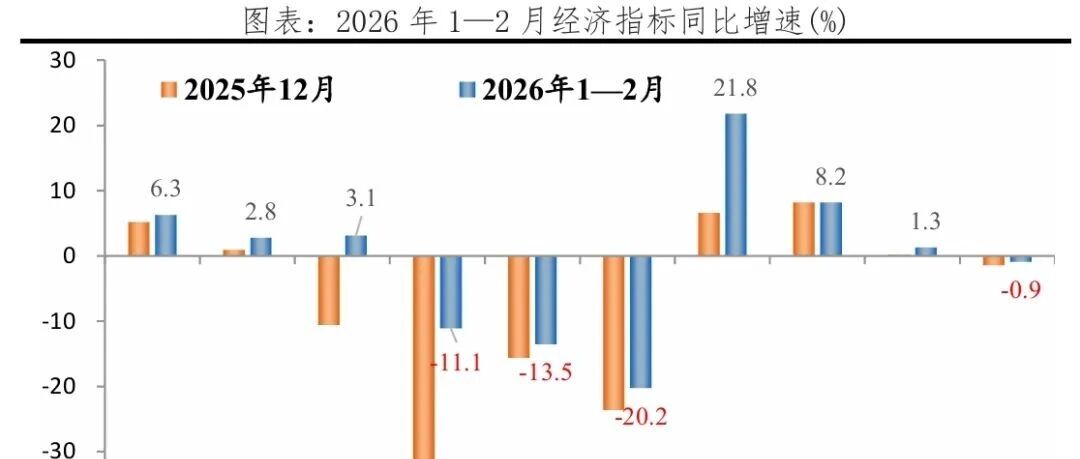
Economic Growth Data - In the first two months of 2026, China's industrial production value increased by 6.3% year-on-year, while the service production index grew by 5.2%[2] - Industrial production growth accelerated by 1.1 percentage points compared to December 2025, and the service sector's growth improved by 0.2 percentage points[2] - Social retail sales rose by 2.8% year-on-year, with fixed asset investment increasing by 1.8%, both showing significant improvements from December 2025 by 1.9 and 5.6 percentage points respectively[2] Sector Performance - High-tech manufacturing value added surged by 13.1%, outpacing overall industrial growth by 6.8 percentage points[2] - Export delivery value also rebounded, growing by 6.3% year-on-year, matching the industrial production growth rate and improving by 3.1 percentage points from December 2025[2] - The service sector saw notable growth in information transmission, software, and IT services (10.1%), finance (7.0%), and transportation (6.3%) during the same period[2] Investment Trends - Fixed asset investment showed a year-on-year increase of 1.8%, with infrastructure and manufacturing investments rising by 9.8% and 3.1% respectively[2] - Real estate investment declined by 11.1%, but this was a smaller drop compared to the previous year's overall decline by 6.1 percentage points[2] - Equipment and tool purchases increased by 11.5%, indicating strong policy support for investment recovery[2] Risks and Outlook - Potential risks include the effectiveness of growth stabilization policies falling short of expectations, unexpected severity of overseas economic downturns, and escalation of geopolitical conflicts[8]
经济开门红——全面解读1-2月经济数据
泽平宏观· 2026-03-16 16:06
Economic Overview - The national economy showed a "new strong, old weak, external strong, internal stable" trend in the first two months of 2026, with high-tech manufacturing and equipment manufacturing leading the growth [2][3] - Industrial production accelerated, with a year-on-year increase of 6.3% in industrial added value, up 1.1 percentage points from December [2][8] - Fixed asset investment turned positive, growing by 1.8% year-on-year, a significant recovery of 16.9 percentage points from December [2][12] Industrial Production - High-tech manufacturing and equipment manufacturing sectors experienced significant growth, with high-tech manufacturing value-added increasing by 13.1% year-on-year [6][9] - The production of upstream raw materials improved due to rising international oil prices, while midstream machinery and equipment sectors benefited from policy effects [9][10] Investment Trends - Fixed asset investment (excluding rural households) showed a year-on-year increase of 1.8%, with high-tech industry investment growing by 5.1% [12][20] - Infrastructure investment surged by 11.4% year-on-year, driven by the acceleration of major projects and statistical adjustments [17][18] Real Estate Market - The decline in real estate investment narrowed, with sales area and sales amount decreasing by 13.5% and 20.2% respectively, but showing improvement from December [15][16] - Real estate companies are still cautious in land acquisition, with a significant drop in land transaction volume [16] Export Performance - Exports exceeded expectations, with a year-on-year growth of 21.8%, driven by global manufacturing recovery and enhanced competitiveness [25][26] - Exports to countries along the Belt and Road increased by 28.5%, accounting for over 50% of total exports [25][26] Consumer Spending - Social retail sales increased by 2.8% year-on-year, with service consumption performing well due to the long Spring Festival holiday [23][24] - Traditional consumer goods saw a significant demand boost during the holiday period, with restaurant income rising by 4.8% [23] Financial Data - Social financing maintained a stable growth rate of 8.2%, supported by government bonds and bank loans [28][29] - M2 growth remained at 9.0%, while M1 increased by 5.9%, indicating a shift in deposit trends towards non-bank institutions [29] Price Trends - CPI rose by 1.3% year-on-year, the highest in nearly three years, influenced by the timing of the Spring Festival [31][32] - PPI decline narrowed, reflecting input inflation and strong demand in certain technology sectors [31][32]

2026年1-2月经济数据点评:开局平稳向好
Tebon Securities· 2026-03-16 10:43
Economic Overview - The macroeconomic data for January-February 2026 shows a positive start, with industrial added value increasing by 6.3% year-on-year, accelerating by 1.1 percentage points from December 2025[1] - Total import and export value grew by 18.3% year-on-year, with exports rising by 19.2%[1] - Retail sales of consumer goods increased by 2.8% year-on-year, with catering revenue up by 4.8%[1] Production Sector - Industrial production saw a significant increase, with the industrial added value growing by 6.3% year-on-year, up from 5.2% in December 2025[2] - The manufacturing PMI for February was 49.0%, indicating a slight contraction, but large enterprises maintained a PMI of 51.5%, suggesting resilience in industrial production[2] Service Sector - The service production index recorded a year-on-year growth of 5.2%, up from 5.0% in December 2025[3] - Key sectors such as information technology services and financial services grew by 10.1% and 7.0% respectively, indicating strong internal momentum in the service industry[3] Demand Side - Retail sales reached 860.79 billion yuan, with a year-on-year growth of 2.8%, significantly up from 0.9% in December 2025[4] - The government has initiated measures to boost consumption, including a special bond issuance of 250 billion yuan to support consumer goods[5] Investment Trends - Fixed asset investment (excluding rural households) grew by 1.8% year-on-year, reversing a decline of 3.8% in 2025[6] - Infrastructure investment surged by 11.4% year-on-year, driven by local special bond issuance and project acceleration[6] Foreign Trade - The total value of goods trade reached 7.73 trillion yuan, with exports increasing by 19.2% and imports by 17.1% year-on-year[7] - Private enterprises' imports and exports grew by 22.8%, indicating enhanced vitality in foreign trade[7] Risks - Potential risks include intensified US-China tensions, geopolitical uncertainties, and challenges in policy implementation[8]
前2月经济数据回升向好,释放多项信号
21世纪经济报道· 2026-03-16 04:44
Economic Performance Overview - The core viewpoint of the article highlights a positive economic performance in China for January-February 2023, driven by multiple factors including better-than-expected export performance, the impact of the extended Spring Festival holiday, the initiation of major projects in the "14th Five-Year Plan," and proactive macroeconomic policies [1][2]. Industrial Growth - The industrial added value for large-scale enterprises increased by 6.3% year-on-year in January-February, accelerating by 1.1 percentage points compared to December of the previous year and rebounding by 0.4 percentage points from the previous year [1]. - The equipment manufacturing sector saw a 9.3% increase, while high-tech manufacturing grew by 13.1%, outperforming the overall industrial growth by 3.0 and 6.8 percentage points respectively [1]. - Specific products such as 3D printing equipment, lithium batteries, and industrial robots experienced significant production increases of 54.1%, 42.6%, and 31.1% year-on-year [1]. Service Sector Performance - The service sector production index grew by 5.2% year-on-year in January-February, showing a slight acceleration of 0.2 percentage points from December, although it was down 0.3 percentage points compared to the annual growth rate of 5.5% [1][2]. - The transportation and accommodation sectors saw notable growth due to increased travel during the Spring Festival [2]. Trade and Export Dynamics - The total import and export value reached 77,321 billion yuan, marking an 18.3% year-on-year increase, with exports at 46,178 billion yuan (up 19.2%) and imports at 31,143 billion yuan (up 17.1%) [5]. - Exports were significantly boosted by strong performance in non-U.S. regions, with integrated circuits and automobiles showing remarkable growth rates of 68.9% and 63.1% respectively [5]. - Imports also exceeded expectations, driven by AI-related investments, with automatic data processing equipment and semiconductor imports increasing by 65% and 14.6% respectively [5]. Investment Trends - Fixed asset investment (excluding rural households) grew by 1.8% year-on-year in January-February, reversing a decline of 3.8% from the previous year [6]. - Infrastructure investment surged by 11.4%, significantly higher than the previous year's growth, contributing to an overall investment increase [6]. - Consumer retail sales rose by 2.8% year-on-year, with notable growth in communication equipment sales and restaurant revenues during the Spring Festival [6]. Economic Outlook - The spokesperson indicated that major economic indicators showed significant recovery, suggesting a positive start to the national economy [7]. - However, challenges remain, including external environmental changes and ongoing geopolitical risks, necessitating more proactive macroeconomic policies to stabilize employment and market expectations [7].

刚刚,重要经济数据公布
第一财经· 2026-03-16 02:17
Core Viewpoint - The article highlights a positive economic outlook for early 2026, driven by strong industrial production, service sector growth, and increased consumer spending, despite ongoing external challenges and domestic economic transitions [3][12]. Group 1: Industrial Production - In January-February, the industrial added value for large-scale enterprises increased by 6.3% year-on-year, accelerating by 1.1 percentage points compared to December [4]. - The equipment manufacturing sector saw a 9.3% increase, while high-tech manufacturing grew by 13.1%, outperforming the overall industrial growth by 3.0 and 6.8 percentage points respectively [4]. - The production of 3D printing equipment, lithium-ion batteries, and industrial robots surged by 54.1%, 42.6%, and 31.1% year-on-year [4]. Group 2: Service Sector Growth - The service sector production index rose by 5.2% year-on-year, with notable growth in information transmission, software, and IT services at 10.1% [5]. - The business activity index for the service sector was at 49.7%, indicating a slight improvement from the previous month, while the business activity expectation index reached 55.8% [5]. Group 3: Market Sales - The total retail sales of consumer goods reached 86,079 billion yuan, growing by 2.8% year-on-year, with urban retail sales at 74,449 billion yuan and rural retail sales at 11,630 billion yuan [6]. - Online retail sales amounted to 32,546 billion yuan, marking a 9.2% increase, with online goods retail at 20,812 billion yuan, growing by 10.3% [6]. Group 4: Fixed Asset Investment - Fixed asset investment (excluding rural households) was 52,721 billion yuan, up by 1.8% year-on-year, reversing a decline of 3.8% from the previous year [7]. - Infrastructure investment grew by 11.4%, while real estate development investment fell by 11.1% [7]. Group 5: Trade and Employment - The total value of goods imports and exports reached 77,321 billion yuan, increasing by 18.3% year-on-year, with exports at 46,178 billion yuan and imports at 31,143 billion yuan [8]. - The urban surveyed unemployment rate averaged 5.3%, remaining stable compared to the previous year, with a slight increase of 0.1 percentage points from the previous month [9]. Group 6: Price Trends - The Consumer Price Index (CPI) rose by 0.8% year-on-year, with food and beverage prices increasing by 0.6% [11]. - The Producer Price Index (PPI) for industrial producers decreased by 1.2% year-on-year, indicating a narrowing decline [11].

【宏观经济】一周要闻回顾(2026年2月26日-3月3日)
乘联分会· 2026-03-03 08:38
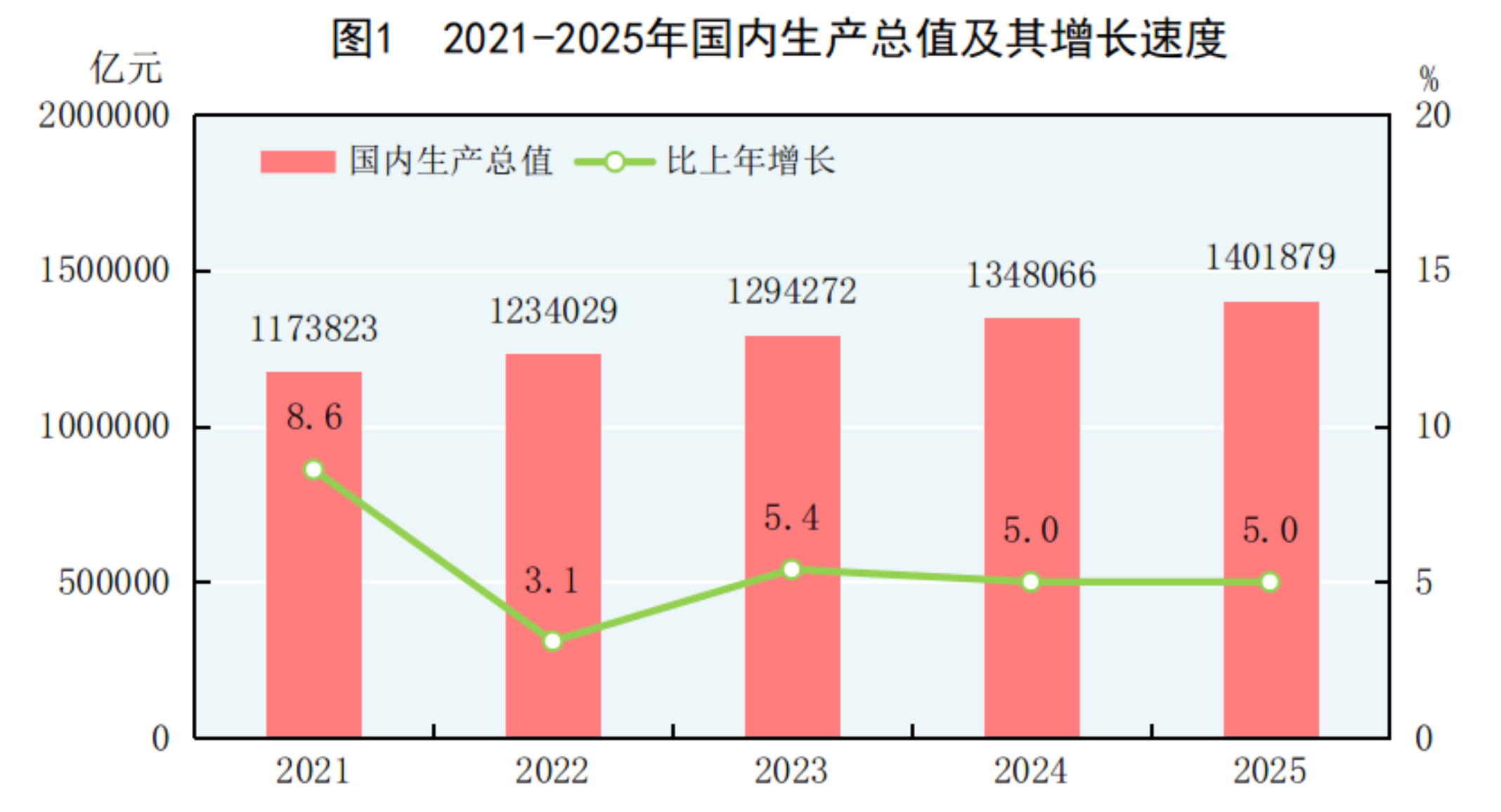
Economic Overview - In 2025, China's GDP reached 140,187.9 billion yuan, growing by 5.0% year-on-year, with the primary industry increasing by 3.9%, the secondary industry by 4.5%, and the tertiary industry by 5.4% [5] - The per capita GDP was 99,665 yuan, reflecting a 5.1% increase from the previous year [5] - The total national income was 1,393,700 million yuan, also up by 5.1% [5] Employment and Labor - The total employment reached 72,504 million, with urban employment accounting for 65.6% [6] - Urban new employment increased by 1,267 million, surpassing the previous year's figures by 110,000 [6] - The average urban survey unemployment rate was 5.2%, with a year-end rate of 5.1% [6] Industrial Growth - The total industrial output value was 416,826 billion yuan, marking a 5.8% increase [11] - The manufacturing sector saw a growth of 6.4%, with significant increases in automotive manufacturing (11.5%) and electrical machinery (9.2%) [12] - Profits from industrial enterprises reached 73,982 billion yuan, a slight increase of 0.6% [13] Agricultural Production - Total grain production was 714.88 million tons, an increase of 1.2% year-on-year [10] - The production of cotton rose by 7.7%, while oilseed production increased by 2.9% [10] Trade and Investment - The total import and export value was 454,685 billion yuan, growing by 3.8%, with exports increasing by 6.1% [20] - In January 2026, foreign direct investment amounted to 920.1 billion yuan, with a 25.5% increase in newly established foreign-invested enterprises [42] - The manufacturing sector attracted 260.9 billion yuan in foreign investment, while the service sector received 640.4 billion yuan [43] Consumer Market - The total retail sales of consumer goods reached 501,202 billion yuan, growing by 3.7% [16] - Online retail sales accounted for 26.1% of total retail sales, amounting to 130,923 billion yuan, a 5.2% increase [18] Financial Sector - The broad money supply (M2) increased by 8.5% to 340.3 trillion yuan [22] - The total social financing scale increased by 35.6 trillion yuan, with a year-end stock of 442.1 trillion yuan [22] Technological Development - R&D expenditure reached 39,262 billion yuan, growing by 8.1% [29] - The number of patents granted was 972,000, although this represented a 7.0% decrease from the previous year [29] Environmental Progress - Carbon emissions per unit of GDP decreased by 5.0% [9] - Clean energy generation increased by 14.4%, with significant growth in solar and wind energy [9]

国家统计局副局长盛来运评读《2025年国民经济和社会发展统计公报》
Guo Jia Tong Ji Ju· 2026-02-28 03:01
Core Viewpoint - The 2025 National Economic and Social Development Statistical Bulletin reflects China's economic resilience and progress amid complex domestic and international challenges, showcasing a commitment to stability and growth under the leadership of the central government [2][3]. Group 1: Economic Growth and Development - In 2025, China's GDP grew by 5.0%, surpassing 140 trillion yuan for the first time, marking a significant achievement in the "14th Five-Year Plan" [3]. - The per capita GDP reached 99,665 yuan, a 5.1% increase from the previous year, translating to approximately 13,953 USD, maintaining a level above 13,000 USD for three consecutive years [4]. - China's contribution to global economic growth is projected to remain around 30%, solidifying its position as the world's second-largest economy [5]. Group 2: Modernization and Technological Advancement - The investment in R&D increased by 8.1%, reaching 2.80% of GDP, surpassing the OECD average for the first time, with basic research funding accounting for 7.08% [6][7]. - The high-tech manufacturing sector saw a value-added growth of 9.4%, with its share of total industrial value-added rising to 17.1% [7]. - The digital economy flourished, with the value-added of the digital product manufacturing industry increasing by 9.3% [8]. Group 3: Domestic and International Circulation - Domestic consumption reached over 50 trillion yuan, growing by 3.7%, with domestic demand contributing 67.3% to economic growth [10]. - The total import and export volume exceeded 45 trillion yuan, marking a 3.8% increase, and maintaining China's position as a key player in global supply chains [11]. Group 4: High-Quality Development and Structural Reforms - The establishment of a unified national market progressed, with the market access negative list reduced to 106 items [12]. - The average urban unemployment rate was 5.2%, with 12.67 million new urban jobs created, reflecting a stable employment situation [15]. - The clean energy consumption ratio reached 30.4%, with significant reductions in energy consumption per unit of GDP and CO2 emissions [14]. Group 5: Social Welfare and Quality of Life - The average disposable income for urban residents increased by 5.0%, aligning with economic growth, while the share of service consumption in total spending reached 46.1% [15]. - The healthcare system expanded, with over 1 million hospital beds and 13.4 million healthcare professionals by year-end [16]. - Social insurance coverage increased, with 1.08 billion people enrolled in basic pension insurance and 1.33 billion in medical insurance [16].
中华人民共和国2025年国民经济和社会发展统计公报
Guo Jia Tong Ji Ju· 2026-02-28 01:33
Economic Overview - The GDP for the year reached 140,187.9 billion yuan, growing by 5.0% compared to the previous year [3] - The primary industry added value was 93,347 billion yuan (3.9% growth), the secondary industry was 499,653 billion yuan (4.5% growth), and the tertiary industry was 808,879 billion yuan (5.4% growth) [3] - The per capita GDP was 99,665 yuan, reflecting a 5.1% increase year-on-year [3] Population and Employment - The total population at the end of the year was 1,404.89 million, a decrease of 3.39 million from the previous year [9] - The urban population was 953.80 million, accounting for 67.9% of the total population [7] - The total employment reached 72.50 million, with an urban employment rate of 65.6% [8] Industrial Performance - The total industrial added value was 416,826 billion yuan, marking a 5.8% increase [24] - The manufacturing sector saw a growth of 6.4%, with significant increases in automotive manufacturing (11.5%) and high-tech manufacturing (9.4%) [26][31] - The profits of industrial enterprises reached 73,982 billion yuan, a 0.6% increase year-on-year [31] Agricultural Output - The total grain output was 714.88 million tons, an increase of 1.2% from the previous year [21] - The production of pork was 59.38 million tons, reflecting a growth of 4.1% [23] Service Sector Growth - The value added by the wholesale and retail sector was 145,808 billion yuan, growing by 5.0% [36] - The information transmission, software, and IT services sector grew by 11.1% [36] Trade and Investment - The total import and export value reached 454,685 billion yuan, with exports growing by 6.1% and imports by 0.5% [60] - Foreign direct investment amounted to 747.7 billion yuan, a decrease of 9.5% [69] Financial Sector - The broad money supply (M2) increased by 8.5% to 340.3 trillion yuan [76] - The total social financing scale increased by 35.6 trillion yuan, with a year-end balance of 442.1 trillion yuan [77]
聚焦生产性服务业增长 广东锚定价值链更高处
Di Yi Cai Jing· 2026-02-25 12:09
Core Insights - The production service industry holds a dominant position in Guangdong's modern service sector, with finance, information transmission, software, and IT services as core engines [1][3] - The Guangdong provincial government emphasizes the synergy between manufacturing and service industries, aiming for a modern industrial system that integrates both sectors for economic growth [1][4] Group 1: Industry Overview - The production service industry includes various services that support production activities, such as R&D, logistics, financial services, and human resource management [2] - From 2020 to 2025, the value added by China's production service industry is expected to increase from 30.3% to 34.4% of GDP, indicating significant growth potential compared to developed countries where it ranges from 40% to 50% [2] Group 2: Regional Development - Guangdong's modern service industry is projected to reach a value added of 55,139.99 billion yuan by 2025, accounting for nearly 37.84% of GDP, with the production service industry being the main contributor [3] - Shenzhen's service industry added value reached 2.42 trillion yuan last year, with modern services accounting for 77%, and the value added from the financial sector exceeding 520 billion yuan [3] Group 3: Challenges and Recommendations - The production service industry in Guangdong faces challenges such as insufficient high-end service supply and the need for improved quality and capability in supporting manufacturing [3][4] - Recommendations include accelerating the development of high-end industries like industrial software and AI, enhancing innovation capabilities, and establishing open testing platforms to support technological advancements [4]