充换电服务

Search documents
高端制造业成为我国用电量增长核心引擎
Ke Ji Ri Bao· 2026-02-03 03:13
Core Insights - In 2025, China's total electricity consumption is projected to exceed 10 trillion kilowatt-hours, marking the first time a single economy has reached this milestone, driven by robust economic growth and structural optimization in electricity consumption [1][2] Group 1: Electricity Demand Growth - The report indicates that electricity consumption in high-tech and equipment manufacturing industries will grow by 6.4% year-on-year in 2025, surpassing the average growth rate of the manufacturing sector by 3 percentage points [2] - The automotive manufacturing sector is expected to see a double-digit growth in electricity consumption, with a growth rate of 10.9% [2] - The photovoltaic equipment and components manufacturing industry will experience a significant increase, with a growth rate of 11.3% in the fourth quarter, reflecting positive responses to the "anti-involution" policies [2] Group 2: Structural Changes in Industries - The report highlights that all nine sectors within high-tech and equipment manufacturing will achieve positive growth in electricity consumption, indicating a shift towards high-end and green transformation in manufacturing [2] - The third sector, including services like charging and swapping services, mobile internet, big data, and cloud computing, is experiencing rapid growth, showcasing the vitality of the digital economy and new infrastructure development [2] Group 3: Future Projections - For 2026, the total electricity consumption in China is expected to reach between 10.9 trillion and 11 trillion kilowatt-hours, with a year-on-year growth of 5% to 6% [2] - The report anticipates that by the end of 2026, the installed capacity of solar power will surpass that of coal power for the first time, with the combined installed capacity of wind and solar power reaching half of the total installed generation capacity [2]
中国年用电量首破10万亿千瓦时 新质生产力驱动用电新增量
Yang Shi Xin Wen· 2026-01-20 23:57
Core Insights - In 2025, China's total electricity consumption will exceed 10 trillion kilowatt-hours for the first time, which is more than double the annual electricity consumption of the United States and higher than the combined total of the EU, Russia, India, and Japan [1] Group 1: Electricity Consumption Growth Drivers - The high-end manufacturing sector is a new driver of electricity consumption growth, with a motorcycle smart factory in Hangzhou projected to achieve revenues exceeding 15 billion yuan in 2025, with over 70% of its sales coming from overseas markets [3] - A new materials company in Hangzhou anticipates electricity consumption exceeding 25 million kilowatt-hours in 2025, driven by the demand for semiconductor high-purity equipment and new energy storage electrode production [5] - The electricity consumption in Hangzhou is expected to surpass 110 billion kilowatt-hours in 2025, with a year-on-year growth rate of 6.5%, particularly in the automotive, computer, communication, and other electronic device manufacturing sectors [7] Group 2: Impact of New Technologies - The rapid penetration of new information technologies, such as artificial intelligence, is driving significant growth in electricity consumption in the internet and related service industries, with a smart elderly care service company experiencing a 25% year-on-year increase in electricity consumption due to model training and new product testing [9] - In Jiaxing, the first "10,000 Card" computing power cluster in Zhejiang is under construction, with electricity consumption in the computing power industry exceeding 790 million kilowatt-hours in 2025, marking a 287% year-on-year increase [11] Group 3: Electric Vehicle Charging Services - The electric vehicle charging service industry is projected to see a consumption growth rate of 48.8% in 2025, making it a significant contributor to the growth of the tertiary sector's electricity consumption [17] - The charging service industry is expected to provide services for nearly 30 million pure electric vehicles in 2025, with electricity consumption exceeding 102 billion kilowatt-hours [19] Group 4: Power Supply and Renewable Energy - China's power supply capacity is steadily improving, with total installed power generation capacity exceeding 3.8 billion kilowatts, and the proportion of green electricity continues to rise, with one-third of electricity consumption coming from renewable energy sources [21] - The establishment of a national unified electricity market is underway to provide cross-regional power support for the anticipated 10 trillion kilowatt-hours of electricity consumption [19][21] - The resilience and development vitality of China's large-scale economy are highlighted by its leading position in electricity consumption, supported by the active construction of a new energy system [23]

10万亿度电!中国用电量不仅超美两倍,更远超欧俄印日四国之和
Sou Hu Cai Jing· 2026-01-20 18:39
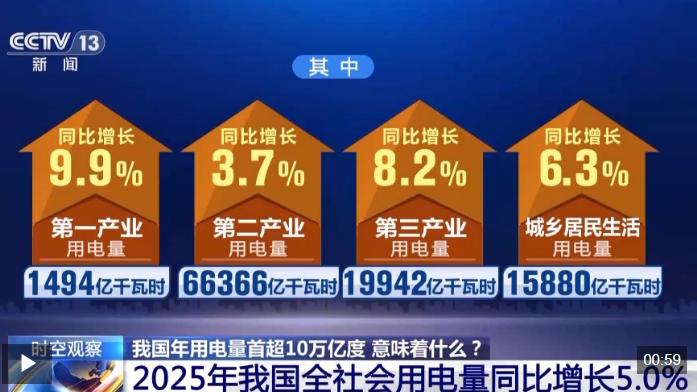
Core Insights - In 2025, China's total electricity consumption is projected to exceed 10.4 trillion kilowatt-hours, marking a historic milestone as the first single country to surpass this threshold [1] - China's electricity demand is more than double that of the United States and greater than the combined total of the EU, Russia, India, and Japan [1] Group 1: Electricity Consumption Breakdown - The primary sector consumed 149.4 billion kilowatt-hours, with a growth rate of 9.9%, reflecting advancements in modern agriculture such as greenhouse farming and smart irrigation [4] - The secondary sector accounted for 6,636.6 billion kilowatt-hours, representing 64% of total consumption, with a stable growth rate of 3.7%, indicating a solid industrial production base [4] - The tertiary sector consumed 1,994.2 billion kilowatt-hours, and urban and rural residential electricity usage was 1,588 billion kilowatt-hours, together contributing to half of the overall growth rate [4][5] Group 2: Emerging Sectors - The charging and swapping service industry saw an impressive electricity consumption growth rate of 48.8%, correlating with the rising number of new energy vehicles [8] - The information transmission and software industry experienced a 17% growth in electricity consumption, highlighting the significant energy demands of digital activities such as online shopping and video streaming [8] Group 3: Infrastructure and Technological Advancements - China's electricity consumption per capita is 7,400 kilowatt-hours, compared to the U.S. at 12,000 kilowatt-hours, but has shown significant improvement over the past decade [10] - The State Grid's recent "14th Five-Year Plan" involves a 4 trillion yuan investment not for building power plants but for upgrading the entire grid system [12] - The integration of ultra-high voltage transmission networks, virtual power plants, and intelligent scheduling systems enables efficient electricity distribution across vast distances [12][14] Group 4: Global Positioning and Future Outlook - China has built a unified national grid system, allowing for efficient electricity transfer across regions, unlike fragmented systems in the U.S. and EU [14] - In 2022, China accounted for over half of the world's new wind and solar power installations, showcasing its leadership in renewable energy [16] - The ability to self-manufacture critical components for ultra-high voltage and flexible direct current equipment enhances China's energy technology confidence [18] - The 4 trillion yuan investment aims to address weaknesses in rural electricity infrastructure while expanding energy capabilities, reflecting a comprehensive approach to energy security [18][20] Group 5: Economic Implications - The 10 trillion kilowatt-hours of electricity consumed is not just a statistic but represents the backbone of China's economic transformation, shifting from traditional coal-based energy to a diversified energy structure [20] - Electricity has become a stabilizer for economic growth and an accelerator for technological advancement, underpinning various modern activities [20] - China's advancements in energy management and infrastructure position it as a leader in the global energy landscape, challenging perceptions of its developmental status [20]

上证早知道|重要预告:今日上午10时;3.69万亿元 光刻机龙头市值创新高
Shang Hai Zheng Quan Bao· 2026-01-18 23:12
Market Updates - The State Council held a meeting on January 16 to discuss measures to accelerate the cultivation of new growth points in service consumption and ensure the payment of wages to migrant workers [2] - The China Securities Regulatory Commission outlined five key tasks for 2026, focusing on market stability, reform, legal enforcement, company value growth, and capital market openness [2] - The People's Bank of China and the National Financial Regulatory Administration announced a minimum down payment ratio of 30% for commercial housing loans [2] Company News - Yubis Technology signed a service agreement with Airbus for humanoid robots, with production capacity expected to reach 10,000 units by 2026 [10] - Lanke Technology expects a net profit of 2.15 billion to 2.35 billion yuan for 2025, a growth of 52.29% to 66.46% year-on-year, driven by strong demand in the AI industry [10] - Changxin Bochuang anticipates a net profit of 320 million to 370 million yuan for 2025, a year-on-year increase of 344.01% to 413.39% due to the rapid growth in data communication market [10] - Oke Yi expects a net profit of 96 million to 110 million yuan for 2025, a growth of 67.53% to 91.96% year-on-year, benefiting from rising prices of raw materials [10] - Haitai Technology forecasts a net profit of 51.5 million to 66.8 million yuan for 2025, a year-on-year increase of 226.86% to 323.97% due to high industry demand [10] - Energy-saving Wind Power announced that its wind power projects received renewable energy subsidies of 1.507 billion yuan, a 122.74% increase year-on-year [12] Industry Insights - The nuclear fusion energy market is expanding, with significant procurement projects signed at the 2026 Nuclear Fusion Technology and Industry Conference, with total funding expected to exceed 10 billion yuan [7] - China's total electricity consumption is projected to exceed 10 trillion kilowatt-hours in 2025, with a year-on-year growth of 5%, driven by the service sector and residential electricity use [8] - The electric vehicle charging service industry is experiencing rapid growth, with a projected increase in charging infrastructure to 28 million units by 2027 [8] Investment Opportunities - The A-share market is expected to focus on companies with solid fundamentals as earnings reports are set to be disclosed in late January [4][5] - Investment firms are advised to pay attention to sectors such as technology, chemicals, and healthcare, particularly those with high growth or turnaround potential [5] - The semiconductor equipment sector is gaining attention, with ASML's stock reaching a new high, driven by increased spending from chip manufacturers to meet AI demand [6]
中国年用电量超10万亿 全球尚属首次
Xin Lang Cai Jing· 2026-01-18 17:25
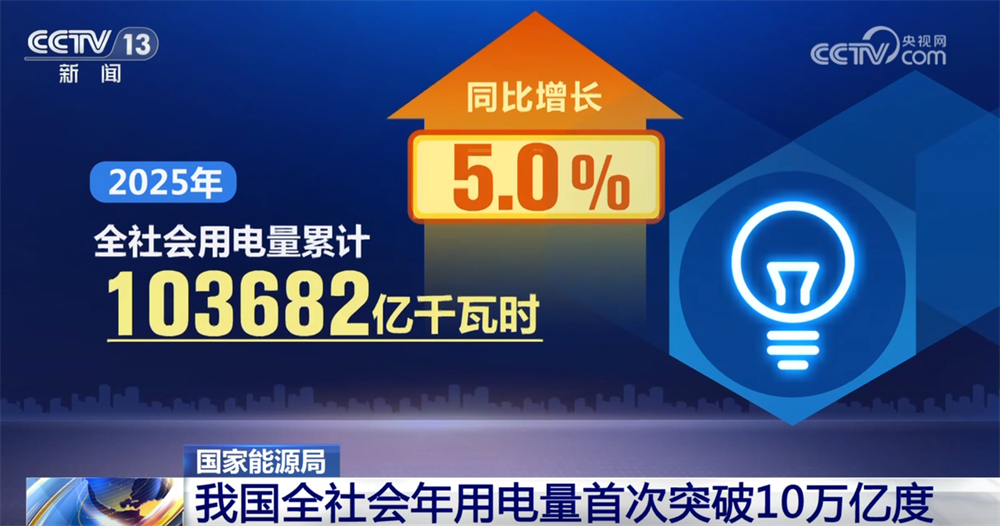
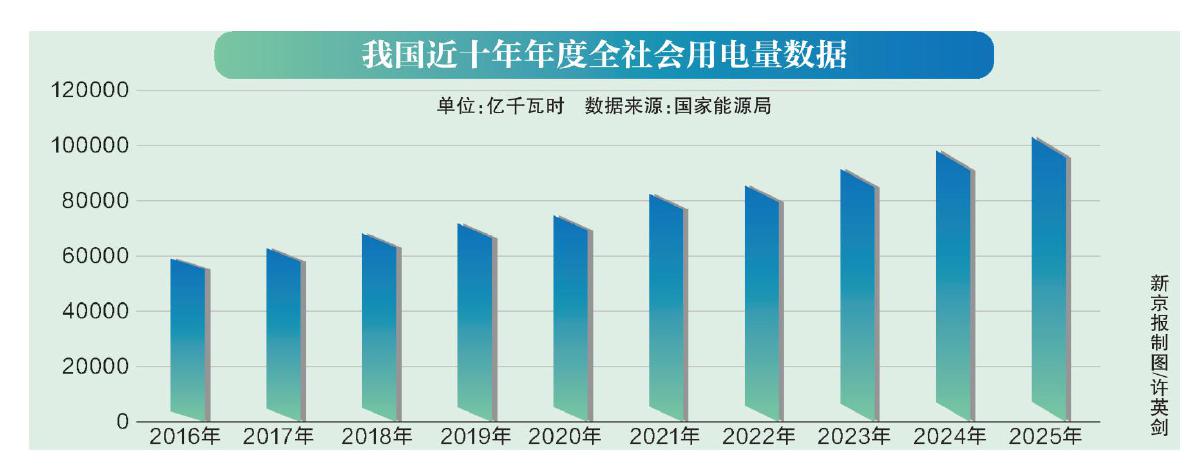
Group 1 - The total electricity consumption in China is projected to reach 10.3682 trillion kilowatt-hours by 2025, marking a 5.0% year-on-year increase, which is the first time any single country has surpassed this threshold globally [1][3] - China's electricity consumption is more than double that of the United States and exceeds the total consumption of the European Union, Russia, India, and Japan combined, highlighting the resilience and vitality of China's super-sized economy [3][4] - Over the past decade, electricity consumption has grown from 5.9198 trillion kilowatt-hours in 2016, with seven years experiencing growth rates exceeding 5% [3][4] Group 2 - The growth in electricity consumption is significantly driven by the tertiary sector, particularly the charging and swapping service industry, which saw a staggering 48.8% increase, alongside the booming information industry [1][5] - The first industry consumed 149.4 billion kilowatt-hours (up 9.9%), the second industry 6,636.6 billion kilowatt-hours (up 3.7%), and the third industry 1,994.2 billion kilowatt-hours (up 8.2%), with urban and rural residential electricity consumption at 158.8 billion kilowatt-hours (up 6.3%) [4][5] - New energy industries, such as high-end manufacturing and digital economy sectors, are emerging as significant contributors to electricity demand, with wind power equipment manufacturing and internet-related services seeing over 30% growth [5][7] Group 3 - The charging and swapping industry is identified as a new driving force for electricity consumption growth, facilitating the integration of electric vehicles and new power systems while promoting grid upgrades and technological innovation [5][6] - By the end of November 2025, the total number of electric vehicle charging infrastructure units reached 19.322 million, reflecting a 52.0% year-on-year increase, driven by the growth of the new energy vehicle and artificial intelligence sectors [6][7] - The manufacturing sector's electricity consumption continues to rise, indicating active production activities and the ongoing expansion of China's manufacturing scale and strength [7]
视频丨年用电量首超10万亿度 展现中国经济发展活力
Yang Shi Xin Wen Ke Hu Duan· 2026-01-18 12:50
Core Insights - China's total electricity consumption is projected to exceed 10 trillion kilowatt-hours in 2025, marking the first time any country has reached this milestone, which is more than double the annual electricity consumption of the United States and surpasses the combined consumption of the EU, Russia, India, and Japan [2][4][5] Group 1: Electricity Consumption Breakdown - In 2025, total electricity consumption is expected to reach 10,368.2 billion kilowatt-hours, representing a year-on-year growth of 5.0% [2] - The breakdown of electricity consumption by sector includes: - Primary industry: 149.4 billion kilowatt-hours, up 9.9% - Secondary industry: 6,636.6 billion kilowatt-hours, up 3.7% - Tertiary industry: 199.4 billion kilowatt-hours, up 8.2% - Urban and rural residential electricity: 158.8 billion kilowatt-hours, up 6.3% [2] Group 2: Driving Forces Behind Growth - The tertiary sector and residential electricity consumption are the main drivers of overall electricity growth, contributing to 50% of the increase [4] - Within the tertiary sector, the electric vehicle charging and swapping services, as well as information transmission, software, and IT services, have seen significant growth rates of 48.8% and 17.0%, respectively [4][6] Group 3: Structural Changes in Energy Consumption - The second industry remains the primary electricity consumer, accounting for approximately 64%, with growth shifting from high-energy-consuming industries to high-end manufacturing [6] - In 2025, electricity consumption in the computer, communication, and other electronic device manufacturing sectors is expected to exceed 50 billion kilowatt-hours, surpassing traditional industries like steel and chemicals [6] Group 4: Digital Economy and Innovation - The digital economy is experiencing rapid growth, with the "East Data West Computing" initiative driving significant increases in electricity consumption in the data industry, particularly in Guizhou, where internet data service electricity consumption surged by 95.01% [8] - The demand for computing power is also rising exponentially, as evidenced by the Huawei Cloud data center in Guian New Area, which has seen a 56.92% increase in electricity consumption [8] Group 5: Implications of Exceeding 10 Trillion Kilowatt-Hours - The surpassing of 10 trillion kilowatt-hours indicates a robust and stable economic development across various sectors, reflecting the resilience of China's energy infrastructure and the strong integration capabilities of its modern industrial system [4][5] - The shift towards high-tech, high-value-added industries and the increasing share of green electricity supply signal a positive outlook for the development of a new energy system centered around renewable sources [8]
全球首次!用电量破10万亿,中国经济引擎拆解
2 1 Shi Ji Jing Ji Bao Dao· 2026-01-18 08:04
Core Insights - The total electricity consumption in China is projected to exceed 10 trillion kilowatt-hours by 2025, marking a historic milestone globally, and is more than double the annual electricity consumption of the United States [1][2] - This significant increase in electricity consumption reflects profound changes in the electricity usage structure across various industries, with the third industry and urban-rural residential electricity contributing to 50% of the growth [1][5] Industry Analysis - The average annual increase in electricity consumption during the 14th Five-Year Plan period is estimated at 563.6 billion kilowatt-hours, with an average growth rate of approximately 6.6%, which is an improvement of 0.9 percentage points compared to the previous five-year period [4] - The first and third industries are leading in electricity consumption growth rates, with increases of 9.9% and 8.2% respectively, indicating a shift towards agricultural electrification and the accelerated growth of service industries [6][7] - The second industry remains the largest consumer of electricity, accounting for about 64% of total consumption, but its growth rate is slowing, reflecting a transition towards industrial upgrades [6][7] Sector-Specific Insights - In the manufacturing sector, high-tech and equipment manufacturing industries are showing a growth rate of 6.4%, with notable increases in automotive manufacturing (10.9%), general equipment manufacturing (8.7%), and instrumentation manufacturing (7.6%) [6] - The four major high-energy-consuming industries have a relatively low growth rate of 1.8%, with only a few sub-industries showing positive growth [6] - The third industry is becoming a new engine for electricity consumption, with significant growth in new infrastructure and emerging service sectors, such as charging services and information technology, which are growing at rates of 48.8% and 17.0% respectively [7] Economic Implications - The electricity consumption data reflects the optimization and upgrading of China's economic structure, with high-end manufacturing becoming a new growth point for electricity demand [7] - The rapid development of the digital economy and emerging technologies is driving electricity demand, particularly in new infrastructure projects like charging stations and 5G base stations, which have seen growth rates exceeding 30% and nearly 50% respectively [7][8]
电动重卡的绿色“账本”
Xin Lang Cai Jing· 2026-01-17 22:51
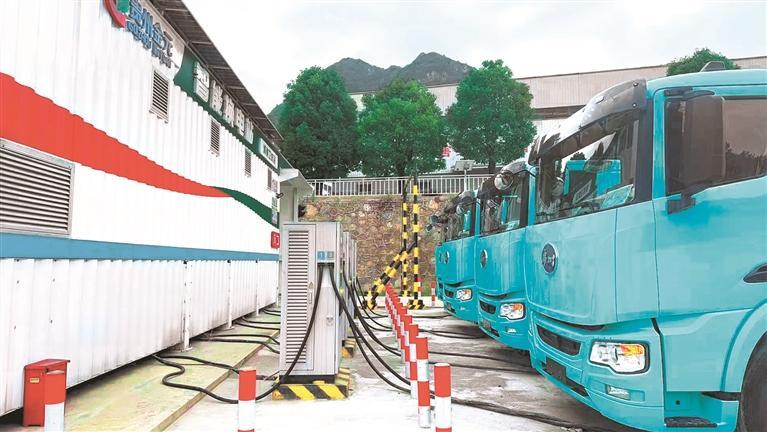
Core Viewpoint - The article highlights the advancements in electric vehicle (EV) infrastructure in Guizhou, particularly focusing on the integration of solar power, energy storage, and battery swapping technology to promote green transportation and support the "Electric Guizhou" initiative [2][3]. Group 1: Technological Advancements - The battery swapping technology at the Zhi Jin Ping Yuan Power Plant has improved from 8 minutes to under 5 minutes for battery replacement, with the fastest time being 3 minutes [2]. - The project has established 3 smart battery swapping stations and 23 charging piles, with a total installed capacity of 11,280 kW and a battery swapping utilization rate exceeding 123% of the design expectations [3]. Group 2: Environmental Impact - By 2025, the project aims to achieve a battery swapping volume of 56 million kWh, resulting in a cumulative total of 230 million kWh, which is expected to save approximately 43,500 tons of fuel and reduce carbon dioxide emissions by 1,361,600 tons [3]. - The environmental benefits are likened to planting 12,000 evergreen trees, showcasing the project's commitment to sustainability [3]. Group 3: Market Adoption Strategies - The company has introduced a "vehicle-battery separation" and "battery leasing" model to lower the initial costs for users, making electric trucks more financially attractive compared to traditional fuel vehicles [5]. - To address concerns about charging efficiency and infrastructure, the company has upgraded battery swapping technology and expanded the charging network across the province, alleviating customer anxieties regarding electric vehicle usage [5]. Group 4: Industry Growth and Collaboration - Since initiating its green transportation efforts in March 2019, the company has built and operated 51 battery swapping stations and installed 223 charging piles, serving over 2,000 vehicles [6]. - The company has invested over 30 million yuan in creating a smart logistics supply chain platform, attracting over 12,321 vehicles and 304 carriers, fostering a collaborative ecosystem among government, industry, academia, and research [6]. Group 5: Future Outlook - The rich mineral resources in Guizhou provide a solid foundation for the application of electric trucks, and the promotion of the "Electric Guizhou" policy is expected to significantly increase the adoption rate of electric trucks in the coming years [7].
10万亿千瓦时,普通人能从中感知什么
2 1 Shi Ji Jing Ji Bao Dao· 2026-01-17 12:11
Core Insights - The total electricity consumption in China is projected to reach 10.3682 trillion kilowatt-hours by 2025, marking a significant milestone as it is the first time the country's electricity consumption surpasses 10 trillion kilowatt-hours. This figure is more than double the annual electricity consumption of the United States and exceeds the combined annual consumption of the EU, Russia, India, and Japan [1][9]. Group 1: Energy Structure - The shift towards electric vehicles is evident, with non-fossil energy sources expected to account for over 60% of installed capacity by 2025, indicating a significant transition towards cleaner energy. One-third of the total electricity consumed will be green energy [3][11]. - In 2025, China's automobile production and sales are projected to reach historical highs of 34.531 million and 34.40 million units, respectively, with a year-on-year growth of 10.4% and 9.4%. New energy vehicle sales are expected to exceed 16 million units, making up over 50% of new car sales [3][11]. Group 2: Technological Transformation - The industrial sector, which is the largest consumer of electricity, is undergoing a technological revolution characterized by advancements in AI, quantum technology, and automation. In the past year, the electricity consumption of the secondary industry reached 66,366 billion kilowatt-hours, accounting for approximately 64% of total consumption [5][13]. - The computer, communication, and other electronic equipment manufacturing sectors are expected to consume over 50 billion kilowatt-hours of electricity in 2025, surpassing traditional industries like steel and chemicals [5][13]. Group 3: Quality of Life - The electricity consumption of the tertiary industry is projected to reach 19,942 billion kilowatt-hours by 2025, with a year-on-year growth of 8.2%. Urban and rural residential electricity consumption is expected to reach 15,880 billion kilowatt-hours, growing by 6.3% [6][14]. - The increase in electricity consumption in the service sector indicates a vibrant social and market environment, with the electric vehicle sector driving a nearly 50% increase in charging service electricity consumption [6][15].
透过数据看经济运行“晴雨表” 我国制造业大国发展底色“足”、能源保障“稳”
Yang Shi Wang· 2026-01-17 06:14
Core Insights - The total electricity consumption in China is projected to exceed 10 trillion kilowatt-hours for the first time in 2025, marking a significant milestone for the country as a manufacturing powerhouse and reflecting its enhanced energy security capabilities [1] Group 1: Electricity Consumption Data - In 2025, the total electricity consumption is expected to reach 10,368.2 billion kilowatt-hours, representing a year-on-year growth of 5.0% [1] - The breakdown of electricity consumption by sector includes: - Primary industry: 149.4 billion kilowatt-hours, up 9.9% year-on-year - Secondary industry: 6,636.6 billion kilowatt-hours, up 3.7% year-on-year - Tertiary industry: 199.4 billion kilowatt-hours, up 8.2% year-on-year - Urban and rural residential electricity consumption: 158.8 billion kilowatt-hours, up 6.3% year-on-year [1] Group 2: Growth Drivers - The tertiary industry and urban-rural residential electricity consumption are the main drivers of overall electricity consumption growth, contributing to 50% of the increase [3] - Within the tertiary industry, the electric vehicle charging and swapping service sector saw an electricity consumption growth rate of 48.8%, while the information transmission, software, and information technology services sector experienced a growth rate of 17.0%, both significantly contributing to the growth in this sector [3][4]