减肥药市场

Search documents
台州博士开卖减肥药,坐望百亿
2 1 Shi Ji Jing Ji Bao Dao· 2025-07-01 07:22
Core Viewpoint - The approval of the new weight loss drug, Masitide (玛仕度肽), marks a significant advancement in the obesity treatment market, targeting long-term weight control for adults with obesity or overweight conditions [1][4]. Group 1: Product Efficacy - Clinical data indicates that after 20 weeks of treatment, patients can lose over 20% of their body weight, reduce liver fat content by over 80%, and decrease waist circumference by 11 cm, while also improving cardiovascular and metabolic indicators such as blood sugar, blood pressure, and liver enzyme levels [2][5]. - Masitide is the first and only dual receptor agonist approved for overweight and obesity indications globally, with unique mechanisms targeting both GLP-1 and GCG receptors, enhancing fat oxidation and energy expenditure [8][7]. Group 2: Market Potential - China has approximately 500 million individuals classified as overweight or obese, creating a substantial market opportunity for weight loss medications, with predictions that the GLP-1 weight loss drug market will exceed 15 billion by 2025 [5][6]. - The company anticipates that Masitide's sales could reach 7 billion in 2025 and 18 billion in 2026, with peak sales estimates ranging from 52 billion to 100 billion, supporting the goal of achieving 20 billion in revenue by 2027 [21]. Group 3: Pricing and Accessibility - The estimated monthly cost for patients using Masitide is between 1500 to 3000 yuan, depending on the dosage and frequency of injections [3][12]. - The company plans to set prices based on the product's value while considering the pricing of similar products and the payment capabilities of the domestic market [14]. Group 4: Broader Implications - The drug not only addresses weight loss but also has potential benefits for related health issues such as fatty liver disease, which affects over 200 million people in China, and may reduce the risks of liver cirrhosis and cancer [16][15]. - The company is also pursuing indications for type 2 diabetes treatment, with expectations for approval later in the year [16].
减肥药进口潮推高对美逆差,小国爱尔兰意外成为美国第二大贸易伙伴
Hua Er Jie Jian Wen· 2025-06-20 11:57
Group 1 - The core point of the article highlights the surge in demand for weight loss drugs and concerns over tariffs, which have propelled Ireland to become the second-largest source of the U.S. trade deficit [1] - In the first four months of this year, the U.S. imported $36 billion worth of hormone drug ingredients from Ireland, more than double the total imports from Ireland for the entire previous year [1] - Nearly 100% of these imports are destined for Indiana, where Eli Lilly, the manufacturer of weight loss drugs Zepbound and Mounjaro, is headquartered [1] Group 2 - The trade deficit has increased, but these drugs are transforming the healthcare landscape, with Novo Nordisk becoming the highest-valued company in Europe [1] - Novo Nordisk is investing billions of dollars to build factories in the U.S., which may alleviate trade imbalances in the long term [1] - Concerns over tariffs have led to a stockpiling trend, with companies rushing to ship goods to the U.S. before tariff deadlines [2] Group 3 - Ireland is at the center of a global stockpiling trend, as it is a major hub for U.S. pharmaceutical giants, partly due to favorable tax policies [2] - The demand for weight loss drugs is currently enormous, prompting companies to build safety stocks [3] - The trade imbalance has placed Ireland in a difficult position, as it was recently placed on the U.S. Treasury's currency manipulation monitoring list [3] Group 4 - Eli Lilly holds a significant position in the weight loss drug market, with sales of its GLP-1 drugs Mounjaro and Zepbound expected to nearly double this year to around $30 billion [4] - Maintaining the supply of weight loss drugs poses challenges for both Eli Lilly and its competitor Novo Nordisk, which manufactures Ozempic and Wegovy [4] - The demand for air logistics has surged, with transportation companies noting an increase in requests for drug shipments, which are typically transported by air due to their lightweight and high value [4]


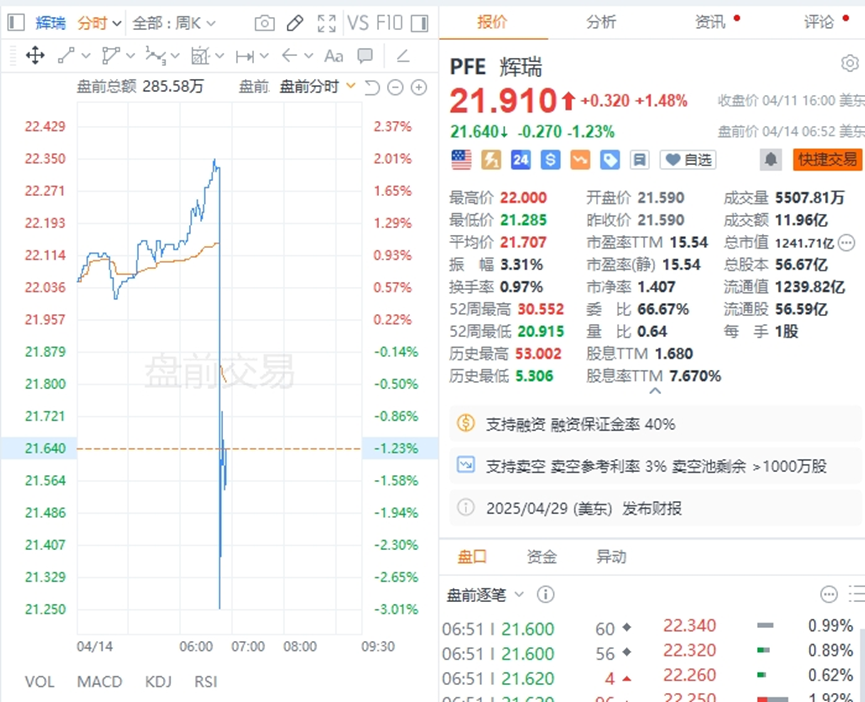
肝损伤拖累,辉瑞退出减肥药竞争,放弃开发口服减肥药Danuglipron
Hua Er Jie Jian Wen· 2025-04-14 13:25
Core Viewpoint - Pfizer has announced the discontinuation of its oral weight loss drug Danuglipron due to potential liver damage observed in a clinical trial patient [1][2]. Group 1: Company Actions - Pfizer will not advance Danuglipron into the final testing phase and will instead focus on early-stage weight loss treatments [2]. - This decision follows previous setbacks in the weight loss drug sector, including the abandonment of a twice-daily formulation of Danuglipron due to high rates of nausea and vomiting in a mid-stage study involving approximately 1,400 participants [4]. - The company had previously halted another oral weight loss drug due to concerning liver effects observed in clinical trials [5]. Group 2: Market Impact - The announcement led to a pre-market decline of about 1% in Pfizer's stock, while competitors Novo Nordisk and Eli Lilly saw stock increases of 4.6% and 2.3%, respectively [2]. - Viking Therapeutics, another biotech company developing weight loss drugs, experienced a pre-market surge of 20% following the news [2]. Group 3: Competitive Landscape - The weight loss drug market is projected to reach a market size of $130 billion by the end of the century, highlighting the competitive nature of this sector [2]. - Eli Lilly's weekly injection Zepbound has rapidly approached annual sales of nearly $5 billion after receiving U.S. approval in 2023, while AstraZeneca and Structure Therapeutics are also developing their own oral weight loss drugs [5]. Group 4: Strategic Implications - Analysts suggest that Pfizer's decision may relieve some investor concerns regarding Danuglipron's competitiveness against other weight loss drugs [5]. - The discontinuation of Danuglipron may prompt Pfizer to seek acquisition opportunities to fill the gap in its product line [5]. - The decision adds pressure on Pfizer's CEO Albert Bourla, who has viewed the company's product line as a potentially underestimated source of future growth, especially as the company is expected to lose approximately $15 billion in revenue due to key drugs losing patent protection by the end of the century [5].


礼来股价坐上“三级火箭”:藏在减肥药市场里的万亿财富密码
新财富· 2025-03-03 08:03
Core Viewpoint - The article discusses the transformative journey of Eli Lilly's stock price, likening it to a "three-stage rocket" that has evolved from a "sugar-reducing injection" to a "metabolic revolution" [3]. Group 1: Historical Upward Cycle - The first stage of advancement is the breakthrough in Alzheimer's disease, which redefined valuation anchors. On May 3, 2023, Eli Lilly announced that its Alzheimer's drug Donanemab met its primary endpoint, significantly slowing cognitive decline in early patients, leading to a 6.7% stock price increase and a market cap growth of $25.6 billion in one day [4]. - The second stage is the commercial validation of metabolic drugs. On August 8, 2023, Eli Lilly's Q2 earnings report revealed that the sales of Tirzepatide exceeded $1 billion in a single quarter, with clinical data showing a 15.6 kg weight loss over 72 weeks, causing a 15.17% stock price surge and a market cap exceeding $500 billion [5]. - The third stage involves the synergy of capacity, payment, and pipeline, forming a "golden triangle." In 2024, Tirzepatide generated $1.766 billion in its first month, and Donanemab was approved in China, with a projected 60% capacity increase for GLP-1 drugs in 2025, leading to a 106% year-on-year net profit increase [6]. Group 2: Current Strengthening Logic - The first engine of change is the upgrade of the "disease radar," with Tirzepatide targeting new indications such as obstructive sleep apnea and heart failure, significantly reducing hospitalization risks [7][8]. - The second accelerator is the revolution in patient compliance, with the oral drug Orforglipron showing a 14.7% weight loss over 36 weeks, appealing to a broader user base compared to injectable options [9]. - The most critical factor is government insurance coverage, with the potential for Medicare to cover obesity drugs significantly increasing market penetration [10][11]. Group 3: Market Size Estimation - The potential of the weight loss drug market hinges on three core parameters: patient base, penetration rate, and annual treatment costs. The global patient base includes 905 million diabetes patients and 1.142 billion obese individuals, with additional new indications [13][14]. - The theoretical market size for diabetes and obesity drugs is estimated at approximately $1 trillion, with current penetration rates at only 2.11% for diabetes and 0.67% for obesity, indicating significant growth potential [16][17]. Group 4: Potential Over-Expectation Variables - The valuation system for GLP-1 drugs may face re-evaluation due to four key drivers: the promising results of Eli Lilly's dual-target drug Retatrutide, which showed a 24.2% weight loss in Phase II trials, potentially threatening the market share of Semaglutide [19]. - Chinese pharmaceutical companies are breaking into the global competitive landscape, with Innovent Biologics' dual-target drug application potentially capturing 20% of the domestic market [20]. - The cross-indication potential of Semaglutide shows a correlation with a 40%-70% reduction in Alzheimer's disease risk, indicating high market interest [21]. - The resolution of supply chain issues through significant capacity expansions by Eli Lilly and Novo Nordisk may lead to unexpected market penetration growth [22]. Group 5: Conclusion - The evolution of GLP-1 drugs from diabetes treatments to lifestyle management products reflects a significant shift in consumer demand and market valuation, with Eli Lilly's market cap soaring as these drugs become integral to weight management across demographics [24].