气候变暖

Search documents
气候变暖对热带森林有何影响?国际最新研究称或加快土壤呼吸
Zhong Guo Xin Wen Wang· 2025-09-17 08:53
Core Insights - The latest research published in the journal "Nature Communications" indicates that climate warming may accelerate soil respiration rates in tropical forests, leading to increased carbon loss from soil, which could impact global climate predictions [1][2] Group 1: Research Findings - A field experiment showed that soil respiration rates in warmed plots were found to be 42%-204% higher than in control plots, reaching some of the highest soil respiration rates reported in terrestrial ecosystems [2] - The additional carbon released from warmed plots was estimated to be between 6.5 to 81.7 tons per hectare annually, depending on the slope position, with the highest carbon release occurring in upper slope areas [2] - The authors suggest that these increases may be due to changes in the microbial community functions in warmed soils, affecting their ability to metabolize carbon or altering the composition of microbial communities [2] Group 2: Implications - The study's findings indicate that in a warmer world, tropical forest ecosystems may experience significant carbon loss, highlighting the importance of further research to understand the underlying mechanisms of these processes for assessing the long-term impacts of climate change [2]
气候变暖致加拿大北极海域出现入侵物种
Xin Hua She· 2025-09-15 09:03
Core Insights - An international team has reported evidence of barnacle invasion in the Arctic waters of Canada, indicating that climate change is allowing foreign species to invade previously cold regions [1] Group 1: Research Findings - Researchers from the British Antarctic Survey and Canadian counterparts published a paper in the journal "Global Change Biology," utilizing environmental DNA barcoding technology to identify genetic material from species in water samples collected from the Arctic [1] - The genetic material of the barnacle species, Amphibalanus improvisus, was found in the samples, which is commonly found in European and Pacific waters and can cause biofouling in ships, pipelines, and other infrastructure [1] Group 2: Climate Change Impact - Historically, the cold waters of the Canadian Arctic prevented the migration and establishment of invasive species [1] - Climate change is rapidly warming the Arctic waters, reducing sea ice, and facilitating new shipping routes, which increases the likelihood of species invasion from other marine areas [1] - The rising water temperatures enhance the survival and establishment potential of invasive species compared to the past [1]
气候变暖导致加拿大北极海域出现入侵物种藤壶
Xin Hua She· 2025-09-14 03:57
Core Insights - An international team has reported evidence of barnacle invasion in the Canadian Arctic, indicating that climate change is allowing foreign species to invade previously cold waters [1] Group 1: Research Findings - Researchers from the British Antarctic Survey and Canadian counterparts published a paper in "Global Change Biology" detailing the use of environmental DNA barcoding to identify species in water samples collected from the Canadian Arctic [1] - The genetic material of the barnacle species, Amphibalanus improvisus, was found in the water samples, which is commonly found in European and Pacific waters and can cause biofouling in ships and infrastructure [1] Group 2: Climate Change Impact - Historically, the cold waters of the Canadian Arctic prevented the migration and establishment of invasive species [1] - Climate change is rapidly warming the Arctic waters, reducing sea ice, and facilitating new shipping routes, which increases the likelihood of species invasion [1] - Warmer water temperatures enhance the survival and establishment of invasive species compared to the past [1]
复旦大学发表最新Science论文
生物世界· 2025-09-13 01:00
Core Viewpoint - The traditional belief that wildfires in the western United States worsen air quality across the country is challenged by new research, which indicates that these wildfires may actually lead to a decrease in PM2.5 concentrations in the eastern United States, offsetting the increases in the west [3][5]. Group 1: Research Findings - A study published in the journal Science reveals that extreme wildfires in the western U.S. lead to a rise in PM2.5 levels locally, but simultaneously cause a decrease in PM2.5 levels in the eastern U.S., effectively canceling each other out [3][5]. - The research attributes this unexpected effect to heat convection caused by wildfires, which weakens the transport of smoke to the east and enhances the wet deposition of air pollutants [5][7]. - Ignoring the heat generated by wildfires could lead to an overestimation of their health impacts, with the study estimating an additional 1,200 premature deaths and $3.3 billion in economic losses attributed to PM2.5 in the densely populated eastern U.S. [5][7]. Group 2: Implications - The findings highlight a previously overlooked connection between localized heat sources and large-scale climate effects, suggesting a need for a revised understanding of wildfire impacts [7]. - Considering the heat generated by wildfires could facilitate cross-regional cooperation in fire management and provide a more scientific basis for climate predictions [7].


财经早报:9月3日
Xin Hua Cai Jing· 2025-09-03 02:16
Group 1 - The China-Shanghai Cooperation Organization (SCO) has officially launched three cooperation platforms focusing on energy, green industries, and digital economy to enhance collaboration and promote sustainable development among member states [2] - In August, the number of new A-share accounts reached 2.65 million, a year-on-year increase of 165%, significantly surpassing the same period last year [2] - The software and information technology service industry in China reported a revenue of 83,246 billion yuan in the first seven months of 2025, with a year-on-year growth of 12.3% [2] - The Beijing Stock Exchange reported that all 274 listed companies completed their semi-annual reports, with total operating income of 92.064 billion yuan, reflecting a year-on-year growth of 6.01% [2] - Major food delivery platforms in China, including Meituan, Alibaba, and JD, reported significant declines in net profits due to increased marketing expenses during a competitive period, with Meituan's net profit dropping nearly 90% [2] Group 2 - The Ministry of Finance and the State Taxation Administration of China issued new tax policies to support the management of state-owned equity and cash income for social security fund transfers [2] - The net inflow of southbound funds in Hong Kong reached 9.281 billion HKD, marking a record high since the launch of the mutual market access mechanism [2] - The People's Bank of China reported a net liquidity injection of 300 billion yuan through medium-term lending facilities in August [2] - The IPO application for Yuzhu Technology is expected to be submitted to the stock exchange between October and December, with quadruped and humanoid robots projected to account for 65% and 30% of sales in 2024, respectively [2]

英、日、韩经历有记录以来“最热夏天”
Xin Hua She· 2025-09-02 08:03
Group 1 - The UK, Japan, and South Korea have experienced their hottest summers on record, attributed to climate change and increasing global heatwaves [1] - The UK recorded an average temperature of 16.10°C from June 1 to August 31, surpassing the previous record of 15.76°C set in 2018 by 1.51°C [2] - Japan's average temperature for summer 2025 was 2.36°C higher than the baseline average, exceeding the previous record set in 2023 and 2024 by 0.60°C [3] - South Korea's average temperature reached 25.7°C, breaking the previous record of 25.6°C from last year, with severe drought conditions reported in some areas [4] Group 2 - The UK Meteorological Office indicated that the likelihood of experiencing summers as hot as 2025 has increased by approximately 70 times due to human-induced climate change [2] - Japan's Meteorological Agency warned that extreme heat events are likely to become more frequent due to global warming [3] - In South Korea, over 4,000 individuals sought medical attention for heat-related illnesses this summer, marking the highest number since 2018 [4]
英国2025年经历有记录以来最热夏季
Zhong Guo Xin Wen Wang· 2025-09-01 22:29
Core Insights - The UK Meteorological Office reported that the average temperature in the summer of 2025 (June to August) reached 16.10 degrees Celsius, the highest since records began in 1884, surpassing the previous record of 15.76 degrees Celsius set in 2018 [1] - This summer's average temperature was 1.51 degrees Celsius above the long-term average, with the hottest five summers on record occurring in the 21st century [1] - Although no extreme temperatures above 40 degrees Celsius were recorded in 2025, frequent heatwaves and persistently high daily temperatures characterized the summer [1] Temperature Records - The highest temperature recorded this summer was 35.8 degrees Celsius on July 1 in Faversham, southeast England, significantly lower than the historical peak of 40.3 degrees Celsius reached in 2022 [1] - In June 2023, the average temperature in the UK was 15.2 degrees Celsius, the second highest on record, following June 2023's average of 15.8 degrees Celsius [1] - England experienced its hottest June on record in 2023, with an average temperature of 16.9 degrees Celsius [1] Contributing Factors - Multiple factors, including soil drought and marine heatwaves, contributed to the prolonged high temperatures this summer [1] - Summer rainfall in the UK was only 84% of the long-term average, leading to water use restrictions in some areas [1] - The UK has faced increasingly record-breaking summer temperatures in recent years, with 2023 also experiencing unusually high temperatures and related issues [1]
日韩经历有记录以来“最热夏天”
Yang Shi Xin Wen· 2025-09-01 13:43
Core Insights - Japan and South Korea have experienced their hottest summer on record, with Japan's average temperature from June to August being 2.36 degrees Celsius higher than the historical average, marking the highest since records began in 1898 [1] - South Korea's average temperature during the same period reached 25.7 degrees Celsius, surpassing last year's record of 25.6 degrees Celsius, according to data collected since 1973 [1] Japan's Situation - The Japan Meteorological Agency reported that the summer temperature has set records for three consecutive years [1] - From May 1 to August 24, there were 84,521 cases of heat-related medical visits in Japan, compared to 83,414 cases during the same period last year [1] South Korea's Situation - The eastern coastal city of Gangneung in South Korea has declared a national disaster status due to prolonged drought, with water levels in its main reservoir dropping below 15% [1] Global Context - Scientists indicate that global heatwaves are becoming more intense and frequent due to climate change [1] - A report from the World Health Organization and the World Meteorological Organization warns that for every 1 degree Celsius increase in temperatures above 20 degrees Celsius, labor productivity can decline by 2% to 3% [1]
在长江源,如何为冰川做“体检”?
Xin Hua She· 2025-08-02 11:39
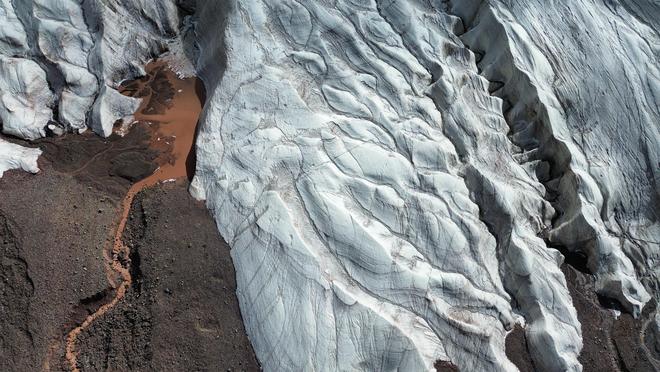
Core Viewpoint - The article discusses the health of glaciers in the Tibetan Plateau, particularly focusing on the Dongkemadi Glacier, and the ongoing research to monitor and understand the impacts of climate change on these glaciers [1][9]. Group 1: Glacier Characteristics - The Dongkemadi Glacier is a compound valley glacier formed by a main glacier flowing south and a tributary glacier flowing southwest, with the main glacier's terminus at an elevation exceeding 5000 meters [2]. - The glacier has over 35 years of continuous observation records, which are crucial for analyzing the evolution of glaciers in the Yangtze River source region [2]. Group 2: Research Methodology - To assess the glacier's health, researchers measure its area and thickness, estimating the glacier's volume and annual changes [4]. - Remote sensing satellites and drones are utilized to monitor changes in glacier area, while ground-based photography captures changes at the glacier's terminus [4]. - For measuring glacier thickness, researchers employ ground-penetrating radar, which allows them to scan approximately 40 meters of the glacier, revealing a maximum thickness of around 15 meters [6][8]. Group 3: Climate Change Impact - The Dongkemadi Glacier is experiencing a retreat trend due to climate warming, with a noticeable acceleration in the rate of retreat in recent years [9]. - The retreat of glaciers may temporarily increase river water supply, but this trend is unsustainable, leading to potential river and lake shrinkage and ecological degradation in cold region ecosystems [9]. - The increasing difficulty in accessing the glacier due to melting ice and changing terrain poses challenges for researchers [10]. Group 4: Long-term Observations - A permanent observation station at an altitude of 5200 meters has been established to monitor various environmental factors, providing essential data for studying water cycle evolution and ecological responses in the Yangtze River source area [12]. - The presence of vegetation, such as the resilient Rhodiola, highlights the ecological significance of glaciers, while areas of degraded soil illustrate the adverse effects of glacier retreat [13].
室温立降2℃,空调省电10%,这一招能帮你撑过夏季暴晒天
3 6 Ke· 2025-08-01 09:50
Core Viewpoint - Effective shading methods can significantly reduce indoor temperatures and energy consumption during hot summer months, with external shading options generally providing better results than internal ones [3][4]. Group 1: External Shading Benefits - External shading devices, such as awnings and roller shades, can reflect sunlight before it reaches the window, leading to a temperature reduction of 1-2°C indoors and a decrease in air conditioning energy consumption by approximately 10% [4]. - The effectiveness of external shading is influenced by various factors, including the material of the shading device, weather conditions, and window size [4]. Group 2: Internal Shading Optimization - Optimizing internal shading devices can help achieve results similar to external options by increasing reflectivity and reducing light transmittance [5]. - High-reflectivity internal shades can reduce cooling energy consumption by up to 56.2% during peak sunlight hours compared to no shading [5]. Group 3: Improving Insulation - To enhance insulation, internal shades should be positioned close to the window to minimize air gaps that allow heat transfer [6][9]. - Adding side tracks to roller shades or using Velcro can improve sealing and reduce heat transfer through gaps [9]. Group 4: Innovative Shading Solutions - Honeycomb shades, designed with air pockets, provide superior insulation by slowing down heat transfer and minimizing air convection [10][13]. - When combined with side tracks, honeycomb shades can achieve optimal insulation performance [13]. Group 5: Energy Efficiency and Climate Impact - As global temperatures rise, the demand for air conditioning will increase, leading to higher carbon emissions from electricity generation [15]. - Improving window shading design is a cost-effective method to reduce energy consumption and enhance comfort in both summer and winter, with honeycomb shades potentially reducing heat loss through windows by 40% or more [16].