
AI基础设施投资

Search documents
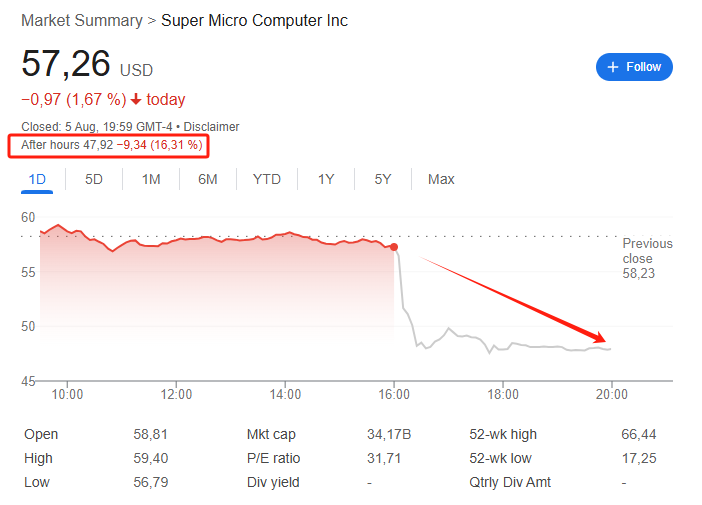
超微电脑增长神话破灭?“价格战”威胁利润率,盘后大跌16%
Hua Er Jie Jian Wen· 2025-08-06 01:33
Core Viewpoint - The latest earnings report from Supermicro has disappointed investors, leading to a significant drop in stock price despite the company's previous strong performance in the AI sector [1][4]. Financial Performance - For the fourth quarter, Supermicro reported revenue of $5.76 billion, a year-over-year increase of 7.5%, but below analyst expectations of $6.01 billion [1]. - Adjusted earnings per share were $0.41, also falling short of the anticipated $0.44 [1]. - The company has significantly lowered its revenue guidance for the next quarter to between $6 billion and $7 billion, and adjusted earnings per share to between $0.40 and $0.52 [1][2]. Profitability Challenges - The company expects an operating profit margin of only 5% for the next quarter, which is well below the analyst forecast of 7% [2][7]. - Supermicro faces dual pressures from inventory backlog and pricing competition, particularly from Dell [7]. Business Difficulties - Demand for current products is being impacted as customers are waiting for the latest NVIDIA chip products [3][7]. - The company is struggling with old inventory while trying to compete for large AI server orders at lower prices [7]. Future Outlook - Supermicro has revised its revenue forecast for the fiscal year 2026 from $40 billion to $33 billion, a reduction of 17.5% [8]. - The optimistic growth expectations earlier this year, driven by AI product demand, have been replaced by a more competitive pricing environment [9].

不太宽的星际之门
3 6 Ke· 2025-08-01 11:36
Core Insights - OpenAI CEO Sam Altman is urgently seeking to raise $40 billion from Middle Eastern sovereign funds and Wall Street giants for the Stargate project, which was initially announced as a $500 billion AI infrastructure plan [1][2] - The project has significantly downsized, now only planning to build a small data center by the end of the year, with SoftBank withdrawing its initial $10 billion commitment due to disagreements [2][3] - The Stargate project, originally intended to create a nationwide AI computing network, is facing severe challenges including funding issues, partnership conflicts, and execution difficulties [4][5] Funding Challenges - The initial funding structure is inadequate, with OpenAI and SoftBank committing only $18 billion each, which is insufficient compared to the $500 billion target [5] - OpenAI is currently losing billions annually, while SoftBank is under pressure to raise $30 billion through new debt and asset sales [5][6] - The unclear business model and the long-term nature of the project make it difficult to attract potential investors [5][6] Partnership Conflicts - There are significant disagreements between OpenAI and SoftBank regarding project goals, with SoftBank focusing on long-term strategy while OpenAI prioritizes immediate computational needs [6][9] - Altman has begun to bypass SoftBank, signing a $30 billion agreement with Oracle and smaller contracts with other cloud service providers, which has intensified tensions [9][10] Infrastructure and Execution Issues - Building a gigawatt-level AI data center poses substantial challenges, including the existing U.S. power grid's inability to support such high energy demands [10][12] - The selection and approval process for data center locations is complex and time-consuming, further complicating project execution [12][13] - The global semiconductor supply chain constraints and potential tariffs add additional layers of risk to the project [12][13] Broader Implications - The Stargate project's difficulties highlight the unique challenges of investing in AI infrastructure, which is highly dependent on technological evolution and market viability [14][16] - The project underscores the need for stronger public sector involvement in large-scale initiatives to balance short-term commercial interests with long-term societal benefits [17][18] - The experience serves as a cautionary tale that ambitious infrastructure projects must be grounded in reality and aligned with industry needs to avoid becoming unfeasible [18]


摩根大通贷款超70亿美元,全额覆盖OpenAI阿比林巨型数据中心
Hua Er Jie Jian Wen· 2025-05-23 03:12
Group 1 - Morgan Stanley has agreed to provide over $7 billion in loans to support the construction of OpenAI's large AI data center in Abilene, Texas, which will become one of the largest data centers globally, housing a total of 400,000 Nvidia chips [1][2] - The project was initially initiated by data center developer Crusoe, which later formed a joint venture with Blue Owl and Primary Digital Infrastructure, raising $3.4 billion to fund the OpenAI data center [2][3] - The data center developers have begun to expand the joint venture to build more AI data centers, with Crusoe, Blue Owl, and Primary Digital announcing they have raised an additional $11.6 billion for expansion [2] Group 2 - Oracle has signed a 15-year lease with the data center and will lease chips to OpenAI, which plans to use the facility to train its AI models [3] - OpenAI, previously reliant on Microsoft for data center computing power, expressed dissatisfaction with the speed of chip acquisition, leading to the collaboration with Oracle for the Abilene facility [3]

