AI基础设施投资

Search documents
银河期货有色金属衍生品日报-20260319
Yin He Qi Huo· 2026-03-19 11:41
1. Report Industry Investment Rating No relevant information provided. 2. Core View of the Report - The copper price decreased due to the geopolitical situation and Fed's stance, with the key support level broken and the center of gravity shifting down. The alumina price is under pressure with new capacity coming online. The aluminum price is dragged down by the financial attribute due to the Middle - East situation. Other metals like zinc, lead, nickel, stainless steel, etc. also have their respective price trends influenced by factors such as supply - demand, geopolitics, and cost [1][3][8][14] 3. Summary According to Related Catalogs 3.1 Market Review - **Copper**: The main contract of Shanghai copper 2605 closed at 94,420 yuan/ton, down 4.52%, and the Shanghai copper index increased its positions by 8,491 lots to 584,000 lots. The average price of 1 electrolytic copper in the spot market was 95,600 yuan/ton, down 3,360 yuan/ton from the previous trading day [1] - **Alumina**: The alumina 2505 contract fell 38 yuan/ton to 3,027 yuan/ton, and the weighted positions increased by 1,330 lots. The spot prices in different regions showed an upward trend [8] - **Electrolytic Aluminum**: The Shanghai aluminum 2605 contract decreased by 655 yuan to 24,180 yuan/ton, and the positions decreased by 39,600 lots [14] - **Zinc**: The Shanghai zinc 2605 fell 3.11% to 22,705 yuan/ton, and the Shanghai zinc index positions increased by 3,983 lots to 209,700 lots. The spot market trading was not as good as the previous day [23] - **Lead**: The Shanghai lead 2605 fell 1.59% to 16,415 yuan/ton, and the Shanghai lead index positions increased by 2,146 lots to 135,100 lots. The spot market trading was light [27] - **Nickel**: The main contract of Shanghai nickel NI2605 fell 3,990 to 131,550 yuan/ton, and the index positions decreased by 16,909 to 330,296 lots. The spot premiums of different nickel types changed [32] - **Stainless Steel**: The main contract of stainless steel SS2605 fell 200 to 13,855 yuan/ton, and the index positions increased by 9,613 to 182,402 lots. The spot prices of different resources were within certain ranges [38] - **Tin**: The main contract of Shanghai tin 2604 closed at 345,730 yuan/ton, down 24,490 yuan/ton or 6.61%, and the positions increased by 2,114 lots to 80,600 lots. The spot price continued to decline [41] - **Carbonate Lithium**: The main contract of carbonate lithium 2605 fell 9,700 to 142,600 yuan/ton, and the index positions decreased by 25,270 to 595,501 lots. The spot prices of battery - grade and industrial - grade carbonate lithium both decreased [55] 3.2 Important Information - **Inflation and Fed Policy**: The US February PPI was 3.4% year - on - year, and the core PPI was 3.9%, a one - year high. The Fed kept the interest rate unchanged, raised the inflation expectation, and still expected to cut interest rates once this year [2][15] - **Geopolitical Situation**: The conflict between the US, Israel and Iran continued, and the Iranian Islamic Revolutionary Guard launched a large - scale missile attack on oil and energy facilities related to the US in the region [15][19] - **Inventory Information**: As of March 19, the SMM national mainstream copper inventory decreased by 8.85% week - on - week to 523,100 tons; the SMM seven - region zinc ingot inventory decreased to 266,100 tons; the SMM lead ingot five - region social inventory reached 78,000 tons as of March 16 [2][24][29] - **Industry News**: Guinea plans to cut bauxite exports in early April; some new alumina production lines in China are expected to be put into trial production; GlobalData said that the global photovoltaic installed capacity will reach nearly 6 terawatts by 2031 [9][48] 3.3 Logic Analysis - **Copper**: The geopolitical situation and Fed's stance led to a decrease in copper price. The supply of copper ore was tight, and the downstream pricing enthusiasm declined [3] - **Alumina**: Guinea's bauxite export policy needs to be monitored. The new domestic alumina capacity needs time to be fully released, and the subsequent pressure on alumina comes from the supply side [10] - **Electrolytic Aluminum**: The Middle - East situation led to concerns about economic slowdown, and the financial attribute dragged down the aluminum price [16] - **Zinc**: The non - ferrous sector was under pressure due to macro factors. The domestic refined zinc supply increased, but the demand recovery was insufficient. However, the expected reduction of overseas smelters and low LME inventory provided some support [25] - **Lead**: The increase in social inventory and inflow of imported lead suppressed the lead price, but the loss of secondary lead smelters provided some support [30] - **Nickel**: The weakening copper price and the tense Middle - East situation affected the nickel price. The nickel ore price was firm, but the nickel - iron price was under pressure [35] - **Stainless Steel**: The overseas manufacturing contraction led to some orders flowing back to China, but the concern about global economic recession still dominated the price trend [39] - **Tin**: The impact of Indonesia's potential tin export ban was limited. The recovery of tin production in Myanmar and the weak downstream demand affected the tin price [43] - **Carbonate Lithium**: The negative growth of new - energy vehicle sales in March and the expected production of Jiangxi Xikeng Mine affected the supply - demand relationship, and the price center shifted down [57] 3.4 Trading Strategy - **Copper**: Unilateral: The price broke the key support level and the center of gravity shifted down; Arbitrage: Wait and see; Options: Wait and see [5][6][7] - **Alumina**: Unilateral: New capacity is coming soon, and the alumina price is under pressure; Arbitrage: Wait and see; Options: Wait and see [12] - **Electrolytic Aluminum**: Unilateral: Weak operation with the sector; Arbitrage: Wait and see; Options: Wait and see [17][18] - **Zinc**: Unilateral: The zinc price may be weak in the short term due to macro and fundamental factors; Arbitrage: Wait and see; Options: Wait and see [26] - **Lead**: Unilateral: Wait and see; Arbitrage: Wait and see; Options: Wait and see [31] - **Nickel**: Unilateral: The price fluctuates weakly; Arbitrage: Wait and see; Options: Wait and see [36][37] - **Stainless Steel**: Unilateral: Wait for the macro situation to stabilize; Arbitrage: Wait and see [41] - **Tin**: Unilateral: The tin price remains weak; Options: Wait and see [44] - **Carbonate Lithium**: Unilateral: The oscillation range moves down; Arbitrage: Wait and see; Options: Wait and see [58][59]
有色金属衍生品日报-20260318
Yin He Qi Huo· 2026-03-18 09:54
1. Report Industry Investment Rating No relevant content provided. 2. Core Views of the Report - The market is affected by the ongoing conflict between the US and Iran, and there is significant uncertainty. The situation in the Middle East and Mozambique is having an impact on the aluminum smelting industry, and the market is waiting for the Fed's interest rate decision. [1][16][20] - The supply and demand of various metals are in different states. For example, copper is in a seasonal destocking phase, while zinc has an increase in domestic inventory due to insufficient demand recovery compared to supply. [1][28] - The prices of different metals are expected to have different trends. For instance, copper prices may test key support levels, and aluminum prices are expected to be weak. [1][16] 3. Summary by Related Catalogs Copper - **Market Review**: The main contract of Shanghai copper 2605 closed at 98,610 yuan/ton, a decrease of 1.5%. The Shanghai copper index increased its position by 9,477 lots to 576,000 lots. The spot market showed different price trends in different regions. [1] - **Important Information**: As of March 16, the national mainstream copper inventory decreased by 5.46% to 547,300 tons. The production and sales of new energy vehicles from January to February decreased year - on - year. Chile's copper production in January was 409,900 tons, and Kazakhstan's refined copper production from January to February decreased by 9.1% year - on - year. [1] - **Logic Analysis**: The conflict between the US and Iran brings uncertainty. The African wet - process copper production may be affected by the shortage of sulfuric acid supply. The downstream consumption is strong, and the substitution of refined copper rods for recycled copper rods is prominent. [1] - **Trading Strategy**: For unilateral trading, wait and see as the market sentiment weakens and copper prices test key support levels. For arbitrage and options, also wait and see. [3][4][5] Alumina - **Market Review**: The alumina 2505 contract rose 10 yuan/ton to 3,048 yuan/ton, and the weighted position decreased by 1,921 lots. The spot prices in different regions showed an upward trend. [6] - **Related Information**: Guinea is discussing policies to restrict bauxite production and exports. The UAE's aluminum exports and raw material transportation are affected by the closure of the Strait of Hormuz. The registered volume of alumina warehouse receipts on the Shanghai Futures Exchange decreased on March 18. China's alumina exports from January to February decreased year - on - year, while bauxite imports increased. New alumina production capacity is expected to be put into trial production. [7][8][9] - **Trading Logic**: The news of Guinea's policy on bauxite has magnified the price fluctuations of alumina. Although the policy details are not clear, the bauxite supply is in a surplus situation. In the short term, alumina prices may be firm, but the subsequent pressure will come from the supply side. There is a basis for spot - futures arbitrage. [10][12] - **Trading Strategy**: For unilateral trading, expect a decline in an oscillatory manner. For arbitrage, buy spot delivery products and sell futures. For options, wait and see. [13][14] Electrolytic Aluminum - **Market Review**: The Shanghai aluminum 2605 contract decreased by 245 yuan/ton to 24,800 yuan/ton, and the position decreased by 9,662 lots. The spot prices in different regions decreased. [16] - **Related Information**: Bahrain Aluminum and Mozal Aluminum have reduced production due to transportation interruptions. China's imports of unforged aluminum and aluminum products from January to February decreased year - on - year, while exports increased. The cancellation of the photovoltaic tax - refund policy may affect the orders of related factories. [16][17] - **Trading Logic**: The situation in the Middle East is still tense, and the market is waiting for the Fed's interest rate decision. The reduction in aluminum smelting production in the Middle East and Mozambique continues, and there is a risk of economic weakness due to geopolitical conflicts and high oil prices. [20] - **Trading Strategy**: For unilateral trading, expect a weak performance. For arbitrage and options, wait and see. [21][22] Casting Aluminum Alloy - **Related Information**: Bahrain Aluminum and Mozal Aluminum have reduced production due to transportation interruptions. The warehouse receipt volume of casting aluminum alloy on the Shanghai Futures Exchange shows certain data. [23] - **Trading Logic**: The situation in the Middle East is tense, and the market is waiting for the Fed's interest rate decision. There is a risk of economic weakness. The supply of scrap aluminum is gradually released, but the demand recovery in the peak season is slow, and high prices and price fluctuations suppress purchasing willingness. [24] - **Trading Strategy**: For unilateral trading, expect a short - term weak performance following the aluminum price. For arbitrage and options, wait and see. [25][26] Zinc - **Market Review**: The Shanghai zinc 2605 contract decreased by 2.26% to 23,345 yuan/ton, and the position of the Shanghai zinc index increased by 1.28 lots to 205,700 lots. The spot market in Shanghai showed that the downstream enterprises took advantage of the low - price to place orders, and the spot discount narrowed. [26] - **Related Information**: As of March 16, the total inventory of zinc ingots in seven regions increased compared to previous periods. The downstream consumption recovery is slower than the arrival of smelter products. [28] - **Logic Analysis**: The supply of refined zinc in China is increasing, while the demand recovery is insufficient, and the domestic inventory is accumulating. However, there is an expectation of overseas smelter production cuts due to rising energy prices, and the low LME zinc inventory provides some support for zinc prices. [29] - **Trading Strategy**: For unilateral trading, expect a weak oscillatory performance in the short term. Wait for the price to stabilize and then go long at low prices. For arbitrage and options, wait and see. [30] Lead - **Market Review**: The Shanghai lead 2605 contract rose 0.79% to 16,650 yuan/ton, and the position of the Shanghai lead index decreased by 11,100 lots to 133,000 lots. The actual shipment volume of recycled refined lead is limited, and downstream battery production enterprises are reluctant to accept the premium price. [31] - **Related Information**: As of March 12, the social inventory of lead ingots increased. The import window is open, and imported lead is increasing. [32] - **Logic Analysis**: The increase in social inventory due to the delivery of goods by holders and the inflow of imported lead suppress the domestic lead market. However, the losses of recycled lead smelting enterprises are expanding, which provides some support for lead prices. [33] - **Trading Strategy**: For unilateral trading, continue to hold profitable long positions and raise the stop - loss line to protect profits. For arbitrage and options, wait and see. [35] Nickel - **Market Review**: The LME nickel price decreased by 130 to 17,255 US dollars/ton, the LME nickel inventory decreased by 174 to 283,740 tons, and the LME nickel 0 - 3 spread was - 206.69 US dollars/ton. [36] - **Important Information**: Greenmei has completed the rectification of the accident in Indonesia, and the production of MHP has resumed. The national economic data from January to February shows certain trends. [37] - **Logic Analysis**: The decline in copper prices and the market's trading of the recession expectation after the sharp rise in oil prices lead to a general decline in the non - ferrous metal sector. Although Greenmei has resumed production, the high cost of MHP provides cost support for nickel prices. In the short term, the macro - situation dominates the market. [37] - **Trading Strategy**: For unilateral trading, expect a weak oscillatory performance. For arbitrage and options, wait and see. [38][39] Stainless Steel - **Important Information**: Due to the geopolitical tension in West Asia, an Indian stainless - steel company has raised its product prices. The supply of industrial gas is interrupted, and logistics costs have increased. [40][42] - **Logic Analysis**: Overseas manufacturing is shrinking due to energy prices and supply issues, and some manufacturing orders are flowing back to China, but the fear of global economic recession still dominates the price trend. Stainless - steel prices are expected to follow the decline of nickel prices. [42] - **Trading Strategy**: For unilateral trading, wait for the macro - situation to stabilize. For arbitrage, wait and see. [43] Tin - **Market Review**: The main contract of Shanghai tin 2604 closed at 370,000 yuan/ton, a decrease of 9,820 yuan/ton or 2.59%. The position increased by 253 lots to 78,500 lots. The spot price decreased, and the market sentiment was cautious. [43] - **Related Information**: NVIDIA expects high revenue from its new AI chips. Nebius and Meta have reached a cooperation agreement. The supply of helium, an important raw material for chip cooling, is affected by the situation in the Strait of Hormuz. [44] - **Logic Analysis**: The situation in the Middle East is tense, and the impact of Indonesia's potential ban on tin exports is currently limited. China's imports of tin concentrates are increasing, but the production of refined tin in February decreased. The spot market is cautious, and downstream enterprises mainly consume inventory. [47] - **Trading Strategy**: For unilateral trading, expect an oscillatory performance in the range due to the unclear situation between the US and Iran and the weakening supply support from Myanmar's resumption of production. For options, wait and see. [48] Industrial Silicon - **Important Information**: An industrial silicon project in Inner Mongolia has its environmental impact assessment file accepted. [49] - **Logic Analysis**: In terms of supply and demand, the production of organic silicon and polysilicon increased in March, and the production of industrial silicon also increased. The overall supply and demand are in a tight - balance state. The low - price shipment willingness of manufacturers is not strong due to cost considerations. [50] - **Trading Strategy**: For unilateral trading, conduct range trading. For arbitrage and options, there is currently no suitable strategy. [51][52][53] Polysilicon - **Important Information**: GlobalData predicts that the global renewable energy installed capacity will increase significantly by 2031, with photovoltaic installed capacity being a major contributor. [54] - **Logic Analysis**: The production of polysilicon increased in March, and the silicon wafer production schedule also increased. The market is in a tight - balance state. The price strategy of manufacturers is divided, and the future price trend depends on whether the industry can maintain sales above the benchmark cost. [57] - **Trading Strategy**: For unilateral trading, expect an oscillatory performance with insufficient liquidity, so wait and see. For arbitrage and options, there is currently no suitable strategy. [58][59][60] Lithium Carbonate - **Important Information**: Tesla and LG Energy will invest in a battery factory in Michigan. An auction of lithium spodumene concentrate was completed. Rongbai Technology plans to adjust the equity structure of its South Korean subsidiary. [61] - **Logic Analysis**: The export of lithium mines from Zimbabwe will affect the domestic supply after May. The demand for batteries is high, and new production capacity of cathode materials will be put into operation in April. The supply and demand are marginally looser in March. Due to the external situation and regulatory environment, it is difficult for lithium prices to reach new highs, but there will be buying support if prices fall sharply. [62][64] - **Trading Strategy**: For unilateral trading, expect a weak oscillatory performance. For arbitrage and options, wait and see. [65][66]
苹果同意三星存储芯片价格翻倍上涨!“卖铲人”·科创半导体ETF(588170)、半导体设备ETF华夏(562590)今年涨23%
Ge Long Hui· 2026-02-27 03:26
Group 1 - The semiconductor equipment sector has emerged as a strong sub-sector, with the Sci-Tech Semiconductor ETF (588170) rising 23.59% year-to-date and the Huaxia Semiconductor Equipment ETF (562590) increasing by 23% in the same period [1] - SK Hynix plans to invest over $15 billion in a new wafer fab in South Korea, while Apple has agreed to increase the price of Samsung's storage chips by 100% [1] - CoreWeave's CEO stated that the demand for AI computing power is "relentless and never-ending," with the company expecting its capital expenditure to double to over $30 billion by 2026 due to surging inference demand [1] - Citigroup has raised its 2026 forecasts for memory chips, increasing the average price increase for DRAM from 53% to 88% and for NAND from 44% to 74%, indicating a "runaway increase" and a "severe seller's market" driven by AI infrastructure investments [1] Group 2 - The semiconductor equipment ETF Huaxia (562590) includes key stocks such as Northern Huachuang (semiconductor equipment), Zhongwei Company (etching equipment), Hushi Silicon Industry (silicon wafers), and Nanda Optoelectronics (ArF photoresist) [2]
2026存储“超级牛市”仍未结束?
Jing Ji Guan Cha Wang· 2026-02-26 11:46
Core Viewpoint - The short-selling report by Citron Research on SanDisk highlights concerns over the storage chip market's supply-demand dynamics, suggesting that the current supply tightness is temporary and that SanDisk's valuation is significantly overstated [1] Group 1: Market Dynamics - Citron Research argues that the storage industry is characterized by strong cyclicality, with NAND flash memory prices and profitability heavily influenced by supply-demand cycles [1] - Historical trends show that the storage industry has experienced cycles of "boom—oversupply—collapse," with significant price drops following periods of high demand and subsequent capacity expansions [1] - The report indicates that the current high gross margins of approximately 50% are often indicative of a market peak rather than a sustainable state [1] Group 2: Company-Specific Insights - Citron compares SanDisk to high-growth stocks like Nvidia, asserting that its products are essentially commoditized and lack long-term technological barriers [1] - The report notes that Western Digital, SanDisk's former parent company and a significant shareholder, has recently sold shares at below-market prices, which Citron interprets as an insider prediction of a market peak [1] Group 3: Stock Performance and Market Reaction - Prior to the report, SanDisk's stock was at a high of $666.49, with a cumulative increase of approximately 175% since the beginning of 2026 and over 1200% in the past 12 months [2] - Following the report, SanDisk's stock fell to a low of $612.92, closing at $638.52, reflecting a decline of 4.20% and a significant increase in trading volume to over 30.4 million shares [2] - Despite the initial impact of the short-selling report, SanDisk's stock rebounded close to pre-report levels within two trading days, while competitors like Samsung and SK Hynix reached historical highs [2] Group 4: Industry Outlook - The CEO of SanDisk previously stated that AI-driven demand for high-bandwidth memory and NAND represents a structural change in the storage market, challenging the cyclical view presented by Citron [2] - Citigroup has raised its 2026 forecasts for DRAM and NAND average selling prices, predicting increases of 88% and 74% respectively, indicating a "runaway" market and a severe seller's market due to AI infrastructure investments [2] - For investors in mainland China, the China-Korea semiconductor ETFs have become important tools for exposure to Korean and American semiconductor giants, with a notable single-day increase of nearly 10% and a closing premium rate of 21.1% [2]
英伟达这周的财报会很好,但投资者更关心3月GTC大会
Hua Er Jie Jian Wen· 2026-02-25 04:16
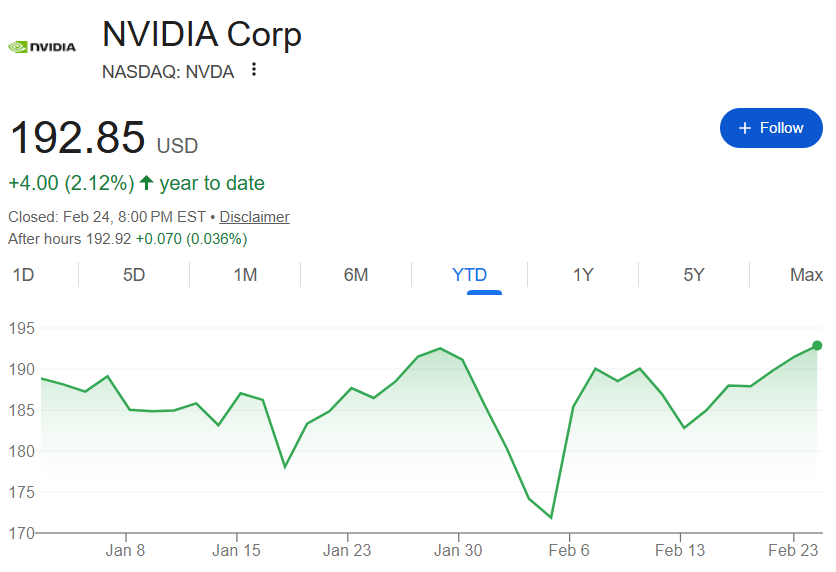
Group 1 - Nvidia is set to release its quarterly earnings report on February 25, with a generally optimistic market expectation, but analysts believe the stock price reaction may remain muted until the March GTC event [1][4] - According to FactSet, Nvidia's Q4 adjusted earnings per share are expected to be $1.54, with revenue projected at $66.1 billion, including $60.7 billion from the data center business [4] - The stock has only risen about 2% this year, significantly lagging behind the Philadelphia Semiconductor Index's 16% increase during the same period [1][4] Group 2 - Key issues for the earnings call include maintaining gross margins amid rising storage chip costs and the competitive landscape, particularly with custom chip projects like Google's TPU [5][6] - Analysts suggest that Nvidia's performance will serve as a benchmark for assessing AI spending trends and will provide insights into the operational status of emerging cloud computing partners [4][6] - Despite strong demand for Nvidia GPUs, the long-term sustainability of its market dominance is being questioned due to increasing competition [6]


“商品大王”:绝不会卖掉金银铜!春节假期将至,如何操作?
Qi Huo Ri Bao· 2026-02-10 23:43
Group 1: Market Insights from Jim Rogers - Jim Rogers has liquidated all his U.S. stock holdings and is focusing on physical commodities like gold, silver, and copper as a "perfect insurance policy" for potential crises [1][2] - He emphasizes the importance of holding gold and silver, stating they will serve as a crucial refuge in times of crisis and can also provide significant returns if the market conditions are favorable [1] - Rogers highlights the increasing demand for copper across various industries, particularly in electric vehicles and electronics, while noting the limited new copper mines being developed globally [1] Group 2: Market Conditions Ahead of Chinese New Year - As the Chinese New Year approaches, the domestic futures market will enter a holiday period while overseas markets continue trading, with macroeconomic data and geopolitical tensions likely influencing market conditions [3] - Analysts suggest that despite limited significant macroeconomic data during the holiday, geopolitical uncertainties require careful position management and risk hedging [3] Group 3: Non-Ferrous Metals Market Outlook - The non-ferrous metals sector has experienced notable adjustments, with pressures from falling precious metal prices and declines in U.S. stock markets leading to a general pullback [4] - There is a potential risk of supply disruptions in the aluminum market due to possible military actions in the Middle East, which could significantly impact global aluminum supply [4] - The long-term outlook for non-ferrous metals remains optimistic, driven by continued demand from AI infrastructure investments and global manufacturing support [4][5] Group 4: Precious Metals Price Volatility - Precious metals are currently experiencing price volatility, with a notable decline in prices but a decrease in volatility levels, indicating a potential stabilization phase [7] - Market sentiment remains bullish on gold's mid-term prospects, while silver and platinum are more volatile due to their industrial applications [7] - The recent decline in precious metal prices is viewed as a stress test for future liquidity tightening risks, with gold still holding significant long-term investment value [7] Group 5: Oil Market Dynamics - The oil market is heavily influenced by geopolitical developments, particularly the outcomes of U.S.-Iran negotiations, which could significantly affect oil prices [8] - Current oil prices reflect a certain level of geopolitical risk premium, and if tensions do not escalate, prices may enter a recovery phase [8] - The ongoing Russia-Ukraine negotiations are also critical, as any progress or setbacks could impact oil price volatility [8]
突发!特朗普:或向中东再派一支航母打击群!内塔尼亚胡紧急访美!“商品大王”:绝不会卖掉金银铜
Qi Huo Ri Bao· 2026-02-10 23:40
Group 1: US-Iran Relations - President Trump is considering deploying another aircraft carrier strike group to the Middle East if negotiations with Iran fail, emphasizing that Iran must not possess nuclear weapons or missiles [1] - The second round of US-Iran negotiations is expected to take place next week, with Trump stating that any agreement must address both nuclear and ballistic missile issues [1] - Israeli Prime Minister Netanyahu is traveling to the US to provide new intelligence on Iran's military capabilities, particularly regarding its ballistic missile capabilities [2] Group 2: Israeli Stance - Netanyahu's visit to the US is aimed at presenting Israel's principled stance on Iran, which he claims is crucial for all nations seeking peace and security [2] - Iran's Foreign Minister has accused Netanyahu of attempting to drag the US into a war with Iran, asserting that Netanyahu supports war over diplomacy [4] Group 3: Market Insights - Jim Rogers, a prominent investor, has liquidated all his US stock holdings, opting instead for physical commodities like gold, silver, and copper as a hedge against potential crises [5] - Rogers advises that holding gold and silver is essential for both risk management and potential profit, while copper demand is expected to rise due to its widespread use in various industries [5] Group 4: Commodity Market Outlook - The non-ferrous metals sector has faced notable adjustments, with pressures from falling precious metal prices and declining US stock markets [8] - Analysts suggest that if the US takes military action against Iran, it could escalate conflicts in the Middle East, potentially disrupting aluminum supply and supporting prices [8] - The overall outlook for non-ferrous metals remains optimistic in the medium term, driven by global fiscal expansion and increased demand from technology sectors [8][9] Group 5: Precious Metals Analysis - Precious metals are currently experiencing volatility, with prices having declined significantly but showing signs of stabilization [10] - Market sentiment remains bullish on gold in the medium term, while silver and platinum are more volatile due to their industrial applications [10] Group 6: Oil Market Dynamics - The oil market is heavily influenced by geopolitical developments, particularly the US-Iran negotiations, which will significantly impact price movements [11][12] - Analysts recommend cautious trading strategies, including options to hedge against potential price fluctuations during the holiday period [12]
微软市值一夜蒸发超2.4万亿
Jin Rong Jie· 2026-01-29 23:43
Core Viewpoint - Microsoft's stock price dropped by 10%, resulting in a market value loss of $357.7 billion, marking the second-largest single-day market value loss on record. This event reignited concerns in the market regarding the substantial investments in AI infrastructure in Silicon Valley, negatively impacting overall Wall Street performance [1]. Company Impact - Tesla's stock fell by over 3% following the news [1]. - Oracle's stock decreased by more than 2% in response to the market sentiment [1]. - Meta's stock experienced a rise of over 10%, indicating a potential divergence in market reactions [1]. - IBM's stock increased by over 5%, suggesting a positive market response compared to other tech companies [1].

光纤涨价“引爆”亨通光电股价,崔根良父子能否借势“翻身”?
Huan Qiu Lao Hu Cai Jing· 2026-01-28 12:10
Core Viewpoint - The recent surge in the stock price of Hengtong Optic-Electric is attributed to a significant long-term supply agreement between Meta and Corning, valued at approximately $6 billion, which will enhance the demand for optical fibers, Hengtong's core business [1][3]. Group 1: Stock Performance - On January 28, Hengtong Optic-Electric's stock rose by 5.52%, closing at 33.62 yuan per share, with a cumulative increase of 35.95% since the beginning of the year [3]. - The stock price has increased from 15.14 yuan to 33.62 yuan since the second half of 2025, representing a total increase of 122.06% [3]. - The demand for optical fibers is expected to grow significantly due to the acceleration of global AI infrastructure investments, with the AI optical fiber market projected to reach $2.1 billion by 2027, growing at a compound annual growth rate (CAGR) of approximately 73% from 2024 to 2027 [3]. Group 2: Financial Performance - For the first three quarters of 2025, Hengtong Optic-Electric reported revenues of 49.621 billion yuan, a year-on-year increase of 17.03%, and a net profit of 2.375 billion yuan, up 2.64% [5]. - The company's revenue for the third quarter was 17.572 billion yuan, reflecting an 11.32% year-on-year growth, while net profit increased by 8.10% to 763 million yuan [5]. Group 3: Business Expansion and Challenges - Hengtong Optic-Electric has made significant technological advancements in hollow-core optical fibers, achieving a loss of ≤0.2 dB/km, which meets international standards [4]. - The financial structure of the Hengtong Group has become strained due to extensive external expansion, leading to frequent pledging of shares to secure funding, with the market value of pledged shares amounting to approximately 10.56 billion yuan for Hengtong Optic-Electric [7][8]. - The group has also faced declining performance in its other listed companies, with Hengtong Shares' net profit dropping from 482 million yuan to 189 million yuan, and Mengguli turning from profit to a loss of 71.3 million yuan in 2024 [7]. Group 4: Leadership Transition - The leadership of the Hengtong Group is gradually transitioning to Cui Wei, the son of founder Cui Genliang, who has been groomed for this role through various positions within the company since 2014 [9][10]. - In October 2023, Hengtong Group announced a capital increase, with Cui Wei subscribing to 2.7 billion yuan, resulting in him holding 73% of the group, while his father retains 27% [10][11].

投资者为何应考虑“撤出美元”?专访BCA Research首席新兴市场策略师
第一财经· 2026-01-16 12:21
Core Viewpoint - The article discusses the gradual fading of the "American exceptionalism" narrative in global capital markets, highlighting a shift in leadership from U.S. equities to other global markets, with a recommendation for investors to consider withdrawing from the dollar [3][4]. Dollar Depreciation Logic - The driving logic behind the dollar's depreciation has shifted from "interest rate differentials" to "balance of payments" due to limited room for interest rate cuts and insufficient capital inflows to support the large current account deficit of approximately $1.4 trillion [6][7]. - Foreign investment in U.S. stocks reached a record net inflow of $700 billion over the past year, with a similar amount in the bond market, but this trend is expected to reverse, leading to a significant drop in total securities investment inflows [6][7]. - A reduction in capital inflows will force the dollar to depreciate, as U.S. consumers will struggle to purchase imports without sufficient external financing, leading to a deep correction in the dollar's value [6][8]. Market Leadership Transition - The article posits that the leadership of global stock markets is changing, with a bearish outlook on U.S. equities due to the belief that future growth will not match historical performance [9][10]. - The current high price-to-earnings (P/E) ratios in U.S. markets may reflect a market bubble, as the PEG ratio does not account for potential future growth declines [9][10]. - The shift in the technology sector's capital discipline is noted, with large investments in AI infrastructure expected to lead to lower capital returns in the coming years, as initial high costs will not be matched by profits [10][12]. Investment Recommendations - The strategist recommends a "neutral" allocation to emerging markets relative to global stock benchmarks, while advising a significant underweight in U.S. equities [13][14]. - Emerging markets are expected to perform better than U.S. stocks in a weakening dollar environment, despite their cyclical nature and reliance on global trade [13][14]. - Japan is favored due to the undervaluation of the yen, while Europe is seen as having potential for relative market performance despite growth concerns, as capital flows may shift back to Europe with a weakening U.S. market [14].