Workflow
贸易谈判
icon
Search documents
中国住建部称将更大力度推动房地产市场止跌回稳
Dong Zheng Qi Huo· 2025-07-07 00:45
日度报告——综合晨报 中国住建部称将更大力度推动房地产市场止 跌回稳 [T报ab告le_日R期an:k] 2025-07-07 宏观策略(黄金) 美国财长贝森特:贸易谈判的最后阶段出现僵局 周五金价震荡微跌,美国独立日休市海外市场交易较为清淡, 市场聚焦关税暂缓期到期后美国对等关税落地情况,9 日前仍有 谈判在推进,主要是欧盟和日本还未与美国达成协议。 宏观策略(股指期货) 住建部:更大力度推动房地产市场止跌回稳 综 合 近期股市情绪持续升温,新题材涌现,使得市场顶住高估压力 持续上涨。这种单边堰塞湖的状态,后续需要基本面回升来夯 实行情。此外海外关税扰动仍不可忽视 晨 宏观策略(国债期货) 报 央行开展了 340 亿元 7 天期逆回购操作 展望下周,预计资金面仍然偏松,债市做多动能继续积累,但 长端品种突破尚需等待。 农产品(豆油/菜油/棕榈油) Mysteel 数据:全国主要油厂大豆压榨预估调查统计 45Z 税收抵免通过,关注 7 月 8 日听证会。 黑色金属(螺纹钢/热轧卷板) 6 月下旬重点钢企钢材库存量 1545 万吨 反内卷政策预期带动钢价偏强,基本面仍有支撑,五大品种库 存并未进一步累积。但随着 ...
据CBS:美国白宫经济顾问哈塞特表示,部分贸易谈判可能会超过截止日期。
news flash· 2025-07-06 14:43
据CBS:美国白宫经济顾问哈塞特表示,部分贸易谈判可能会超过截止日期。 ...
美国财长贝森特:贸易谈判进入最后阶段,形势十分拥挤。
news flash· 2025-07-06 13:25
美国财长贝森特:贸易谈判进入最后阶段,形势十分拥挤。 ...
美国财长贝森特:与欧盟的贸易谈判正在取得进展,美国在与欧盟的贸易谈判中占优势。
news flash· 2025-07-06 13:25
美国财长贝森特:与欧盟的贸易谈判正在取得进展,美国在与欧盟的贸易谈判中占优势。 ...
国泰君安期货研究周报:农产品-20250706
Guo Tai Jun An Qi Huo· 2025-07-06 12:49
Report Summary 1. Report Industry Investment Rating No investment rating information is provided in the report. 2. Core Views - **Palm Oil**: It is in a situation of weak reality and strong expectation. The short - term pressure comes from the复产 situation. If there is excessive inventory accumulation from August to September or poor demand sentiment in China and India, it is suitable for seasonal short - allocation, mainly using the 9 - 1 reverse spread strategy. There is still room for price pressure to be released due to the concentrated listing of European rapeseed and potential downward pressure on crude oil. In the second half of the year, there are potential positives in production and demand. After the fundamental problems are digested in the third quarter, there may be opportunities to go long on palm oil at low positions [4][5][9]. - **Soybean Oil**: It is also in a pattern of weak reality and strong expectation. Currently, inventory is accumulating rapidly, but it may peak in July. After the third quarter, if there are issues in soybean imports, there may be opportunities to go long on soybean oil and narrow the spread between rapeseed oil and soybean oil. Attention should be paid to the expected change in palm oil inventory inflection point and the US soybean oil biodiesel policy [8][9]. - **Soybean Meal and Soybean No.1**: It is expected that the prices of soybean meal and soybean No.1 futures will fluctuate. For soybean meal, attention should be paid to US trade agreements, US soybean production area weather, and the July USDA supply - demand report. For domestic soybeans, the spot market is stable, and the futures price is expected to fluctuate with the soybean market [22]. - **Corn**: It is expected to run in a volatile manner. CBOT corn has risen, wheat prices have increased, and corn starch inventory has risen. The futures market has declined due to import corn auctions, but the supply - demand imbalance pattern remains unchanged [42][44][47]. - **Sugar**: Internationally, it is in low - level consolidation, with a pattern of strong reality and weak expectation. Domestically, it lacks guidance and is in narrow - range consolidation, with an internal - strong and external - weak pattern continuing [79][108]. - **Cotton**: ICE cotton is in a low - level volatile market, affected by the higher - than - expected US cotton planting area and the approaching deadline of US tariff policy. Domestic cotton futures are also in a volatile trend, with price support from concerns about tight domestic cotton inventory, but limited upward momentum due to poor downstream conditions [109][110][126]. - **Hogs**: The spot price is running strongly, with tight supply at the beginning of the month and decreased demand. The futures price is also running strongly [130]. 3. Summaries According to Relevant Catalogs Palm Oil and Soybean Oil - **Last Week's Situation**: Palm oil followed crude oil and US soybean oil, with the 09 contract rising 1.15%. Soybean oil had weak reality trading, with the 09 contract falling 0.72% [4]. - **This Week's Situation**: Palm oil is in an oscillatingly strong pattern, but there are uncertainties in Malaysian production from June to August. Indonesian prices are high, and the market is sensitive to the reduction of US soybean oil supply. Soybean oil inventory may peak in July, and there are potential positives after the third quarter [5][8]. - **Market Data**: Palm oil main - continuous contract had an opening price of 8,366 yuan/ton, a closing price of 8,472 yuan/ton, and a weekly increase of 1.15%. Soybean oil main - continuous contract had an opening price of 7,994 yuan/ton, a closing price of 7,944 yuan/ton, and a weekly decrease of 0.72% [11]. Soybean Meal and Soybean No.1 - **Last Week's Situation**: US soybean futures prices rose mainly due to the rise of US soybean oil and potential progress in US - China trade negotiations. Domestic soybean meal futures prices were mixed, and soybean No.1 futures prices were weak [17][18]. - **International Market Fundamentals**: US soybean net sales increased week - on - week, the excellent - good rate was flat, Brazilian soybean CNF premiums and import costs increased, and the USDA planting area report was positive while the quarterly inventory report was negative [18]. - **Domestic Spot Situation**: For soybean meal, trading volume increased, pick - up volume decreased, basis decreased, inventory increased, and soybean crushing volume decreased. For soybean No.1, the price was stable in the north and rose slightly in the south, and new beans in the northeast were growing well [21][22]. Corn - **Market Review**: In the spot market, corn prices rose in the week of July 4. In the futures market, prices fell due to import corn auctions, and the basis strengthened [42][43]. - **Market Outlook**: CBOT corn rose due to expected rainfall. Wheat prices increased, and import corn auctions were active. Corn starch inventory increased, and the futures market declined due to policy - driven imports, but the supply - demand imbalance remained [44][45][47]. Sugar - **This Week's Market Review**: Internationally, the US dollar index decreased, the US dollar - Brazilian real exchange rate decreased, WTI crude oil prices fell, and New York raw sugar prices fell. Fund net long positions decreased significantly. Domestically, the spot price in Guangxi rose slightly, and Zhengzhou sugar futures prices fell slightly, with a slightly higher basis [77][78]. - **Next Week's Market Outlook**: Internationally, it is in low - level consolidation, with a pattern of strong reality and weak expectation. Domestically, it lacks guidance and is in narrow - range consolidation, with an internal - strong and external - weak pattern continuing [79]. Cotton - **Situation as of July 4**: ICE cotton fell 1.28% after the release of the US cotton planting area report. Domestic textile enterprises' operating conditions did not improve, and domestic cotton futures were oscillatingly strong, with limited upward momentum due to poor downstream conditions [109][110]. - **Fundamentals**: Internationally, US cotton export sales data showed different trends in different periods. Other major cotton - producing and consuming countries had different situations in planting, production, and trade. Domestically, cotton spot trading was weak, prices were stable, and downstream trading was still light [114][115][121]. Hogs - **This Week's Market Review (June 30 - July 6)**: In the spot market, hog prices were running strongly, with tight supply and decreased demand. In the futures market, the price was also running strongly, and the basis decreased slightly [130].
欧盟内部对美贸易立场分歧明显 德媒称谈判前景不乐观
news flash· 2025-07-06 09:29
德国《商报》当地时间7月6日发表评论文章称,欧盟与美国之间围绕新一轮贸易安排的谈判正进入关键 阶段。德国与意大利因出口依赖倾向推动尽快达成协议,而法国、西班牙、丹麦等国则对可能的让步表 示担忧。欧盟在对美贸易立场上的分歧日益凸显,相关谈判进展缓慢,前景不容乐观。文章指出,尽管 欧盟委员会主席冯德莱恩强调希望达成"框架性协议",以避免美方新一轮关税措施生效,但多方担忧欧 方在压力下被迫接受一份"不对等"的协议。多名外交人士直言,目前谈判结果可能对欧盟整体不利。 (央视新闻) ...
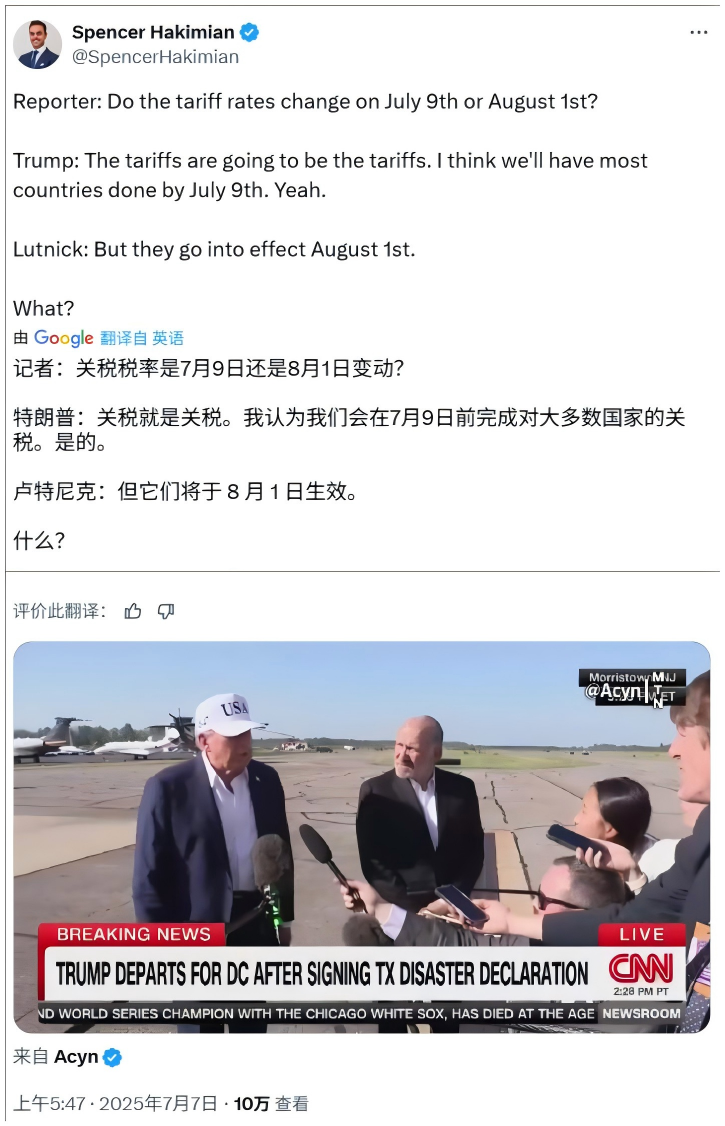
重磅!美国8月1日起关税上限或飙至70%
Huan Qiu Wang· 2025-07-06 01:38
Core Points - The U.S. government is set to implement new unilateral tariffs starting August 1, with the President indicating that the rates could range from 10% to 70% [1][2] - The President has criticized certain trade partners, including the EU and Japan, for being too rigid in negotiations, and has threatened high tariffs, particularly on Japan [2][4] - The trade negotiations with Japan are particularly contentious over the automotive and agricultural sectors, with Japan refusing to compromise on its agricultural policies [4] - India has also drawn "red lines" in negotiations, particularly concerning agriculture and dairy products, indicating a strong stance to protect its farmers [4] - The EU is pushing for a tougher stance in negotiations with the U.S., particularly regarding high industry tariffs, and is facing potential expansion of U.S. tariffs to additional sectors [5] - Recent U.S. trade data shows a decline in both imports and exports, indicating the negative impact of the current tariff policies on the U.S. economy [6] Group 1 - The U.S. will send letters to multiple countries regarding new tariffs, with expectations of 10 to 12 letters being sent out [1] - The President has set July 9 as the deadline for tariff negotiations, indicating urgency in the discussions [1][2] - The potential for tariffs exceeding 50% could exacerbate inflation risks in the U.S. economy [2] Group 2 - Japan's core industries, particularly automotive, are significantly affected by proposed U.S. tariffs, with a 25% tariff on cars posing a major economic threat [4] - India's firm stance on agricultural tariffs reflects the sensitivity of these issues in trade negotiations [4] - The EU is advocating for a united front against U.S. tariff increases, emphasizing the need for retaliatory measures [5]
市场消息:印度可能在与美国的贸易谈判中对转基因动物饲料做出让步,但在乳制品和农业问题上维持坚定立场。
news flash· 2025-07-05 10:54
Core Viewpoint - India is likely to make concessions on genetically modified animal feed in trade negotiations with the United States, while maintaining a firm stance on dairy and agricultural issues [1] Group 1 - India may show flexibility regarding genetically modified animal feed during trade talks with the U.S. [1] - The country is expected to uphold a strong position on dairy products and agricultural matters [1]
宋雪涛:关税豁免日到期后会发生什么?
雪涛宏观笔记· 2025-07-05 07:59
Core Viewpoint - The article discusses the ongoing trade negotiations between the United States and various countries, focusing on the U.S. demands in the tariff negotiations and the potential outcomes as the July 9 deadline approaches [2][21]. Group 1: U.S. Demands in Tariff Negotiations - The U.S. aims to use "reciprocal tariffs" as leverage to increase government revenue, reduce fiscal spending, attract foreign investment, enhance supply chain security, and create a more favorable global operating environment for American companies [3]. - One of the primary demands is to expand U.S. exports, particularly in the energy and agricultural sectors, which account for an average of 28% of total U.S. exports over the past five years [4][5]. - The U.S. government seeks to reduce overseas spending, particularly foreign aid, using tariffs as a tool to compel recipient countries to lessen their dependency on U.S. support [6]. - Another key demand is to promote the return of manufacturing to the U.S. to enhance supply chain resilience, especially in critical industries like semiconductors and medical supplies [9][10]. Group 2: Specific Negotiation Developments - The U.S. has made significant progress in negotiations with countries like India, Pakistan, and Switzerland, with expectations of reaching trade agreements or frameworks [15][21]. - The article highlights specific investments from various countries, such as Diageo's $415 million investment in Alabama and Japan's $44 billion investment in a natural gas project in Alaska, indicating active engagement in trade discussions [11]. - The U.S. has also been addressing discriminatory taxes imposed by other countries, particularly the digital services tax (DST), which targets major U.S. tech companies [12][13]. Group 3: Potential Outcomes and Future Negotiations - As the July 9 deadline approaches, the U.S. has shown a fluctuating stance on tariff increases, indicating that the outcome will depend on the substantive compromises made by both parties [14][21]. - Countries like the EU and Japan face significant uncertainties in negotiations due to disagreements over issues like the digital services tax and automotive tariffs [18]. - The article suggests that countries with large trade deficits with the U.S. may agree to purchase more American goods and ease market access in order to reach trade agreements [16][20].