Agentic AI

Search documents
Elastic Achieves the AWS Agentic AI Specialization
Businesswire· 2025-12-01 14:20
Core Insights - Elastic has achieved the Amazon Web Services (AWS) Agentic AI Specialization, recognizing its capabilities in deploying smart, self-operating AI systems [1] Company Summary - The AWS Agentic AI Specialization is a new category within the AWS AI Competency, highlighting Elastic as a partner that enables customers to implement complex business processes through AI [1]


CrowdStrike Operationalizes and Secures Agentic AI Workloads on AWS
Businesswire· 2025-12-01 13:02
Core Insights - CrowdStrike has been recognized as an inaugural AWS Agentic AI Specialization Partner, highlighting its expertise in securing and operationalizing intelligent AI systems at scale [1][2] - The collaboration aims to transform cybersecurity operations by integrating human expertise with intelligent AI agents to enhance breach prevention and secure autonomous systems [2][4] Group 1: Operationalizing Security Agents - CrowdStrike is transitioning security analysts from alert handlers to orchestrators within the agentic Security Operations Center (SOC), where intelligent agents handle time-consuming tasks [3] - The company is enhancing protection for the entire AI lifecycle for customers using AWS, focusing on securing AI applications, services, and large language models [3] - CrowdStrike's acquisition of Pangea allows it to secure the interaction layer of AI systems, providing the industry's first complete AI Detection and Response (AIDR) solution [3] Group 2: Agentic Security Platform - The Agentic Security Platform offers a rich AI-ready data layer, providing complete environmental context and making signals actionable for both agents and analysts [5] - The platform includes the Agentic Security Workforce, which features mission-ready agents trained on real human expertise and response actions [5] - Charlotte AI AgentWorks enables organizations to build and customize their own agents without coding, while Charlotte Agentic SOAR orchestrates collaboration among various agents [5] Group 3: Future of Agentic AI - CrowdStrike emphasizes that secure AI is essential for scaling operations with confidence and trust, enabling customers to innovate safely and efficiently [4] - The partnership with AWS is focused on operationalizing and securing the future of agentic AI, allowing customers to build, deploy, and scale autonomous systems in the cloud [4]


The Top 5 CPG Tech Trends Shaping 2026
Prnewswire· 2025-12-01 12:58
Core Insights - Technology is fundamentally redefining the consumer goods industry, with Kellanova identifying it as a catalyst for growth and innovation [2][3][20] Group 1: Key Technology Trends - **Agentic AI**: This technology enables real-time data analysis, recommendations, and actions without human intervention, enhancing operational efficiency and decision-making speed [5][6][7] - **Advanced Analytics**: The rise of data from digital interactions allows brands to gain deeper consumer insights, leading to more effective marketing strategies and improved ROI [8][9][10] - **Connected Commerce**: The integration of digital and physical shopping experiences is essential, creating seamless consumer journeys across channels [12][13] - **Smart Supply Chains**: Utilizing IoT, predictive analytics, and blockchain enhances supply chain resilience, transparency, and consumer trust [14][15] - **Sustainable Tech**: The focus on sustainability is intertwined with technological advancements, promoting a circular economy and responsible business practices [16][17] Group 2: Company Strategy and Vision - Kellanova aims to leverage technology to connect insights to actions, enhancing agility and adaptability in a rapidly changing market [3][20] - The company is committed to sustainability, integrating it into every stage of its innovation pipeline, and addressing consumer values through measurable progress [17][22] - Kellanova's vision is to become a leading snacks-led powerhouse, with a goal of creating better days for 4 billion people by 2030 [21][22]



Wall Street Breakfast Podcast: Japanese Yields Causing Tremors
Seeking Alpha· 2025-12-01 12:25
Group 1: Japanese Government Bonds and Market Impact - A significant increase in Japanese government bond (JGB) yields has occurred, reaching levels not seen since 2008, raising concerns about carry trades and affecting global markets [2][3] - The 2-year yield surpassed 1%, the 5-year yield approached 1.4%, and the benchmark 10-year yield exceeded 1.85%, all marking the highest levels since 2008 [3] - The Bank of Japan Governor Kazuo Ueda indicated that the bank would continue to raise policy interest rates if economic conditions align as expected, which could lead to capital repatriation from overseas bonds [4][5] Group 2: Databricks Valuation and Financial Performance - Databricks is in discussions to raise approximately $5 billion at a valuation of $134 billion, which is nearly 32 times the expected sales of about $4.1 billion for the year [6] - The company has raised its sales forecast multiple times this year, now anticipating a 55% increase in sales [6] - Databricks reported a faster-than-expected decline in gross margin to 74%, down from an earlier target of 77%, attributed to increased usage of its AI products [7] Group 3: Federal Reserve Chair Speculation - President Donald Trump has indicated he knows who he will nominate as the next Federal Reserve chair, with Kevin Hassett currently having a 77% chance of the nomination according to prediction markets [8]

Jensen Huang Says This Artificial Intelligence Transition Will Be "Revolutionary"
The Motley Fool· 2025-11-30 21:27
Core Insights - Nvidia continues to see significant growth opportunities in artificial intelligence (AI) despite a slight slowdown in sales growth [1][2] - CEO Jensen Huang anticipates a "revolutionary" transition in AI, which could lead to new applications and services [2][3] - The company reported record revenue of $57 billion for the quarter ending October 26, marking a 62% year-over-year increase [7] Financial Performance - Nvidia's market capitalization stands at $4.3 trillion, making it the most valuable company globally [9] - The company expects sales to rise to approximately $65 billion in the current quarter, with gross profit margins projected at about 75% [8] - Nvidia's forward price-to-earnings multiple is 23, slightly above the S&P 500 average of 21, indicating a justified premium based on its growth prospects [9] AI Growth Potential - The transition to agentic AI is expected to create new applications beyond current capabilities, such as complex task management [3] - Physical AI is identified as the next growth leg for Nvidia, with potential applications in robotics and autonomous vehicles, representing a multitrillion-dollar opportunity [5][6] - Nvidia's Chief Financial Officer highlighted the transformative potential of AI across various industries [6]


Portfolio Update +129%. ALL TIME HIGHS
Austin.Substack· 2025-11-30 12:17
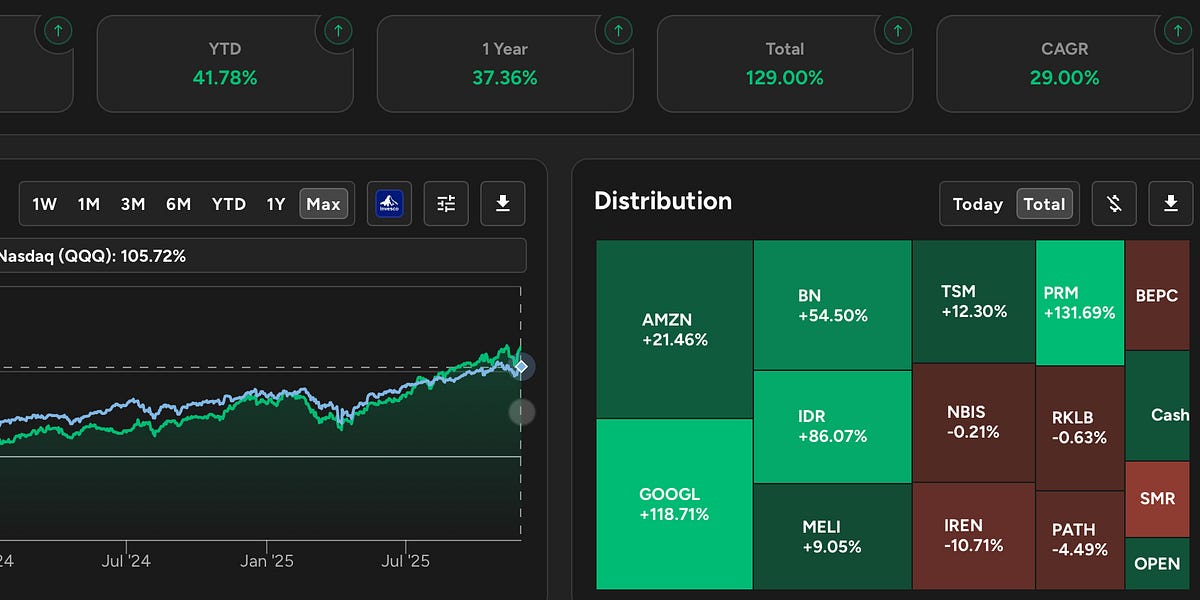
Core Insights - The portfolio has shown strong performance, increasing by 129% since August 29, 2022, compared to a 106% return of the QQQ, with a compound annual growth rate (CAGR) of 29% [4] Company Performance - Analysts expect UiPath's Q3 2026 revenue to be around $392–$393 million and earnings per share (EPS) to be approximately $0.14–$0.15 (adjusted) [8] - The Annualized Renewal Run-Rate (ARR) is projected to reach roughly $1.77 billion, which is a critical metric for subscription software companies [9] Business Strategy - UiPath is transitioning from "Robotic Process Automation" to "Agentic Automation," focusing on AI agents capable of autonomous actions [10] - Management needs to demonstrate customer adoption of new AI products, with specific customer wins or partnerships being crucial for validation [10] Risks and Challenges - The company faces shareholder class-action lawsuits alleging management overstated the success of their AI strategy, adding uncertainty [11] - Consistent insider selling by CEO Daniel Dines may negatively impact investor sentiment [12] Financial Health - UiPath maintains a strong balance sheet with significant cash reserves and no debt, alongside a healthy net retention rate of approximately 108% [13]

MercadoLibre (MELI) Q3 2025 Earnings Transcript
Yahoo Finance· 2025-11-27 23:32
Core Insights - The company reported a 39% year-on-year revenue growth, marking the 27th consecutive quarter of growth above 30% [4][76] - Strategic investments in logistics, free shipping, and credit card offerings are driving growth while putting some pressure on EBIT margins [1][4] - Argentina remains a key market with strong long-term growth potential despite macroeconomic challenges [7][10] Financial Performance - Operating income reached USD 724 million, growing by 30% year-on-year [1] - Revenue growth in Argentina was 39% year-on-year in USD and 97% in local currency, with items sold increasing by 34% [8] - The credit portfolio grew by 100% year-on-year while maintaining low first pay defaults [9] Market Dynamics - The reduction in the free shipping threshold in Brazil has led to accelerated GMV and items sold, with items sold growth increasing from 26% to 42% quarter-on-quarter [29] - Monthly active users in Mercado Pago grew significantly, with record high NPS levels in Brazil [3][52] - The company is experiencing strong demand from sellers, particularly in the lower price range, leading to increased listings [3] Strategic Initiatives - The company opened a second fulfillment center in Argentina and launched a new credit card, indicating ongoing investment in growth [7][38] - Marketing spend represented about 11% of revenues, with a focus on user acquisition through performance and affiliate channels [15][16] - The company is deploying robotics and technology in warehouses to improve efficiency and reduce shipping costs, which decreased by 8% quarter-on-quarter in Brazil [22][25] User Engagement - The total unique buyers on the platform reached 75 million, with 7.8 million being new buyers in the latest quarter [12][39] - The company is focused on improving the value proposition for users, which has resulted in higher retention and conversion rates [52][66] - The credit card business is seeing positive engagement metrics, with older cohorts becoming profitable [26][60] Competitive Landscape - The company maintains a strong market position in Brazil, with a tripling of market share since 2014 and a doubling since the pandemic [72] - The competitive environment remains intense, but the company believes its strategies are rational and focused on user satisfaction [71][73] - The company is optimistic about future growth opportunities in both e-commerce and fintech sectors [4][51]

无问芯穹宣布获近5亿元A+轮融资,珠海科技集团领投
Xin Lang Ke Ji· 2025-11-27 12:10
Core Insights - AI infrastructure company Wunwen Xinqiong has completed nearly 500 million yuan in A+ round financing, led by Zhuhai Technology Group and Foton Capital, with participation from several other investors [1][2] - The funds will be primarily used to enhance technological advantages, expand AI cloud products and terminal solutions, and increase investment in intelligent infrastructure development [1] Group 1 - The financing round aims to strengthen Wunwen Xinqiong's soft and hard technology collaboration and heterogeneous advantages [1] - The company plans to scale AI cloud products and terminal solutions in various industries [1] - There will be a significant increase in R&D investment for intelligent infrastructure to build a top-tier service platform and supporting cloud and terminal infrastructure [1] Group 2 - CEO Xia Lixue emphasized that the paradigm shift towards Agentic AI represents both a strategic opportunity and a mission for the company [2] - Wunwen Xinqiong has successfully transitioned to a native infrastructure for intelligent agents, leveraging years of technical expertise in AI systems [2] - The company aims to optimize AI infrastructure systems and build an ecosystem focused on producing, collaborating, and servicing intelligent agents [2]
珠海上海联手,投了一对清华师徒
3 6 Ke· 2025-11-27 04:46
Core Insights - Wuwen Chipong has successfully completed an A+ round financing of nearly 500 million yuan, led by Zhuhai Technology Group and Futeng Capital, with participation from various other investors [1][2] - The company, founded in May 2023 by Professor Wang Yu from Tsinghua University, aims to be a leading "computing power operator" in the Agentic AI era [1][2] - The financing was finalized in the first half of the year, and the company has now completed the technology achievement transformation process [1][4] Company Positioning - Wuwen Chipong is positioned as a key player in the AI infrastructure sector, which is less visible compared to high-profile areas like robotics and large models, but is crucial for the AI industry [2][3] - The company has seen significant market growth, with a tenfold increase in the inference market from last year to this year [7][8] - The shift in narrative from AI Infra to Agentic Infra reflects the company's evolution in understanding the role of AI as a collaborator rather than just a tool [8][9] Market Dynamics - The capital market's focus has shifted from single-point technological breakthroughs to a more comprehensive view of the entire industry chain, especially after the emergence of Deepseek [3][7] - The collaboration with Zhuhai's local state-owned assets is seen as a natural outcome of shared visions regarding AI development [3][4] - The company aims to integrate various AI technologies into its infrastructure, enhancing its capabilities and market offerings [8][9] Future Aspirations - Wuwen Chipong aspires to become a major computing power operator in China, facilitating the integration of chip hardware, computing services, and AI [15][16] - The company is focused on supporting innovative teams and entrepreneurs in the AI space, promoting a flexible and supportive ecosystem [6][12] - The ultimate goal is to make AI accessible to a broader audience, enhancing its application in everyday life [15][16]
训练AI,然后被裁?Uber AI项目突遭裁员,零工、博士都没留下来
Tai Mei Ti A P P· 2025-11-27 03:20
Group 1 - Uber's AI training program "Project Sandbox" has recently laid off many project members due to changes in client internal priorities, despite initial commitments of at least three months of employment [2] - The layoffs affected both gig workers and PhD holders, with many employees not having received their first paycheck yet, which may be delayed by up to seven weeks [2] - Project Sandbox was launched a month ago, primarily to assist Google in developing AI tools, involving over ten outsourcing companies [2][3] Group 2 - Uber has been accelerating its AI business development, leveraging its experience in ride-hailing and food delivery to optimize pricing, matching, and scheduling efficiency [3] - The company aims to help clients build and test smarter AI models and applications by utilizing its decade-long data accumulation and business experience [3] - Uber's focus on Agentic AI is highlighted in its official publication detailing the requirements for large-scale adoption by 2026, emphasizing the need for extensive human input [4] Group 3 - The AI data labeling industry has seen significant growth, with many individuals participating in AI training tasks, some as a career path and others as a side income [4] - Companies like Surge AI and Scale AI are providing artificial training services for tech giants, but the market remains unstable, with layoffs being a common occurrence [5] - Major AI companies, including Scale AI, have initiated large-scale layoffs due to client losses and operational issues, with Scale AI laying off over 200 full-time employees and more than 500 contractors [6] Group 4 - Meta has also begun significant layoffs in its AI division, with plans to cut 600 AI-related positions between October and November [7] - Despite the current lack of visible impact on overall employment from AI, job postings in data analysis have decreased by 40% compared to pre-pandemic levels, indicating a potential shift in the job market [7] - The early adopters of AI may achieve success, but there is a paradox where those who initially contributed to AI development may ultimately face job insecurity [8]