新型浮动费率基金

Search documents
宏利基金拟1000万自购旗下新型浮动费率基金
news flash· 2025-06-07 01:10
Group 1 - The core point of the article is that Manulife Investment plans to invest 10 million yuan in its newly launched floating rate fund, reflecting confidence in the long-term stability of the Chinese capital market [1] - The fund, named Manulife Smart Navigation Mixed Securities Investment Fund, is a new type of floating rate fund product introduced by Manulife Investment [1] - Other asset management companies such as Dongfanghong Asset Management, Tianhong Fund, Bosera Asset Management, China Europe Fund, and Xingzheng Global Fund have also announced their self-purchases since the launch of the first batch of floating rate funds on May 27 [1]
36只产品本周首发 新型浮动费率基金唱重头戏
Zhong Guo Zheng Quan Bao· 2025-06-04 21:16
Group 1 - The core viewpoint of the articles highlights the ongoing enthusiasm for new fund issuances, with 36 new products launched in a week despite only having four trading days [1][2] - The total issuance of newly established funds this year has exceeded 410 billion units, with equity funds accounting for 166.34 billion units, representing a significant increase to 39.93% of the total [1][3] - Index products continue to expand, with 11 passive index funds among the newly launched products, indicating a growing variety of investment tools for investors [1][2] Group 2 - The issuance of new floating fee rate funds has gained momentum since late May, with all 11 newly launched mixed funds being equity mixed funds [2][3] - The new floating management fee rate products link management fees to the investor's holding period and fund performance, enhancing the investment experience for investors [2] - A total of 522 new funds have been established this year, with a combined issuance of 416.61 billion units [2][3] Group 3 - The issuance of equity funds has become a key focus for fund companies this year, particularly in passive index products, with the proportion of equity fund issuance rising from 21.14% to 39.93% [4]
首只提前结募新型浮动费率基金诞生 利益共担模式获市场认可
Zheng Quan Ri Bao· 2025-06-04 16:44
Core Viewpoint - The early closure of the Oriental Red Core Value Mixed Fund marks a significant market validation of the new floating fee rate fund model, indicating a shift towards a shared interest model between public fund companies and investors [1][2]. Group 1: Fund Details - The Oriental Red Core Value Mixed Fund, launched on May 27, reached its fundraising cap of 2 billion yuan within just six working days, leading to an early end of the subscription period originally set to close on June 17 [1]. - The fund's management fee structure is linked to the performance of the fund relative to a benchmark, aligning the interests of fund managers and investors [1][2]. Group 2: Market Response - The rapid fundraising success reflects strong market enthusiasm for actively managed floating fee rate funds, particularly in a recovering equity market [2]. - The fund's manager, Zhou Yun, is recognized for his historical performance, contributing to investor confidence and interest in the product [2]. Group 3: Industry Implications - The launch of the floating fee rate fund is seen as a response to long-standing criticisms of fixed fee structures, which do not vary with fund performance [1][2]. - The initiative aligns with the China Securities Regulatory Commission's action plan aimed at promoting high-quality development in public funds, emphasizing investor-centric practices [1][3].
新型浮动费率基金刷屏!怎么“浮”?如何选?
Xin Lang Ji Jin· 2025-06-04 03:45
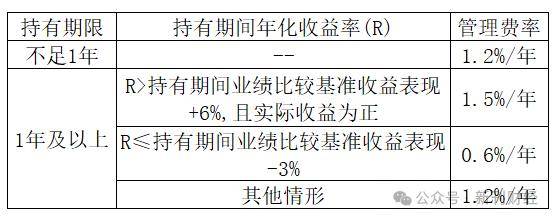
Core Viewpoint - The new round of public fund reform accelerates with the introduction of a floating management fee mechanism linked to fund performance, particularly for newly established actively managed equity funds [1][5]. Summary by Relevant Sections Floating Management Fee Mechanism - Traditional fixed-rate funds charge management fees at a constant rate, while floating management fee products adjust fees based on holding time and performance, allowing for higher fees when performance exceeds benchmarks and lower fees when it does not [1][5]. - For example, if an investor holds the Yinhua Growth Smart Selection Mixed Fund for one year, the management fee can vary based on performance: 1.5% if annualized excess return exceeds 6%, 0.6% if it is -3% or lower, and 1.2% for other scenarios [2][3][4][5]. Benefits for Investors - The new floating fee structure allows for differentiated charging, enabling a "one customer, one share" approach, which promotes personalized fee structures [6]. - It encourages long-term holding by linking fee adjustments to holding periods, thus fostering a compounding effect on investments [6]. - The mechanism promotes risk-sharing and profit-sharing, aligning the interests of fund companies and investors [6]. - It incentivizes fund managers to enhance their active management capabilities, reducing reliance on market beta returns [7]. - The performance benchmark serves as a measure to avoid style drift in fund investments [8]. Selection Criteria for Floating Fee Funds - Investors should evaluate fund managers' expertise, as their investment capabilities and styles are crucial in selecting funds [9]. - Long-term performance stability is an important indicator of a fund manager's ability, with historical performance data serving as a reference [10]. - The professional capability of the research and investment team behind the fund manager is also a significant factor in decision-making [10].
来了!新型浮动费率基金| 一文读懂
Sou Hu Cai Jing· 2025-05-30 06:02
Group 1 - The core viewpoint of the article is the introduction of a new type of floating fee rate fund, which deeply binds the interests of fund companies and investors, marking a significant innovation in the public fund reform [2][4][17]. - The first product launched under this new model is the Huatai-PineBridge Balanced Potential Preferred Mixed Fund (Class A: 024441 / Class C: 024442), which has officially started selling [3][16]. - The new floating fee rate fund is characterized by three main features: management fees linked to investor returns, a personalized fee structure, and a benchmark aligned with mainstream broad-based indices [5][6][7]. Group 2 - The floating fee rate fund is designed to adjust management fees based on the investor's holding period and performance, promoting a shared interest between the fund company and investors [17][18]. - This fund is particularly suitable for investors looking for equity asset allocation, those planning long-term investments, and investors optimistic about the revaluation of Chinese assets [8][10][12]. - The fund's design emphasizes performance benchmarks, which helps constrain fund investment style drift and encourages fund managers to enhance their active management capabilities [7][12]. Group 3 - Huatai-PineBridge has extensive experience in operating floating fee rate products, having launched similar products as early as 2016, and has a strong foundation in active equity management [13][14]. - The company has established a disciplined evaluation system based on product positioning and performance benchmarks, ensuring that fund managers are held accountable for generating excess returns [14][15]. - The fund aims to create sustainable long-term investment returns by focusing on quality stocks across various sectors, including manufacturing, TMT, consumer goods, pharmaceuticals, and cyclical industries [35].


自购绑定 全员发海报 业绩基准“分水岭” 16只同日冲锋 新型浮动费率基金闪击
Zhong Guo Zheng Quan Bao· 2025-05-27 20:31
Group 1 - The first batch of new floating rate funds was launched on May 27, with 16 products available for subscription, marking a significant transformation in the public fund industry [1][2] - The rapid issuance of these funds occurred just two trading days after receiving approval from the regulatory authority, indicating a swift response from the industry [1][2] - Initial sales were strong, with reports of some products achieving subscription scales exceeding several hundred million yuan on the first day [2] Group 2 - The fund companies have deployed their top-performing fund managers for these new products, emphasizing a balanced and stable investment style [3] - The performance benchmarks for these floating rate funds vary, with many choosing broad market indices like CSI 300 and CSI 500, reflecting the fund managers' market style predictions [4][5] - The management fees for these funds will be dynamically calculated based on the actual returns to investors, introducing a new level of operational and system capability requirements for fund companies [6][7] Group 3 - The floating management fee mechanism links the fee rate to the excess return relative to the performance benchmark, aiming to enhance investor satisfaction and promote long-term investment behavior [7] - The current market environment is viewed as a "golden window" for equity investments, with favorable external conditions and relatively low valuations in both A-share and Hong Kong markets [7]
从"规模驱动"向"回报导向"转型迈出关键一步!首批新型浮动费率基金华夏瑞享混合5月27日开售 拟任基金经理王君正
Sou Hu Cai Jing· 2025-05-27 11:44
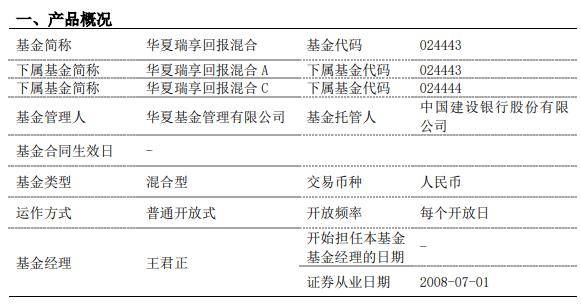
Core Viewpoint - The launch of the new floating rate fund, Huaxia Rui Xiang Mixed Fund, represents a significant shift in China's public fund industry from a "scale-driven" model to a "return-oriented" approach, aligning with the China Securities Regulatory Commission's initiative for high-quality development in public funds [1] Fund Overview - Fund Name: Huaxia Rui Xiang Mixed Fund - Fund Codes: A Class 024443, C Class 024444 - Fund Manager: Huaxia Fund Management Co., Ltd. - Custodian: China Construction Bank Co., Ltd. - Fund Type: Mixed Fund - Trading Currency: RMB - Operation Mode: Ordinary Open-end - Open Frequency: Every open day - Fund Manager: Wang Junzheng, with a securities industry experience since July 1, 2008 [2] Fee Structure - The fund's management fee consists of fixed management fees, contingent management fees, and excess management fees, which are based on the holding duration and annualized return of each fund share, adopting a tiered collection method [3] - The fee structure encourages fund managers to pursue excess returns while alleviating the burden on investors during poor performance periods [4] Investment Strategy - Wang Junzheng, the fund manager, focuses on large-cap growth stocks and employs a combination of quantitative and qualitative investment methods, favoring companies with high and stable long-term ROE [8] - The fund targets sectors such as finance, real estate, consumer healthcare, and technology manufacturing, with a positive outlook on emerging industries like automotive, innovative pharmaceuticals, and AI applications [8] Market Reception - Multiple sales channels have positively evaluated the product design, highlighting its advantages and aligning it with current investor demand for stable returns [9] - The innovative fee structure is seen as beneficial for investors, promoting a long-term investment approach and enhancing the professional capabilities of fund managers [9] - The issuance of floating rate funds like Huaxia Rui Xiang Mixed Fund is viewed as a significant innovation in the public fund industry's fee model, contributing to a virtuous cycle of value creation and improved investor experience in China's capital market [9]
5月27日ETF晚报丨多只医药生物板块ETF逆市上涨;首批新型浮动费率基金今起发行
2 1 Shi Ji Jing Ji Bao Dao· 2025-05-27 09:18
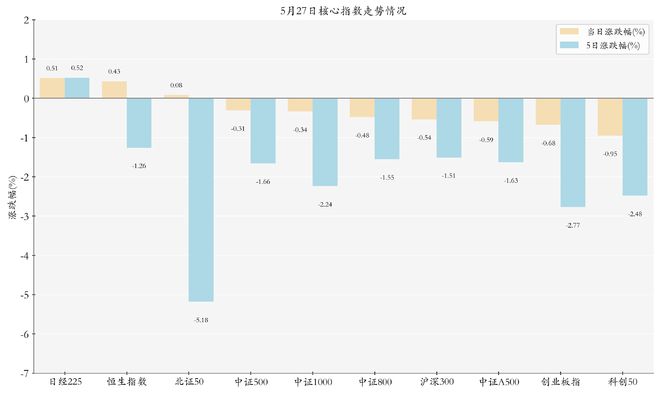
ETF Industry News - The three major indices experienced fluctuations and declines, with the Shanghai Composite Index down by 0.18%, the Shenzhen Component Index down by 0.61%, and the ChiNext Index down by 0.68. However, several ETFs in the pharmaceutical and biotechnology sector saw gains, including the Huatai-PB Innovation Drug ETF (517120.SH) up by 1.96%, the Innovation Drug ETF for Shanghai-Hong Kong-Shenzhen (517110.SH) up by 1.86%, and the Innovation Drug ETF for Hong Kong-Shenzhen (159622.SZ) up by 1.80% [1][4][11] - According to Everbright Securities, multiple domestic innovative drug research projects have been selected for the 2025 ASCO conference, indicating a robust trend in domestic pharmaceutical research, particularly in cancer treatment [1][4] - Minsheng Securities highlighted that the innovative drug sector is a key focus for the year, emphasizing areas such as anti-tumor, autoimmune, GLP-1, stem cell, and gene therapy, while also monitoring domestic innovation in pharmaceuticals and medical consumption, especially in the beauty sector [1][4] ETF Market Performance - As of April 2025, the total scale of ETFs in the Shanghai and Shenzhen markets exceeded 4 trillion yuan, with the Shanghai market having 680 ETFs valued at 29,625.45 billion yuan and the Shenzhen market having 467 ETFs valued at 10,947.55 billion yuan [3] - The cross-border ETFs performed the best today, with an average increase of 0.60%, while commodity ETFs had the worst performance, with an average decrease of 0.67% [9] - The top-performing ETFs today included the Huatai-PB Innovation Drug ETF (517120.SH), the Innovation Drug ETF for Shanghai-Hong Kong-Shenzhen (517110.SH), and the Innovation Drug ETF for Hong Kong-Shenzhen (159622.SZ), with respective gains of 1.96%, 1.86%, and 1.80% [11][12] Trading Volume - The top three ETFs by trading volume today were the A500 ETF (512050.SH) with 2.714 billion yuan, the A500 Index ETF (159351.SZ) with 2.466 billion yuan, and the CSI 300 ETF (510300.SH) with 2.285 billion yuan [14][15]
看好估值抬升空间 平安价值优享混合基金今日发行
news flash· 2025-05-27 06:32
作为业内首批上报的新型浮动费率基金,平安价值优享混合基金今日(5月27日)正式发行。平安价值优 享混合作为市场首批新模式浮动费率产品,以"业绩决定费率"机制打破传统管理费与收益脱钩的痛点, 实现基金管理人和投资人利益绑定,在提升投资者盈利体验的同时,也激励基金管理人提升投资能力和 业绩。基金经理何杰表示,当前时点布局权益投资,正逢国内政策、外部环境、市场估值等多维度共筑 的权益投资黄金窗口期,中期来看,宏观面处于外需冲击和内需提振交织的复杂阶段。但好的一面是, 市场对外需的悲观预期已经比较充分,对内需的改善预期底部抬升,判断市场整体向下空间有限,对中 长期市场持相对积极的态度。(人民财讯) ...

首批浮动费率基金发行!宏利基金孟杰“7管5亏”能否胜任
Sou Hu Cai Jing· 2025-05-27 05:35
Core Viewpoint - The introduction of new floating-rate funds by various fund companies, including Manulife, aims to address long-standing issues in the public fund industry, particularly the "guaranteed returns" problem, by linking management fees more closely to performance [5][22]. Group 1: New Floating-Rate Funds - The first batch of 26 new floating-rate funds received approval from the CSRC on May 23, 2025, with issuance starting on May 27, 2025 [1][5]. - These funds have a tiered management fee structure with three levels: 1.2% for the base rate, 1.5% for the upper tier, and 0.6% for the lower tier, depending on performance relative to a benchmark [1][3]. - The management fee will be adjusted based on the fund's annualized return compared to the performance benchmark after one year of holding [1][5]. Group 2: Fund Managers and Performance - The appointment of experienced fund managers for these new funds is seen as a strategic endorsement of the new model, with managers like Zhou Yun from Dongfanghong Core Value having over 10 years of experience [5][7]. - However, some fund companies are criticized for appointing managers with less impressive track records, raising concerns about their ability to generate significant returns under the new fee structure [7][12]. - Manulife's fund manager Meng Jie has a mixed performance record, with five out of seven funds he manages showing negative returns, leading to skepticism about the company's research capabilities [12][22]. Group 3: Industry Context and Challenges - The introduction of floating-rate funds is part of a broader initiative to improve the quality of public funds, as outlined in the "Public Fund High-Quality Development Action Plan" [5][22]. - The industry has faced significant personnel changes, particularly at Manulife, which has seen a wave of departures among key investment personnel, raising questions about the stability of its investment research framework [21][22]. - The shift to a foreign-owned structure for Manulife has coincided with ongoing personnel turmoil, which may impact the company's ability to effectively manage complex products like floating-rate funds [22].