
港股回购

Search documents
康宁杰瑞制药-B(09966.HK)11月17日回购35.00万股,耗资341.98万港元
Zheng Quan Shi Bao Wang· 2025-11-17 14:01
Core Viewpoint - Corning Jereh Pharmaceutical-B (09966.HK) has conducted a share buyback on November 17, purchasing 350,000 shares at a total cost of HKD 3.4198 million, indicating a strategic move to enhance shareholder value [1][2]. Group 1: Buyback Details - On November 17, the company repurchased 350,000 shares at prices ranging from HKD 9.640 to HKD 9.860 per share, with a closing price of HKD 9.790 on that day [1]. - The total trading volume for the stock on that day was HKD 15.6234 million [1]. - Year-to-date, the company has completed six buybacks, totaling 2.031 million shares and an aggregate expenditure of HKD 23.3849 million [2]. Group 2: Buyback Summary Table - The buyback details are as follows: - November 17: 350,000 shares at a maximum price of HKD 9.860 and a minimum price of HKD 9.640, costing HKD 3.4198 million - November 7: 560,000 shares at a maximum price of HKD 9.520 and a minimum price of HKD 9.240, costing HKD 5.2610 million - October 28: 320,000 shares at a maximum price of HKD 11.970 and a minimum price of HKD 11.530, costing HKD 3.7684 million - October 16: 400,000 shares at a maximum price of HKD 13.820 and a minimum price of HKD 13.520, costing HKD 5.4830 million - October 14: 293,000 shares at a maximum price of HKD 13.830 and a minimum price of HKD 13.030, costing HKD 3.9669 million - October 13: 108,000 shares at a maximum price of HKD 13.800 and a minimum price of HKD 13.690, costing HKD 1.4860 million [2].
极兔速递-W(01519.HK)11月17日回购625.31万港元,年内累计回购3.05亿港元
Zheng Quan Shi Bao Wang· 2025-11-17 14:01
Core Viewpoint - J&T Express-W (01519.HK) has repurchased shares worth HKD 625.31 million on November 17, bringing the total repurchase amount for the year to HKD 3.05 billion [1][2]. Summary by Category Share Repurchase Details - On November 17, J&T Express-W repurchased 640,000 shares at prices ranging from HKD 9.700 to HKD 9.860, with a total expenditure of HKD 625.31 million [1]. - The stock closed at HKD 9.870 on the same day, reflecting a decrease of 0.30% with a total trading volume of HKD 1.93 billion [1]. Year-to-Date Repurchase Activity - Since the beginning of the year, J&T Express-W has conducted 50 repurchase transactions, totaling 4.9075 million shares and an aggregate repurchase amount of HKD 3.05 billion [2]. - The repurchase activity includes various transactions with different volumes and prices, indicating a consistent strategy to buy back shares throughout the year [2][3].
【读财报】港股10月回购透视:合计回购超93亿港元 小米集团-W、中国飞鹤等加速回购
Xin Hua Cai Jing· 2025-11-06 23:23
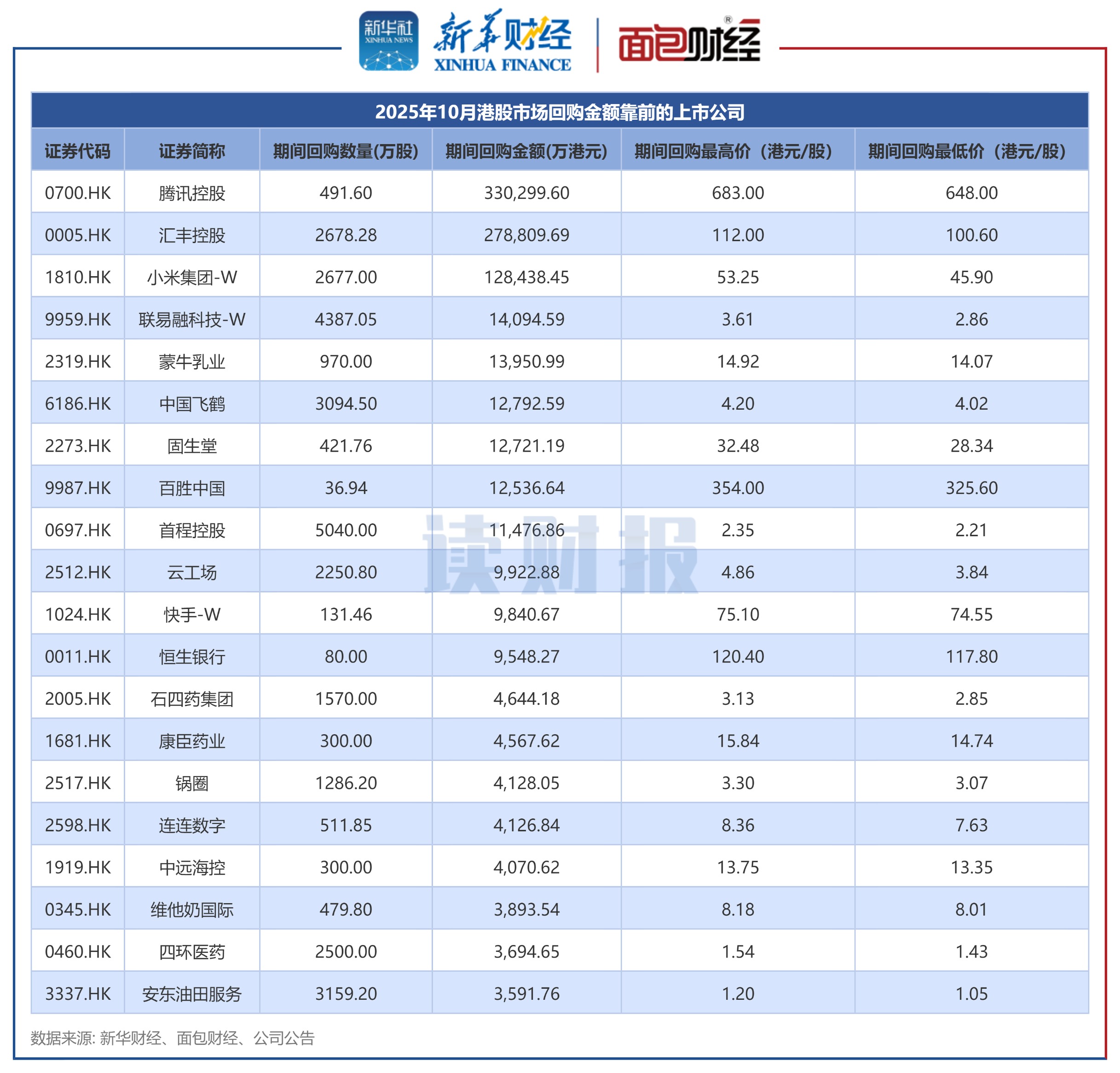
Summary of Key Points Core Viewpoint - In October 2025, a total of 94 Hong Kong-listed companies initiated share buybacks, with a cumulative repurchase of 525 million shares and a total amount of HKD 9.372 billion, representing a 1.09% increase compared to HKD 9.271 billion in the same period last year [1][2]. Company-Specific Insights - Notable companies that increased their buyback efforts in October include Xiaomi Group-W, China Feihe, and Kangning Jereh Pharmaceutical-B, with Xiaomi's buyback amounting to HKD 1.284 billion for 26.77 million shares [7]. - Tencent Holdings and HSBC Holdings also ranked among the top companies in terms of buyback amounts in October [2]. - The buyback amounts for Tencent Holdings, HSBC Holdings, and Xiaomi Group-W were HKD 491.6 million, HKD 2.678 billion, and HKD 1.284 billion respectively [4][7]. Industry Trends - The majority of companies initiating buybacks in October 2025 were concentrated in the software services and other healthcare sectors [8][11]. - The software services industry led in both the total buyback amount (HKD 3.641 billion) and the number of companies involved (13 companies) [8][10]. - The other healthcare sector had 11 companies participating in buybacks, with notable increases from companies like Meili Tianyuan Medical Health and Yidu Technology [11].


明源云(00909.HK)11月5日回购328.60万港元,已连续5日回购
Zheng Quan Shi Bao· 2025-11-05 15:17
Core Viewpoint - Mingyuan Cloud has been actively repurchasing its shares on the Hong Kong Stock Exchange, indicating a strategy to support its stock price amidst recent declines [1]. Summary by Category Share Buyback Activity - On November 5, Mingyuan Cloud repurchased 1 million shares at prices ranging from HKD 3.250 to HKD 3.300, totaling HKD 3.286 million [1]. - The stock closed at HKD 3.290 on the same day, reflecting a decrease of 0.60%, with a total trading volume of HKD 18.6657 million [1]. - Since October 30, the company has conducted buybacks for five consecutive days, acquiring a total of 5.983 million shares for a cumulative amount of HKD 19.846 million [1]. - During this period, the stock has seen a total decline of 0.90% [1]. - Year-to-date, the company has executed 35 buybacks, acquiring a total of 17.254 million shares for a total expenditure of HKD 52.5718 million [1]. Detailed Buyback Information - The buyback details include specific dates, number of shares repurchased, highest and lowest prices, and total amounts spent [1]. - For instance, on October 30, 178.3 thousand shares were repurchased at a price range of HKD 3.220 to HKD 3.300, costing HKD 5.8572 million [1]. - The buyback activity reflects a consistent effort by the company to stabilize its stock price amid market fluctuations [1].
港股市场回购统计周报 2025.10.27-2025.11.2-20251103
Zhe Shang Guo Ji Jin Rong Kong Gu· 2025-11-03 11:09
Group 1: Weekly Buyback Statistics - The total number of companies conducting buybacks this week is 49, a decrease from 60 last week[13] - The total buyback amount this week is HKD 470 million, an increase from HKD 320 million last week[13] - China Feihe (6186.HK) ranks first with a buyback amount of HKD 104 million this week[13] Group 2: Top Buyback Companies - The top ten companies by buyback amount include China Feihe with HKD 10,422.82 million, accounting for 0.28% of total shares[12] - COSCO Shipping Holdings (1919.HK) ranks second with a buyback amount of HKD 4,070.62 million, representing 0.02% of total shares[12] - Sinopec (0386.HK) ranks third with a buyback amount of HKD 3,484.77 million, which is 0.01% of total shares[12] Group 3: Industry Distribution - The majority of buyback amounts are concentrated in the consumer staples, healthcare, and information technology sectors[16] - The healthcare sector has the highest number of companies initiating buybacks, with 14 companies participating[16] - The information technology sector follows with 11 companies conducting buybacks[16]
固生堂(02273.HK)连续28日回购,累计回购453.54万股
Zheng Quan Shi Bao· 2025-10-21 13:57
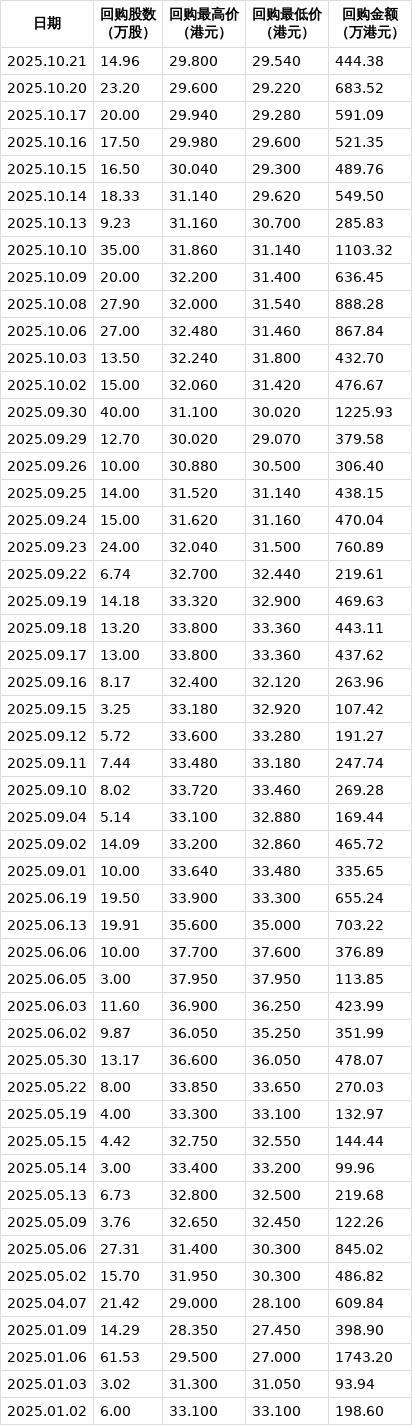
Summary of Key Points Core Viewpoint - The company Gushengtang has been actively repurchasing its shares on the Hong Kong Stock Exchange, indicating a strategy to support its stock price amidst a recent decline [1]. Share Buyback Details - On October 21, Gushengtang repurchased 149,600 shares at prices ranging from HKD 29.540 to HKD 29.800, totaling HKD 4.4438 million [1]. - The stock closed at HKD 29.600 on the same day, reflecting a slight increase of 0.34% with a total trading volume of HKD 28.6768 million [1]. - Since September 10, the company has conducted buybacks for 28 consecutive days, acquiring a total of 4.5354 million shares for a cumulative amount of HKD 142 million [1]. - The stock has experienced a cumulative decline of 11.08% during this buyback period [1]. - Year-to-date, Gushengtang has executed 51 buybacks, totaling 7.49 million shares and an aggregate amount of HKD 236 million [1]. Buyback Transaction Summary - A detailed table of buyback transactions shows various dates, number of shares repurchased, highest and lowest prices, and total amounts for each transaction [1]. - For example, on October 20, 2025, the company repurchased 23,200 shares at a maximum price of HKD 29.600, totaling HKD 6.8352 million [1]. Market Context - The ongoing buyback activity suggests the company's commitment to stabilizing its stock price amid market fluctuations [1]. - The overall trading environment reflects investor sentiment and market dynamics that may influence future buyback decisions [1].
联易融科技-W(09959.HK)10月16日回购747.51万港元,已连续24日回购
Zheng Quan Shi Bao Wang· 2025-10-16 12:43
Core Viewpoint - 联易融科技-W has been actively repurchasing its shares, indicating a strategy to support its stock price amid market fluctuations [1][2]. Group 1: Share Buyback Details - On October 16, 2025, the company repurchased 2.39 million shares at prices ranging from 3.080 to 3.150 HKD, totaling 7.4751 million HKD [1]. - The stock closed at 3.120 HKD on the same day, reflecting a decrease of 0.64%, with a total trading volume of 14.724 million HKD [1]. - Since September 11, 2025, the company has conducted buybacks for 24 consecutive days, acquiring a total of 49.697 million shares for a cumulative amount of 164 million HKD, during which the stock has declined by 2.19% [1]. Group 2: Year-to-Date Buyback Summary - Year-to-date, the company has executed 32 buybacks, acquiring a total of 61.515 million shares for a total expenditure of 195 million HKD [2]. - The buyback details include various dates, share quantities, and price ranges, showcasing a consistent effort to stabilize the stock price [2].
康宁杰瑞制药-B(09966.HK)10月16日回购40.00万股,耗资548.30万港元
Zheng Quan Shi Bao Wang· 2025-10-16 12:42
Core Viewpoint - Corning Jereh Pharmaceutical-B (09966.HK) repurchased 400,000 shares on October 16, 2025, at a total cost of HKD 5.483 million, indicating a strategic move to enhance shareholder value [1][2]. Group 1: Share Buyback Details - The company repurchased shares at prices ranging from HKD 13.520 to HKD 13.820 per share [1]. - The closing price on the day of the buyback was HKD 13.700, reflecting a 2.54% increase in share price [1]. - The total trading volume for the day was HKD 35.6313 million [1]. Group 2: Year-to-Date Buyback Summary - Year-to-date, the company has conducted three buyback transactions, totaling 801,000 shares repurchased [2]. - The cumulative amount spent on buybacks this year is HKD 10.9358 million [2]. - Detailed buyback transactions include: - October 16: 400,000 shares at a maximum price of HKD 13.820 and a minimum price of HKD 13.520, costing HKD 5.483 million [2]. - October 14: 293,000 shares at a maximum price of HKD 13.830 and a minimum price of HKD 13.030, costing HKD 3.9669 million [2]. - October 13: 108,000 shares at a maximum price of HKD 13.800 and a minimum price of HKD 13.690, costing HKD 1.4860 million [2].
小米集团-W(01810.HK)连续5日回购,累计回购1592.00万股
Zheng Quan Shi Bao Wang· 2025-10-16 12:42
Core Viewpoint - Xiaomi Group-W has been actively repurchasing its shares, indicating a strategy to support its stock price amid recent declines [1][2]. Summary by Category Share Buyback Activity - Xiaomi Group-W has conducted share buybacks for five consecutive days since October 10, totaling 15.92 million shares repurchased and an aggregate amount of HKD 783 million [1]. - On October 16, the company repurchased 4 million shares at prices ranging from HKD 47.60 to HKD 48.40, amounting to HKD 192 million [1][2]. - The stock price has decreased by 10.59% during the buyback period [1]. Cumulative Buyback Data - Year-to-date, Xiaomi Group-W has completed 11 buyback transactions, repurchasing a total of 23.43 million shares for a total expenditure of HKD 1.044 billion [2]. - Detailed buyback transactions include: - October 16: 400,000 shares at a maximum price of HKD 48.40 and a minimum of HKD 47.60, totaling HKD 19.18 million [2]. - October 15: 200,000 shares at a maximum price of HKD 49.54, totaling HKD 9.89 million [2]. - October 14: 400,000 shares at a maximum price of HKD 49.00, totaling HKD 19.49 million [2].
安东油田服务(03337.HK)连续2日回购,累计回购919.00万股
Zheng Quan Shi Bao Wang· 2025-10-16 12:42
Core Viewpoint - Antong Oilfield Services (03337.HK) has conducted share buybacks for two consecutive days, totaling 9.19 million shares repurchased, indicating a strategic move to enhance shareholder value and potentially support the stock price [1] Summary by Category Share Buyback Details - On October 16, the company repurchased 4.50 million shares at prices ranging from HKD 1.080 to HKD 1.130, with a total expenditure of HKD 4.9991 million [1] - The stock closed at HKD 1.100 on the same day, reflecting a 2.80% increase, with total trading volume of HKD 16.9611 million [1] - Since October 15, the cumulative buyback has reached 9.19 million shares, with a total amount of HKD 9.9916 million spent [1] - During this period, the stock price has increased by 6.80% [1] Year-to-Date Buyback Activity - Year-to-date, the company has executed 9 buybacks, totaling 41.82 million shares, with an aggregate expenditure of HKD 44.8221 million [1] Buyback Transaction Summary - A detailed table of buyback transactions shows the number of shares, highest and lowest repurchase prices, and total amounts for each transaction, highlighting the company's consistent buyback strategy [1]