
港股回购

Search documents
理想汽车-W3月30日回购7158.64万港元,已连续4日回购
Xin Lang Cai Jing· 2026-03-31 05:07
Group 1 - The core point of the news is that Li Auto-W has been actively repurchasing its shares, indicating a strategy to support its stock price amidst market fluctuations [1][4][5] - On March 30, 2026, Li Auto-W repurchased 1.0437 million shares at a price range of HKD 68.150 to HKD 69.300, totaling HKD 71.5864 million [1][4] - Since March 25, 2026, the company has conducted four consecutive days of repurchases, totaling 2.2881 million shares and an aggregate amount of HKD 159 million [1][4] Group 2 - Year-to-date, Li Auto-W has completed eight repurchase transactions, acquiring a total of 3.2513 million shares for a total of HKD 167 million [5] - The stock price of Li Auto-W experienced a decline of 1.78% on the day of the latest repurchase, closing at HKD 68.800 [1][4] - The total trading volume for Li Auto-W on the day of the latest repurchase was HKD 699 million [1][4] Group 3 - Li Auto-W has seen significant net buying from southbound funds, with a cumulative net purchase of HKD 7.46 billion over three days, despite a stock price decline of 3.18% [2][7] - On August 6, 2025, the stock was part of a larger trading volume of HKD 389.72 billion in the Hong Kong stock market, with a net buying amount of HKD 32.46 billion [2][7] - The stock has shown resilience with a net buying amount of HKD 4.13 billion over three days in July 2025, during which the stock price increased by 8.66% [3][7]

【读财报】港股2月回购透视:合计回购超64亿港元 中通快递、金山软件等年内首度回购
Xin Hua Cai Jing· 2026-03-16 23:29
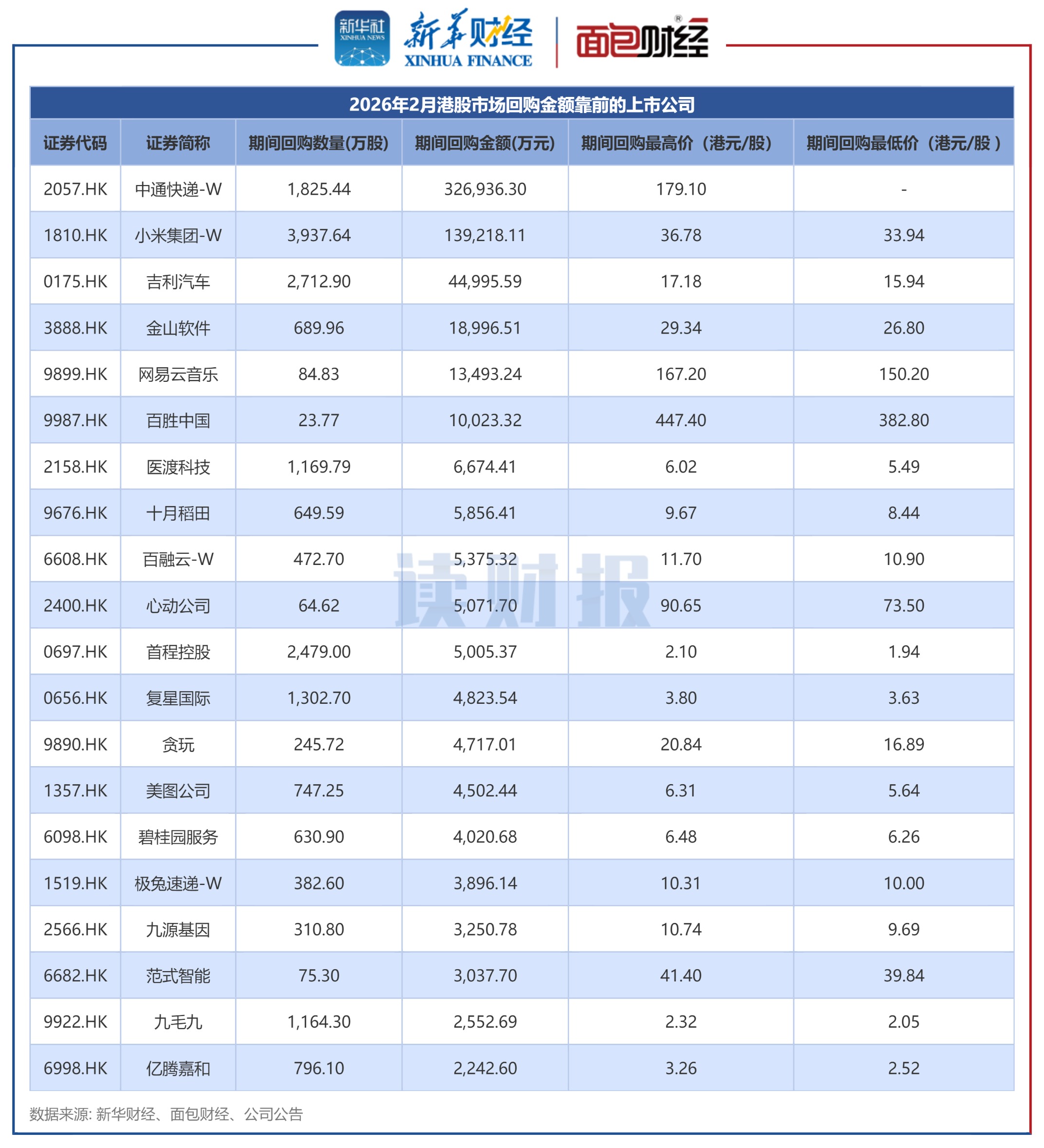
Summary of Key Points Core Viewpoint - In February 2026, Hong Kong stock market saw a total of 69 listed companies initiating share buybacks, with a cumulative repurchase of 263 million shares and a total amount of 6.478 billion HKD, representing a 12.4% decrease compared to 7.395 billion HKD in the same period last year [1][2]. Company-Specific Insights - ZTO Express led the buyback amount in February, repurchasing shares worth 3.269 billion HKD, with 18.2544 million shares bought back at a price of 179.1 HKD per share [3][4]. - Xiaomi Group followed with a buyback amount of 1.392 billion HKD, repurchasing 39.3764 million shares at prices ranging from 33.94 HKD to 36.78 HKD per share [5]. - Geely Automobile also participated, repurchasing shares worth 449.96 million HKD, totaling 27.129 million shares [3][4]. - Kingsoft and NetEase Cloud Music made their first buybacks of the year in February, with amounts of 189.9651 million HKD and 134.9324 million HKD respectively [2][5]. Industry Insights - The majority of buybacks in February 2026 were concentrated in the software services and industrial transportation sectors [6][9]. - The industrial transportation sector had the highest buyback amount, totaling 3.308 billion HKD, with companies like ZTO Express and Jitu Express leading the efforts [6][8]. - In the software services sector, 15 companies initiated buybacks, including Kingsoft and Fan Shi Intelligent, marking their first buybacks of the year [9].

港股市场回购统计周报-20260303
Zhe Shang Guo Ji Jin Rong Kong Gu· 2026-03-03 08:36
Group 1: Weekly Buyback Statistics - The total buyback amount for the week was HKD 982 million, an increase of HKD 708 million from the previous week[10] - A total of 39 companies conducted buybacks this week, an increase of 9 companies compared to last week[10] - Xiaomi Group (1810.HK) led the buybacks with an amount of HKD 399.99 million[10] Group 2: Industry Distribution of Buybacks - The information technology sector accounted for the highest buyback amount at HKD 517 million[13] - The number of companies conducting buybacks in the information technology sector was the highest, with 14 companies participating[13] - The consumer discretionary sector ranked second with 10 companies engaging in buybacks[13] Group 3: Individual Company Buyback Data - Geely Automobile (0175.HK) ranked second in buybacks with HKD 210.86 million[10] - NetEase Cloud Music (9899.HK) was third with a buyback amount of HKD 74.99 million[10] - The buyback amounts for the top three companies were 40.00%, 21.00%, and 7.50% of the total buyback amount respectively[10] Group 4: Significance of Buybacks - Company buybacks are defined as the repurchase of shares from the secondary market using liquid cash[21] - Large-scale buyback trends often occur during bear markets, indicating that companies believe their stock prices are undervalued[21] - Historical data shows that buyback waves in the Hong Kong market since 2008 have been followed by subsequent price increases[21]
港股股票回购一览:14只个股获公司回购
Mei Ri Jing Ji Xin Wen· 2026-02-26 07:04
Group 1 - The core point of the article highlights that on February 25, a total of 14 Hong Kong stocks conducted company buybacks, with four stocks having buyback amounts exceeding 10 million Hong Kong dollars [1] - Xiaomi Group-W, Geely Automobile, and Paradigm Intelligence had the largest buyback amounts, with respective totals of 99.9969 million Hong Kong dollars, 23.7638 million Hong Kong dollars, and 21.8795 million Hong Kong dollars [1] - As of February 25, 133 Hong Kong stocks have conducted company buybacks this year, with 14 stocks having cumulative buyback amounts exceeding 100 million Hong Kong dollars [1] Group 2 - Tencent Holdings, Xiaomi Group-W, and ZTO Express-W have the highest cumulative buyback amounts this year, totaling 6.358 billion Hong Kong dollars, 3.732 billion Hong Kong dollars, and 3.269 billion Hong Kong dollars respectively [1]
新华财经早报:2月22日
Xin Hua Cai Jing· 2026-02-22 01:09
Group 1 - The National Development Bank plans to issue loans of 786.3 billion yuan to the urban renewal sector by 2025, focusing on the renovation of old residential areas, urban villages, and infrastructure improvements [2] - The loans will support urban structural optimization, functional enhancement, cultural heritage preservation, and ecological restoration [2] Group 2 - The 2026 annual film box office (including pre-sales) has surpassed 7 billion yuan, with the Spring Festival box office (including pre-sales) exceeding 4.4 billion yuan [3] - The total cross-regional population flow during the Spring Festival has reached 5.08 billion person-times, averaging 250 million person-times per day, marking a historical high [3] Group 3 - The U.S. President announced an increase in the "global import tariff" from 10% to 15%, effective immediately, with further legal tariffs to be determined in the coming months [4] - The Japanese yen's effective exchange rate index has hit a 53-year low due to prolonged economic stagnation [4]

港股1月回购透视:金额合计约128亿港元 舜宇光学科技、泡泡玛特等时隔一年多重启回购
Xin Lang Cai Jing· 2026-02-04 23:52
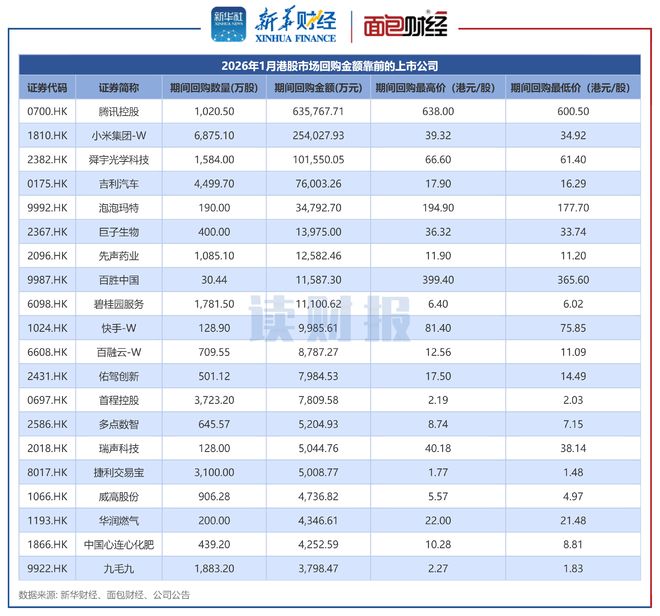
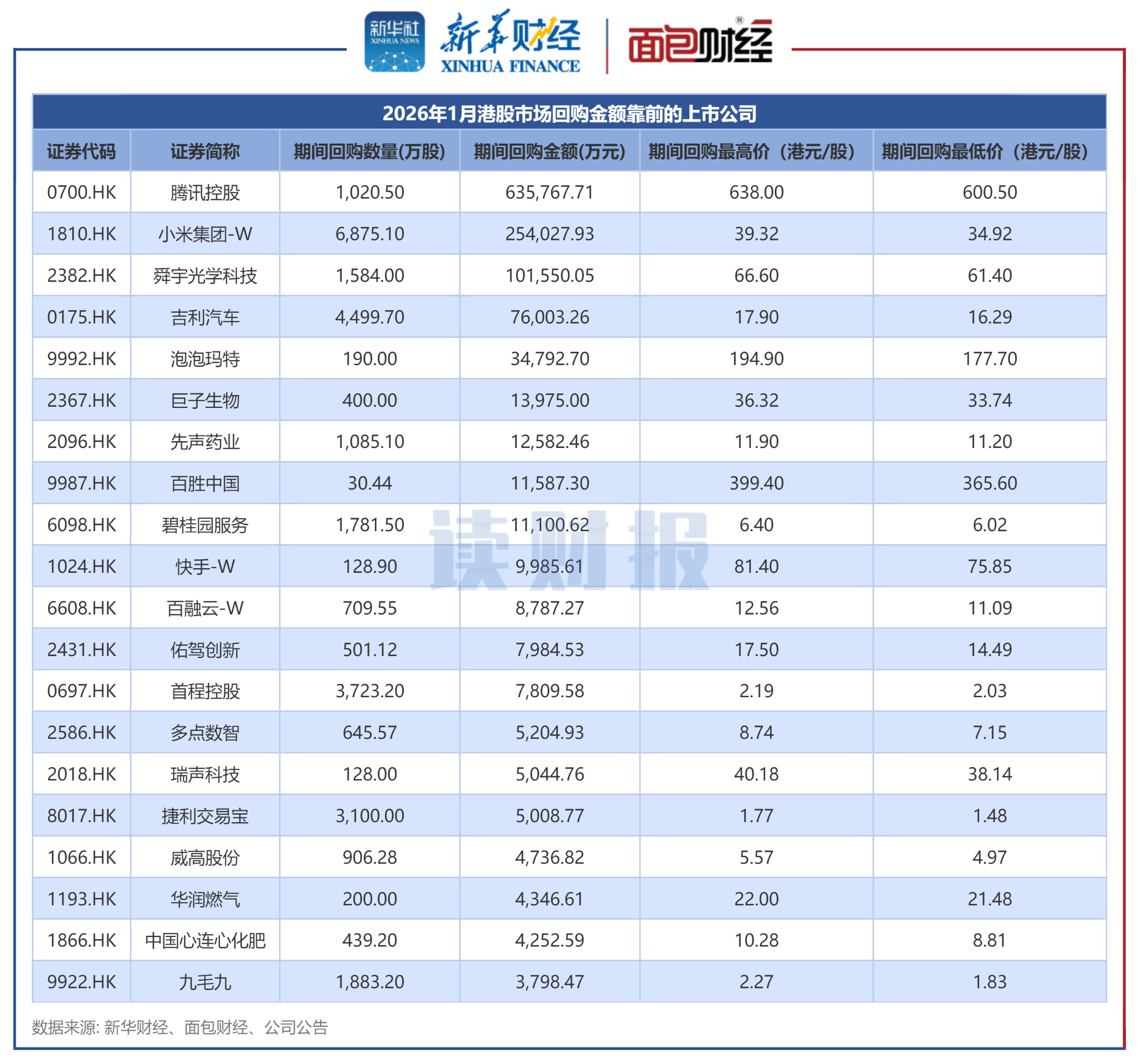
Company Summary - In January 2026, a total of 116 Hong Kong-listed companies initiated share buybacks, repurchasing 4.82 million shares for a total amount of 12.831 billion HKD, representing a 48.05% decrease compared to 24.699 billion HKD in the same period last year [1][2] - Tencent Holdings, Xiaomi Group, and Sunny Optical Technology were among the companies with the highest buyback amounts, with Xiaomi repurchasing shares worth 2.540 billion HKD and Sunny Optical repurchasing shares worth 1.016 billion HKD [1][3] - Other notable companies that executed significant buybacks include Geely Automobile, Pop Mart, and Giant Bio, each with buyback amounts exceeding 100 million HKD [1][2] Industry Summary - The majority of the companies initiating buybacks in January 2026 were concentrated in the software services and other healthcare sectors [4][5] - The software services industry led in both buyback amount and number of companies, with a total buyback amount of 6.720 billion HKD and 20 companies participating, including BaiRong Cloud and Youjia Innovation [4][5] - The other healthcare sector also had a significant presence, with 12 companies, including Giant Bio and Weigao Group, engaging in buybacks [5][6]

【读财报】港股1月回购透视:金额合计约128亿港元 舜宇光学科技、泡泡玛特等时隔一年多重启回购
Xin Hua Cai Jing· 2026-02-04 23:12
Company Summary - In January 2026, a total of 116 Hong Kong-listed companies initiated share buybacks, repurchasing 482 million shares for a total amount of 12.831 billion HKD, representing a 48.05% decrease compared to 24.699 billion HKD in the same period last year [1][2] - Notable companies with significant buyback amounts include Tencent Holdings, Xiaomi Group, Sunny Optical Technology, and Pop Mart, with Tencent repurchasing 10.205 million shares and spending 6.357 billion HKD [3][4] - Xiaomi Group repurchased 68.751 million shares for a total of 2.54 billion HKD, with a buyback price range between 34.92 HKD and 39.32 HKD per share [4][5] - Sunny Optical Technology repurchased 15 times in January, totaling 15.84 million shares and 1.016 billion HKD [5] - Pop Mart executed buybacks on January 19 and 21, acquiring 1.9 million shares for 348 million HKD, with a price range of 177.7 HKD to 194.9 HKD per share [5] Industry Summary - The companies initiating buybacks in January 2026 were primarily concentrated in the software services and other healthcare sectors [6][9] - The software services industry led in both buyback amount and number of companies, with a total buyback amount of 6.720 billion HKD and 20 companies participating, including Baidu Cloud and Youjia Innovation [7] - The other healthcare sector had 12 companies conducting buybacks, including Giant Bio and Weigao Group [9] - The pharmaceutical and biotechnology sectors also had a notable presence, with 12 companies, including Xiansheng Pharmaceutical and Shisi Pharmaceutical Group, engaging in buybacks [9]
2026.01.26-2026.02.01港股市场回购统计周报-20260203
Zhe Shang Guo Ji Jin Rong Kong Gu· 2026-02-03 06:33
Group 1: Weekly Buyback Statistics - The total buyback amount for the week was HKD 1.115 billion, a decrease of HKD 977 million from the previous week[10] - A total of 56 companies conducted buybacks this week, down by 8 companies compared to last week[10] - Xiaomi Group (1810.HK) led the buybacks with an amount of HKD 290 million[10] Group 2: Industry Analysis - The information technology sector accounted for the highest buyback amount, totaling HKD 573 million[13] - The number of companies conducting buybacks in the information technology sector was the highest, with 16 companies participating[13] - The consumer discretionary sector ranked second with 12 companies involved in buybacks[13] Group 3: Individual Company Buyback Data - Geely Automobile (0175.HK) ranked second in buybacks with HKD 273 million[10] - Sunny Optical Technology (2382.HK) was third with a buyback amount of HKD 196 million[10] - The buyback amounts for the top three companies were 29,019.63, 27,314.31, and 19,595.36 thousand HKD respectively[14]
港股上市公司回购热度持续 机构称市场有望震荡上行
Zhong Guo Zheng Quan Bao· 2026-01-27 22:00
Group 1 - The core viewpoint of the article highlights the ongoing trend of stock buybacks in the Hong Kong market since 2026, with significant participation from major companies like Tencent and Xiaomi, indicating a positive signal for maintaining company value and investor confidence [1][2][3][4]. - As of January 26, 2026, a total of 112 Hong Kong-listed companies have repurchased 413 million shares, amounting to over 12 billion HKD, although the total buyback amount has decreased compared to the same period in 2025 [2][3]. - The technology sector dominates the buyback activity, with Tencent and Xiaomi accounting for over 70% of the total buyback value, reflecting the financial foundation for these companies to engage in buybacks due to their relatively low valuations [4]. Group 2 - The Hang Seng Index and other indices have shown positive performance since 2026, with the Hang Seng Index rising by 5.84%, indicating a stable market environment amidst the buyback activities [5][6]. - Various industry sectors have experienced growth, with materials, conglomerates, and real estate leading the market, while telecommunications have underperformed [5][6]. - The overall market valuation has increased, with the rolling P/E ratio of the Hang Seng Index rising from 11.77 to 12.34, suggesting a recovery in investor sentiment and market confidence [6]. Group 3 - Analysts predict that the technology sector will remain a key focus for long-term investments, driven by factors such as rising prices in the supply chain and accelerated AI applications [7][8]. - There is an expectation for a continued rebound in the Hong Kong market, supported by a stable liquidity environment and gradual economic recovery, although the emphasis is on substantial earnings recovery rather than mere valuation expansion [7][8]. - Investment strategies should focus on sectors like AI, innovative pharmaceuticals, and quality consumer leaders, with a gradual accumulation approach recommended [8].
港股上市公司回购热度持续机构称市场有望震荡上行
Zhong Guo Zheng Quan Bao· 2026-01-27 20:57
Core Viewpoint - The Hong Kong stock market has seen a sustained trend of share buybacks since 2026, with significant participation from major companies, indicating a positive signal for maintaining company value and potentially improving investor sentiment [1][2][3]. Group 1: Share Buyback Activity - As of January 26, 2026, 112 Hong Kong-listed companies have repurchased a total of 413 million shares, amounting to over 12 billion HKD [1]. - The total number of shares repurchased and the total buyback amount have decreased compared to the same period in 2025, but the enthusiasm for buybacks remains strong among over 110 companies [2]. - Major companies leading the buyback trend include Tencent Holdings, Xiaomi Group-W, and Sunny Optical Technology, with Tencent alone accounting for 63.58 billion HKD in buybacks [2][3]. Group 2: Market Performance - The Hang Seng Index, Hang Seng China Enterprises Index, and Hang Seng Technology Index have seen cumulative increases of 5.84%, 3.72%, and 4.33% respectively since the beginning of 2026 [3]. - Various sectors in the Hong Kong market have shown positive performance, with materials, conglomerates, and real estate leading the way, while telecommunications have declined by 3.17% [3][4]. - Approximately 80% of the stocks in the Hang Seng Index have risen, with notable gains from companies like Alibaba Health and New World Development, which have increased by over 21% [4]. Group 3: Investment Outlook - Analysts suggest that the technology sector remains a key focus for long-term investment, supported by favorable conditions such as rising prices in the supply chain and accelerated AI applications [6]. - The overall valuation of the Hong Kong stock market is still considered attractive compared to global standards, indicating a high investment value [6]. - There is an expectation for a structural market trend in 2026, with a focus on sectors like AI, semiconductor, and innovative pharmaceuticals, as well as a gradual accumulation of quality consumer leaders [5][6].