银行上市

Search documents
乌鲁木齐银行启动IPO辅导的第8年:第二大股东或将“易主”,董事长王辉上任
Sou Hu Cai Jing· 2025-06-25 03:32
Core Viewpoint - The Urumqi Urban Transportation Investment Company is set to acquire a 14.22% stake in Urumqi Bank, potentially making it the second-largest shareholder, as part of the bank's preparations for an IPO planned for 2025 [2][3]. Group 1: Shareholding Changes - The Urumqi Urban Transportation Investment Company will receive 568,820,428 shares from Urumqi Urban Construction Investment Group Co., representing a 14.22% stake in Urumqi Bank, through a non-compensatory transfer [2]. - Following this transfer, Urumqi Urban Transportation Investment Company will become the second-largest shareholder of Urumqi Bank [2]. Group 2: IPO Preparations - Urumqi Bank has been preparing for its IPO for eight years, having signed a counseling agreement with Haitong Securities in March 2017, but remains in the counseling phase [5]. - Haitong Securities has issued 32 progress reports regarding Urumqi Bank's IPO counseling since 2017 [5]. - Urumqi Bank has identified "promoting the listing" as a core objective for 2025 in its 2024 annual report [2]. Group 3: Corporate Governance - Urumqi Bank's complex shareholding structure has been attributed to historical reasons, prompting Haitong Securities to recommend corrective actions [7]. - Urumqi Bank is currently working on capital increase and share expansion, pending regulatory approval [7]. - Recent changes in leadership include the appointment of Wang Hui as the chairman of Urumqi Bank, following the resignation of the previous chairman due to work changes [8].

乌鲁木齐银行股权变更:新股东入局,上市攻坚待破
Sou Hu Cai Jing· 2025-06-24 10:30
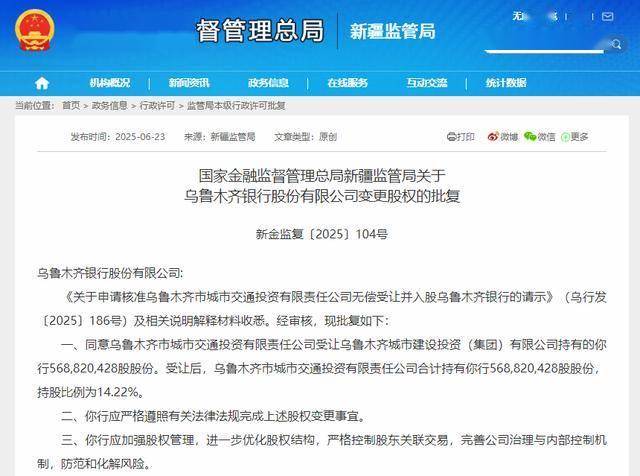
Company Dynamics - On June 23, the Xinjiang Regulatory Bureau of the National Financial Supervision Administration approved the transfer of 568,820,428 shares of Urumqi Bank from Urumqi Urban Construction Investment Group to Urumqi Urban Transportation Investment Company, resulting in the latter holding 14.22% of Urumqi Bank's shares, with the transfer being gratuitous [2] - As of the end of 2024, Urumqi Urban Construction Investment Group remains the second-largest shareholder of Urumqi Bank, holding 58,455 million shares, accounting for 14.61% of the total share capital [2] - Urumqi Urban Construction Investment Group's investment history in Urumqi Bank dates back to November 10, 1997, with the first shareholding date recorded on December 31, 2013 [2] Leadership Changes - In June 2025, Wang Hui was approved to serve as the chairman of Urumqi Bank, having recently obtained the qualification for the position of president in November 2024 [3] - Wang Hui is expected to leverage his extensive financial industry experience to navigate Urumqi Bank through its ongoing challenges, particularly the prolonged listing counseling period [3] Financial Goals and Challenges - Urumqi Bank aims to achieve total assets of 238 billion yuan, deposits of 156 billion yuan, loans of 134 billion yuan, and a net profit of 9.45 billion yuan in 2025, while maintaining a non-performing loan ratio below 2% [4] - The bank has identified "promoting listing" as a key focus for 2025 and plans to enhance shareholding confirmation work to improve the confirmation ratio [4] - The complexity of the bank's shareholding structure has been a significant barrier to its listing process, necessitating efforts for capital increase and shareholding clarification [4] Performance Overview - Urumqi Bank has shown revenue growth over the past three years, with net profit experiencing a decline in 2024; revenues were 2.987 billion yuan in 2022, 3.456 billion yuan in 2023, and 4.251 billion yuan in 2024, while net profits were 873 million yuan, 1.035 billion yuan, and 937 million yuan respectively [4] Future Outlook - Urumqi Bank is positioned to face various challenges and opportunities in its new development phase, with a focus on accelerating the listing process to contribute more significantly to the economic development of the Xinjiang region [5]

广州银行,不配上市?
Sou Hu Cai Jing· 2025-05-21 00:49
Core Viewpoint - Guangzhou Bank has faced multiple challenges in its journey towards IPO, including a significant drop in net profit and high executive turnover, which reflect deeper operational and governance issues [3][4][5]. Financial Performance - In 2024, Guangzhou Bank reported a revenue decline of 13.86% to 13.785 billion yuan and a net profit drop of 66.47% to 1.012 billion yuan [3][5]. - The bank's net profit has decreased for four consecutive years, from 4.101 billion yuan in 2021 to 1.012 billion yuan in 2024, with an average annual decline exceeding 30% [5][32]. - Interest income fell below 10 billion yuan for the first time, decreasing by 18.03% year-on-year [6]. Revenue Structure and Quality - Net interest income accounted for over 70% of total income, but it dropped to 9.667 billion yuan in 2024, a decrease of 21.26 billion yuan [6][9]. - The bank's non-performing loan (NPL) ratio was 1.84% in 2024, higher than the industry average of 1.50% [6][33]. - Real estate loans totaled 60.4 billion yuan, representing 13% of total loans, with a personal housing loan NPL ratio of 2.07% [6][33]. Regulatory and Compliance Issues - In 2023, the bank faced regulatory penalties totaling 44.8 million yuan, with ongoing compliance issues highlighted by multiple fines in 2024 [7][34]. - The bank has been under scrutiny for internal control deficiencies, with significant litigation risks amounting to 9.758 billion yuan in unresolved lawsuits [35]. Governance and Management Challenges - Frequent changes in leadership have led to strategic inconsistency, with the bank experiencing its fourth chairman in recent years [16][30]. - The governance structure is complicated by a high number of unconfirmed shareholders, which complicates compliance and decision-making processes [31]. Strategic Outlook - To overcome its challenges, the bank needs to focus on regional strengths, enhance risk management, and explore new capital sources [22][25][37]. - The introduction of strategic investors and a focus on digital transformation are essential for future growth and stability [26][28][37].
多户股东失信 赣州银行上市之路添阻
Zhong Guo Zheng Quan Bao· 2025-05-13 20:29
Core Viewpoint - The governance structure of commercial banks is significantly impacted by the behavior of shareholders, with instances of misconduct or reputational issues potentially leading to increased credit and market risks for banks, as well as uncertainties in their listing processes [1][6]. Group 1: Shareholder Issues - As of the end of 2024, several shareholders of Ganzhou Bank have been listed as dishonest executors by the court, which raises concerns about the bank's reputation and trustworthiness among clients [2][3]. - The bank's shareholders include companies with a history of legal issues, such as being listed as dishonest executors multiple times, which reflects poorly on the bank's governance [2][3]. - The bank's response indicates that the shares held by these problematic shareholders constitute a small percentage of the total equity, suggesting limited immediate impact on operations [2]. Group 2: Shareholder Equity and Legal Challenges - By the end of 2024, 21 shareholders held a total of 327 million shares in pledge status, while 10 shareholders had 123 million shares under court seizure or freezing, indicating significant equity constraints [4][5]. - The case of Jiangxi Huashen Investment Guarantee Co., a major shareholder, illustrates the extent of the issue, with 76.85% of its shares either pledged or frozen [4]. - The frequent auctioning of shares, often resulting in no buyers, highlights the weak risk-bearing capacity of many shareholders, particularly those from local investment and real estate sectors facing operational pressures [5]. Group 3: Regulatory and Listing Concerns - Regulatory scrutiny has increased due to the bank's failure to adequately vet shareholder qualifications, resulting in fines and warnings from financial authorities [6][7]. - The bank's ownership structure is fragmented, with no single shareholder holding more than 15%, which complicates governance and may hinder the bank's listing ambitions [6][8]. - The presence of numerous shareholders with poor qualifications is a common issue among small and medium-sized banks, posing challenges for their listing processes [6][8].
资产质量承压,珠海农商行规模突破千亿净利润却大跌超30%
2 1 Shi Ji Jing Ji Bao Dao· 2025-04-30 03:21
Core Viewpoint - Zhuhai Rural Commercial Bank reported a significant decline in performance for 2024, with net profit dropping by 32.84% despite an increase in total assets, indicating challenges in maintaining profitability amidst competitive pressures and changing market conditions [1][2]. Financial Performance - As of the end of 2024, the bank's total assets reached 100.83 billion yuan, a year-on-year increase of 10.31% [1]. - The bank achieved operating income of 1.797 billion yuan, a decrease of 0.69% year-on-year [1]. - Net profit for 2024 was 404 million yuan, down by approximately 197 million yuan or 32.84% compared to the previous year [2]. - The net interest margin stood at 1.50%, a decrease of 0.31% year-on-year, while the net interest spread was 1.42%, down by 0.27% [2]. Revenue Structure - Interest income accounted for nearly 70% of total revenue, with net interest income at 1.22 billion yuan, a decline of 7.31% year-on-year [2]. - Fee and commission income increased by 9.36% to 46 million yuan [2]. - Investment income and fair value changes saw significant growth, with increases of 17.58% and 69.88%, respectively, reaching 360 million yuan and 145 million yuan [2]. Asset Quality - The bank's non-performing loan (NPL) balance was 687 million yuan, with an NPL ratio of 1.32%, up by 0.13% year-on-year [3]. - The provision coverage ratio was 198.96%, a decrease of 26.95% from the previous year [3]. Strategic Initiatives - In February 2024, the bank announced a strategic plan focusing on "technology leadership, Bay Area benchmark, and listing efforts," marking its first public indication of a goal to pursue an IPO [1][4]. - The bank aims to position itself as a significant player in the Bay Area and is committed to long-term strategic initiatives to achieve its listing aspirations, although it has not yet begun preparations for the IPO [4].
15家银行上市辅导进行时:资本、股权、资产问题如何求解?
Sou Hu Cai Jing· 2025-04-29 11:47
Core Insights - The progress of bank IPOs has been slow, with only Yibin Bank successfully listing on the Hong Kong Stock Exchange in the past three years, while the A-share market has not seen any new listings since Lanzhou Bank in January 2022 [1][17] - Despite the slow progress, there remains a large number of banks preparing for IPOs, with 15 banks currently in the listing guidance period [1][17] - Capital adequacy remains a significant challenge for many small and medium-sized banks, impacting their IPO processes [3][12] Group 1: IPO Progress - Yibin Bank is the only small bank to have listed in the past three years, while several banks have withdrawn their IPO applications in 2024, leaving only six banks in the queue [1][17] - The banks currently in the listing guidance period include Hankou Bank, Tianjin Bank, and others, with Hankou Bank having initiated its IPO plans as early as December 2010 [1][2] Group 2: Capital Adequacy Challenges - Hankou Bank has faced difficulties in increasing profitability, with revenues of 6.802 billion, 8.393 billion, and 8.521 billion yuan from 2021 to 2023, while net profits were 1.25 billion, 1.915 billion, and 1.445 billion yuan, indicating a "revenue without profit" situation [3][4] - Despite a capital increase in 2024, Hankou Bank's capital adequacy indicators remain under pressure, necessitating further capital supplementation [4][5] - Tianjin Bank has also struggled with capital adequacy, with its non-performing loan total increasing from 6.816 billion yuan in 2023 to 7.609 billion yuan in 2024, despite a slight decrease in the non-performing loan ratio [5][6] Group 3: Asset Certainty Issues - Guilin Bank has faced delays in its IPO due to issues with property rights and ongoing legal disputes, which have hindered its progress since its initial listing ambitions in 2011 [8][10] - Other banks, such as Gansu Bank and Wenzhou Bank, are also dealing with similar asset certainty challenges, which complicate their listing processes [11][12] Group 4: Shareholding Structure Challenges - Jiangsu Jiangnan Rural Commercial Bank is facing regulatory challenges due to internal shareholding exceeding the limits set by financial regulations, which has delayed its IPO process [12][14] - The bank is working on a plan to rectify the shareholding structure by transferring excess shares held by employees to qualified institutional investors [17]
密集披露辅导进展,中小银行IPO长跑仍有这些“预备役”
Bei Jing Shang Bao· 2025-04-24 14:04
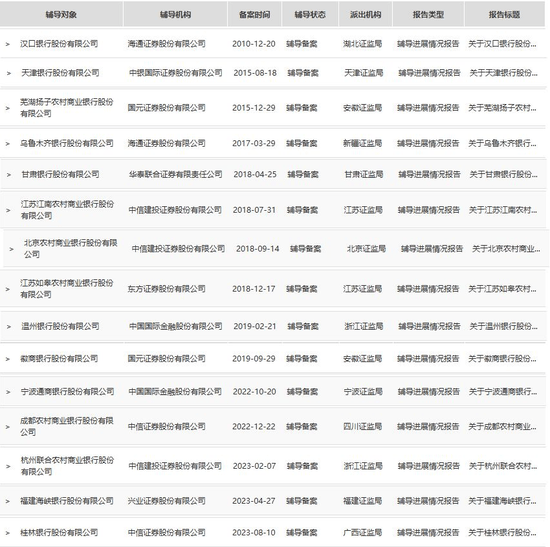
A股IPO"候场"银行不断缩减的同时,"预备役"队伍依旧庞大。4月24日,北京商报记者注意到,桂林银行上市辅导进展报告近期"出炉",报告显 示,该行仍需进一步完善少量自有房产土地及租赁房产权属手续以及处理未决的法律诉讼。除桂林银行之外,年内还有天津银行、汉口银行、北 京农商行、成都农商行、杭州联合农商行等14家银行辅导进展披露,个别银行IPO长跑已近15年。 按照上市的进程,IPO辅导只是上市的"第一步",辅导完成后将进入材料申报、沟通反馈阶段,进阶IPO"后备军"队列。不过,自2022年兰州银行 成功上市后,A股银行IPO就已进入"空窗期",至今尚有6家"候场"。在分析人士看来,在大中型银行已相继上市的情况下,若缺乏新的发展亮 点,中小银行上市之路或将较为艰难。 又有银行辅导进展披露 近日,中信证券披露了桂林银行首次公开发行股票并上市的辅导工作进展情况报告,介绍了2025年1月至3月辅导期间,对桂林银行的辅导情况。 根据报告内容,桂林银行此前存在的两个主要问题仍需进一步解决,一个是因历史原因存在的少量自有房产土地未办理权证、部分租赁房产未备 案登记等情况,需进一步完善相关权属手续。另一个则是在日常经营中涉及 ...