Stagflation

Search documents
Stagflation will derail one of the biggest drivers of the stock market rally next year, Apollo's top economist says
Yahoo Finance· 2025-12-20 03:43
JOHANNES EISELE/AFP via Getty Images Stagflation is one of the biggest risks staring down the Fed in 2026, Apollo's Torsten Sløk says. The scenario, often thought to be the worst-case for the economy, entails slow growth and elevated inflation. That risk is one of the biggest obstacles to the Fed cutting rates next year, in Sløk's view. A top economist is back with a stagflation warning. Torsten Sløk, the chief economist at Apollo Global Management, said he believes stagflation is still one of the ...
Stock Market Today, Dec. 19: AI Optimism and Inflation Data Buoys Stocks
Yahoo Finance· 2025-12-19 22:23
Market Performance - The S&P 500 rose 0.88% to 6,834.50, the Nasdaq Composite gained 1.31% to 23,307.62, and the Dow Jones Industrial Average added 0.38% to 48,134.89, all influenced by volatile quad-witching flows [1] - AI-linked and broader tech names led market gains, with Oracle and Micron Technology boosting prices, while consumer stocks like Nike and Lamb Weston lagged due to disappointing earnings and guidance [2] Economic Indicators - Reports of cooling inflation and a softer labor market have strengthened expectations for a potential Federal Reserve rate cut early next year [4] - The University of Michigan revised its December consumer sentiment expectations downwards, citing high prices and weak hiring as contributing factors [5] Sector Challenges - Mixed results from Nike and Lamb Weston highlight ongoing challenges in consumer-facing sectors, with Nike beating analyst estimates but experiencing a stock decline due to concerns over profits and sales in China [5] - Apollo Global Management has warned of stagflation risks next year, particularly if AI does not meet expectations [4]

It's going to be an uphill battle to convince the fed to cut rates: Apollo Global’s Torsten Slok
CNBC Television· 2025-12-19 16:31
Let's continue the conversation right here with Toron Slack. He's chief economist at Apollo Global Management. Um, you have a favorite in that Fed race, by the way.Well, so I don't have a personal favorite, but I think it's clear that the market is trying to chew hard on which of these candidates will have implications for what's happening, especially of course in rates. What the conclusion of course here is that it all becomes about can the new fetcher persuade the other FOMC members about whatever his vie ...

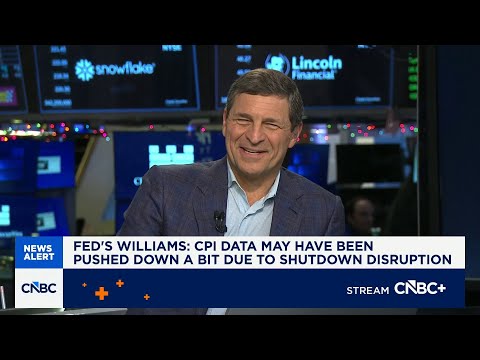
It's going to be an uphill battle to convince the fed to cut rates: Apollo Global's Torsten Slok
Youtube· 2025-12-19 16:31
Economic Outlook - The market is focused on the implications of the new Fed chair on interest rates, particularly the challenge of convincing other FOMC members to support rate cuts [2][3] - There are expectations of economic growth accelerating due to various tailwinds, including the "one big beautiful bill" and favorable oil prices [4][5] - Inflation is currently around 3%, and there are concerns about maintaining interest rates in a growing economy [6] Employment Trends - Job growth has slowed significantly, with net immigration into the US dropping from around 3 million annually to a projected 500,000 over the next two years [8] - The new equilibrium rate for non-farm payrolls has decreased from 200,000 to 30,000 jobs created monthly due to reduced immigration [9] Risks to Growth - Stagflation is identified as a significant risk, particularly if AI does not meet growth expectations [10] - The construction of data centers has contributed positively to GDP growth, but a slowdown in capital expenditures could pose risks [11] - Inflation remains a complex issue, with various forces at play, and there are expectations of elevated inflation risks in the coming months [12][14] FOMC Considerations - The FOMC is divided on the approach to interest rates, balancing a weaker labor market against persistent inflation risks [15]


November CPI Report: Inflation Lower, Fed Trajectory Remains Favorable
Seeking Alpha· 2025-12-18 14:20
Economic Overview - The U.S. economy is currently facing a unique situation characterized by rising inflation alongside slowing job growth over the past year [1] - This situation has created complexities that may resemble stagflation, although it has not been explicitly labeled as such in previous analyses [1]

'Beary Burry' Warns Of Multi-Year Bear Market As Stock Wealth Tops Real Estate - SPDR S&P 500 (ARCA:SPY)
Benzinga· 2025-12-17 06:39
Core Insights - Michael Burry, known for predicting the 2008 financial crisis, warns of a potential downturn in the U.S. stock market due to a significant shift in household wealth allocation, with stocks now surpassing real estate [1][2] Group 1: Market Trends - The chart "Exhibit 12," shared by Burry, indicates that U.S. household allocations to equities have recently overtaken those in real estate, marking a significant historical shift [2] - This crossover is described as a high-conviction danger signal that has not been observed in decades, suggesting a potential long-term market decline [2] Group 2: Historical Context - Burry references historical precedents where household stock wealth exceeding real estate wealth occurred in the late 1960s and late 1990s, both of which preceded significant market downturns [3] - The late 1960s crossover led to a decade of stagflation and poor real returns, while the late 1990s instance coincided with the peak of the Dot-Com bubble [3] Group 3: Market Performance - As of 2025, the S&P 500 index has increased by 15.88% year-to-date, the Dow Jones index has returned 13.50%, and the Nasdaq Composite has gained 19.87% during the same period [4] - On a recent trading day, the SPDR S&P 500 ETF Trust (SPY) closed down 0.27% at $678.87, while the Invesco QQQ Trust ETF (QQQ) rose by 0.20% to $611.75 [5]

AI talent war continues in tech without generating many jobs, says KPMG's Swonk
Youtube· 2025-12-16 18:56
Economic Overview - Consumers are still spending despite an early chill for the holiday season, with core retail sales up 0.9%, indicating stronger performance than the headline figure suggests [1] - The labor market has shown stagnation in payroll since April, with the unemployment rate affected by government shutdowns leading to temporary layoffs [2] Holiday Season Insights - The holiday season is compressed into December, which previously resulted in strong job gains, suggesting a potential repeat this year [3] Future Economic Indicators - Anticipated rate cuts by the Fed and expansions to tax cuts retroactive to 2025 may lead to double-digit gains in tax refunds, which consumers often treat as windfall gains, potentially affecting inflation data [4] Inflation and Labor Market Dynamics - The labor market is currently driven by healthcare and social assistance sectors, with concerns about the stickiness of inflation persisting even with potential improvements in employment [6][7] - There is a normalization of inflation occurring over five years, with sequential tariff-related increases contributing to this trend [8] Fed's Position and Market Sentiment - The Fed faces a divide between those advocating for lower rates and those concerned about inflation, with the current economic data suggesting that price stability has not been achieved [5][9]
These 3 Dividend ETFs Outperformed Every Market Crash Since 2000
247Wallst· 2025-12-16 17:41
Core Viewpoint - Investors are advised to consider dividend ETFs as a defensive strategy during potential market downturns, with historical performance indicating resilience during recessions [1][2]. Group 1: Dividend ETFs Overview - The State Street Consumer Staples Select Sector SPDR ETF (XLP) focuses on companies selling essential goods, providing stability during economic downturns due to inelastic demand for consumer staples [3][4]. - The State Street Health Care Select Sector SPDR ETF (XLV) includes large healthcare companies, benefiting from consistent demand for medical services regardless of economic conditions [6][7]. - The iShares TIPS Bond ETF (TIP) offers exposure to U.S. Treasury Inflation-Protected Securities, serving as a hedge against inflation and providing liquidity [9][10]. Group 2: Performance and Characteristics - XLP has 40 holdings, with Walmart (11.64%), Costco (9.08%), and Procter & Gamble (7.67%) as its largest components, featuring a 2.66% dividend yield and a low expense ratio of 0.08% [5]. - XLV has outperformed the S&P 500 during past downturns, showing a 12% increase over the past year, with a 1.58% dividend yield and an expense ratio of 0.08% [8]. - TIP has a dividend yield of 3.29%, which fluctuates with inflation, and an expense ratio of 0.18% [10][11].

How AI stocks could 'fall a lot,' why one analyst thinks Tesla is a Sell
Youtube· 2025-12-15 22:11
Market Overview - The Dow closed down 41 points, while the NASDAQ fell about half a percent, indicating a lack of significant movement in major indices ahead of important economic data releases [1][2] - The S&P 500 equal-weighted index showed positive performance, suggesting a broader market strength despite the tech sector's decline [3] Sector Performance - The healthcare sector was the top performer, followed by utilities, while technology and energy sectors experienced declines [4] - Defensive sectors showed some strength, indicating a cautious market sentiment as investors await key reports [4] Ford's Strategic Shift - Ford announced a pivot towards gas-powered vehicles, including more trucks and hybrids, while canceling the Lightning EV pickup due to high costs [25][28] - The company plans to convert existing EV plants into truck production facilities and develop a new range-extended EV model with a 700-mile range [25][26] - Ford will also focus on battery storage solutions for grid-scale operators, acquiring battery plants previously in a joint venture with SK [25][26] Financial Implications for Ford - Ford is set to report a $19.5 billion charge related to special items, with $8 billion attributed to EV asset write-downs and $6 billion for restructuring [26][31] - The market reacted positively to Ford's announcement, with a 2% increase in stock price, indicating investor approval of the strategic changes [29][31] Tesla's Market Position - Tesla shares closed near record highs following the launch of a new robo-taxi test in Austin, although analysts view this as an incremental step rather than a significant breakthrough [37][43] - Concerns remain regarding Tesla's high valuation, with the stock trading at over 175 times 2027 EPS estimates, suggesting potential overvaluation [39][41] - The company has faced a decline in domestic sales, particularly after the expiration of the federal EV tax credit, which may impact future performance [41][43] Economic Data Insights - Upcoming economic data includes the November jobs report, with expectations of 50,000 new jobs and a 4.5% unemployment rate, which will influence the Fed's monetary policy [45][46] - Retail sales data is also anticipated, with core retail sales expected to show stronger underlying consumer strength despite a slowdown in headline sales [47]



Why December 16 to 18 Could Be Big Days for the S&P 500 Index
The Motley Fool· 2025-12-15 13:50
Economic Data Release - The government plans to release several important economic data points between December 16 and December 18, which were delayed due to the government shutdown [2][5] - Key metrics include non-farm payrolls, retail sales, and the Consumer Price Index (CPI), which are critical for assessing the economy's performance and the Federal Reserve's potential actions regarding interest rates [5][7] Market Performance and Sentiment - The stock market has increased over 17.5% as of December 11, indicating a strong performance for the third consecutive year despite volatility [3] - Investors are facing uncertainty due to potential headwinds such as high inflation, recession risks, and stagflation concerns [3] Labor Market Insights - Non-farm payrolls data for October and November is expected to show a slump in October due to the government shutdown, with a rebound anticipated in November; the unemployment rate is projected to remain at 4.4% [6][7] - The labor market's condition is a primary concern for the Federal Reserve, influencing its decisions on interest rate adjustments [6][9] Retail Sales and Consumer Spending - Retail sales data is crucial as it reflects consumer demand, which is vital for an economy heavily reliant on consumer spending; stronger retail sales are expected during the holiday season [8] - The CPI is forecasted to increase by 0.3% month-over-month and 3% year-over-year, serving as a key inflation gauge [8] Federal Reserve's Interest Rate Strategy - The Federal Reserve is likely to continue cutting interest rates if the labor market shows weakness and inflation remains subdued, as lower rates can stimulate economic growth [9][10] - The Fed aims to avoid stagflation, where high inflation coincides with rising unemployment, complicating its ability to support the labor market [10]