
产业链一体化

Search documents
供需双弱持续,原料风险关注
Yin He Qi Huo· 2025-12-31 03:18
Report Industry Investment Rating - Not provided in the content Core Viewpoints of the Report - In 2026, the overcapacity situation in the asphalt industry remains unchanged, but the pace of capacity clearance accelerates, with no new capacity added. Supply will tighten month - on - month, and resources will concentrate on refineries with quotas and industrial chain integration advantages. - As the first year of the "14th Five - Year Plan", the start of terminal demand for asphalt is slow, with the focus shifting to stock maintenance. There is an expected increase in demand for modified asphalt. - Inventory levels are expected to be low in the first half of the year supported by low supply, but the de - stocking speed will slow down in the second half due to weak demand, resulting in a relatively high inventory level at the end of the year. - The price trend is expected to fluctuate according to seasonal patterns [5][48]. Summary by Relevant Catalogs 1. Market Review - In 2025, the asphalt market was influenced by cost, policy, and supply - demand patterns. In the first quarter, low start - up, low inventory, and the release of winter storage demand drove up spot prices. In February, weakening oil prices, slower - than - expected post - holiday demand recovery, and raw material premium fluctuations led to a decline in futures prices. In the second quarter, oil prices fluctuated widely, and asphalt futures prices followed suit. In the second half of the year, prices declined. In the third quarter, the market was "strong in the north and weak in the south", and in the fourth quarter, supply exceeded demand, leading to rising inventory and falling prices [4][12][13]. 2. Fundamental Situation Supply Overview - In 2025, China's total asphalt production is expected to be 28.08 million tons, a year - on - year increase of 260,000 tons or 10%. The growth mainly came from local refineries and PetroChina, while Sinopec continued to contract. - In 2026, it is expected that Sinopec's production will continue to decline by about 14% to around 5.4 million tons, and PetroChina's production will decline slightly by 0.6%. Local refineries with crude oil quotas will make more flexible production decisions, and the production of local refineries is expected to increase by 1.8% to 14.71 million tons [21][23][24]. Demand Overview - In 2025, asphalt market demand was weak, showing the characteristic of "not prosperous in the peak season and weaker in the off - season". Climate, capital status, and regional project progress are the main factors affecting demand. - In 2026, as the first year of the "14th Five - Year Plan", highway investment and downstream asphalt demand are expected to start slowly, accounting for 18% of the entire five - year plan, with an estimated total demand of 28.3 million tons, a year - on - year decrease of 8% [34][35][36]. Inventory and Valuation - In 2025, inventory remained low throughout the year, fluctuating due to seasonal demand, refinery production adjustments, weather disturbances, and winter storage policies. - In terms of cost, international crude oil prices showed a downward trend throughout the year, reducing refinery raw material costs. Refineries with crude oil quotas had relatively low comprehensive costs and achieved profitability in some periods, while refineries without quotas suffered deep losses and gradually stopped production [40][41][42]. 3. Future Outlook and Strategy Recommendations Future Outlook - Supply: The long - term overcapacity situation remains unchanged, but the exit of backward production capacity accelerates. In 2026, there will be no new capacity, and supply will likely remain in a tight - balance pattern. - Demand: The overall demand in the "14th Five - Year Plan" is expected to be the same as that in the "13th Five - Year Plan". In 2026, demand starts slowly, and there is an expected increase in demand for modified asphalt. - Price: The price trend is expected to fluctuate seasonally, with potential pressure in the first half of the year and a possible rebound in the second half [48]. Strategy Recommendations - Unilateral: The BU main contract will fluctuate widely throughout the year, with an operating range of 2700 - 3300. - Arbitrage: In the first half of the year, trade raw material risks and overweight asphalt in oil products. In the second half of the year, if demand is less than expected, short the asphalt - crude oil spread. - Options: Wait and see [6][48][49]
红星冷链(01641.HK)拟全球发售2326.3万股H股 引入福慧达香港作为基石
Ge Long Hui· 2025-12-31 00:03
Core Viewpoint - Hongxing Cold Chain (01641.HK) plans to globally offer 23.263 million H-shares at a price of HKD 12.26 per share, with the offering period from December 31, 2025, to January 8, 2026, and trading expected to commence on January 13, 2026 [1][2]. Company Overview - The company is a provider of frozen food storage services and frozen food store leasing services, headquartered in Changsha, Hunan Province. It has developed a business model that combines frozen food warehouses with leasing services to connect wholesalers and retailers in the frozen food supply chain [2]. - The company offers frozen food storage services to wholesalers and retailers, providing warehouse capacity and management services, including sorting, classification, packaging, inventory tracking, and safety management [2]. - The company also leases stores to wholesalers and retailers for conducting frozen food transactions, charging rent based on the store's location [2]. Fundraising and Use of Proceeds - The estimated net proceeds from the global offering are approximately HKD 252.3 million. The company plans to allocate these funds as follows: about 57.5% for building a new processing plant and expanding frozen food storage warehouses; approximately 12.8% for upgrading existing equipment and IT infrastructure, including investments in AI technology; around 19.7% for seeking strategic acquisitions and partnerships; and about 10.0% for working capital and general corporate purposes [3]. - The company has entered into a cornerstone investment agreement with Fuhua Hong Kong, which will subscribe for shares worth approximately HKD 22.06 million at the offering price [2][3].
中伟股份(300919) - 300919中伟股份投资者关系管理信息20251230
2025-12-30 11:06
定 5-6 亿湿吨镍矿资源的供应,并已在印尼建立四大镍原料产业 基地,打通资源、冶炼、材料的垂直一体化产业链生态。 2、对此次镍价上涨周期怎么看? 答:公司持续完善一体化产业链生态的搭建,LME 镍价上涨 对公司经营利润有积极影响。 3、公司与下游客户的谈价周期和定价机制是什么,是否受 上游金属价格波动影响? 答:公司与大客户主要签订长期合作协议方式,协议时间至 少三年以上。公司采取"以销定产"的经营策略以及"主要原材 料成本+加工费"的价格传导定价机制,辅以套期保值业务,最 大程度降低原材料价格波动的直接影响。 4、公司 2025 年镍系三元未来增长驱动因素有哪些? 答:展望未来,基于中国市场对长续航需求提升、单车带电 量提升、固态电池产业化、欧洲新能源车需求向好,未来镍系材 料仍然具备较大市场增长空间。 5、公司磷酸铁锂相关的资源布局、开采情况及成本等信息? 答:产能布局方面:目前公司在贵州开阳布局了 20 万吨磷 酸铁和 5 万吨磷酸铁锂产能。资源布局方面:磷资源,公司在贵 州开阳掌控优质磷矿资源,磷矿资源量达 9844 万吨,平均品位 25%;规划年开采量 280 万吨,近期即将启动动工;锂资源,公 ...
开源证券:复合肥行业供需向好 看好龙头企业量利修复、分红提升
智通财经网· 2025-12-30 03:20
复合肥企业包括生产型和营销型两大类,2020年以来,复合肥产业链宽幅震荡后回归理性,行业竞争加 剧,两大类企业围绕成本、产品、品牌和渠道等全方位的角逐已成常态,头部企业竞争优势愈发突出。 (1)新洋丰:复合肥年产能798万吨、磷酸一铵年产能185万吨,公司复合肥产销量连续多年位居国内 第一,磷矿石、硫酸、合成氨等配套日臻完善。(2)云图控股:复合肥年产能745万吨、磷酸一铵年产 能43万吨,着力打造"盐—碱—肥"氮肥产业链和磷酸分级利用产业链。(3)史丹利:复合肥年产能590 万吨,磷酸一铵年产能110万吨,"品牌+渠道+产品+服务"综合经营模式,随着河北承德和湖北松滋磷 化工项目进入使用状态,公司实现了磷肥原料的部分自供。2022年以来,龙头企业存货及应收账款周转 速度稳健,经营现金呈持续净流入,现金分红比例稳中有升。 复合肥:行业供需向好,看好龙头企业量利修复、分红提升 复合肥上游为氮肥、磷肥、钾肥等单质肥,下游对接农业生产。(1)需求端:据国家统计局数据, 2000-2023年国内农用复合肥施用折纯量自918万吨增长至2,401万吨,CAGR达到4.3%,增速显著高于氮 肥、磷肥以及农用化肥总施用量;2 ...
复合肥行业深度报告:行业供需向好,看好龙头企业量利修复、分红提升
KAIYUAN SECURITIES· 2025-12-30 02:15
Investment Rating - The industry investment rating is "Positive" (maintained) [1] Core Viewpoints - The report indicates that the compound fertilizer industry is experiencing a favorable supply-demand dynamic, with expectations for leading companies to see volume and profit recovery, as well as increased dividends [5][7][28] - The compound fertilizer market is transitioning towards new types of fertilizers that are more efficient, specialized, functional, and precise, driven by changes in agricultural practices and consumer demand [28] Summary by Sections 1. Demand Side - The consumption of compound fertilizers has a strong necessity attribute, with the compound fertilizer application rate in China expected to continue rising. From 2000 to 2023, the application of compound fertilizers increased from 9.18 million tons to 24.01 million tons, with a CAGR of 4.3%, while the overall fertilizer application rate reached 47.8% in 2023 [20][24][22] 2. Supply Side - The compound fertilizer industry operates on a sales-based production model, with a low operating rate. As of November 2025, the domestic compound fertilizer capacity was 134.14 million tons, with an annualized operating rate of 38.8% [27][39][36] - The industry is characterized by a seasonal demand pattern, with production concentrated in resource-rich areas or sales locations, leading to a fragmented capacity distribution [28][39] 3. Price Review and Competitive Landscape - The pricing of compound fertilizers is primarily based on a cost-plus model, with raw material costs accounting for over 80% of total costs. The report notes that fluctuations in raw material prices significantly impact the profitability of compound fertilizers [43][42] - Leading companies are enhancing their competitive advantages through comprehensive strategies involving cost management, product development, branding, and distribution channels [6][7][28] 4. Company Analysis - Key players in the compound fertilizer industry include New Yangfeng, Yuntu Holdings, and Stanley, all of which have demonstrated significant advantages in terms of production capacity and integrated supply chains [6][7][28] - New Yangfeng has a production capacity of 7.98 million tons of compound fertilizers and has maintained a leading position in sales volume for several years [6][7] - Yuntu Holdings focuses on developing a nitrogen-phosphorus fertilizer industry chain and has a production capacity of 7.45 million tons [6][7] - Stanley employs a comprehensive business model that integrates branding, channels, products, and services, with a production capacity of 5.90 million tons [6][7]


【投资视角】启示2025:中国液压行业投融资及兼并重组分析(附投融资事件、产业基地和兼并重组等)
Qian Zhan Wang· 2025-12-28 06:09
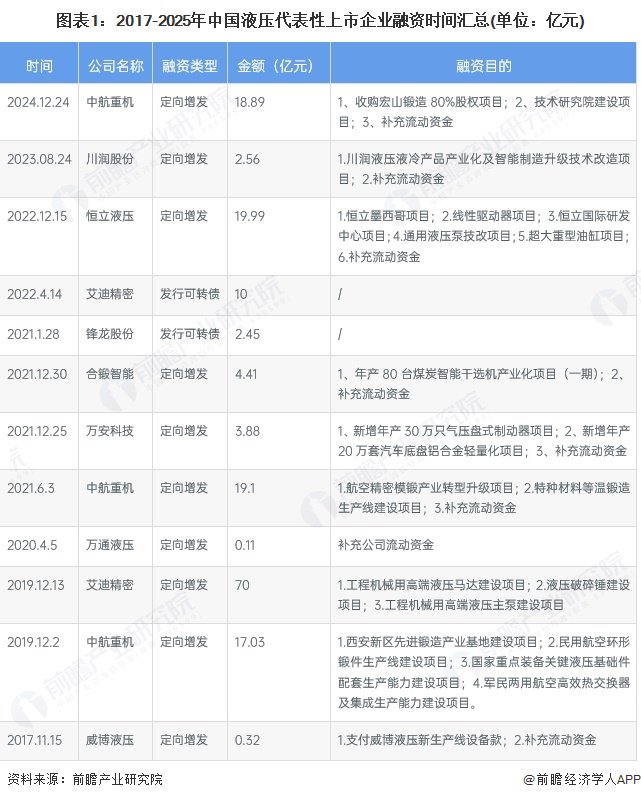
Financing and Investment - The primary financing methods for listed companies in the hydraulic industry are through targeted placements, mainly aimed at expanding production lines and supplementing working capital [1][2] - Notable financing events include: - AVIC Heavy Machinery's targeted placement of 1.889 billion yuan for acquiring 80% of Hongshan Forging and establishing a technology research institute [2] - Hengli Hydraulic's targeted placement of 1.999 billion yuan for various projects including the Mexico project and international R&D center [2] - Aidi Precision's issuance of convertible bonds amounting to 1.0132 billion yuan for technological upgrades [2] External Investments - Representative companies in the hydraulic industry are diversifying their external investments to achieve vertical integration within the supply chain [3][4] - Examples of external investments include: - Hengli Hydraulic's 60 million yuan investment in Jiangsu Hengli Hydraulic Technology Co., focusing on hydraulic components and software development [3] - Aidi Precision's investments in various subsidiaries for hydraulic machinery and tools, totaling over 80 million yuan [3][4] Mergers and Acquisitions - Recent mergers and acquisitions in the hydraulic industry include significant transactions aimed at expanding market reach and product offerings [13][14] - Notable acquisitions include: - The acquisition of Zhongmei Hydraulic by Chuangli Group's subsidiary, enhancing their market position in coal machinery [13] - Bosch Rexroth's acquisition of HydraForce, which strengthens their presence in North America and expands their product offerings [14] Capital Market Activity - The investment heat in the primary capital market for the hydraulic industry remains relatively low, with companies focusing on high-end and miniaturized hydraulic products [6][7] - Key investment events include: - Hengchuang Precision's B round financing of 30 million yuan for hydraulic components [7] - Various A round financings for companies like Yuci Hydraulic and Bole Hydraulic, focusing on high-pressure pumps and hydraulic systems [7][9] Industry Development Bases - The hydraulic industry has established several key development bases recognized by the government, which continue to drive industry growth [10][12] - Notable bases include: - Fuxin National Hydraulic Equipment High-tech Industrialization Base, covering 33.8 square kilometers with multiple research centers [12] - Luzhou National High-performance Hydraulic Components Base, with a planned area of approximately 20 square kilometers [12] Summary of Industry Trends - The hydraulic industry is witnessing a trend towards diversification and integration, with companies investing in various sectors and expanding their operational capabilities [4][6] - The focus on high-end hydraulic products and technological advancements is expected to shape the future landscape of the industry [6][16]


TCL科技子公司TCL华星拟4.9亿拿下兆元光电80%股权及相关债权
Zheng Quan Shi Bao Wang· 2025-12-26 14:49
Core Viewpoint - TCL Technology plans to acquire 80% of Fujian Zhaoyuan Optoelectronics Co., Ltd. for 490 million yuan to gain control over LED chip design and manufacturing, thereby establishing a self-controlled supply chain system [1][2]. Group 1: Acquisition Details - The acquisition involves the transfer of 80% equity and all debts of Zhaoyuan Optoelectronics, totaling 1.759 billion yuan, with a final transaction price of 490 million yuan [1][2]. - The transaction does not constitute a related party transaction or a major asset restructuring, thus does not require shareholder approval [2]. Group 2: Company Background - Zhaoyuan Optoelectronics, established in March 2011, focuses on the R&D, production, and sales of LED epitaxial wafers and chips [2]. - In 2024, Zhaoyuan Optoelectronics reported revenues of 888 million yuan and a net loss of 389 million yuan, with revenues of 710 million yuan and a net loss of 300 million yuan from January to October 2025 [2]. Group 3: Strategic Implications - The acquisition will accelerate the integration of the LED vertical supply chain and enhance the development of high-end display technologies such as Mini/MicroLED [3]. - TCL Technology aims to leverage Zhaoyuan's existing assets to improve product competitiveness and profitability, while enhancing its overall efficiency and market position in high-performance display solutions [3].

兆驰股份(002429) - 投资者关系活动记录表(2025-008)
2025-12-25 15:06
Group 1: Company Overview and Market Position - The company has established partnerships with major domestic clients and is actively expanding into international markets [1][2] - The 200G and below low-speed optical modules have achieved stable mass production, while 400G/800G high-speed modules are in the sample testing phase with expected small batch shipments in Q2 2026 [1][2] Group 2: Strategic Development and Capacity Expansion - The company adopts a customer demand-driven approach for capacity expansion, focusing on small batch production to explore market needs before scaling up [3] - A stepwise development strategy is employed, starting with mature products to build customer resources and industry experience before moving to high-value products [3] Group 3: Importance of 200G and Below Optical Modules - The decision to prioritize 200G and below optical modules is based on their strong demand stability and significant economies of scale, which enhance market competitiveness [5] - Stable mass production of these modules supports the development of high-speed module production lines and improves overall operational efficiency [5] Group 4: Core Competencies and Innovations - The company has strong capabilities in scaling production and converting laboratory technologies into market-ready products, which benefits the optical communication business [6] - Emphasis on innovation and cost structure optimization through continuous process improvements and automation enhances competitive advantages [7] Group 5: Micro LED Technology Strategy - The Micro LED optical interconnect technology addresses key issues in high bandwidth and high-speed scenarios, positioning the company for long-term growth in optical communication [8][10] - Current focus is on achieving breakthroughs in core light source technology and building intellectual property barriers for future industrialization [10] Group 6: Smart Terminal Business Outlook for 2026 - The smart terminal business is expected to recover in 2026 due to global layout strategies, automation improvements, and diversification of product offerings [10]

从“增长”到“重塑”:解码2025锂电扩产潮里的产业变局
Xin Lang Cai Jing· 2025-12-23 04:58
Core Insights - The Chinese lithium battery storage industry is undergoing significant expansion, with 132 new lithium-ion battery manufacturing projects planned to achieve an annual capacity of 1803 GWh by the end of 2025, backed by a total investment of approximately 428.27 billion yuan [1][23][20] Regional Distribution - The geographical distribution of lithium battery production capacity is shifting from a previously concentrated model in the southeast coastal regions to a more collaborative structure involving East China leading, Central China rising, and Southwest China advancing [3][25] - East China remains a cornerstone, with Shandong, Jiangsu, and Zhejiang leveraging their mature chemical industry foundations and supply chain advantages to become core manufacturing hubs [3][25] - Central China, particularly Hubei, is emerging as a significant player with a storage industry cluster generating over 60 billion yuan, achieving over 20% of the national power battery capacity [5][28] - Southwest China, led by Sichuan, is attracting large-scale energy-sensitive storage battery projects due to its abundant hydropower resources and lower electricity costs [8][31] Technological Developments - Phosphate iron lithium (LFP) batteries maintain a dominant position, accounting for 81.2% of the loading volume in power and storage sectors, with a 51.4% year-on-year increase in exports [9][32] - Sodium-ion batteries are transitioning from laboratory to industrial production, presenting a strategic reserve for addressing lithium resource fluctuations [11][34] - Solid-state batteries are making strides in industrialization, with projects in Sichuan and Anhui exceeding 5 billion yuan in total investment [11][34] - The penetration of large cylindrical batteries is accelerating, with projections indicating global production capacity could exceed 300 GWh by 2026 [11][34] Competitive Landscape - Leading companies like CATL are expanding aggressively, with individual project investments exceeding 10 billion yuan and capacity planning reaching 10 GWh [12][35] - The second-tier players are intensifying their positioning battles, with companies like Guoxuan High-Tech and others focusing on niche markets and specific technologies [12][38] - The number of newly registered lithium battery-related companies reached approximately 37,000 in the first 11 months of 2025, indicating strong capital and entrepreneurial interest in the sector [12][38] Project Progress - As of November 2025, 74 projects are in substantial stages of construction, representing nearly 70% of the total planned projects, with 30 newly started, 23 under construction, and 21 already in production [16][39] - There are 28 projects in preliminary stages, with 12 already partially completed, indicating a steady influx of new capacity into the market [19][42] Structural Changes - The expansion of capacity is characterized by a supply-side structural reform, focusing on high-quality replacements rather than low-level repetitive construction [20][43] - New production lines are targeting high-capacity cells of 314 Ah and above, leading to the exit of outdated capacities under price and technological pressures [20][43] - Companies with integrated capabilities from lithium mining to recycling are gaining advantages in cost control and supply chain security [20][43] - Chinese storage enterprises are accelerating localized capacity layouts in Southeast Asia, Europe, and North Africa to navigate complex international trade environments [22][45]



华峰化学拟3.48亿出售资产聚焦主业 三重压力之下前三季仍赚14.62亿
Chang Jiang Shang Bao· 2025-12-21 23:21
Core Viewpoint - Huafeng Chemical, a global leader in spandex, is planning to sell its logistics subsidiary to focus on its core business of spandex production [1][2]. Group 1: Asset Sale - Huafeng Chemical announced the transfer of 100% equity of its wholly-owned subsidiary, Chongqing Futong Logistics Co., Ltd., to its affiliate, Huafeng Logistics, for a transaction price of 348 million yuan [1][5]. - The sale aims to optimize asset allocation and enhance operational efficiency, as logistics services contribute less than 1% to the company's revenue [2][5]. - Futong Logistics, established in 2015, has shown profitability, with total assets of 575 million yuan and net assets of 334 million yuan as of September 2025 [6]. Group 2: Financial Performance - Huafeng Chemical has maintained strong annual profits exceeding 2 billion yuan since 2020, despite facing industry challenges [3][11]. - The company reported a net profit of 1.462 billion yuan in the first three quarters of 2025, demonstrating resilience amid market pressures [3][11]. - As of September 2025, the company's debt-to-asset ratio was 26.78%, and it had a negative financial expense for the third quarter [4]. Group 3: Business Focus and Strategy - The company emphasizes a development strategy centered on strengthening its core business, with a focus on the polyurethane industry chain [2][10]. - Huafeng Chemical has established itself as a leader in the production of spandex fibers, polyurethane raw materials, and other related products, with significant market share [9][10]. - The company has a strong research and development advantage, holding numerous patents and standards in the industry, which supports its competitive position [10].
