
外交政策

Search documents
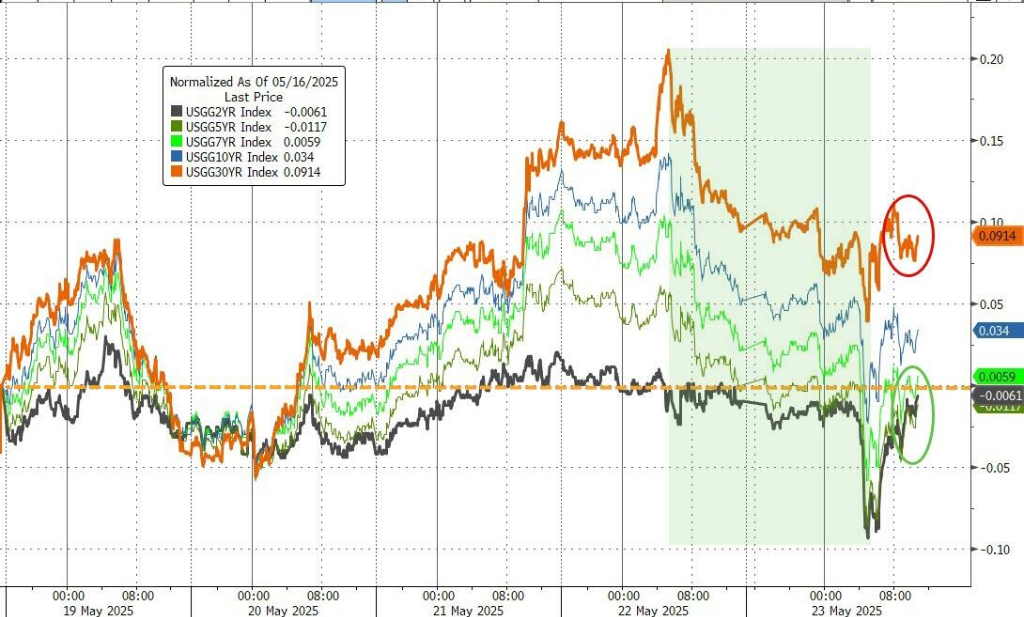
特朗普“关税威胁”越多,美元和美债砸的越狠
Hua Er Jie Jian Wen· 2025-05-24 03:51
Core Viewpoint - Deutsche Bank warns that the United States' dual deficit status makes it highly reliant on foreign capital inflows, and Trump's confrontational policies are undermining international investor confidence, posing a direct threat to the stability of the dollar and the U.S. Treasury market [1][3]. Group 1: Economic and Market Implications - The core challenge facing the dollar and U.S. Treasury market is the need for continuous foreign capital inflows to sustain the dual deficit status [1]. - A cooling interest from foreign investors in U.S. Treasuries and the dollar could lead to increased exchange rate volatility and significant fluctuations in bond yields [1]. - The recent downgrade of the U.S. sovereign credit rating, weak performance in the 20-year Treasury auction, and growing concerns over rising U.S. fiscal spending have all impacted the Treasury market [1]. Group 2: Investor Sentiment and Policy Impact - Trump's tariff policies and aggressive diplomatic stance are quietly eroding foreign investors' trust in the U.S. market [3]. - Saravelos highlights that Trump's unpredictable style complicates foreign investors' ability to forecast U.S. policies, diminishing their willingness to hold dollars and Treasuries [3]. - If confrontational diplomatic and economic policies persist, the outlook for the dollar and Treasuries will become increasingly pessimistic, necessitating a more moderate approach from the U.S. government to maintain market stability [3].

美国国务卿鲁比奥:我们外交政策的成果属于我们的总统,而不是某个法官。
news flash· 2025-04-30 17:28
Core Viewpoint - The U.S. Secretary of State Rubio emphasizes that the achievements of U.S. foreign policy are attributed to the President rather than any individual judge [1] Group 1 - The statement reflects a clear delineation of responsibility in U.S. foreign policy, asserting that the President is the primary actor in shaping diplomatic outcomes [1]
德媒:默茨忠实盟友将成德国新外长,或极大减少新任政府内部分歧
Huan Qiu Shi Bao· 2025-04-29 22:31
Group 1 - The core point of the article is the approval of a coalition government agreement between the Christian Democratic Union (CDU) and the Social Democratic Party (SPD) in Germany, with Friedrich Merz set to become the new Chancellor if the SPD membership approves the agreement [1] - The CDU will manage foreign and economic affairs, while the SPD will oversee finance and defense, with the CDU holding 10 out of 17 cabinet positions [1] - The new Foreign Minister, Johann Wadephul, is a conservative and experienced in defense and foreign policy, marking a shift from the previous foreign minister's approach [2][3] Group 2 - Wadephul emphasizes the need for Germany to enhance its ability to respond to global crises and plans to implement a coherent foreign and security policy [3] - The new government aims to break down departmental silos and establish a National Security Council to coordinate efforts across various government levels [3] - Merz has called for the cancellation of all tariffs by the U.S. and mutual recognition of technical standards to reduce bureaucratic barriers in trade [4]
80年来美国历任总统支持率最低,特朗普执政百日民调结果出炉
Xin Lang Cai Jing· 2025-04-28 07:15
Core Insights - Trump's approval rating has dropped to 39%, marking the lowest approval rating for a U.S. president at the 100-day mark in the past 80 years [2] - A significant portion of the public, 72%, believes Trump's economic policies may lead to a recession in the short term, with 53% stating that the economic situation has worsened since he took office [2] - Trump's handling of immigration and government management has faced disapproval from over half of the respondents [2] Group 1: Approval Ratings - Trump's overall approval rating stands at approximately 39%, with a notable decline of 4 percentage points since March and a 7-point drop since February [2] - Among Republicans, about 86% express approval, while 93% of Democrats disapprove, indicating a stark partisan divide [2] - Support among independents has fallen to 31%, reflecting a significant decrease in cross-party appeal [2] Group 2: Economic Concerns - Trump's approval regarding economic management has decreased by 9 percentage points to 35%, with only 52% of respondents expressing confidence in his economic handling, down 13 points from December [3] - Concerns over tariffs have also contributed to a 4-point drop in approval to 35%, leading to volatility in the stock market and rising price concerns [2][3] - Approximately 41% of respondents feel their financial situation has deteriorated since Trump's presidency began [2] Group 3: Public Sentiment on Policies - A majority of Democrats view Trump's immigration and tariff policies as excessive, with many expressing a negative outlook on his economic prospects compared to his previous term [1] - Trump's foreign policy, particularly his stance on Russia amid the Ukraine conflict, has garnered significant opposition, with only 39% approval [3] - Confidence in Trump's ability to handle foreign affairs has decreased to 50%, down from 55% before he took office [3]