大语言模型

Search documents
质疑VLA模型、AI完全不够用?有从业者隔空回应宇树王兴兴
Di Yi Cai Jing· 2025-08-11 11:33
Core Viewpoint - The traditional humanoid robots face three core challenges: perception limitations, decision-making gaps, and generalization bottlenecks [5] Group 1: Industry Challenges - The industry is currently unable to utilize full parameter models effectively, indicating a need for deeper collaboration between the robot's brain, cerebellum, and limbs [2] - Traditional robots often rely on preset rules for task execution, making it difficult to adapt to complex and dynamic environments [5] - Robots require manual intervention for reprogramming or strategy adjustments during multi-task switching [5] Group 2: Perspectives on VLA Model - The VLA (Vision-Language-Action) model is seen as a controversial yet pivotal paradigm for humanoid robot motion control, with many in the industry betting on its potential [4] - The OPEN VLA, based on the Llama2 language model with 7 billion parameters, is an example of a smaller-scale model that still faces challenges in effectively utilizing large language models [4] - There is a call for the industry to explore the collaborative distribution of computing power between cloud and edge devices to create a comprehensive deployment architecture [4] Group 3: Future Directions - The ideal "brain" model for humanoid robots should not only be a large language model but a complete system that deeply integrates hardware and software [4] - The industry is encouraged to rethink the VLA model and seek new paradigms, potentially through biomimicry to develop original foundational models for embodied intelligence [6] - There is growing confidence in the humanoid robot industry, with many believing it will become a significant sector, marking this year as a potential turning point for mass production [6]

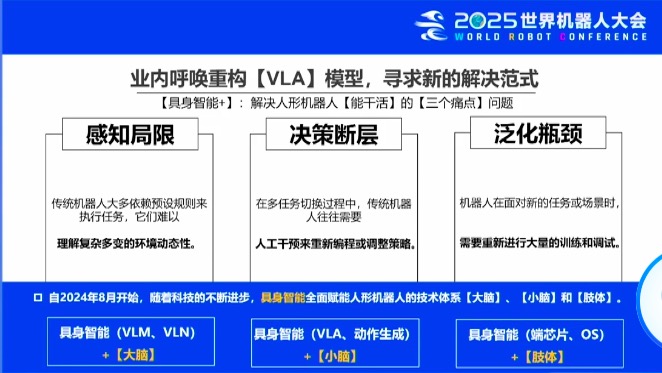
瑞承:从竞赛到实用,AI模型如何在性能与效率间寻找平衡
Jin Tou Wang· 2025-08-11 09:46
Core Insights - Google has officially launched the Gemini 2.5 Deep Think model for Google AI Ultra subscribers, marking a new phase in the competition of large language models with enhanced reasoning capabilities [1] - The model is an upgrade from the Gemini 2.5 Pro series, utilizing a new research approach to improve answer quality through multi-hypothesis reasoning while optimizing for everyday use cases [1] Technical Positioning - The Gemini 2.5 Deep Think model retains its core advantage in multi-step reasoning from its predecessor, which won a gold medal at the International Mathematical Olympiad (IMO), but has been optimized for daily applications [2] - This optimization has resulted in a drop in performance to a bronze medal level in IMO benchmark tests, reflecting a trade-off between precision and efficiency necessary for practical use [2] Performance Breakthrough - Third-party testing indicates that Gemini 2.5 Deep Think excels in various authoritative benchmarks, achieving superior accuracy in fields such as humanities and social sciences in the MMLU (Massive Multitask Language Understanding) test [3] - The model shows significant improvement in solving complex arithmetic problems in the GSM8K dataset and ranks highly in syntax correctness and logical completeness for code generation tasks in Python and Java [3] - The underlying "multi-hypothesis reasoning" framework allows the model to generate multiple reasoning paths before arriving at the optimal solution, particularly beneficial for step-by-step proof scenarios [3] User Experience - Currently, Gemini 2.5 Deep Think is available exclusively to Google AI Ultra subscribers, following Google's strategy of prioritizing high-end features for paying users [4] - The model supports long text processing, real-time translation, and code explanation, with optimizations for vertical fields like education and programming [4] - The subscription model raises discussions about technology accessibility, as it may widen the experience gap between different user groups compared to competitors' tiered pricing strategies [4] - The launch of Gemini 2.5 Deep Think reflects a shift in the industry focus from parameter scale competition to reasoning efficiency, scenario adaptation, and user experience [4]

金融IT深度报告:牛市复盘,金融IT何时发力
ZHESHANG SECURITIES· 2025-08-11 08:02
Investment Rating - The industry investment rating is optimistic [1] Core Insights - The financial IT sector shows significant elasticity during the initial stages of a bull market, with notable price increases and valuation expansions [3] - The combination of technology and finance attributes leads to a "Davis Double Play" effect during bull markets, particularly highlighted in 2015 [4] - Current advancements in AI and new business developments are expected to drive further growth in the financial IT sector [5] Summary by Sections 2014-2015: Liquidity Explosion, Financial Technology Leads - The bull market from 2014 to 2015 was driven by ample liquidity and the rise of mobile internet, leading to significant gains in financial technology stocks [15][19] - Financial technology stocks experienced substantial price increases, with some stocks seeing gains close to 450% compared to mid-2014 levels [4] - The financial IT sector benefited from increased investor participation and software usage during the bull market [33] 2016-2018: Structural Bull Market, Varied Performance in Financial Technology - The period from 2016 to 2018 was characterized by a structural bull market influenced by supply-side reforms and foreign capital inflows [43] - Financial technology stocks underperformed compared to the broader market during this period, primarily due to high valuations and changing market preferences [46][52] - The financial IT sector faced challenges as the market shifted focus towards blue-chip and consumer stocks, leading to a decline in growth stocks [56] 2019-2021: Core Assets Drive Structural Bull Market - The financial technology sector saw a resurgence from 2019 to 2021, driven by global liquidity and domestic industrial upgrades [70] - The introduction of the Sci-Tech Innovation Board in 2019 significantly boosted the financial technology sector, with strong performance noted in various market phases [76][81] - Financial technology stocks outperformed the market during key periods, reflecting the sector's recovery and growth potential [82]





智谱终于发布GLM-4.5技术报告,从预训练到后训练,细节大公开
机器之心· 2025-08-11 07:12
Core Viewpoint - The article highlights the release of GLM-4.5 and GLM-4.5-Air, which integrate reasoning, coding, and agentic capabilities into a single model, achieving the highest ranking among domestic and open-source models in 12 global benchmarks [2][11][19]. Group 1: Model Performance and Reception - GLM-4.5 achieved third place in global rankings across 12 recognized benchmarks, outperforming all domestic and open-source models [2][19]. - The model's announcement generated significant attention, with over 1.2 million views on social media and topping the Hugging Face trends for seven consecutive days [2][3]. - The technical report for GLM-4.5 was voted as the "1 Paper of the day" by Hugging Face users [13]. Group 2: Technical Innovations - GLM-4.5 employs a MoE (Mixture of Experts) architecture, enhancing computational efficiency during training and inference [21][24]. - The model features a unique training process, including pre-training on 15 trillion tokens and mid-training on 7 trillion tokens, with a maximum sequence length expanded from 4K to 128K [25][27]. - The introduction of the slime framework supports efficient reinforcement learning training, addressing common bottlenecks in agentic tasks [31][34]. Group 3: Key Capabilities - GLM-4.5 integrates three core capabilities: agentic ability for real-world interaction, complex reasoning for multi-step problem-solving, and advanced coding skills for software engineering tasks [22][19]. - The model's performance in agentic tasks was evaluated against competitors, showing superior results in benchmarks like TAU-bench and BFCL V3 [44]. - In reasoning tasks, GLM-4.5 outperformed OpenAI's models in several benchmarks, including AIME 24 and SciCode [47][50]. Group 4: Code Task Performance - GLM-4.5 excelled in code-related benchmarks, outperforming GPT-4.1 and Claude Sonnet 4 in SWE-bench Verified and Terminal-Bench [52][53]. - The model's overall performance in coding tasks positions it as a strong competitor to Claude Sonnet 4 [53]. Group 5: Future Implications - The release of the technical report provides insights into the development direction for domestic open-source large models, serving as a key reference for future research [56][57].

港股异动 | 七牛智能(02567)涨超5% 七牛云AI推理平台上新GPT-OSS 相关模型可通过控制台或API快速调用
智通财经网· 2025-08-11 02:53
Core Viewpoint - Qiniu Intelligent (02567) has seen a significant increase in stock price, rising over 5% and accumulating a gain of over 50% in the past month, attributed to the release of OpenAI's new open-source language model series, GPT-OSS [1] Company Summary - Qiniu Intelligent's stock price rose by 5.71%, reaching HKD 1.48, with a trading volume of HKD 2.0961 million [1] - The company has quickly deployed and optimized the newly released GPT-OSS models from OpenAI, integrating them into Qiniu Cloud's model marketplace [1] Industry Summary - OpenAI has launched the GPT-OSS series, which includes two models: GPT-OSS-120b and GPT-OSS-20b, marking its first open-source model release since GPT-2 in 2019 [1] - The GPT-OSS models are designed as community general-purpose large language models, featuring key capabilities such as function calling, tool invocation, and structured output, suitable for building agent architectures and knowledge Q&A [1]
七牛智能涨超5% 七牛云AI推理平台上新GPT-OSS 相关模型可通过控制台或API快速调用
Zhi Tong Cai Jing· 2025-08-11 02:53
Group 1 - Qiniu Intelligent (02567) has seen a stock price increase of over 5%, with a cumulative rise of more than 50% over the past month, currently trading at 1.48 HKD with a transaction volume of 2.0961 million HKD [1] - OpenAI has released a new open-source language model series called GPT-OSS, which includes two models: GPT-OSS-120b and GPT-OSS-20b, marking the first open-source model release since GPT-2 in 2019 [1] - The GPT-OSS models are designed as community general-purpose language models, featuring key capabilities such as function calling, tool invocation, and structured output, suitable for building agent architectures, knowledge Q&A, and RAG retrieval generation scenarios [1] Group 2 - Qiniu Cloud has promptly completed the deployment and tuning of the GPT-OSS models, which are now integrated into the Qiniu Cloud model marketplace, allowing developers to quickly access them via console or API without local deployment [1]
中金《秒懂研报》 | AI赋能玩具:开启情感陪伴新纪元
中金点睛· 2025-08-10 01:08
Core Viewpoint - The article discusses the evolution and market potential of AI toys, highlighting their ability to provide emotional interaction and companionship through advanced technologies like large language models and multimodal interaction [4][7][18]. Group 1: Evolution of AI Toys - AI toys are not just simple toys; they utilize advanced technologies to engage in natural conversations and emotional interactions with users [7]. - The variety of AI toys ranges from small AI accessories to plush toys and comprehensive companion robots, catering to different demographics including children, young adults, and the elderly [7]. - The development of AI toys has progressed from concept to reality, with notable examples like Sony's AIBO and various products in China that leverage AI breakthroughs to offer high cost-performance [7][8]. Group 2: Drivers of AI Toy Demand - Changing modern lifestyles have created new consumer demands, such as the need for educational and companionship products for children and emotional support for the elderly [8]. - Key technological advancements, including the development of large language models and multimodal interaction technologies, have made AI toys feasible [8]. - The improvement in AI chip miniaturization and cost reduction, along with enhanced cloud computing capabilities, supports the continuous learning and functionality of AI toys [8]. Group 3: Market Outlook and Competitive Advantages - The ongoing technological evolution and diverse consumer needs are creating significant market opportunities for AI toys [11]. - The core competitive advantage of AI toys lies in their ability to engage in natural conversations and understand children's language, heavily relying on advanced language models and interaction technologies [11]. - The presence of well-known IP characters can attract consumers and enhance product appeal, although the alignment between IP and product is crucial [13]. Group 4: Future of AI Toys - Future advancements in AI technology are expected to lead to significant improvements in functionality and performance, enhancing user experience and expanding market size [17]. - However, the market also faces challenges, including concerns over children's information security and privacy, as well as the potential impact on social skills and emotional development [17]. - The AI toy industry is still in its early stages, with a low global market penetration rate, indicating substantial growth potential, with projections suggesting the market could reach $60 billion by 2033 [15].

刘若鹏称形成5大超材料生产基地 光启制造大纲字数多达38亿
Shen Zhen Shang Bao· 2025-08-09 18:33
Core Viewpoint - Shenzhen Guoke Technology Co., Ltd. has made significant advancements in the field of metamaterials, achieving a transition from laboratory research to large-scale production, which has been applied extensively in advanced aerospace equipment [1][2]. Group 1: Company Achievements - Over the past 15 years, the company has completed 117,200 design drawings, built 545,000 digital simulation models, and written 7.74 billion words of metamaterial design documentation and 38.28 billion words of manufacturing guidelines [1]. - The company has developed and designed 13.31 million lines of source code, accumulated 2.2 million measured imaging data, and created 8 million measured curves [1]. - The company has established a comprehensive industrial chain layout, including 1 headquarters, 5 production bases, 7 capability platforms, 8 specialized companies, and 1,919 upstream and downstream supporting entities [2]. Group 2: Strategic Development - The company has adopted a "deep vertical" industry development strategy, focusing on large-scale core material development to systematically promote vertical integration of the metamaterial industry chain [3][4]. - The company has applied for over 6,000 patents, with more than 4,000 granted, making it a leader in patent applications in the metamaterials field globally [4]. Group 3: Future Outlook - The company plans to establish new research institutions to support disruptive innovations and develop new tools for micro-material design and manufacturing [6]. - The company is considering the development trends of metamaterials 5.0, aiming to integrate more sensor technologies and next-generation semiconductor technologies into future products [6][7].

ARPO:智能体强化策略优化,让Agent在关键时刻多探索一步
机器之心· 2025-08-09 06:02
Core Viewpoint - The article introduces a novel method called Agentic Reinforced Policy Optimization (ARPO), designed to enhance the performance of large language models (LLMs) in multi-round interactions by addressing the challenges of uncertainty and exploration during tool usage [3][41]. Group 1: Research Motivation and Background - The emergence of Agentic Reinforcement Learning (RL) is driven by the need for LLMs to engage in dynamic multi-round interactions with external tools, moving from static problem-solving to a more interactive agent-environment reasoning paradigm [8]. - Existing Agentic RL methods often underestimate the value of multi-round interactions due to sparse rewards and overuse of tools, leading to a lack of fine-grained exploration of tool usage [8][41]. - The study identifies a significant increase in entropy (uncertainty) after tool calls, indicating an opportunity for exploration that current methods do not fully leverage [14][16]. Group 2: ARPO Methodology - ARPO introduces an entropy-driven adaptive rollout strategy that enhances exploration during high-entropy tool usage phases, allowing for more diverse reasoning paths [11][20]. - The method includes four key steps: initialization of global rollout, monitoring entropy changes, adaptive branching based on entropy, and defining termination conditions for the rollout process [24][27]. - ARPO incorporates advantage attribution estimation to help the model better internalize the value differences in tool usage at each step [28][30]. Group 3: Experimental Results - ARPO outperforms existing sample-level RL methods, achieving better performance with only half the tool call budget across 13 challenging benchmarks, demonstrating its efficiency in training multi-round reasoning agents [21][41]. - The method shows consistent improvements in performance metrics such as Pass@3 and Pass@5, particularly in dynamic, multi-round tasks [37][39]. - In comparative tests, ARPO achieves higher accuracy than GRPO and DAPO in various tasks, including deep search and knowledge-intensive reasoning [41][42]. Group 4: Future Directions - Future research may explore the application of ARPO in multi-modal tasks, expanding its capabilities beyond text-based reasoning to include images and videos [42]. - There is potential for integrating a broader range of external tools to enhance complex task performance through optimized tool usage strategies [42]. - The scalability and real-time deployment of ARPO in larger models and dynamic environments could further improve its practical value and cost-effectiveness [42].

给自动驾驶感知工程师的规划速成课
自动驾驶之心· 2025-08-08 16:04
Core Insights - The article discusses the evolution and importance of planning modules in autonomous driving, emphasizing the need for engineers to understand both traditional and machine learning-based approaches to effectively address challenges in the field [5][8][10]. Group 1: Importance of Planning - Understanding planning is crucial for engineers, especially in the context of autonomous driving, as it allows for better service to downstream customers and enhances problem-solving capabilities [8][10]. - The transition from rule-based systems to machine learning systems in planning will likely see a coexistence of both methods for an extended period, with a gradual shift in their usage ratio from 8:2 to 2:8 [8][10]. Group 2: Planning System Overview - The planning system in autonomous vehicles is essential for generating safe, comfortable, and efficient driving trajectories, relying on inputs from perception outputs [11][12]. - Traditional planning modules consist of global path planning, behavior planning, and trajectory planning, with behavior and trajectory planning often working in tandem [12]. Group 3: Challenges in Planning - A significant challenge in the planning technology stack is the lack of standardized terminology, leading to confusion in both academic and industrial contexts [15]. - The article highlights the need for a unified approach to behavior planning, as the current lack of consensus on semantic actions limits the effectiveness of planning systems [18]. Group 4: Planning Techniques - The article outlines three primary tools used in planning: search, sampling, and optimization, each with its own methodologies and applications in autonomous driving [24][41]. - Search methods, such as Dijkstra and A* algorithms, are popular for path planning, while sampling methods like Monte Carlo are used for evaluating numerous options quickly [25][32]. Group 5: Industrial Practices - The article discusses the distinction between decoupled and joint spatiotemporal planning methods, with decoupled solutions being easier to implement but potentially less optimal in complex scenarios [52][54]. - The Apollo EM planner is presented as an example of a decoupled planning approach, which simplifies the problem by breaking it into two-dimensional issues [56][58]. Group 6: Decision-Making in Autonomous Driving - Decision-making in autonomous driving focuses on interactions with other road users, addressing uncertainties and dynamic behaviors that complicate planning [68][69]. - The use of Markov Decision Processes (MDP) and Partially Observable Markov Decision Processes (POMDP) frameworks is essential for handling the probabilistic nature of interactions in driving scenarios [70][74].