AI bubble

Search documents
Factbox-Opinions split over AI bubble after billions invested
Yahoo Finance· 2025-10-16 15:58
Core Viewpoint - Concerns are rising about a potential bubble in artificial intelligence investments, reminiscent of the dotcom boom, as investors remain vigilant for signs of declining demand or underperformance of massive spending [1][2]. Group 1: Investor Sentiment - A BofA Global Research survey indicates that 54% of investors believe AI stocks are in a bubble, while 38% do not share this view [1]. - The Bank of England warns that a downturn in investor sentiment regarding AI could lead to significant market declines [2]. Group 2: Market Risks - The Bank of England's Financial Policy Committee highlights an increased risk of a sharp market correction due to AI-related investments, noting the potential for material spillovers to the financial system [3]. - Bryan Yeo from GIC Private emphasizes the existence of a hype bubble in early-stage AI ventures, suggesting that valuations may not be justified for all companies [4]. Group 3: Perspectives on Investment Sustainability - Joseph Briggs from Goldman Sachs argues that the influx of multibillion-dollar investments in U.S. AI infrastructure is sustainable, countering fears of overheating in the sector [5]. - Despite a strong macroeconomic case for AI investment, Briggs cautions that identifying the ultimate winners in the AI space remains uncertain due to rapid technological changes and low switching costs [6].

Fed governor Waller in favor of an October rate cut, Nestle to slash 16,000 jobs
Youtube· 2025-10-16 14:28
Group 1: AI and Semiconductor Industry - Taiwan Semiconductor reported record profits and raised its 2025 revenue outlook for the second time this year, citing stronger-than-expected AI demand [1][14] - The company expects 2025 revenue to grow in the mid-30% range, up from prior guidance, following a 39% jump in net income last quarter [1][14] - The AI investment cycle is described as self-funding, with significant investments from major players like Google and OpenAI, raising concerns about a potential AI bubble [1][14] Group 2: Airline Industry - United Airlines reported mixed third-quarter results, with a slight revenue miss but a strong fourth-quarter profit outlook, exceeding analyst expectations [1][2] - The company noted a 3% year-over-year increase in revenue, with premium segment revenue rising 6% and loyalty revenue up 9% [2] - United Airlines is addressing operational challenges at Newark airport, one of its major hubs, amid ongoing staffing shortages and air traffic control issues [2] Group 3: Federal Reserve Commentary - Fed Governor Christopher Waller supports a 25 basis point rate cut at the end of the month but suggests a cautious approach thereafter, indicating a need for clarity on the job market and economy [3][5] - Waller highlighted a conflict in data showing a weaker job market alongside a strong economy, emphasizing the need for careful policy adjustments [3][5] - The government shutdown is complicating economic data reporting, affecting the availability of key reports like the September jobs report [3][4] Group 4: Other Notable Companies - Nestle shares rose approximately 8% after reporting a rebound in sales and announcing plans to cut 16,000 jobs, driven by price hikes in coffee and candy [10][11] - Salesforce raised its revenue outlook for the next few years, expecting over $60 billion in revenue by 2030, excluding the impact of a pending acquisition [12] - Charles Schwab's stock jumped after beating earnings and revenue expectations, with total client assets increasing 17% year-over-year to a record $11.6 trillion [13]



Stocks may be in an AI bubble. Is it time to hoard cash?
Yahoo Finance· 2025-10-16 09:07
Core Viewpoint - The stock market is perceived to be in "bubble" territory, with analysts drawing parallels to previous market crashes in 2008 and 1999, raising concerns about potential overvaluation and the sustainability of current stock prices [1][7]. Market Performance - Stock indexes have been breaking records in 2025, which is typical for the market; however, the high price-to-earnings (P/E) ratios indicate potential overvaluation [4][5]. - The cyclically adjusted price-to-earnings (CAPE) ratio for the S&P 500 stands at 39.65, a level not seen since the dot-com bubble and the Great Depression [5]. Investor Sentiment - There is a growing trend among investors to shift funds into cash or cash-equivalent assets, with money market funds reaching a record $7.7 trillion in assets as of September [8][9]. - Financial planners report increased panic among clients regarding stock market investments, prompting discussions about the appropriateness of hoarding cash [2][8]. Economic Commentary - Fed Chair Jerome Powell and JPMorgan Chase CEO Jamie Dimon have both expressed concerns about stock prices being "fairly highly valued" and entering bubble territory, respectively [7]. - The significant gains of tech giants, referred to as the "Magnificent Seven," have contributed to the inflated market, with a collective return of 698% from 2015 to 2024, compared to the S&P 500's 178% [8]. Investment Strategy - Experts caution against attempting to time the market, as accurately predicting when to sell high and buy low is challenging [11][12]. - Financial advisors recommend maintaining cash reserves to capitalize on potential market downturns, allowing investors to buy discounted stocks when prices fall [14][15][16].
X @The Wall Street Journal
The Wall Street Journal· 2025-10-16 07:34
AI Usage - AI 使用量,以“tokens(tokens)”为单位衡量,正在飙升 [1] Market Trend - 密切关注 AI 的使用情况,这可能是预测 AI 泡沫如何破裂的关键 [1]
Friday sell-off a wakeup call to leverage in equity markets, says NewEdge Wealth's Cameron Dawson
Youtube· 2025-10-15 19:43
Market Overview - The recent market pullback of barely 3% has led to indecisiveness, with trading stuck within a range [2][3] - There is a significant amount of leverage built up in certain market segments, particularly in Bitcoin and speculative high beta stocks, which experienced substantial downside moves [3][4] - Despite the pullback, earnings are coming in strong, and estimates continue to rise, indicating a potential for continued upward drift in the market, albeit not in a straight line [4][5] Earnings and Estimates - The forward earnings estimates are crucial; if they continue to make new highs, the S&P 500 is likely to follow suit [8] - The earnings revisions are primarily driven by a small number of AI-related companies and banks, while small caps have seen a rise of 45% since liberation day, despite a 10% cut in earnings estimates for 2025 and 2026 [10][11] Market Dynamics - There is a K-shaped recovery within the equity market, where certain sectors are thriving while others, like small caps, are struggling with estimate revisions [9][10] - The current environment shows abundant liquidity, particularly in high beta and speculative areas, indicating a strong appetite for risk [12] - The market may be entering a new leadership phase, where quality stocks could outperform lower-quality stocks in the long term [12][13] AI Sector Insights - Concerns about an AI bubble are present, with the potential for a bubble in earnings as well as valuations; however, many AI-related companies do not exhibit bubble-like valuations despite supernormal earnings growth [15] - The slowing capital expenditure growth rate is a critical factor to watch, as it may lead to a reassessment of the expected earnings growth trajectory for AI companies [16]

Here's what will shape the market's next move
Youtube· 2025-10-15 19:02
Market Overview - The market is currently experiencing renewed US-China trade tensions and is at the beginning of the September quarter earnings season, with big banks reporting mixed results [2][70]. - There is uncertainty regarding the Federal Reserve's actions, with expectations of one or two rate cuts by year-end, but the overall economic outlook remains unclear [10][24]. Economic Indicators - Recent economic data has been sparse, leading to concerns among investors who are relying on alternative data points [7][11]. - Consumer sentiment is declining slightly, which is causing uncertainty about the economic trajectory [8][9]. - The ADP payroll data for September showed weak job growth, raising questions about the employment market [14][20]. AI and Technology Sector - There are concerns about the legitimacy of spending in the AI sector, with comparisons being made to past bubbles like FTX [25][27]. - Major tech companies are still seeing robust adoption of AI technologies, but the sustainability of this growth is questioned [31][39]. - The capacity for AI data centers is expected to rise, but demand remains uncertain, particularly on the consumer side [40][41]. US-China Trade Relations - The ongoing trade negotiations between the US and China are characterized by saber-rattling, with expectations of a meeting between Trump and Xi in South Korea [50][52]. - The market is becoming accustomed to Trump's negotiation tactics, which often involve making bold announcements followed by backtracking [56][58]. - The potential Supreme Court review of tariffs could introduce significant uncertainty for businesses and the economy [60][67]. Earnings Season Insights - The upcoming earnings season is anticipated to be crucial, particularly for the technology sector, which represents a significant portion of the market [91][92]. - Investment banking and trading activities appear strong, but IPO activity may be hindered by the government shutdown [71][72]. - There is optimism for a good year in 2026 for banks, driven by expected rate cuts and improved M&A activity [72][73].
Is the AI stock boom a bubble? What Wall Street analysts say
Yahoo Finance· 2025-10-15 14:41
Core Viewpoint - The current market environment is characterized by a split among analysts regarding the sustainability of the AI-driven growth, with some viewing it as a legitimate expansion while others warn of potential bubbles and risks associated with concentrated investments in a few companies [1][4][6]. Group 1: Market Sentiment and Positioning - Bank of America's global survey indicates a cash level of 3.8%, the most risk-on stance since February, while simultaneously identifying an "AI bubble" as the top tail risk [2][7]. - The IMF highlights that risk assets are trading "well above fundamentals," increasing the likelihood of a sharp correction if economic conditions change [3]. - Goldman Sachs suggests that while valuations are becoming stretched, they are not yet at historical bubble levels, emphasizing the risk of market concentration [6]. Group 2: AI Investment and Corporate Spending - UBS forecasts global AI capital spending to reach $375 billion in 2025, a 67% increase from 2024, and predicts a further rise to $500 billion in 2026, with AI revenues expected to grow at a 41% compound annual rate through 2030 [10]. - Morgan Stanley notes that a small number of companies are responsible for the majority of AI's growth, raising concerns about market stability and the potential for a "Cisco moment" [8][9]. - Citi warns that an increasing share of hyperscaler spending may be financed through debt, introducing risks related to rising interest costs and weaker operating margins [13]. Group 3: Analyst Perspectives - Barclays maintains a constructive outlook on AI growth and earnings, provided that there are no significant bottlenecks in power, data, or financing [11]. - Wedbush describes the current tech market as a "golden age," viewing recent pullbacks as opportunities for investment rather than signs of a market top [12]. - Evercore's analysis suggests that while a significant bull run is possible, volatility should be seen as an opportunity rather than a precursor to a bear market [14]. Group 4: Structural Concerns and Financial Relationships - Morgan Stanley raises concerns about the complex relationships between AI players, suggesting that vendor financing and related-party deals could distort performance metrics [15][16]. - Bernstein warns that the dual role of companies like Nvidia as both suppliers and investors could blur the lines between demand and engineering, complicating the assessment of actual market performance [17].
X @Doctor Profit 🇨🇭
Doctor Profit 🇨🇭· 2025-10-15 11:56
Market Analysis - The market is currently experiencing an AI bubble, drawing parallels to the Dot Com bubble [1] - The analysis suggests a potential market correction or crash similar to the Dot Com bubble [1] Company Risk Assessment - MicroStrategy (MSTR) is identified as a potential "big short" opportunity [1] - Michael Saylor, associated with MSTR, is predicted to be a significant loser in the AI bubble, mirroring his losses during the Dot Com bubble [1] - MSTR experienced a 99% crash during the Dot Com bubble [1]

Jamie Dimon gets real on AI, sees stocks ‘in some form of bubble territory’
Yahoo Finance· 2025-10-14 22:46
Core Insights - Jamie Dimon, CEO of JPMorgan, emphasizes the importance of addressing job losses due to AI advancements, comparing it to historical technological disruptions like tractors and cars [1][2] - Dimon acknowledges the transformative potential of AI but warns against labeling the entire AI sector as a speculative bubble, suggesting a nuanced view of asset prices [2][3] - He draws parallels between the current AI enthusiasm and the early internet era, indicating that while some projects may not succeed as expected, the overall impact of AI is likely to be positive [3] Group 1: Job Loss and Economic Impact - Dimon highlights the need for society, government, and businesses to find solutions to mitigate job losses caused by AI, advocating for retraining and alternative income sources [2] - He warns that failing to address these job losses could lead to significant social unrest, citing the disparity between current and former income levels [2] Group 2: AI Technology and Market Conditions - Dimon asserts that AI technology is real and transformative, urging businesses to adopt it while also recognizing that some asset prices may be inflated [2][3] - He expresses caution regarding current market conditions, noting a 30% chance of a stock market correction, indicating a more pessimistic outlook compared to others [3]
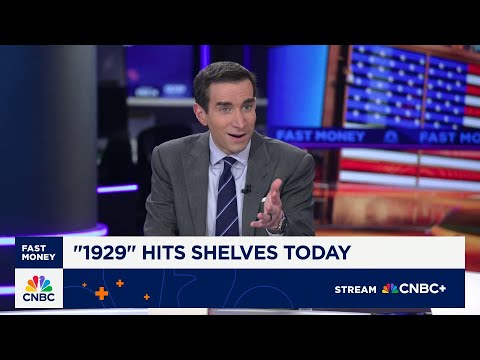
CNBC's Andrew Ross Sorkin's book '1929' hits shelves today
CNBC Television· 2025-10-14 22:10
Back on track here, a new book about Black Tuesday and the fallout on Wall Street and beyond. Uh, it hits the shelves today. 1929, Inside the Greatest Crash in Wall Street history and how it shattered a nation is now available.The author, CNBC Squawkbox co-host, New York Times financial columnist, Dealbook founder, subject of a 60 Minutes piece this Sunday, Andrew Ross. I mean, it's royalty here sitting at the the table and queen. This is the first time you've ever been on this show.I I was going to say I f ...