
新型储能

Search documents
大湾区外资“引力场”效应凸显,欧莱雅们的选择揭示什么?
2 1 Shi Ji Jing Ji Bao Dao· 2025-07-11 07:26
Core Insights - The Greater Bay Area (GBA) is demonstrating strong attraction for foreign investment amidst global economic uncertainties, with over 1,300 companies establishing or expanding operations in Hong Kong from January 2023 to mid-2025, generating over HKD 160 billion in foreign direct investment (FDI) and creating more than 19,000 new jobs [1][2] Investment Trends - Guangdong Province reported a 23.4% year-on-year increase in newly established foreign enterprises, totaling 12,000 from January to May 2023, with actual foreign investment reaching USD 50.84 billion, a 6.1% increase [1][6] - Major multinational companies, such as L'Oréal, are significantly investing in the GBA, with L'Oréal expanding its operations in Guangzhou and viewing the region as a strategic priority for its global layout [3][7] Major Projects - Significant foreign investment projects include ExxonMobil's USD 10 billion ethylene project in Huizhou, which is the first major petrochemical project wholly owned by a U.S. company in China [3] - Other notable projects include the construction of a 160,000-ton/year ethylene facility by CNOOC and Shell, a fully automated energy factory by GAC Honda, and a gas turbine service base by Mitsubishi Heavy Industries [4] Financial Market Performance - Hong Kong's IPO market raised HKD 107.1 billion in the first half of 2025, a sevenfold increase year-on-year, making it the top global market for IPOs during this period [5] - The performance of foreign enterprises in Hong Kong exceeded expectations, with 671 foreign companies establishing operations, primarily from the U.S., U.K., Singapore, and Canada [5] Economic Environment - The GBA has developed a comprehensive advantage with a complete industrial ecosystem, convenient infrastructure, active technological innovation, and a rich talent pool, enhancing its attractiveness to foreign investors [6][8] - The region is witnessing a shift in foreign investment focus from manufacturing to high-value sectors such as product development, biomedicine, and artificial intelligence, reflecting a transformation in its competitive landscape [6][7] Policy and Talent Dynamics - Policies tailored for foreign investment, such as Guangzhou's "20 measures for high-quality foreign investment development," and Shenzhen's incentives for new foreign enterprises, are fostering a conducive environment for multinational companies [8] - The GBA continues to experience population growth, with an increase of 440,000 residents from 2022 to 2024, supporting its labor market and economic dynamism [8]

27个项目8.24GWh!四川省2025年度电网侧新型储能项目清单发布
中关村储能产业技术联盟· 2025-07-11 07:16
Core Viewpoint - The Sichuan Provincial Development and Reform Commission has released a list of new energy storage projects for the year 2025, totaling a capacity of 3.02 GW and 8.24 GWh, with various technologies involved [1][3]. Summary by Sections Project Overview - A total of 27 new energy storage projects have been announced, with a combined capacity of 3.02 GW and 8.24 GWh [1]. - The technologies included in these projects are compressed air storage, new solid-state batteries, supercapacitors, lithium iron phosphate, sodium-ion, all-vanadium flow storage, and titanium acid lithium [1]. Project Implementation Guidelines - Local development and reform commissions and energy authorities are instructed to guide and coordinate the construction of these projects [3]. - Project owners are encouraged to expedite implementation based on market principles, and projects that do not commence within one year will be removed from the list [3]. - Emphasis is placed on safety responsibilities and compliance with safety and fire management requirements during construction and operation [3]. Detailed Project List - The project list includes various projects such as: - Longquanyi District: 100 MW/200 MWh centralized storage [5]. - Shudao Clean Energy Group: 300 MW/2400 MWh compressed air storage [5]. - Huaneng Jingshun: 200 MW/400 MWh new energy storage [5]. - Multiple projects across Chengdu, Yibin, and other regions, with capacities generally around 100 MW/200 MWh [5][6]. Related Information - Additional information regarding the operational revenue calculation for user-side new energy storage in Sichuan has been published [7].

浙江储能建设计划动态调整,5MW及以上用户侧储能无须纳规
中关村储能产业技术联盟· 2025-07-10 05:34
Core Viewpoint - The Zhejiang Provincial Energy Bureau has issued a notice for the dynamic adjustment of the 2025 new energy storage project construction plan, emphasizing the need for local governments to coordinate regional grid operations and renewable energy consumption while submitting project adjustment suggestions [1]. Group 1: Grid-side Energy Storage Projects - The construction scale for grid-side energy storage projects should be no less than 50,000 kW/100,000 kWh, following the "total control, one in one out" principle, meaning that the installed capacity applied for increase cannot exceed that applied for reduction [2][10]. - Projects included in the national-level scientific and technological research plan are exempt from the above requirements [10]. Group 2: Power-side Energy Storage Projects - Projects that coordinate with thermal power units for frequency regulation should have a single unit power of no less than 18,000 kW and a comprehensive adjustment performance index (Kpd) value of no less than 0.9; the scale and technical characteristics of renewable energy projects are to be determined by the owners based on actual needs [3][10]. Group 3: User-side Energy Storage Projects - The Provincial Energy Bureau will no longer manage annual construction plans for user-side projects of 5 MW and above, delegating the management to local energy authorities, which will compile construction plans and report to the bureau [4][11]. - User-side projects must be registered with local authorities before construction, and they need to consult with grid companies regarding connection plans [4][11]. Group 4: Application and Approval Process - Local energy authorities are responsible for organizing project applications and preliminary reviews, while the Provincial Energy Bureau will evaluate and form an adjusted construction plan based on the results [12]. - Project owners must ensure the authenticity and completeness of application materials, with any false information leading to disqualification from the application process [12].

96个项目18.6GW!山东2025年度新型储能入库项目公示
中关村储能产业技术联盟· 2025-07-09 10:22
Core Viewpoint - The Shandong Provincial Energy Bureau has announced the public listing of new energy storage projects for 2025, which includes a total of 81 lithium battery energy storage peak shaving projects, 2 compressed air energy storage projects, 1 flow battery energy storage project, 7 frequency modulation energy storage projects, and 5 other new energy storage projects, with a total storage capacity of 18.6292 GW [1][3]. Group 1: Project Overview - A total of 81 lithium battery energy storage peak shaving projects are included in the 2025 new energy storage project list, with a combined capacity of 1,010 MW [5][9]. - There are 2 compressed air energy storage projects listed, with a total capacity of 50 MW [9]. - One flow battery energy storage project is included, with a capacity of 20 MW [9]. - The list also features 7 frequency modulation energy storage projects, contributing a total of 111.5 MW [9]. - Additionally, 5 other new energy storage projects are included, with a total capacity of 50 MW [9]. Group 2: Project Details - The largest project is the "Dongying Lu Bei New Energy 510 MW/1020 MWh Shared Energy Storage Station," which has a capacity of 51 MW [6]. - Other notable projects include the "Qingdao Zhi Yuan Ju Neng Technology 250 MW/1000 MWh Independent Shared Energy Storage Station" and the "Shandong Huaneng New Tai Independent Energy Storage Demonstration Project" with capacities of 25 MW and 40 MW respectively [5][7]. - The projects span various cities in Shandong, indicating a broad regional investment in energy storage technology [4][8]. Group 3: Public Participation - The public announcement period for the project listing is from July 9 to July 15, 2025, during which stakeholders can raise objections in writing [3][4]. - The announcement encourages both organizations and individuals to provide feedback, ensuring transparency and community involvement in the project selection process [3].
北海独立共享储能项目全钒液流电池+超级电容储能系统设备采购
中关村储能产业技术联盟· 2025-07-09 09:10
Core Viewpoint - The article discusses the procurement of all-vanadium flow battery and hybrid supercapacitor energy storage system equipment for the Beihai Independent Shared Energy Storage Project, highlighting the project's scale and the specific equipment requirements [1][2]. Group 1: Project Overview - The Beihai Independent Shared Energy Storage Project has an initial storage capacity of 300MW/600MWh, with a main transformer capacity of 2*180MVA. The final storage capacity is planned to reach 700MW/1400MWh, with a main transformer capacity of 2*180+2*240MVA [2]. Group 2: All-Vanadium Flow Battery System Procurement - The procurement includes a 0.5MW/2MWh all-vanadium flow battery storage system, which requires the supply and installation guidance of various components such as battery containers, power conversion systems, and related electrical cabling [3]. Group 3: Hybrid Supercapacitor System Procurement - The procurement also covers a 3MW/0.3MWh (6min) hybrid supercapacitor storage system, which includes the supply and installation guidance of components like supercapacitor containers, power conversion systems, and necessary electrical cabling [4].

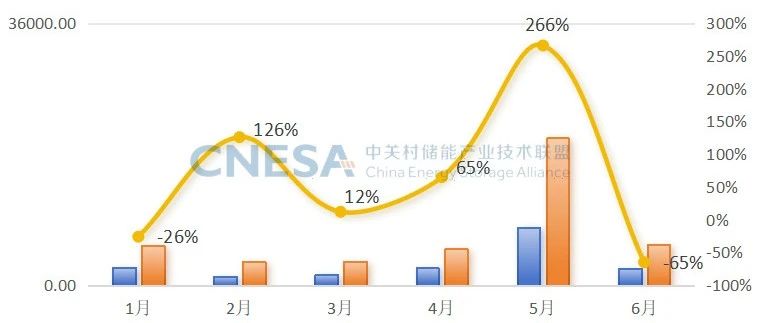
大储新增装机同比下降68%,上半年装机高峰前移!—6月源网侧新型储能项目分析
中关村储能产业技术联盟· 2025-07-08 09:08
Core Insights - The article highlights a significant decline in the newly installed capacity of new energy storage projects in China, with a year-on-year decrease of 65% in June 2025, attributed to the "rush to install" driven by renewable energy [2][5]. Summary by Sections Overall Market Performance - In June 2025, the newly installed capacity of new energy storage projects reached 2.33 GW/5.63 GWh, marking a year-on-year decline of 65% and a month-on-month decline of 71% [2][5]. - Despite the negative growth in June, the second quarter saw a total of 12.61 GW/30.82 GWh of new installations, which is a year-on-year increase of 24% and 27% respectively [2][5]. Regional Insights - Jiangsu province led the country with over 750 MW of new installations in June, accounting for more than 35% of the national total [5][12]. - In Inner Mongolia, 17 new projects commenced construction in June, with a total capacity of 8.2 GW/33.1 GWh [5][18]. Storage Duration - The average storage duration for new projects in Xinjiang, Inner Mongolia, and Qinghai exceeded 3.5 hours, while most other provinces had an average duration of around 2 hours [5][15]. Technology Trends - Lithium battery technology dominated the new installations, with lithium iron phosphate battery technology accounting for 89% of the installed capacity. Non-lithium technologies, such as vanadium flow batteries, also saw deployment [5][16]. Market Expectations - The total new installed capacity for the year is expected to exceed 43 GW, driven by over 23 GW of projects currently under construction and more than 10 GW in planning stages [5][19].
【投资视角】启示2025:中国压缩空气储能行业投融资分析(附投融资事件和产业基金等)
Qian Zhan Wang· 2025-07-08 08:02
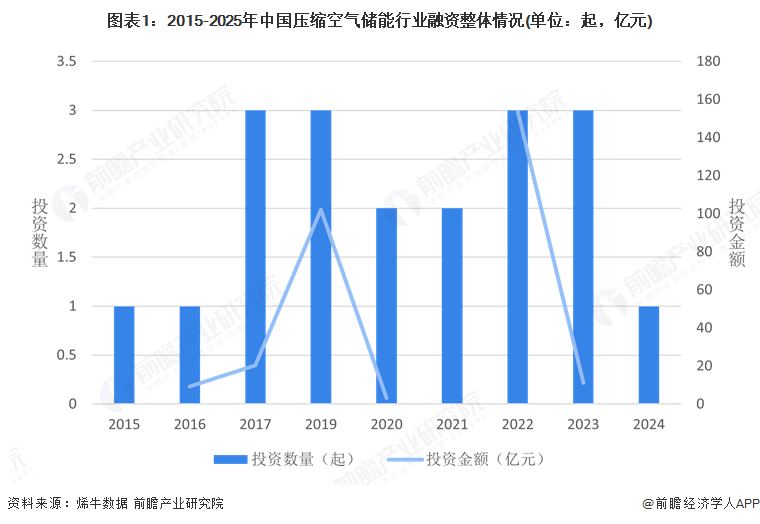
Group 1 - The recent investment and financing activity in the compressed air energy storage (CAES) industry in China has decreased, with no financing events reported in 2025 as of May 13 [1][7] - The average single financing amount in the CAES sector has shown significant variation, with an average of 3.15 billion RMB in 2020 and a peak of 76.77 billion RMB in 2022, indicating a high demand for capital [2][4] - The financing rounds in the CAES industry have increasingly concentrated in later stages, with only three events in the angel and A rounds, suggesting high entry barriers for startups [4][14] Group 2 - The CAES industry financing is predominantly concentrated in Beijing and Jiangsu, with five and four companies respectively, reflecting the competitive advantages of large state-owned enterprises and local government support [6][9] - The primary investment focus in the CAES sector is on energy storage equipment manufacturing and the research and development of storage technologies and systems [9][10] - The majority of investors in the CAES industry are capital organizations, accounting for over 83%, with notable investment entities including Shenglong Investment and Dize Investment [14][16] Group 3 - As of May 13, 2025, there have been 23 financing events in the CAES industry in China, with a trend of initial growth followed by a decline in investment scale [7][21] - The CAES industry is characterized by a lack of dedicated industrial investment funds, although existing energy storage and renewable energy funds are expected to support its development [16][18] - The CAES sector is primarily represented by equipment manufacturing companies, which account for 42% of the total investment events, highlighting the importance of breakthroughs in core technologies [12][14]
电力负荷创新高 迎峰度夏如何平稳有序
Zhong Guo Qing Nian Bao· 2025-07-08 06:08
Core Viewpoint - The article highlights the record high electricity demand in China due to high temperatures and economic growth, while the electricity supply remains stable, supported by enhanced generation capacity and various measures taken by the government [1][2]. Group 1: Electricity Demand and Supply - On July 4, the national peak electricity load reached 1.465 billion kilowatts, an increase of approximately 200 million kilowatts from late June and nearly 150 million kilowatts year-on-year, setting a historical record [1]. - The National Energy Administration stated that the overall electricity supply is stable and orderly, with the power supply-demand situation better than last year [1]. - As of May 31, the total installed power generation capacity in the country reached 3.61 billion kilowatts, a year-on-year increase of 18.8% [2]. Group 2: Generation Capacity and Infrastructure - The coal power plants' coal inventory exceeded 120 million tons as of June 26, an increase of 1.81 million tons year-on-year, with available days of inventory up by 1.7 days [1]. - Major power generation enterprises completed investments of 257.8 billion yuan in the first five months of the year, indicating a growth trend [2]. - The investment in national grid projects reached 204 billion yuan from January to May, a year-on-year increase of 19.8% [2]. Group 3: New Technologies and Innovations - New energy storage and virtual power plants are being integrated into the electricity supply system to optimize power distribution and manage peak demand [3][4]. - By the end of 2024, the cumulative installed capacity of new energy storage projects is expected to reach 73.76 million kilowatts, approximately 20 times that of the end of the 13th Five-Year Plan [3]. - The first million-kilowatt-level residential virtual power plant is under construction in Jiangsu, utilizing big data and IoT technologies to manage household appliances for peak shaving [4]. Group 4: Market Mechanisms and Future Outlook - The article emphasizes the importance of market mechanisms in optimizing electricity supply, with ongoing efforts to establish a unified national electricity market and facilitate cross-regional green electricity trading [5]. - Future reforms will focus on enhancing the pricing mechanism and transaction system in the electricity market to better reflect the value of electricity in terms of time, space, and attributes [5].
93座电站参与!江苏完成全国最大规模新型储能集中调用
中关村储能产业技术联盟· 2025-07-08 01:55
Core Viewpoint - The article highlights the significant role of new energy storage systems in managing peak electricity demand in Jiangsu, China, particularly during high-temperature periods, showcasing a record peak load and the largest scale of centralized energy storage deployment to date [1]. Group 1: Peak Electricity Demand - As of July 7, Jiangsu's electricity grid reached a record peak load of 152 million kilowatts, marking the third time this year it has set a historical record [1]. - On July 6, 93 new energy storage stations collectively discharged a maximum power of 7.14 million kilowatts during peak evening hours, demonstrating the effectiveness of centralized energy storage [1]. Group 2: Energy Storage Capacity and Utilization - The total capacity of energy storage projects in Jiangsu is 7.616 million kilowatts, ranking fourth in the country, and includes various forms such as electrochemical storage and compressed air storage [2]. - The centralized discharge during the peak on July 6 involved 64 grid-side and 29 source-side energy storage stations, with a total participation capacity of 7.248 million kilowatts, achieving a record scale of centralized utilization with a year-on-year increase of 56.9% [1][2]. Group 3: Operational Strategy - The timing of charging and discharging for energy storage systems is crucial, as it must align with urban electricity demand while also maximizing revenue for storage projects [2]. - The energy storage systems serve as "spatial and temporal regulators," with peak electricity demand in southern Jiangsu occurring during the day and in northern Jiangsu at night, allowing for strategic energy management [2].
支撑今夏用电负荷三创新高
Xin Hua Ri Bao· 2025-07-07 21:57
Core Insights - The State Grid of Jiangsu has reported a record high electricity load of 152 million kilowatts as of July 7, driven by sustained high temperatures, marking the third time this year that the record has been broken [1] - On July 6, 93 new energy storage stations in Jiangsu collectively discharged a maximum power of 7.14 million kilowatts during peak evening electricity demand, representing the largest scale of centralized new energy storage utilization in China [1] - The centralized discharge of new energy storage has increased by 56.9% year-on-year compared to last summer's peak discharge of 4.55 million kilowatts [1] Group 1 - New energy storage is referred to as a "super battery," providing peak load regulation during high electricity demand and assisting in renewable energy consumption during low demand periods [1] - The total capacity involved in the centralized discharge was 7.248 million kilowatts, with the actual maximum utilization reaching 7.14 million kilowatts, capable of meeting the electricity needs of approximately 48 million households for one hour [1] - Jiangsu's new energy storage projects are strategically located, with a total installed capacity of 7.616 million kilowatts, ranking fourth in the country, and include various forms such as electrochemical storage and compressed air storage [2] Group 2 - The timing of charging and discharging for energy storage systems requires careful consideration to maximize profitability while meeting urban electricity demands [2] - The peak electricity demand in southern Jiangsu occurs during the day, while northern Jiangsu experiences peak demand at night, allowing energy storage to act as a "spatial-temporal regulator" [2]