
高铁建设

Search documents
金建高铁兰建段今起带电运行
Mei Ri Shang Bao· 2025-11-14 22:23
Core Viewpoint - The new Jinhua to Jiande high-speed railway's Lankei to Jiande section has officially entered the electrification phase, marking a critical milestone in its construction and paving the way for subsequent testing and commissioning [1] Group 1: Project Details - The Jinhua to Jiande high-speed railway spans 64.51 kilometers with a design speed of 250 kilometers per hour [1] - The railway will connect four stations: Jinhua, Lankei East, Dayang, and Jiande, with Lankei East and Dayang being newly constructed stations [1] - The Lankei to Jiande section is expected to be operational by the first quarter of 2026, while the Lankei to Jinhua section will depend on the completion of the ongoing Jinhua railway hub expansion project [1] Group 2: Safety and Infrastructure - The electrification process involves the contact network and related equipment operating at a voltage of 27.5 kilovolts, emphasizing the importance of safety awareness among local units and residents [1] - The Jinhua to Jiande high-speed railway is a significant part of the Huangshan to Jinhua railway corridor, which will connect with multiple lines including the Hangzhou-Changsha high-speed railway and the Shanghai-Kunming high-speed railway [1] Group 3: Economic and Tourism Impact - The railway is expected to enhance connectivity within the "Huangshan tourism economic circle" and the "Zhejiang Central urban agglomeration," creating a "golden tourism line" that links famous mountains, waters, and attractions [1]
泰中高铁二期8份土建工程招标
Shang Wu Bu Wang Zhan· 2025-11-14 15:35
据泰媒报道,泰交通部消息称,内阁已批准泰中高铁二期项目预算框架,泰国国家铁路局(SRT)正制 定工程范围及基准价,预计2025年12月招标,2026年6月开始施工,2030年完工。土建分8个合同段,总 投资3413.5亿泰铢,线路全长357公里,设5个车站(布莱、班派、孔敬、乌隆、廊开),连通老挝和中 国。列车初期使用18列中国标准列车,预计首年日均乘客约7,000人。项目征地费124.2亿泰铢,涉及 1,991块土地和1,428处建筑物,预计2028年4月完成征地。维护系统合同将采用PPP模式,预算约857.3亿 泰铢,预计2026年初提交审批。 ...
汕头南至汕头段启动联调联试 汕汕高铁全线开通运营进入倒计时
Nan Fang Ri Bao Wang Luo Ban· 2025-11-12 07:48
Core Viewpoint - The Shantou South to Shantou section of the Shantou-Shantou High-Speed Railway has officially entered the joint debugging and testing phase, marking a significant step towards its opening [1] Group 1: Project Development - The joint debugging and testing will be followed by trial operations, bringing the entire line closer to operational status [1] - Two comprehensive testing trains are being used for various tests, including track geometry, contact network, communication, signal, and aerodynamic tests [1] - Simulated tests for signal scenarios and earthquake warning scenarios are being conducted using operational trains to ensure all systems meet operational conditions [1] Group 2: Strategic Importance - The Shantou-Shantou High-Speed Railway is a crucial part of the national "eight vertical and eight horizontal" high-speed rail network along the coastal corridor [1] - Once fully operational, it will enable a "half-hour commuting circle" for central cities in the Shantou-Chaozhou-Jieyang area and a "one-hour transportation circle" for the eastern Guangdong region [1] - This development will facilitate the integration of the eastern Guangdong region into the Guangdong-Hong Kong-Macao Greater Bay Area [1]
潍宿高铁至青岛连接线 桃园隧道顺利贯通
Feng Huang Wang Cai Jing· 2025-11-11 03:03
Core Insights - The successful completion of the Taoyuan Tunnel marks a significant milestone in the construction of the Weishui High-Speed Railway to Qingdao connection line, which is crucial for the project's progress [1][2] - The tunnel, measuring 940 meters in length, faces complex geological challenges, including high-pressure environments and proximity to existing infrastructure, necessitating advanced construction techniques [1][2] Group 1: Project Overview - The Weishui High-Speed Railway to Qingdao connection line spans 108.78 kilometers with a designed speed of 350 km/h, serving as an important link in China's high-speed rail network [2] - The project is part of the national "Eight Vertical and Eight Horizontal" high-speed rail framework and is essential for enhancing connectivity between the Jiaodong Peninsula and major economic regions [2] Group 2: Construction Techniques and Achievements - The construction team implemented a "dual-direction tunneling" approach, reducing the planned construction period from 14 months to 11 months, achieving over a 20% increase in efficiency [2] - Strict adherence to a comprehensive construction guideline ensured that ground subsidence was controlled to within 3 millimeters, significantly below regulatory limits, thereby ensuring safety during the tunneling process [2]
清水河特大桥顺利合龙 雄忻高铁建设迎关键性突破
Yang Shi Xin Wen Ke Hu Duan· 2025-11-03 07:15
Core Points - The successful completion of the Qing Shui He Grand Bridge marks a significant breakthrough in the construction of the Xiongxin High-Speed Railway, laying a solid foundation for the timely completion and operation of the entire line [1][3]. Group 1: Project Details - The Qing Shui He Grand Bridge is located in the Wutai Mountain Scenic Area of Xinzhou City, with a total length of approximately 1.4 kilometers and 36 piers, the highest of which reaches 75.5 meters [3]. - The bridge's superstructure employs various construction techniques, including cast-in-situ methods, cantilever casting, moving formwork, and continuous beam formwork [3]. - To protect the ecological environment of the Wutai Mountain Scenic Area, automatic sprinkler systems and firewalls have been installed on both sides of the bridge, ensuring a harmonious balance between construction and ecological protection [3]. Group 2: Railway Significance - The Xiongxin High-Speed Railway connects Xiong'an New Area in Hebei Province with Xinzhou City in Shanxi Province, with a total length of approximately 342 kilometers [5]. - It is the first high-speed railway in Shanxi Province designed for a speed of 350 kilometers per hour, expected to be completed and operational by 2027 [5]. - Once completed, the railway will establish the third high-speed rail corridor connecting Shanxi and Beijing, reducing travel time from Taiyuan to Beijing to one and a half hours [5].

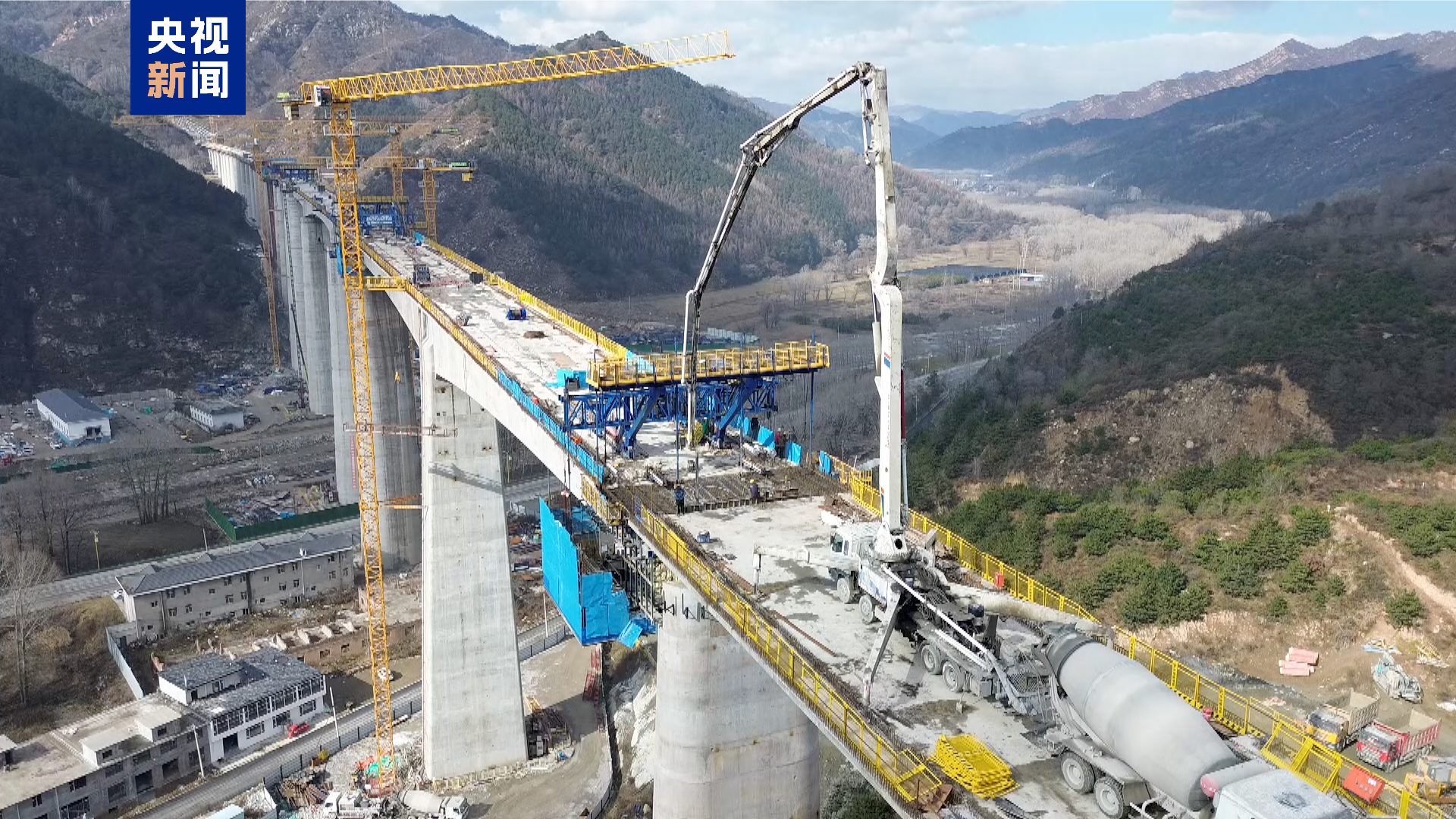
包银高铁银巴支线建设取得阶段性突破
Xin Hua She· 2025-10-30 13:51
Core Insights - The successful completion of the last concrete pouring for the Baoyin High-speed Railway's Yinba branch marks a significant milestone in the project's construction, paving the way for subsequent track-laying work [1] Project Overview - The Baoyin High-speed Railway Yinba branch starts in Yinchuan, Ningxia, and ends in Bayannur, Inner Mongolia, covering a total length of approximately 115 kilometers [1] - Upon completion, the project will integrate the Alxa League into the national high-speed railway network, facilitating rapid connections with surrounding regions such as Ningxia, Shaanxi, and Gansu [1] Economic Impact - The project is expected to have a substantial impact on promoting regional economic and social development [1]
两条途经佛山高明的高铁,迎来新进展!
Nan Fang Du Shi Bao· 2025-10-22 16:00
Core Insights - The Shenzhen-Nanning High-Speed Railway is a crucial link between Guangdong and Guangxi, with recent construction progress reported in the Foshan area [1][3]. Group 1: Project Overview - The Shenzhen-Nanning High-Speed Railway spans approximately 357 kilometers, connecting Shenzhen in Guangdong to Nanning in Guangxi, enhancing rapid connectivity within the Guangdong-Hong Kong-Macao Greater Bay Area and the southwestern region [3][5]. - The railway includes several segments: - The Shenzhen to Jiangmen segment (116 kilometers) with design speeds of 200 km/h and 250 km/h, featuring seven stations [5]. - The Jiangmen to Pearl River Delta Airport segment (99 kilometers) with a design speed of 350 km/h, including four stations [5]. - The segment from the Pearl River Delta Airport to the provincial border (142 kilometers) also has a design speed of 350 km/h, with two stations [5]. Group 2: Construction Progress - The completion of the last tunnel in the Foshan area on October 21 marks a significant milestone in the construction of the Zhujiang-Zhaoqing High-Speed Railway [5]. - The project is expected to be completed and operational by 2027, significantly enhancing the passenger transport quality between Guangdong and Guangxi [5]. Group 3: Related Developments - The Guangzhou-Zhanjiang High-Speed Railway is also making progress, with recent speed tests achieving a trial speed of 385 km/h, indicating ongoing efforts to ensure timely operational readiness [5].
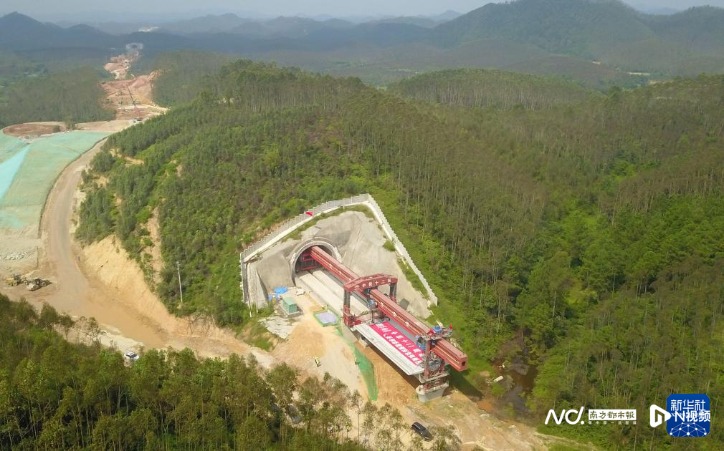
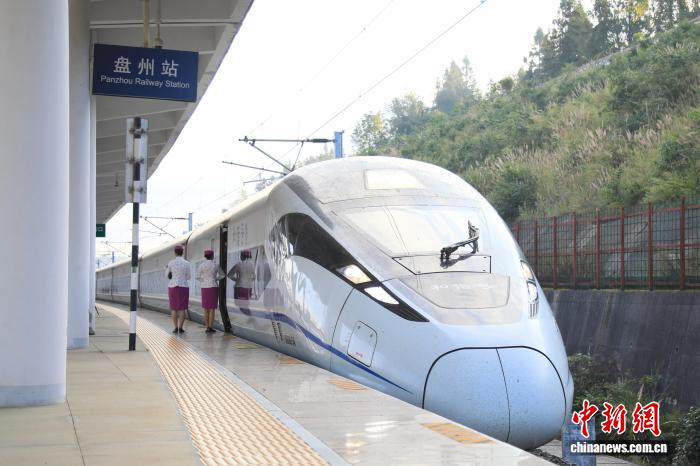
盘兴高铁进入运行试验阶段
Zhong Guo Xin Wen Wang· 2025-10-11 10:11
Core Points - The Pan-Xing High-Speed Railway has officially entered the operational testing phase as of October 11, 2025, following the successful completion of joint debugging and testing [1][2][5] Group 1: Project Overview - The Pan-Xing High-Speed Railway connects from the Panzhou Station of the Hukun High-Speed Railway, passing through several towns and ending at the Xingyi South Station, with a total length of approximately 98 kilometers [2][5] - The railway is designed for a maximum speed of 250 kilometers per hour and includes 46 bridges and 38 tunnels, which together account for about 90% of the line [2][5] - There are three stations along the route, including one renovated station (Panzhou Station) and two newly built stations (Baotian Station and Xingyi South Station) [2] Group 2: Testing and Operational Readiness - The operational testing phase involves various simulations and drills, including fault simulations, emergency rescue exercises, and testing of train operation parameters to ensure the railway's systems can handle both normal and abnormal conditions [2][5] - The testing aims to validate the operational organization methods and provide a technical basis for a scientifically sound transportation organization plan [2] Group 3: Economic and Regional Impact - The completion of the Pan-Xing High-Speed Railway is crucial for achieving the goal of "high-speed rail connectivity between all cities" in Guizhou Province, significantly reducing travel time between Guiyang and Xingyi to just 2 hours [5] - The railway will create a high-speed rail traffic circle within 1 to 2 hours connecting Guiyang to eight central cities in the province, enhancing regional connectivity and promoting local economic development [5]
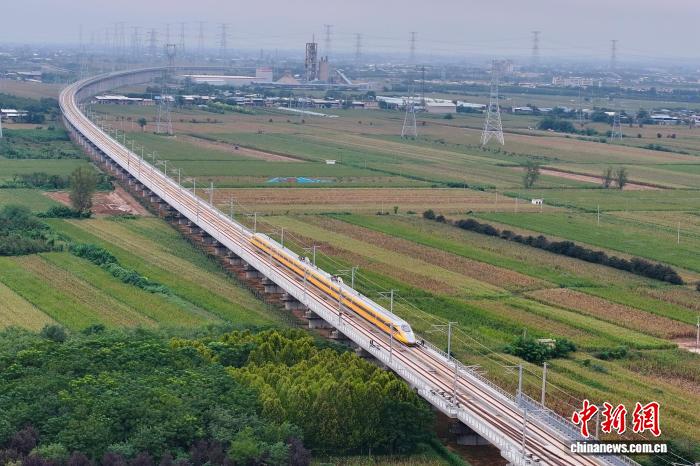
西延高铁全线拉通试验顺利完成
Zhong Guo Xin Wen Wang· 2025-10-09 09:05
Core Points - The successful completion of the full-line test for the Xi'an to Yan'an high-speed railway marks a significant milestone, indicating that the joint debugging and testing work is in its final stages, laying a solid foundation for subsequent trial operations and official opening [1][2] Group 1: Testing and Validation - The full-line test is a crucial dynamic verification phase in railway construction, integrating various individual tests to ensure compliance with design standards across multiple systems such as tracks, power supply, and contact networks [2] - The Xi'an Railway Bureau employed a dual-vehicle collaborative model during the test, utilizing a comprehensive detection train and a confirmation train to conduct systematic testing along the line [2] - The comprehensive detection train achieved a stable operation at the designed speed of 350 km/h, successfully collecting key data on track geometry, contact network, and signal parameters [2] Group 2: Progress and Collaboration - The overall progress of the joint debugging and testing has reached 45%, with nearly 100 test trains operated since the initiation of the process, collecting tens of thousands of data points [2][3] - A command center was established by the Xi'an Railway Bureau in collaboration with over 20 organizations to ensure efficient progress, with clear roles and daily meetings to manage issues effectively [3] Group 3: Communication Systems - The Xi'an communication section is simultaneously testing the communication systems along the line, achieving a 74% coverage rate for the public network during maximum speed testing [5] - Innovative techniques were employed to ensure stable signal transmission in complex terrains, including the use of combination towers and specialized cable coverage in long tunnels [5] Group 4: Strategic Importance - The Xi'an to Yan'an high-speed railway is a key project in the "14th Five-Year Plan," with a total length of 299.8 km and a design speed of 350 km/h, significantly reducing travel time from 2.5 hours to approximately 1 hour [6] - This railway is an important part of the national high-speed railway network and will enhance the regional advantages of Shaanxi Province, contributing to the revitalization of rural areas in revolutionary old districts [6]
3万余名建设者国庆节期间奋战一线 四川多条高铁建设刷新进度条
Si Chuan Ri Bao· 2025-10-08 01:39
Core Insights - Multiple high-speed rail projects in Sichuan are progressing steadily during the National Day holiday, with over 30,000 construction workers on site [1][2] - Significant advancements have been made in the construction of the Xining to Chengdu high-speed railway, with 45% of the overall project completed [1] - The Chengdu North Station expansion and the Chengdu railway station capacity enhancement are ongoing, with all personnel committed to meeting project deadlines [1] Group 1 - The Xining to Chengdu high-speed railway has seen the completion of 6 out of 14 tunnels and 88% of bridge works, with overall project progress at 45% [1] - The Chengdu North Station has completed various supporting projects, including high slope protection and emergency response buildings [1] - The Chengdu railway station is being upgraded to enhance its capacity as a comprehensive transportation hub, with all machinery operating at full speed [1] Group 2 - The Xuyou high-speed railway project has implemented an intelligent production line, achieving 65% of box beam pre-fabrication and 53% of beam installation [2] - The Yukun high-speed railway's main tunnel and bridge works are completed, with 99% of box beam installation finished [2] - The next phase for the Yukun high-speed railway involves the commencement of ballastless track construction to ensure timely operation [2]