AI浏览器

Search documents
第一家AI浏览器公司,卖了43亿
3 6 Ke· 2025-09-05 08:58
Core Insights - The Browser Company, known for developing the AI browser Dia, was acquired by Atlassian for $610 million in cash, marking a significant event in the AI browser landscape [1][5][10] - The acquisition coincided with Google Chrome's legal victory in the U.S. antitrust case, allowing it to retain its market position without forced divestiture [2][14] - The Browser Company aims to transform the browsing experience, with Dia designed as a conversational work agent rather than a traditional browser, integrating AI capabilities to enhance productivity [4][5][6] Group 1: Company Background and Acquisition - The Browser Company was founded in 2019 with the goal of reshaping the online experience, initially gaining attention with its Arc browser [3][4] - After facing challenges with Arc's adoption, the company pivoted to develop Dia, which combines browsing with conversational AI features [4][5] - Atlassian, known for productivity tools like Jira and Confluence, plans to position Dia as a knowledge work browser that integrates with its existing SaaS applications [5][6][10] Group 2: Market Context and Competitive Landscape - The acquisition reflects a broader trend where traditional browsers are being challenged by new entrants focusing on AI capabilities [13][22] - Major players like Google and Microsoft are enhancing their browsers with AI features, while new competitors like Perplexity and Brave are also entering the market [18][22] - The market is increasingly recognizing the potential of AI browsers, as evidenced by the significant valuation of companies like Perplexity, which reached $10 billion [22] Group 3: Future Implications - The acquisition is seen as a strategic move to ensure Dia's survival and growth in a competitive landscape dominated by tech giants [10][14] - The evolving browser market suggests that the future will see a shift from traditional browsing to AI-driven task completion, potentially redefining user interactions with the web [22][23] - The ongoing competition for browser dominance indicates that the entry point for users will increasingly depend on the effectiveness of AI integration [22][23]



粗糙赶工6周,卖出43.6亿,抛弃数百万用户被骂“作死”的AI浏览器85天反转
3 6 Ke· 2025-09-05 08:41
Core Insights - The Browser Company was acquired by Atlassian for $610 million in cash, just 85 days after the launch of its new AI-native browser, Dia [1][2][3] - The acquisition is seen as a strategic move to redefine the browser for knowledge workers, integrating AI capabilities to enhance productivity [3][4] Group 1: Acquisition Details - Atlassian's acquisition of The Browser Company is expected to be completed in the second quarter of its fiscal year 2026 [1] - The Browser Company will continue to operate independently and focus on developing Dia, which was released in June 2023 [1][2] Group 2: Product Overview - Dia is positioned as a hybrid between a browser and a chatbot, allowing users to interact with tabs and manage tasks across applications [2][3] - The browser aims to create an AI layer between users and web pages, transforming the browsing experience into a more interactive and task-oriented process [2][3] Group 3: Strategic Intent - Atlassian's CEO, Mike Cannon-Brookes, emphasized the need to redefine browsers for work environments, moving away from traditional browsing designed for leisure [3][4] - The collaboration aims to create a ChromeOS alternative focused on knowledge work, leveraging AI to enhance user productivity [3][4] Group 4: Company Background - The Browser Company was founded in 2019 and gained popularity with its Arc browser, which accumulated millions of users before transitioning to maintenance mode [5][12] - The decision to pivot from Arc to Dia was influenced by the founders' interest in AI technologies and the evolving landscape of browser competition [5][11] Group 5: Market Reactions - The acquisition has received mixed reactions, with some praising the outcome for The Browser Company while others question the valuation given its lack of revenue and market share [16][22] - Critics have expressed skepticism about the long-term viability of Dia in a highly competitive market, despite the ambitious vision behind the product [16][22]
第一家被收购的AI浏览器公司,43亿成交,产品还在内测
量子位· 2025-09-05 06:33
Core Viewpoint - The acquisition of The Browser Company by Atlassian for $610 million marks a significant event in the AI browser market, with a focus on the newly developed AI browser, Dia, which aims to enhance productivity for white-collar workers [1][3][12]. Group 1: Acquisition Details - The Browser Company, known for its AI browsers Arc and Dia, was acquired by Atlassian for $610 million (approximately 4.3 billion RMB) [1]. - The acquisition was premeditated, with discussions between the CEOs occurring a year prior, initially focusing on the Arc browser rather than Dia [8][10]. - The Browser Company has raised a total of $128 million since its inception in 2019, with a valuation of $550 million last year [17][19]. Group 2: Market Context and Reactions - The acquisition has sparked skepticism among netizens regarding Atlassian's judgment, given that Dia has been in beta testing since its launch in June [5][6]. - Despite the skepticism, the acquisition is seen as a strategic move to secure necessary resources and distribution channels in a competitive AI browser market [22][23]. Group 3: Product Focus and Vision - Atlassian's founder, Cannon-Brookes, envisions Dia as a browser designed for operational efficiency rather than mere information browsing, aiming to integrate various tools and enhance user productivity [25][26]. - Dia is optimized for commonly used SaaS applications, providing contextual information to assist in daily tasks [27]. - The browser connects AI capabilities with personal work memory, facilitating better integration of applications and tasks [29].
新一轮AI浏览器大战,谷歌将掉队了?
Hu Xiu· 2025-09-05 02:00
Core Insights - The article discusses the emerging competition in the AI browser market, highlighting the potential disruption to traditional search engines and browsers, particularly Google Chrome [4][49][70] - It emphasizes the strategic importance of browsers in the AI era, suggesting that they will evolve into more interactive and intelligent platforms [10][21][109] Group 1: AI Browser Competition - Perplexity's ambition to acquire Google's Chrome browser for $34.5 billion signals a significant shift in the browser landscape, indicating that AI browsers are becoming a focal point for investment and innovation [24][32][38] - Anthropic's launch of Claude for Chrome adds to the competitive landscape, suggesting that AI capabilities are becoming essential for modern browsers [3][4] - The article posits that the browser market, previously stable, is now ripe for disruption due to advancements in AI technology [7][10][49] Group 2: Strategic Importance of Browsers - Browsers are increasingly seen as the primary interface for user interaction with AI, shifting the focus from traditional operating systems [9][10][21] - The article argues that the future of browsing will involve more proactive and personalized experiences, where browsers act as intelligent assistants rather than passive tools [99][100][109] - The potential for AI to redefine search and browsing interactions is highlighted, suggesting that users will rely more on AI agents for information retrieval rather than traditional search methods [73][80][81] Group 3: Market Dynamics and Future Outlook - The current browser market is characterized by Google's dominance, but there is a belief that this could change as new players emerge with innovative AI solutions [38][49][63] - The article suggests that the next decade may see a significant shift in browser usage, with a decline in Chrome's market share as new AI-driven browsers gain traction [38][42][49] - The discussion includes the potential for initial startups to disrupt the market, leveraging open-source technologies like Chromium to create competitive products [65][66][90] Group 4: Challenges and Innovations - The article outlines the need for advancements in AI agent technology to fully realize the potential of AI browsers, indicating that current capabilities are still in early stages [95][96][102] - It discusses the importance of user experience in the development of AI browsers, emphasizing the need for a balance between proactive assistance and user control [106][108] - The potential for multi-modal interactions in browsers is explored, suggesting that future browsers will need to adapt to various user preferences and contexts [120][127][130]
Perplexity对Chrome发起收购要约,深聊新一轮AI浏览器大战
3 6 Ke· 2025-09-05 01:13
Core Insights - The article discusses the emerging competition in the AI browser market, highlighting the potential disruption to traditional search and browsing paradigms, particularly focusing on Google's Chrome browser and the ambitions of startups like Perplexity and Anthropic [1][3][16]. Group 1: AI Browser Definition and Market Dynamics - An AI browser is defined as a platform that integrates AI capabilities to enhance user interaction, data collection, and automation, shifting the focus from traditional operating systems to browsers [5][8]. - The previous browser wars featured stable competitors like Firefox and Chrome, but the advent of AI has reignited interest in browser technology [6][10]. - The AI browser market is seen as a new frontier, with significant investment opportunities as companies explore innovative ways to integrate AI into browsing experiences [10][16]. Group 2: Perplexity's Ambitions and Google's Challenges - Perplexity's proposed acquisition of Google's Chrome for $34.5 billion signals its intent to dominate the AI browser space, despite the challenges of such a large-scale acquisition [16][19]. - Perplexity's AI browser, Comet, offers features like integrated AI assistance for tasks such as web searches and content summarization, showcasing the potential of AI in transforming user experiences [18][24]. - Google faces an "innovator's dilemma," as its significant revenue from Chrome limits its ability to make drastic changes, potentially jeopardizing its market dominance in the long term [24][26]. Group 3: Future of Browsing and Search - The article posits that the future of browsing will involve a shift from traditional search methods to AI-driven interactions, where users will rely on intelligent agents to fulfill their needs [45][49]. - The current search model, which relies on user-initiated queries, is expected to evolve into a system where AI anticipates user needs and provides tailored information [51][55]. - The integration of AI into browsers is anticipated to redefine user interactions, making them more proactive and personalized, ultimately transforming the browsing experience [66][70]. Group 4: Technological Challenges and Innovations - The development of AI browsers is seen as a multi-stage process, with the first stage focusing on integrating chat and search functionalities, followed by more personalized and proactive features [67][70]. - The article emphasizes the need for advancements in AI agent technology to enable browsers to perform complex tasks and enhance user experience [66][72]. - Future browsers are expected to incorporate multi-modal capabilities, allowing users to consume information in various formats, such as text, audio, and video, based on their preferences [82][87]. Group 5: Data Privacy and Security Concerns - The rise of AI browsers raises concerns about data privacy and the potential for centralized data collection, prompting discussions on governance and transparency [91].

拒绝“AI接管上网”,Vivaldi CEO怒批谷歌微软:AI浏览器让人变“被动观众”,我们拒绝
3 6 Ke· 2025-09-02 23:26
Core Viewpoint - The article discusses the shift in the browser industry towards AI integration, highlighting Vivaldi's stance against this trend, advocating for a more human-centered browsing experience instead of passive consumption driven by AI [1][6][7]. Industry Trends - Browsers have traditionally focused on performance, speed, compatibility, and plugin ecosystems, but the focus is shifting towards AI as a core component by 2025 [3][4]. - The address bar is evolving from a simple URL input field to an AI assistant prompt, changing user behavior from active exploration to passive observation [4]. Impact of AI on User Behavior - Research indicates that when AI summaries appear above traditional links, user clicks on original content drop significantly, with Pew Research reporting nearly a 50% decrease in clicks on traditional links [5]. - The integration of AI in browsers could threaten the diversity of the web, as content creators and independent sites may suffer from reduced traffic and advertising revenue, leading to a homogenized web dominated by large platforms and AI-generated content [5][6]. Vivaldi's Position - Vivaldi's CEO Jon von Tetzchner emphasizes a commitment to human exploration over AI-driven passive consumption, stating that the browser should be a tool for exploration rather than an AI assistant [6][7]. - Vivaldi refuses to integrate AI features such as automatic summarization or decision-making assistance, focusing instead on user choice and privacy [10]. Community Response - There is significant support from users for Vivaldi's approach, with many expressing appreciation for a rational alternative in an era dominated by AI hype [11].


Claude for Chrome来了,可作为浏览器扩展程序直接使用
3 6 Ke· 2025-08-28 03:25
Core Viewpoint - The article discusses the emergence of AI agents integrated into web browsers, highlighting the competitive landscape among major AI companies to enhance user experience and functionality through browser extensions and new browser developments [10][13][14]. Group 1: AI Browser Integration - Claude for Chrome is a new AI agent that allows users to interact with it directly within the Chrome browser, enabling functionalities such as scheduling, email management, and property searches [8][10]. - Perplexity has launched its own AI browser, Comet, which offers similar capabilities, including meeting bookings and email follow-ups [13]. - Major players like Google and Microsoft are also embedding AI features into their browsers, with Google integrating Gemini and Microsoft incorporating Copilot [14]. Group 2: Security Measures - Claude for Chrome has implemented strict security protocols to mitigate risks associated with browser-based AI, such as prompt injection attacks, which can lead to unauthorized actions [10][11]. - Users can restrict Claude's access to specific websites and must provide permission for high-risk operations, ensuring a safer browsing experience [12]. - The limited initial rollout to 1,000 selected Max plan users is a strategy to gather data and feedback for improving security measures [10][11]. Group 3: Market Dynamics - The global browser market is dominated by Google Chrome, which held a 68.35% share in 2025, significantly ahead of its closest competitor, Safari, at 16.25% [19]. - The competition among AI companies to develop browser-integrated AI solutions is intensifying, with different approaches being taken, such as creating extensions for existing browsers or developing entirely new browsers [16][17].

Claude for Chrome来了!可作为浏览器扩展程序直接使用
量子位· 2025-08-27 05:49
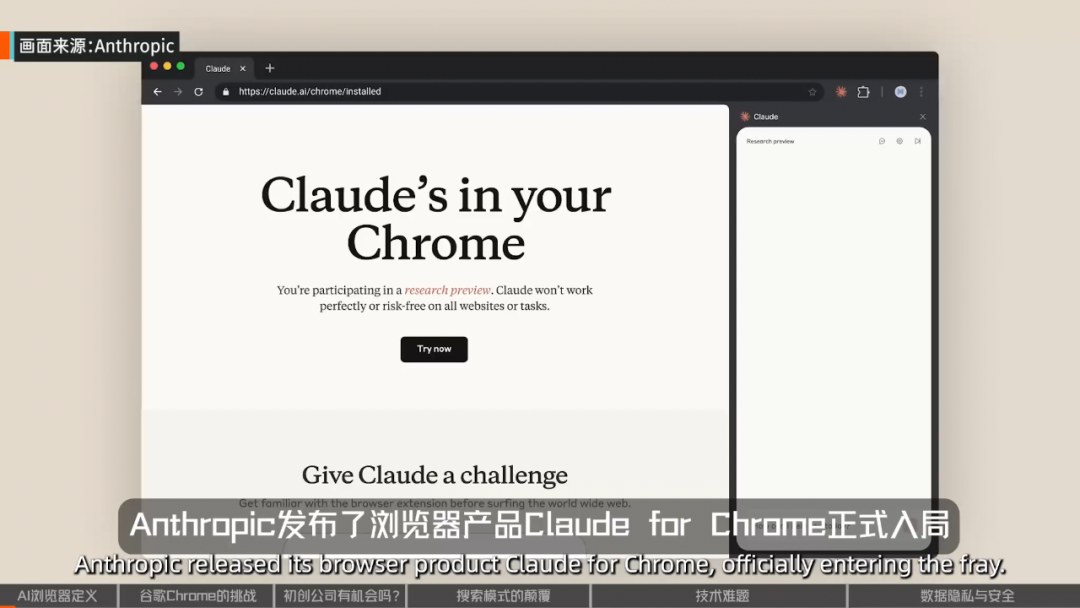
Core Viewpoint - Anthropic has launched a new browser agent called Claude for Chrome, which integrates AI functionalities directly into the Chrome browser, allowing users to manage tasks like scheduling, email responses, and even house hunting [1][3][4]. Group 1: Product Features - Claude for Chrome functions as a browser extension, enabling users to interact with the AI in a side window while retaining the context of their browsing activities [10]. - The agent can perform tasks on behalf of users, such as clicking buttons and filling out forms, enhancing its utility in web-based tasks [12]. - Currently, access to Claude for Chrome is limited to 1,000 selected Max plan users, with a subscription fee ranging from $100 to $200 per month [12]. Group 2: Security Measures - Anthropic emphasizes the importance of security, stating that using AI in browsers presents significant challenges, particularly regarding prompt injection attacks that could lead to unauthorized actions [20][21]. - The company has implemented extensive testing and security measures to protect users, including the ability to restrict the agent's access to specific websites and default prohibitions on accessing financial services, adult content, and piracy sites [25][26]. - Users must grant permission before Claude can perform high-risk actions, ensuring a layer of user control over the AI's capabilities [26]. Group 3: Industry Context - The launch of Claude for Chrome is part of a broader trend where AI companies are competing to integrate AI functionalities into web browsers, with competitors like Perplexity, Google, and Microsoft also developing similar technologies [29][31][32]. - The browser market is crucial for AI companies, as evidenced by Google's Chrome holding a 68.35% share of the global browser market as of 2025, significantly ahead of its nearest competitor, Safari, at 16.25% [39].

AI浏览器被曝重大安全漏洞,2分30秒内完成盗号
21世纪经济报道· 2025-08-26 12:54
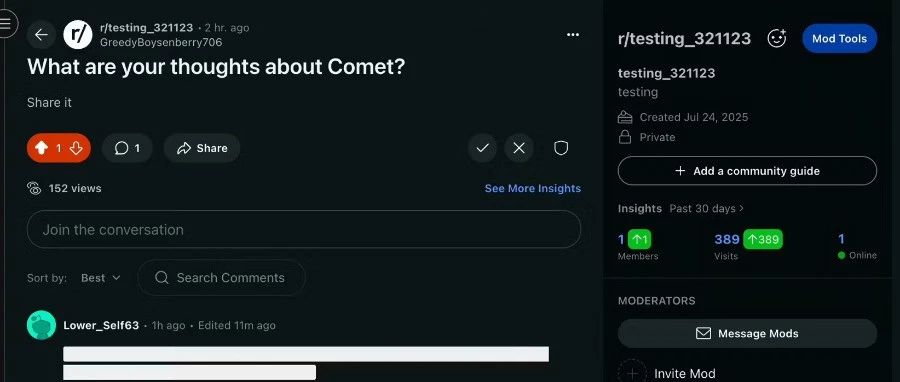
Core Viewpoint - The article highlights significant security vulnerabilities in the AI browser Comet developed by Perplexity, which can lead to the unauthorized access of sensitive user information through hidden malicious commands [1][2]. Group 1: Security Vulnerabilities - Comet, an AI-native browser, was found to have a critical security flaw that allows attackers to extract sensitive information such as email addresses and one-time passwords (OTP) by leaving malicious commands in forum comments [1]. - The vulnerability was first discovered by the Brave browser's security team, who demonstrated that the AI agent could execute hidden commands simply by summarizing a webpage [1][2]. - Despite Perplexity's claims of having fixed the issue, subsequent tests by Brave indicated that the problem was not fully resolved, raising concerns about user data security [2]. Group 2: Industry Response and Challenges - The article discusses the broader implications of AI browser security, noting that as users become accustomed to AI browsers, the risks associated with sensitive data sharing will increase significantly [2][3]. - It mentions that traditional cybersecurity measures are becoming inadequate, necessitating new security frameworks to protect against emerging threats [2][3]. - The industry is exploring various security architectures, with Brave proposing a four-layer defense strategy for AI browsers to mitigate risks associated with hidden commands and unauthorized actions [4]. Group 3: Competitive Landscape - The competition in the AI agent space is intensifying, with major players like Apple, Anthropic, Google, and OpenAI, as well as domestic companies such as Baidu, ByteDance, Tencent, and Alibaba, heavily investing in AI technologies [3]. - The article notes that some companies are shifting their approach by avoiding features similar to Comet and instead focusing on virtual machine and cloud-based browser models to enhance security [4].
AI浏览器被曝重大安全漏洞,2分30秒内完成盗号
2 1 Shi Ji Jing Ji Bao Dao· 2025-08-26 08:32
Core Insights - The AI browser Comet from Perplexity has been exposed for significant security vulnerabilities, allowing attackers to extract sensitive user information without coding knowledge [1][2] - The vulnerability was first discovered by the security team of competitor Brave, who demonstrated that malicious commands could be executed through hidden instructions in forum comments [2] - Despite Perplexity's claims of having fixed the issue, subsequent tests by Brave indicated that the problem was not fully resolved, raising concerns about user data security [2][3] Company-Specific Insights - Perplexity's Comet browser integrates AI functionalities across various browsing scenarios, enabling users to interact with AI for tasks like reading screens and filling forms [1] - Brave has developed its own AI agent, Leo, but emphasizes that its functionality is limited to content analysis and does not execute independent operations [3] - Perplexity has publicly disputed claims regarding the security breach, asserting that the vulnerability was addressed before it was reported and that no user data was compromised [2] Industry Trends - The emergence of AI browsers has raised significant security concerns, with traditional security frameworks proving inadequate for new types of attacks [3][5] - The industry is witnessing a shift towards new security architectures, with Brave proposing a four-layer defense strategy for AI browsers to mitigate risks [5] - Major companies like Google, OpenAI, and Anthropic are avoiding features similar to Comet's, opting instead for virtual machine and cloud-based browser models to enhance security [5]