
Financial Stability

Search documents
X @ESMA - EU Securities Markets Regulator 🇪🇺
ESMA - EU Securities Markets Regulator 🇪🇺· 2025-09-26 08:32
🤝 #ESMA’s CCP Resolution Committee events this week promoted the dialogue on fostering convergence, enhancing preparedness, and strengthening #FinancialStability across the EU.We thank all participants for their valuable contributions!🔗 https://t.co/l9BdMZRYIV https://t.co/XOxTWbHA6n ...
X @Bloomberg
Bloomberg· 2025-09-25 02:18
South Korea’s central bank warned that risks from US tariffs, prolonged industrial weakness and housing market imbalances could undermine financial stability https://t.co/iJI32SPIf6 ...
The Home Depot, Inc. (HD) Completes the $5.5 Billion Acquisition of GMS Inc.
Yahoo Finance· 2025-09-22 21:32
Group 1 - The Home Depot, Inc. has completed the acquisition of GMS Inc. for $5.5 billion, enhancing its position in the building materials distribution sector [2][3] - The acquisition allows The Home Depot to better serve professional contractors and unlock cross-selling opportunities [3] - Nearly 80% of GMS shares were tendered, facilitating its integration as a wholly owned subsidiary of The Home Depot [3] Group 2 - The Home Depot is recognized as one of the best stocks for financial stability and investment [1][4] - The company operates as the world's largest home improvement retailer, providing a wide range of building materials and professional solutions [4]

X @The Wall Street Journal
The Wall Street Journal· 2025-09-21 21:20
The economic contract of marriage has shifted, and now young people are looking for financial stability before the wedding https://t.co/SPJy9velCu ...
15 Best Stocks to Invest in for Financial Stability
Insider Monkey· 2025-09-21 13:35
Group 1: Market Overview - Wall Street experienced a quieter note on September 19, 2025, following a week of record-breaking highs, reflecting a balance between investor optimism and economic caution [2] - The stock market rally was fueled by positive corporate earnings, Federal Reserve policy shifts, and renewed interest in transformative technologies [2] - The Russell 2000 index surged to its first record since 2021, indicating renewed confidence in smaller companies, often seen as leaders of financial stability [3] Group 2: Federal Reserve Insights - The Federal Reserve's comments on a cooling labor market and focus on rate cuts provided reassurance that monetary easing could mitigate growth risks without leading to policy errors [3] Group 3: Investment Strategy - The list of the 15 Best Stocks to Invest in for Financial Stability was curated based on insights from investing forums, analyst reports, and advice from money managers and billionaires [6] - The stocks selected belong to defensive sectors such as consumer staples, healthcare, and industrials, ranked by the number of hedge funds holding stakes as of Q2 2025 [6][7] Group 4: Company Highlights - American Tower Corporation (NYSE:AMT) is one of the best stocks for financial stability, with 70 hedge fund holders, and recently priced a public offering of $200 million in senior unsecured notes due 2030 and $375 million due 2035 [8][9] - The Goldman Sachs Group, Inc. (NYSE:GS), with 73 hedge fund holders, released a report indicating steady allocations towards private credit, infrastructure, and public equities, despite geopolitical concerns [11][12] - Lockheed Martin Corporation (NYSE:LMT), also with 73 hedge fund holders, announced a strategic partnership with BAE Systems to co-develop uncrewed autonomous air systems, focusing on electronic warfare and attack capabilities [14][15]





TikTok: Is ORCL Stock A Buy At $300?
Forbes· 2025-09-19 13:15
Core Insights - A consortium led by Oracle, Silver Lake, and Andreessen Horowitz plans to acquire 80% of TikTok's US operations to prevent a ban in the US [2][3] - Oracle's stock has increased by 21% over the past month, supported by a strong five-year forecast and a 359% year-over-year rise in remaining performance obligations (RPO) to $455 billion [2][10] - The current market capitalization of Oracle is $852 billion, with a diverse range of offerings including cloud software applications and enterprise databases [5][10] Valuation - Oracle's stock valuation appears very high, raising questions about its attractiveness at the current price level around $300 [4][6] - The company has demonstrated strong operating performance and financial health, but its current valuation may be considered expensive [4][10] Growth - Oracle has experienced an average top-line growth rate of 10.2% over the past three years, with revenues increasing from $54 billion to $59 billion over the last 12 months [10] - Quarterly revenues rose by 12.2% to $15 billion in the most recent quarter compared to $13 billion a year prior [10] Profitability - Oracle's operating income over the last 12 months was $19 billion, resulting in an operating margin of 31.6% [10] - The company generated approximately $12 billion in net income, indicating a net margin of about 21.1% [10] Financial Stability - Oracle had $105 billion in debt at the end of the last quarter, leading to a Debt-to-Equity Ratio of 12.3% [10] - The company's cash (including cash equivalents) constitutes $11 billion of $180 billion in total assets, resulting in a Cash-to-Assets Ratio of 6.1% [10] Resilience - Oracle has shown greater resilience than the S&P 500 index during various economic downturns, recovering quickly from declines [8][11]

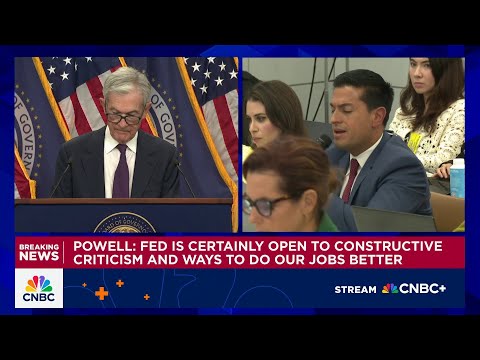
Fed Chair Powell: We're tightly focused on our goals
CNBC Television· 2025-09-17 20:14
Thanks, Chair Powell. Matt Eaggan from CNN. We re we we recently learned that average FICO credit scores are down this year by two points, the most since 2009 during the Great Recession, and delinquencies are high for car loans, personal loans, credit cards.How concerned, if at all, are you about the health of consumer finances. And do you expect today's cut will help. So, you know, we're aware of that.I think this default rates have been um kind of ticking up and we do watch that. Um they're not at a level ...
Coinbase Defends Stablecoins Against Banking Threat Claims, Says ‘Math Doesn’t Add Up’
Yahoo Finance· 2025-09-16 12:25
Coinbase published a comprehensive defense against banking industry claims that stablecoins threaten traditional financial stability, arguing the “deposit erosion” narrative is a “myth” designed to protect banks’ $187 billion annual payment processing monopoly. The exchange released research titled “Beyond the Deposit Debate,” challenging Treasury estimates of $6 trillion in potential deposit outflows from yield-bearing stablecoins. Research Challenges Banking Industry’s Deposit Flight Claims The defens ...

Buy Wheaton Precious Metals Stock At $93?
Forbes· 2025-08-25 11:50
Core Viewpoint - Wheaton Precious Metals stock has increased by 61% year-to-date, driven by rising precious metal prices, strong operational results, and increasing institutional confidence, although it remains volatile due to elevated valuation [2][3][8] Financial Performance - In Q2 2025, Wheaton achieved record revenue of $503 million, a 28% increase in sales volume, and net earnings surged by 139% to $292 million, with adjusted earnings reaching $286 million [3] - Cash flow from operations hit a quarterly high of $415 million, and the company maintains a flawless balance sheet with $1 billion in cash, no debt, and a $2 billion credit line available [3][7] Valuation Metrics - Wheaton's price-to-sales ratio is 25.8, significantly higher than the S&P 500's 3.2, with an earnings multiple of 54.4 compared to 21.5 for the index, indicating a considerable premium placed on the stock [4] - The free cash flow multiple stands at 56.8 against 23.7 for the S&P 500, further underscoring the elevated valuation [4] Growth Rates - Over the last three years, Wheaton's revenues have grown at an average annual rate of 16.2%, compared to 6.1% for the S&P 500, with a 46.8% increase in sales over the past twelve months, rising from $1.1 billion to $1.7 billion [5] - Quarterly revenue rose by 68.3% year-over-year to $503 million, while the S&P 500 achieved just over 4.8% growth [5] Profitability - Wheaton produced $1 billion in operating income with a 61.5% margin, alongside $1.3 billion in operating cash flow (81.2% margin) and $798 million in net income (47.5% margin), all significantly higher than S&P 500 averages [5][6] Financial Stability - The company has a low debt-to-equity ratio of 0.02%, well below the S&P 500 average of 20.9%, and cash accounts for nearly 13% of total assets compared to 6.8% for the index, providing flexibility for investments [7]


浙商宏观:预计2025年货币政策维持宽松基调 年内央行还有一次50BP降准,以及20BP降息
Sou Hu Cai Jing· 2025-08-17 10:00
Core Viewpoint - The People's Bank of China (PBOC) maintains a moderately accommodative monetary policy, focusing on stabilizing employment, economic growth, and promoting reasonable price recovery [1][2] Group 1: Monetary Policy Direction - The PBOC emphasizes the importance of stabilizing employment, enterprises, markets, and expectations, indicating a continued focus on accommodative monetary policy [2] - The central bank acknowledges external shocks and structural contradictions in domestic demand and supply, necessitating a moderately accommodative monetary policy to counter economic downturn pressures [2] - The expectation for the year includes one 50 basis points (BP) reserve requirement ratio (RRR) cut and a 20 BP interest rate reduction [2] Group 2: Financial Stability Measures - The PBOC reiterates the need to prevent fund diversion while balancing financial support for the real economy and maintaining financial health [3] - The current deleveraging process is expected to be relatively mild, utilizing gradual measures to guide financial institutions in reducing leverage without causing systemic risks [3] Group 3: Establishment of Financial Stability Committee - The establishment of the Macro-Prudential Financial Stability Committee aims to enhance the analysis of systemic financial risks and develop macro-prudential policies [4] - The committee will focus on improving real estate financial management, supporting stable capital market operations, and regulating bond market violations [4][5] Group 4: Focus on Inclusive Finance and Loan Growth - As of June, the balance of structural monetary policy tools supporting the "five major articles" is 3.8 trillion yuan, with inclusive finance being a significant component [7] - Loan growth rates for various sectors show that the pension industry leads with a 43.0% increase, followed by green loans at 25.5% and technology loans at 12.5% [8] Group 5: Support for Technological Innovation - The PBOC has enhanced financing channels for technological innovation, launching the "Science and Technology Innovation Board" for bond issuance [9] - The introduction of bond risk-sharing tools aims to support equity investment institutions in issuing innovation bonds, enhancing their capital strength [10] Group 6: Risk Monitoring and Financial Infrastructure - The PBOC is developing a comprehensive risk monitoring and assessment system to enhance the resilience of the financial system [13] - The establishment of an interbank transaction reporting database aims to improve financial market infrastructure and transparency [14]