
机器人技术

Search documents
世界人形机器人运动会火热开幕,机器人ETF易方达(159530)半日净申购达5600万份
Mei Ri Jing Ji Xin Wen· 2025-08-14 05:41
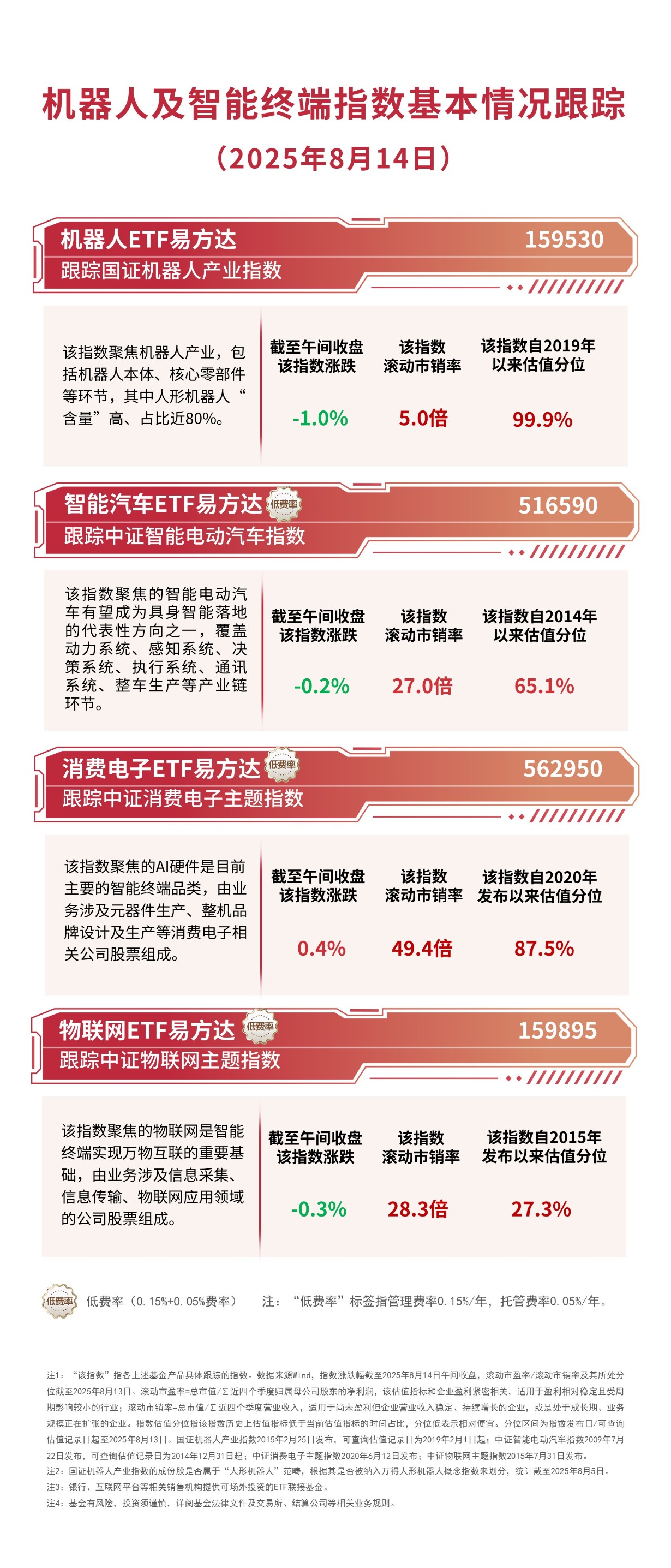
Group 1 - The core viewpoint of the article highlights the performance of various indices related to the consumer electronics and robotics sectors, with the China Securities Consumer Electronics Theme Index rising by 0.4% and the China Securities Robotics Industry Index declining by 1% [1] - The global first humanoid robot sports event has commenced, showcasing not only a competition of robotic technology but also a collaboration between technology and finance to promote industry development [1] - The E Fund Robotics ETF (159530) is the only public fund official sponsor of the event, indicating a significant integration of financial resources into this unprecedented competition [1]


浙大四足机器人打破百米冲刺吉尼斯世界纪录
Xin Hua She· 2025-08-13 13:14
Core Insights - The four-legged robot "Bai Xi," developed by Zhejiang University, has set a new Guinness World Record by completing a 100-meter dash in 16.33 seconds [1] Group 1 - The achievement highlights advancements in robotics technology, particularly in the field of four-legged robots [1] - The record-breaking performance may enhance the reputation of Zhejiang University in robotics research and development [1] - This milestone could attract potential investments and collaborations in the robotics industry [1]
USA Rare Earth (USAR) FY Conference Transcript
2025-08-12 20:30
Summary of USA Rare Earth (USAR) FY Conference Call - August 12, 2025 Company Overview - **Company**: USA Rare Earth (USAR) - **Public Listing Date**: March 2, 2025 - **Market Cap**: $1.5 billion [12] - **Cash Reserves**: Approximately $130 million [12] Industry Context - **Industry**: Rare Earth Elements and Magnet Manufacturing - **Market Size**: North American rare earth magnet industry estimated at 50,000 metric tons per year, expected to double due to growth in sectors like AI, data centers, and robotics [3][4] - **China's Market Control**: China controls 90% of rare earth processing and 70% of magnet manufacturing, posing a significant challenge for the US [4] Core Business Strategy - **Focus**: Building a US-based supply chain for rare earth magnets, starting with magnet production [2] - **Facilities**: - Flagship magnet making facility in Stillwater, Oklahoma (310,000 square feet) with initial production capacity of 600 metric tons [7] - Research and development lab for Round Top deposit in Texas [7] - **Production Goals**: - Magnet production facility aims for 5,000 metric tons capacity, with potential expansion to 10,000 metric tons [8] - Anticipated shipment of 200 to 400 tons of product in the next year [15] Customer Engagement and Market Demand - **Customer Base**: Over 70 potential customers across various industries, including automotive, AI, and oil and gas [16][44] - **Market Opportunity**: The company targets the 92% of the market not covered by government investments in MP Materials, focusing on electric vehicles, wind energy, and medical applications [10][18] - **Pricing Strategy**: USAR's magnets priced 2 to 3 times higher than Chinese counterparts, but demand remains strong due to the critical nature of these components [36] Government Support and Industry Collaboration - **Government Engagement**: Active discussions with US government for potential grants, loans, and support similar to MP Materials [5][20][26] - **Investment in Recycling**: Exploring recycling as a means to secure rare earth supply, treating it as a source akin to mining [14][33] Future Plans and Growth Projections - **Employee Growth**: Plans to double workforce to approximately 100 employees by year-end [21] - **Capital Expenditure**: Expected to spend around $60 million on capital expenditures, with potential for growth based on business needs [22] - **Timeline for Production**: Full production capacity could be achieved by 2027 with sufficient capital investment [47] Technical Development and Feasibility - **Round Top Deposit**: Unique heavy rare earth deposit containing valuable elements like dysprosium and terbium, critical for national security [11][31] - **Development Steps**: - Flow sheet development to confirm extraction and separation processes [28] - Feasibility studies and pilot plant operations planned to validate economic viability [29] Challenges and Considerations - **Supply Chain Bottlenecks**: Concerns about sourcing heavy rare earths post-initial production, with plans to mitigate through recycling and diversifying suppliers [33] - **Environmental and Regulatory Landscape**: Favorable conditions for development due to supportive state policies and administration [37] Conclusion - **Strategic Positioning**: USA Rare Earth is well-positioned to capitalize on the growing demand for rare earth magnets in North America, supported by government initiatives and a robust customer pipeline. The company is focused on building a sustainable supply chain while navigating challenges posed by market dynamics and competition from China.
大摩评特斯拉(TSLA.US)解散Dojo团队:“DOGE式效率”革命启动 百亿AI开支有望重配机器人赛道
智通财经网· 2025-08-12 08:23
Core Viewpoint - Morgan Stanley maintains an "Overweight" rating on Tesla (TSLA.US) with a target price of $410, highlighting a strategic shift involving the dissolution of the in-house Dojo supercomputer team to optimize AI program cost-effectiveness [1] Group 1: Strategic Changes - Tesla is reportedly disbanding its Dojo supercomputer team, with team leader Peter Bannon leaving the company, although Tesla has not confirmed this news [1] - The Dojo supercomputer was designed to process vast amounts of data and video generated by Tesla vehicles for training Full Self-Driving (FSD) and Optimus machine learning models [1] - Elon Musk has ordered the termination of the Dojo project, with plans to increase collaboration with external tech partners like NVIDIA (NVDA.US) and AMD (AMD.US) for computational support [1] Group 2: Financial Implications - Analyst Adam Jonas suggests that this move reflects significant strategic and financial considerations, potentially part of Tesla's cost-cutting plan to reduce capital and operational expenditures associated with the Dojo project [2] - Tesla's Q2 report indicated that AI initiatives have increased operational expenses, with capital expenditures expected to exceed $9 billion in fiscal year 2025, primarily directed towards AI-related fields [2] Group 3: Focus on Robotics and Edge Computing - The strategic shift may benefit Musk's xAI company, which is taking on more responsibilities for developing Tesla's "AI brain" and utilizing data from social media and real-world vehicle operations [2] - Tesla appears to be refocusing on robotics technology and edge inference capabilities, with Musk emphasizing the potential strategic value of Tesla's global fleet as a distributed inference network [2] - As the commercialization of Optimus accelerates, analysts believe Tesla may redirect capital expenditures and R&D investments towards reducing robot production costs and optimizing manufacturing systems [2] Group 4: Market Context - The timing of Tesla's spending reduction is notable, as the GPU shortage that previously pressured the company to develop in-house computing resources has significantly eased [2] - Joe Moore from Morgan Stanley notes that developing ASIC chips that can outperform NVIDIA's offerings is becoming increasingly difficult due to NVIDIA's annual R&D spending exceeding $15 billion and the expanding scope of AI investments [3]

世界机器人大会“煎饼果子机器人”爆单,老外排单近1小时
Xin Lang Cai Jing· 2025-08-12 01:23
特别声明:以上文章内容仅代表作者本人观点,不代表新浪网观点或立场。如有关于作品内容、版权或其它问 题请于作品发表后的30日内与新浪网联系。 ...
上海沿浦: 上海沿浦精工科技(集团)股份有限公司关于投资设立控股子公司暨关联交易的公告
Zheng Quan Zhi Xing· 2025-08-11 16:17
证券代码:605128 证券简称:上海沿浦 公告编号:2025-069 上海沿浦精工科技(集团)股份有限公司 关于投资设立控股子公司暨关联交易的公告 本公司董事会及全体董事保证本公告内容不存在任何虚假记载、误导性陈述或者重大遗 漏,并对其内容的真实性、准确性和完整性承担个别及连带责任。 重要内容提示 ? 上海沿浦精工科技(集团)股份有限公司(以下简称"公司"或者"上海沿浦")拟 与上海机器人产业技术研究院有限公司(以下简称"上海机器人产业技术研究院")、蒲卫 东先生以及"持股平台"(即公司实际控制人张思成先生和周建清先生拟共同设立的有限合 伙企业,其中张思成先生担任执行事务合伙人。该"持股平台"系公司关联方,名称最终以 市场监督管理局核准的名称为准,以下简称"持股平台")合资设立上海锡纳泰克智能科技 有限公司(以下简称"锡纳泰克"或者"合资公司",暂定名,最终以市场监督管理局核准 的名称为准)。 ? 锡纳泰克注册资本为 3,000 万元人民币,其中,公司拟使用自有资金出资 1,530 万元 人民币,占注册资本的 51%;上海机器人产业技术研究院拟出资 300 万元,占注册资本的 10%; 蒲卫东先生拟出资 7 ...

秀我中国|在世界机器人大会遛“机器人娃”
Xin Hua She· 2025-08-11 11:32
作者:蔡紫涵、高依菲、刘洋 新华社音视频部制作 0:00 跟随新华社"秀我中国"栏目行走体验官一起走进2025世界机器人大会,认识可爱的"机器人幼崽",看它 们和人类萌娃的有爱互动! ...
江苏雷利:公司子公司中科灵犀将于北京机器人博览会正式推出全新一代绳驱式灵巧手
Zheng Quan Ri Bao Zhi Sheng· 2025-08-11 11:12
(编辑 袁冠琳) 证券日报网讯 江苏雷利8月11日在互动平台回答投资者提问时表示,江苏雷利子公司中科灵犀将于北京 机器人博览会正式推出全新一代绳驱式灵巧手,具备22个自由度,配置力觉及触觉传感器,并搭载公司 自研的灵巧手控制系统。公司正积极对接机器人领域下游客户,争取市场机会。 ...

涛涛车业(301345.SZ):已先后与K-SCALE、开普勒机器人、宇树科技等公司达成战略合作
Ge Long Hui A P P· 2025-08-11 07:37
Core Viewpoint - The company is actively embracing the wave of intelligence by strategically laying out plans in robotics and autonomous driving technologies while maintaining its core business in smart electric low-speed vehicles and special vehicles [1] Group 1: Business Development - The company aims to build a common technology platform across product lines by integrating research and development achievements from emerging fields into its core products, thereby enhancing the development of its main business [1] - The company is planning to establish a global technology research and development network, including a domestic research institute in Zhangjiang, Shanghai, and an overseas team for cutting-edge technology incubation in the United States [1] Group 2: Strategic Collaborations - The company has formed strategic partnerships with K-SCALE, Kepler Robotics, and Yushu Technology to collaborate on sales expansion, scenario applications, and product secondary development [1]

这届机器人,太会打工了
Hu Xiu· 2025-08-11 07:24
这届机器人,真是能打工的全才,调酒、卖艺、做手术、打拳击、送货……样样不落。只能说今年的机 器人,不止能炫技,干活儿也越来越靠谱了。 ...