区块链

Search documents
广东与新加坡首个跨境数据验证平台上线试运行 将开展信用报告双向跨境验证
Nan Fang Ri Bao Wang Luo Ban· 2025-12-01 07:55
Core Insights - The Shenzhen-Singapore Cross-Border Data Verification Platform has been launched for trial operation, aimed at addressing compliance, security, and trust issues in cross-institutional, cross-industry, and cross-scenario data integration between Guangdong and Singapore [1][2] - The platform is supported by government departments from both regions and developed using blockchain technology to ensure data integrity and traceability [1] Group 1 - The platform utilizes a model of "user self-upload and platform hash verification" to facilitate data flow between Guangdong and Singapore [1] - It is the first digital infrastructure for data circulation established between the two regions [1] - The platform is developed based on the FISCO BCOS blockchain technology and Distributed Data Transmission Protocol (DDTP) [1] Group 2 - The initial phase of the platform focuses on cross-border financial services, with a pilot project involving mutual verification of personal credit reports between Baixin Credit and Experian Credit Services Singapore [2] - Future expansions will include more verifiable data sources and additional application scenarios [2]
上海中广云智投:模块化架构加速投资功能迭代速度
Sou Hu Cai Jing· 2025-12-01 02:40
Core Insights - The investment sector is undergoing a profound transformation driven by technological architecture innovations, moving away from traditional "monolithic" systems that face iterative challenges [1] - The rise of modular architecture introduces agility into investment systems, allowing for rapid response and dynamic optimization through the decoupling of functions and component reuse [1] Group 1: Modular Architecture Benefits - Modular architecture breaks down complex systems into independent functional units, enabling focused development on macroeconomic analysis, risk assessment models, and quantitative trading algorithms [1] - Investors can quickly adapt to changing market conditions by adjusting module combinations or upgrading specific functions without overhauling the entire system [1] - The ability to integrate international macroeconomic monitoring and currency risk hedging modules enhances cross-border investment capabilities efficiently [1] Group 2: Technological Support for Modular Architecture - Standardization and openness in technology are crucial for accelerating the iteration of modular architecture, ensuring seamless data access and interaction among modules [2] - Distributed computing and real-time processing technologies significantly enhance data exchange efficiency, supporting high-frequency trading scenarios [2] - The proliferation of open-source ecosystems lowers development barriers, allowing developers to quickly build and optimize new modules through community collaboration [2] Group 3: Industry Ecosystem Transformation - Modular architecture is reshaping the division of labor in the investment sector, allowing specialized institutions to focus on deep development of specific modules [3] - Investors can select module combinations to create personalized strategy factories, reducing technical barriers for smaller institutions and enhancing module quality through market competition [3] - The integration of artificial intelligence and blockchain technologies will further advance modular architecture towards intelligence and automation, providing a more reliable technical foundation for investment decisions [3]


“香港加密资产第一股”来了!HashKey通过港交所聆讯,香港最大持牌虚拟资产交易所
Sou Hu Cai Jing· 2025-12-01 02:37
Core Viewpoint - HashKey Holdings Limited has successfully passed the Hong Kong Stock Exchange hearing and is positioned as a leading digital asset company in Asia, offering a comprehensive range of services including trading facilitation, on-chain services, and asset management [2][3]. Group 1: Company Overview - HashKey provides a licensed digital asset platform that facilitates trading, on-chain services, and asset management, with capabilities to issue and circulate tokenized real-world assets [2]. - The company has established itself as a mature digital asset company in Asia, with a global presence and a focus on building a digital asset ecosystem through end-to-end financial infrastructure and technology [2][3]. - According to Frost & Sullivan, HashKey is the largest regional onshore platform in Asia by trading volume projected for 2024 [2]. Group 2: Product and Service Offerings - HashKey's platform supports 80 types of digital asset tokens, including major Layer-1 assets, DeFi tokens, stablecoins, and emerging ecosystem projects as of September 30, 2025 [3]. - The company offers OTC trading services designed for large-scale or customized digital asset transactions, providing a compliant trading venue with higher flexibility and confidentiality [7]. - HashKey's on-chain services include blockchain staking infrastructure, tokenization capabilities, and blockchain-native development, making it the largest staking service provider in Asia with HKD 29 billion in staked assets [7]. Group 3: Financial Performance - HashKey's revenue sources include trading facilitation, on-chain services, and asset management, with significant growth in trading facilitation services [6][10]. - The company's revenue for 2022, 2023, and 2024 was HKD 129 million, HKD 208 million, and HKD 721 million respectively, reflecting rapid expansion in trading facilitation services [10]. - As of August 31, 2025, HashKey held HKD 1.657 billion in cash and cash equivalents, along with HKD 592 million in digital assets, with mainstream tokens comprising 84% of the digital asset portfolio [11]. Group 4: Market Position and Strategy - HashKey's trading volume surged from HKD 4.2 billion in 2022 to HKD 328 billion in 2023, and further to HKD 638.4 billion in 2024, driven by the launch of its Hong Kong digital asset trading platform [12]. - The company plans to allocate funds raised from its IPO for technology and infrastructure upgrades, market expansion, ecosystem collaboration, and general corporate purposes [12].
人民日报:加强金融科技伦理建设
Ren Min Ri Bao· 2025-12-01 00:14
登录新浪财经APP 搜索【信披】查看更多考评等级 当今世界,以人工智能技术为代表的新一轮科技革命蓬勃发展,不断催生出新场景、新业态、新模式, 在赋能人类社会经济发展进步的同时,也带来了一些风险挑战和安全隐患。习近平总书记强调:"妥善 应对科技发展带来的规则冲突、社会风险、伦理挑战。"党的二十届四中全会《建议》提出:"加强科技 法治、伦理、诚信、安全建设。"金融是国民经济的血脉,是国家核心竞争力的重要组成部分。在人工 智能、大数据等新技术的赋能下,金融科技不断创新并深度融入金融业发展。对金融科技活动进行有效 治理,是防范化解金融风险、维护金融安全、推动金融高质量发展的题中应有之义。我们要深入学习贯 彻习近平总书记重要讲话精神,认真贯彻落实党的二十届四中全会决策部署,持续加强金融科技伦理建 设,不断筑牢国家金融安全防线。 金融活动以信用为核心,而信用的根基在于信任。金融伦理正是这种信任的制度化与规范化体现,是金 融运行的道德规范与行为准则。近年来,随着人工智能、大数据、区块链等技术与金融业务深度融合, 金融科技创新已成为推动金融业发展的重要力量,为金融发展提供了源源不断的动力,同时也带来一些 挑战。比如,金融科技 ...
加强金融科技伦理建设
Ren Min Ri Bao· 2025-11-30 22:20
当今世界,以人工智能技术为代表的新一轮科技革命蓬勃发展,不断催生出新场景、新业态、新模式, 在赋能人类社会经济发展进步的同时,也带来了一些风险挑战和安全隐患。习近平总书记强调:"妥善 应对科技发展带来的规则冲突、社会风险、伦理挑战。"党的二十届四中全会《建议》提出:"加强科技 法治、伦理、诚信、安全建设。"金融是国民经济的血脉,是国家核心竞争力的重要组成部分。在人工 智能、大数据等新技术的赋能下,金融科技不断创新并深度融入金融业发展。对金融科技活动进行有效 治理,是防范化解金融风险、维护金融安全、推动金融高质量发展的题中应有之义。我们要深入学习贯 彻习近平总书记重要讲话精神,认真贯彻落实党的二十届四中全会决策部署,持续加强金融科技伦理建 设,不断筑牢国家金融安全防线。 金融活动以信用为核心,而信用的根基在于信任。金融伦理正是这种信任的制度化与规范化体现,是金 融运行的道德规范与行为准则。近年来,随着人工智能、大数据、区块链等技术与金融业务深度融合, 金融科技创新已成为推动金融业发展的重要力量,为金融发展提供了源源不断的动力,同时也带来一些 挑战。比如,金融科技创新在提升金融效率、拓宽普惠服务方面成效显著,能够 ...
HashKey Holdings Limited(03887) - 聆讯后资料集(第一次呈交)
2025-11-30 16:00
香港交易及結算所有限公司、香港聯合交易所有限公司與證券及期貨事務監察委員會對本聆訊後資料集的 內容概不負責,對其準確性或完整性亦不發表任何意見,並明確表示概不就因本聆訊後資料集全部或任何 部分內容而產生或因倚賴該等內容而引致的任何損失承擔任何責任。 HashKey Holdings Limited (「本公司」) (於開曼群島註冊成立的有限公司) 的聆訊後資料集 警告 本聆訊後資料集乃根據香港聯合交易所有限公司(「聯交所」)及證券及期貨事務監察委員會(「證監會」)的 要求而刊發,僅用作提供資料予香港公眾人士。 本聆訊後資料集為草擬本,其內所載資料並不完整,亦可能會作出重大變動。 閣下閱覽本文件,即代 表 閣下知悉、接納並向本公司、本公司的保薦人、整體協調人、顧問或承銷團成員表示同意: 本公司招股章程根據香港法例第32章公司(清盤及雜項條文)條例送呈香港公司註冊處處長登記前,本公 司不會向香港公眾人士提出要約或邀請。倘在適當時候向香港公眾人士提出要約或邀請,有意投資者務請 僅依據於香港公司註冊處處長註冊的本公司招股章程作出投資決定,招股章程的文本將於發售期內向公眾 人士刊發。 (a) 本文件僅為向香港公眾人士提 ...
市场情绪有所回暖,看好谷歌相关的加密矿场
SINOLINK SECURITIES· 2025-11-30 05:08
Investment Rating - The report maintains an optimistic outlook for the market performance leading up to the expected interest rate cut in December, but expresses caution regarding the market's performance in early 2026 [4][29]. Core Insights - The total market capitalization of cryptocurrencies reached $3.11 trillion this week, reflecting a 6.1% increase from the previous week, driven by rising expectations of a 25 basis point rate cut by the Federal Reserve [10][11]. - Bitcoin closed at $90,919, up 6.8% week-over-week, while Ethereum closed at $3,032, up 9.6% [10][11]. - The current sentiment in the cryptocurrency market is still considered overly pessimistic, despite a slight recovery in the fear and greed index, which stands at 20, indicating extreme fear [11][17]. Summary by Sections Industry Dynamics - The Federal Reserve's expected interest rate cut in December has increased the total cryptocurrency market capitalization to $3.11 trillion, with Bitcoin and Ethereum showing significant price increases [10][11]. - The fear and greed index indicates extreme fear, but there are signs of a potential market rebound in the coming month [11][17]. Global Policy and Industry News - Texas has become the first U.S. state to purchase Bitcoin, investing $10 million through BlackRock's IBIT ETF [22]. - The SEC is set to discuss governance and tokenization of equity securities in a public meeting scheduled for December 4, 2025 [24]. - Hong Kong is developing a regulatory framework for digital asset trading and custody services, with a market size of approximately $3 billion for tokenized products [22]. Company News - The CFTC has granted Polymarket a license to operate in the U.S., and the Intercontinental Exchange is considering a $2 billion investment in Polymarket [27]. - Robinhood has acquired 90% of the cryptocurrency derivatives exchange MIAXdx, expanding its presence in the prediction market [28]. - Cipher Mining issued $333 million in senior secured notes at a 7.125% interest rate to fund the construction of a digital center [28]. Investment Recommendations - The report suggests focusing on cryptocurrency mining companies with partnerships or potential equity relationships with Google, as well as companies with substantial power reserves [4][29].
产业规模达4405亿元,上海金融科技产业已形成规模化发展态势
Xin Hua Cai Jing· 2025-11-29 14:03
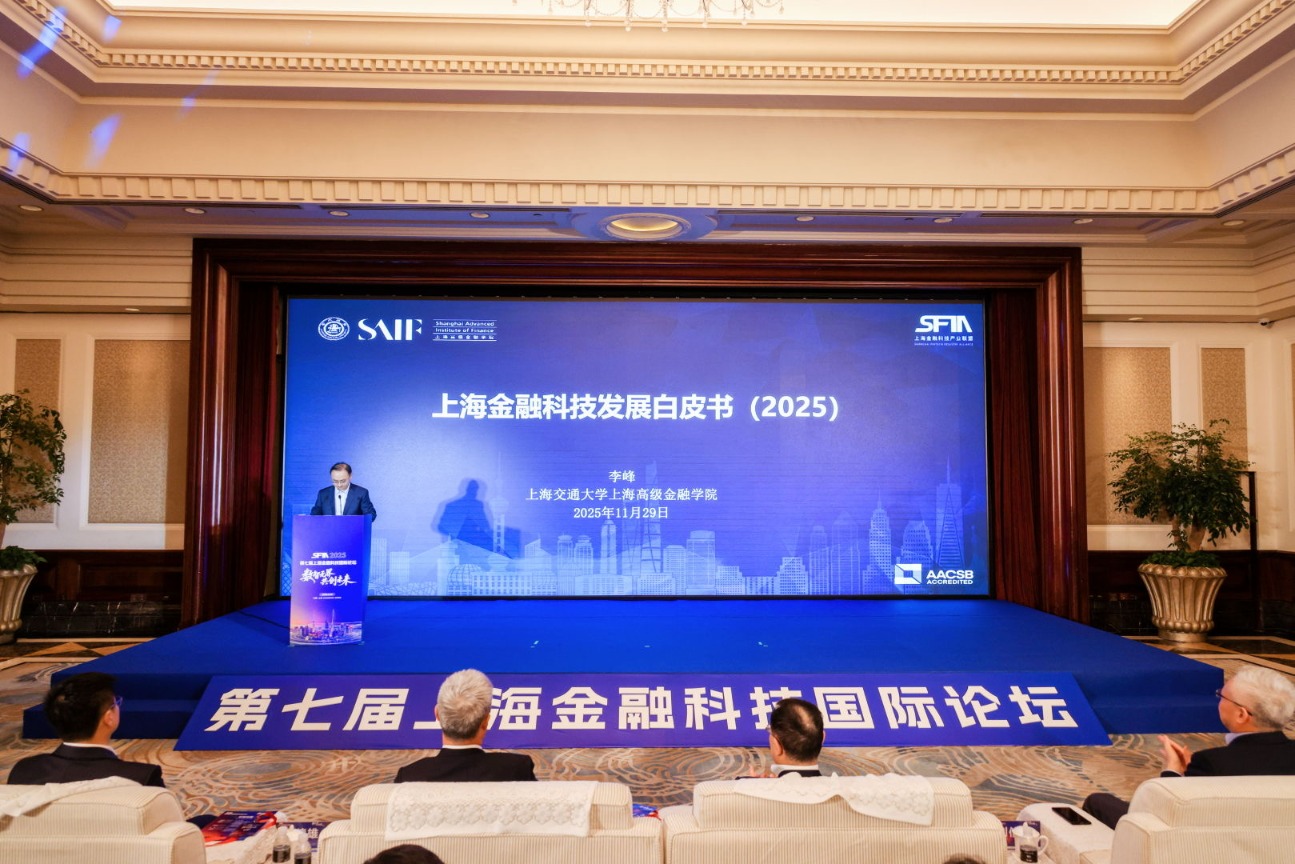
Core Insights - The Shanghai Financial Technology Development White Paper (2025) indicates that the financial technology industry in Shanghai is projected to reach a scale of approximately 440.5 billion yuan by 2024, demonstrating a trend towards large-scale development [1][3] - Shanghai has transitioned from the "concept" phase of financial technology to a "practical" stage, with expectations to become a globally leading financial technology center through the integration of technological innovation, scenario empowerment, ecological collaboration, and innovative regulation [1][3] Industry Development - Shanghai's financial technology sector shows significant achievements, with overall R&D investment ranking among the top in the country, stable technology investment in the banking sector, steady growth in the securities industry, and accelerated quality improvement in insurance technology [3] - The application level of financial technology is gradually improving, with expanding use cases for digital currency and artificial intelligence [3] Future Trends - The future of Shanghai's financial technology development is expected to feature deeper technological integration, with artificial intelligence becoming a core driver of innovation, supported by upgrades in blockchain and cloud computing technologies [3][4] - Financial technology will increasingly serve key areas such as inclusive finance, cross-border finance, and green finance, with innovations like open banking and cross-border payments enhancing the collaborative financial service ecosystem [3][4] - The rise of Asian financial technology capabilities is noted, with cities like Shanghai, Hong Kong, and Singapore forming a competitive yet cooperative landscape that enhances the global voice of the East [3][4] Regulatory Environment - Shanghai aims to explore more flexible financial technology innovation regulatory mechanisms, enhancing the application of regulatory technology while ensuring financial security [4] Global Positioning - The Global Financial Technology Center Development Index (2025) ranks Shanghai among the top four global financial technology hubs, alongside New York, Beijing, and San Francisco, highlighting the deep integration of finance and technology as a core competitive advantage [4] - Shanghai's comprehensive financial system and large-scale application scenarios position it as a benchmark for the transformation of traditional financial centers into technology-driven entities [4]
2025年稳定币创新对非银支付生态的影响动态研究报告
Sou Hu Cai Jing· 2025-11-29 12:14
Core Insights - The report discusses the impact of stablecoin innovation on the non-bank payment ecosystem, highlighting the transformation driven by blockchain technology in cross-border payments and the involvement of various financial and technology companies [1][2][3]. Group 1: Traditional Non-Bank Financial Institutions - Traditional remittance institutions are actively integrating stablecoins into their business models, enhancing cross-border payment systems through self-built applications and API integrations [6][7]. - Major players like MoneyGram and Western Union are launching stablecoin mobile applications and exploring the issuance of their own stablecoins to facilitate cross-border transactions [7][8]. - Visa and Mastercard are focusing on stablecoin strategies, emphasizing card services and tokenization platforms to bridge crypto assets with everyday consumption [9][10]. Group 2: Technology Companies - Technology companies are becoming key players in stablecoin payment innovation, with platforms like PayPal and Stripe developing their own stablecoin capabilities to enhance cross-border payment solutions [2][19]. - PayPal's PYUSD aims to create a closed-loop payment ecosystem, significantly reducing cross-border payment costs by over 80% [20]. - Stripe is expanding its stablecoin services through acquisitions and the development of its own blockchain, targeting emerging markets for enhanced payment efficiency [21][22]. Group 3: Market Trends and Opportunities - The total transaction volume of stablecoins is rapidly increasing, with an estimated $5.7 trillion in transactions in 2024, primarily serving internal crypto asset flows [26]. - B2B cross-border payments are identified as the main opportunity for stablecoin applications, with potential market size in non-G10 regions reaching $18.8 trillion [28][29]. - The penetration of stablecoins in cross-border payments remains low, particularly in underdeveloped emerging markets, indicating significant growth potential [27][28].