
防沙治沙

Search documents
内蒙古的“绿色版图”越扩越大
Zhong Guo Chan Ye Jing Ji Xin Xi Wang· 2025-07-22 02:20
Core Points - Inner Mongolia has seen an increase in migratory bird species and populations, including endangered species like the red-crowned crane and the great bustard, attributed to its improving ecological environment and expanding "green territory" [1][3] - The "Three-North" project has made significant progress, with Inner Mongolia completing 13.31 million acres of construction tasks in 2023 and 30.6 million acres planned for 2024, leading the nation in desertification control efforts [1][3] - The Yellow River "bent" area has implemented a comprehensive sand control strategy, reducing sediment flow into the river from 27 million tons to 4 million tons annually [3][4] Group 1 - Inner Mongolia recorded its first summer stay of the swan species, with four swans observed in Tengger Lake Wetland [1] - The region's ecological restoration efforts have led to a significant increase in the number of migratory birds and endangered wildlife [1][3] - The "Three-North" project is entering a new phase of high-quality development, with a focus on combating desertification [1][3] Group 2 - The Yellow River "bent" area has completed over 42 million acres of "Three-North" project tasks and 23 million acres of desertification control since the beginning of 2023 [3][4] - The ecological restoration in the Kubuqi Desert has established multiple protective barriers, significantly reducing sediment flow into the Yellow River [3][4] - Inner Mongolia's efforts in the Khorchin and Hunshandak areas have led to the elimination of nearly 60,000 acres of bare sand land [4] Group 3 - The region has developed a comprehensive sand control network, including 17 roads spanning 494.5 kilometers, to effectively manage sand movement [4] - The construction of a 1,856-kilometer sand control belt has been completed to prevent the encroachment of major deserts [5] - Inner Mongolia's "green territory" is expanding, reinforcing the ecological security of northern China [6]
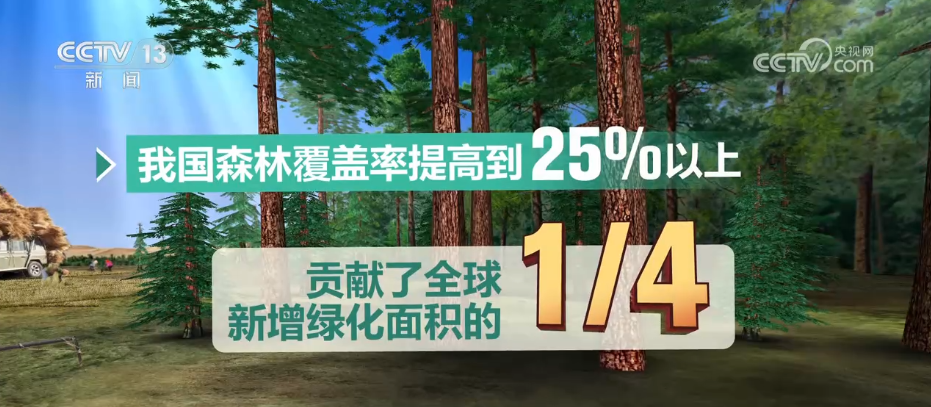
3.65亿亩、25%以上 数据见证我国防沙治沙工作卓越成就
Yang Shi Wang· 2025-07-12 03:21
Group 1 - The core theme of this year's International Day for the Prevention of Dust Storms is "Preventing Dust Disasters, Jointly Protecting the Blue Sky," aimed at raising global awareness of the health and environmental challenges posed by dust storms [1] - China has made significant progress in combating desertification, having restored 365 million acres of desertified land over the past decade [5] - The "Three-North" project has preserved 48 million acres of afforestation, rehabilitated 128 million acres of degraded grasslands, and controlled 67 million acres of soil erosion, effectively protecting 45 million acres of farmland [3] Group 2 - The World Meteorological Organization reports that dust storms are increasingly causing health and economic losses, with global dust concentrations expected to remain high in severely affected areas [6] - Approximately 2 billion tons of dust enter the atmosphere annually, with over 80% originating from deserts in North Africa and the Middle East [6] - Climate change is exacerbating land degradation and desertification, leading to the emergence of new dust sources [6] Group 3 - International experts commend China's effective land management strategies in combating dust storms, highlighting the establishment of green belts at the edges of deserts as a successful example [7] - China's afforestation efforts have significantly improved the living environment and helped mitigate the risks associated with dust storms [7]

通讯:科技赋能 中国煤炭大市绿色发展变迁记
Zhong Guo Xin Wen Wang· 2025-07-09 11:17
Core Viewpoint - The article highlights the transformation of Ordos City, a major coal-producing area in China, towards green development through technological empowerment, particularly in combating desertification and promoting renewable energy sources [1][2]. Group 1: Desertification Control - Ordos City has implemented advanced technologies to combat desertification in the Kubuqi Desert, achieving a governance rate increase from 4.6% in the early 21st century to 40% [2]. - The use of robots and advanced machinery has significantly improved the efficiency of planting and sand control, with robots planting at a rate of one seedling every five seconds and a solid sand vehicle sowing 2,000 plants per hour, which is 80 times more efficient than manual labor [2]. - The Kubuqi Desert ecological governance area has been recognized by the United Nations as a "Global Desert Ecological Economic Demonstration Zone" [2]. Group 2: Renewable Energy Development - The Ujier Wind Farm in Ordos features large wind turbines and a solar power station with 196,300 photovoltaic panels, generating 2 billion kilowatt-hours of green electricity annually, saving approximately 680,000 tons of standard coal and reducing carbon dioxide emissions by about 1.65 million tons [2][4]. - Ordos City is developing a large-scale wind and solar energy base, with a total potential of 140 million kilowatts, equivalent to the capacity of 6.2 Three Gorges Hydropower Stations [4]. - By 2024, Ordos is expected to add over 10 million kilowatts of new energy capacity, bringing the total installed capacity to 21.24 million kilowatts, which accounts for nearly one-sixth of Inner Mongolia's total renewable energy capacity [4]. Group 3: Technological Innovation - Ordos has established several research institutions focused on sustainable development, including the Ordos Energy Research Institute and the Ordos Carbon Neutral Research Institute, contributing to significant technological advancements [5]. - The city has attracted high-level innovative talent, enhancing its innovation capabilities and ranking among the top 100 cities in China for innovation [5].
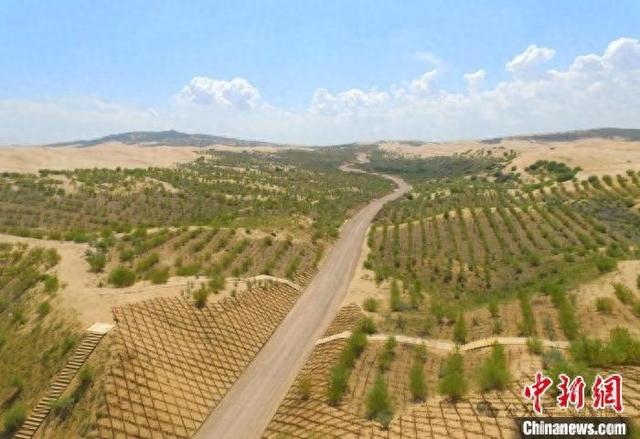
1856公里,锁住沙漠!内蒙古完成三大沙漠林草锁边带合龙
Xin Hua Wang· 2025-07-06 08:21
Core Points - The completion of a 1856-kilometer sand prevention and control belt marks a significant achievement in combating desertification in the Alxa League, Inner Mongolia [1][2] - The project aims to effectively curb the spread of the Badain Jaran, Tengger, and Ulan Buh deserts, which together cover 94,700 square kilometers, accounting for 35.07% of the local land area and 83.04% of Inner Mongolia's desert area [1] - The initiative employs various methods, including biological, photovoltaic, and engineering techniques, to systematically manage desertification and enhance ecological safety [2] Project Details - The sand prevention project was initiated on February 28 and took over four months to complete the final segment of the 1856-kilometer belt [1] - The use of grass grid technology helps stabilize shifting sands and supports the growth of drought-resistant native plants, creating a multi-layered sand prevention system [2] - Over 40 years, the Alxa League has treated nearly 10 million acres of desert, establishing two protective belts totaling 460 kilometers in length [2]
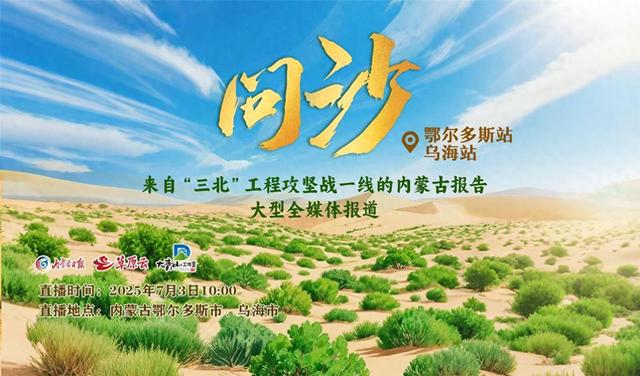
7月3日“几字弯”上再“问沙”
Nei Meng Gu Ri Bao· 2025-07-01 12:50
Core Viewpoint - The article highlights the ecological restoration efforts in Inner Mongolia, particularly focusing on the "Three-North" shelter forest program, which aims to combat desertification and promote green development in the region [1]. Group 1: Ecological Restoration Efforts - Ulaanbaatar City is located at the intersection of the Ulan Buh Desert, Kubuqi Desert, and the Maowusu Sandy Land, where local residents have developed a "green retreat from sand" ecological development path over the years [3]. - The Gander Mountain Ecological Governance Area, previously known as Baiduguai Bay, has transformed from a barren landscape into a green area due to persistent efforts over the past 20 years [5]. - The Kubuqi Desert's northern edge in the Dalate Banner has implemented a comprehensive governance strategy, achieving significant results through a combination of afforestation and sand control measures [6]. Group 2: Specific Initiatives and Goals - In the Kubuqi Desert, the "Ten Major Kongs" area has been targeted for ecological restoration, utilizing favorable water conditions to create green barriers and effectively control desertification [8]. - The Hangjin Banner, which has a significant portion of its land covered by the Kubuqi Desert, has established a 199,500-acre lock forest belt to prevent the northward expansion of the desert [10]. - A comprehensive plan is in place to complete ecological restoration of 10.92 million acres and solar-powered desertification control of 2 million acres from 2024 to 2030, aiming for a governance rate of over 70% [10].
中国锁边奇迹再现!腾格里沙漠153公里镶上“绿链”
Xin Hua She· 2025-06-30 13:48
Group 1 - The core viewpoint of the articles is the completion of a significant ecological project in the Tengger Desert, which involves a 153-kilometer "green chain" to combat desert expansion and protect the Yellow River [1][2] - The project is part of a broader initiative to manage desertification in China, emphasizing the importance of not eliminating deserts but rather managing their expansion [2][3] - The Ningxia region has successfully retreated the Tengger Desert by 25 kilometers over the past decades through various ecological projects, including the "Three-North" program [2][3] Group 2 - The locking technique involves using grass grids to stabilize shifting sands, which has proven effective in preventing desert encroachment [3][4] - Innovative technologies are being employed, such as a specialized planting tool that increases the survival rate of saplings in sandy conditions from 60% to over 80% [4] - Future plans include enhancing cooperation with Inner Mongolia for joint ecological management and developing sustainable industries like desert tourism and solar energy [5][6]
新疆和田地区多元化防沙治沙 激发绿色经济新活力
Zhong Guo Xin Wen Wang· 2025-06-27 11:15
Group 1 - The core viewpoint of the articles highlights the significant progress made in combating desertification in the Hotan region of Xinjiang, with a focus on multi-faceted strategies and community involvement [1][2] - The Hotan region has implemented various measures such as engineering sand fixation, afforestation, irrigation, and photovoltaic sand control, leading to an increase in forest coverage to over 32% [1] - From 2024 to the first half of 2025, the region has treated 5.3129 million acres of desertified land, achieving over 65% of the planned target for Xinjiang [1] Group 2 - The region has introduced policies for land contracting and established a process for community participation, allocating 589,400 acres of state-owned unused sandy land to 795 administrative villages, benefiting 12,600 households with a clear 70-year land management right [1] - The integration of biological sand control with agricultural development is being promoted, with plans to cultivate traditional Chinese medicinal herbs and specialty crops, aiming for 740,000 acres of medicinal herb planting by 2025 [2] - The expected output value from the medicinal herb industry is projected to reach 722 million yuan, creating stable employment for 12,600 people and flexible employment for 53,500 person-times [2]
新疆巩固防沙治沙成果 新增治理面积479万亩
Zhong Guo Jing Ji Wang· 2025-06-27 08:57
Core Insights - Xinjiang is focusing on combating desertification through the "Three-North" project, aiming to enhance green protective belts and increase governance areas significantly this year [1][2] - The region has successfully completed substantial tasks under the "Three-North" project, achieving a total of 28.34 million acres of construction and creating a 3,046-kilometer green barrier against desert encroachment [1] Group 1 - Xinjiang plans to scientifically determine suitable crops and utilize groundwater resources effectively, increasing the width of green protective belts from 110 meters to 7,500 meters and adding 4.79 million acres of governance area [1] - The "government-led, community-participation" model in the Yutian County has engaged approximately 36,000 residents in sand control efforts, promoting the cultivation of sand-resistant plants and developing sand-related industries [1] - The region has achieved a dual improvement in desertification control and water management, leading to a reduction in both desert and sandy land areas [1] Group 2 - The Yutian County Wanhuayuan "closing" area is a critical segment of the 285-kilometer gap along the southern edge of the Taklamakan Desert, exploring diverse planting models to enhance windbreak and sand-fixing capabilities while also tapping into economic value [2] - A special fund of 1.1 billion yuan has been allocated for this year, promoting an incentive model of "doing first, then compensating" and advancing technical upgrades with distributed photovoltaic systems and saline water irrigation [2] - A pilot project for forest and grass carbon sink development is set to cover 3.9 million acres [2]
【科技日报】近百名专家学者研讨塔克拉玛干沙漠锁边工程新模式
Ke Ji Ri Bao· 2025-06-27 01:14
Core Insights - The "Taklamakan Desert Locking Project" aims to combat desertification through innovative engineering and ecological methods, culminating in a 3046 km "green collar" around the desert by November 28, 2024 [2][3] - The project integrates engineering, biological, and photovoltaic techniques to create a comprehensive sand prevention and control technology model [3] - Experts emphasize the importance of interdisciplinary collaboration and technological innovation to ensure the sustainability and stability of the locking project [2][3] Group 1 - The Taklamakan Desert is the largest shifting sand desert in China, posing significant threats to surrounding oases and infrastructure due to frequent sandstorms [2] - A high-level academic salon was held in Hotan, Xinjiang, where nearly a hundred experts discussed scientific governance, technological breakthroughs, and innovative models for high-quality sand prevention and control [2] - Key topics included "Smart Diagnosis of Wind and Sand and Intelligent Decision-Making for Sand Control," "Utilization of Saline Water in Desert Areas," and "Ecological Photovoltaics for High-Quality Sand Control" [2] Group 2 - The project requires the development and application of new materials, technologies, and models to further consolidate the locking results [3] - The prevention and control of desertification is characterized by a comprehensive, long-term, and holistic approach, necessitating new ideas and pathways for integrating sand control with industries like photovoltaics and tourism [3] - During the event, two roundtable forums were held on "Desert Edge Effects and Locking Projects" and "New Materials and Technologies for Sand Prevention and Control," along with field visits to research stations and construction sites [3]
植绿扩边479万亩 新疆为塔克拉玛干沙漠织厚“绿围脖”
Xin Hua She· 2025-06-25 07:41
Group 1 - Xinjiang has expanded the green protective belt around the Taklamakan Desert by 4.79 million acres this year, building on last year's achievements [1] - The width of the green protective belt has increased from 110 meters to 7,500 meters through scientific determination of suitable crops and utilization of groundwater resources [1] - The government has introduced the "Nine Sand Policies" to address challenges in the desertification control efforts, ensuring the availability of water, electricity, and land [1] Group 2 - The financial support for desertification control includes nearly 1.1 billion yuan allocated annually by the regional and corps finance for new sand control tasks [1] - The mechanism of benefit-sharing has significantly increased community participation, with local residents benefiting from the ecological restoration efforts [2] - The cultivation of specialty economic crops such as meat and desert roses on 6.24 million acres has generated over 30 billion yuan in output value, creating stable employment for over 300,000 people [2]