Rate cuts

Search documents
Santa’s Sleigh Doesn’t Have BTC In It
Yahoo Finance· 2025-12-15 17:20
Group 1 - Bitcoin (BTC) continues to experience rangebound trading, with recent tests of mid $90k levels failing and dropping below $87k after three consecutive days of decline [1][2] - The upcoming macroeconomic events, including Non-Farm Payroll (NFP) and Consumer Price Index (CPI) reports, could influence market expectations for rate cuts, which may impact BTC and other cryptocurrencies [2] - Perpetual futures funding rates for BTC are flat at around 3% annualized on centralized exchanges, while decentralized exchanges (DEX) show higher rates around 11% annualized, indicating potential for arbitrage trading [3]
IGEB: Carry Income While BBB Spreads Stay Benign
Seeking Alpha· 2025-12-15 16:57
Core Viewpoint - The case for holding IGEB is supported by a positive outlook on rate cuts, liquidity injections, and a strong economy [1] Group 1: Economic Conditions - Financial conditions are expected to be looser rather than tighter, which may benefit investment opportunities [1]


MU $300 Price Target, INTC Buying SambaNova, TXN Double Downgrade
Youtube· 2025-12-15 15:00
Micron Technology - Wedbush has raised its price target for Micron to 300, indicating further upside potential from its current price just below 250 [2][3] - Micron's shares have increased by over 3% following this positive outlook, with expectations for fiscal Q2 to benefit from sharper-than-expected increases in memory pricing [3][6] - Forecasts suggest DRAM prices will rise at least 30% and NAND prices at least 20% in the current quarter, with Micron's own guidance potentially being understated [4][5] Texas Instruments - Goldman Sachs has downgraded Texas Instruments from a buy to a sell, slashing its price target from 200 to 156 [8][9] - The downgrade is part of Goldman's broader outlook for the semiconductor sector, indicating that Texas Instruments may not benefit from increasing hyperscale or AI spending [9] - Texas Instruments has experienced a 6% decline in shares year-to-date, reflecting lackluster performance [10] Intel - Intel is reportedly in advanced talks to acquire AI chip startup Samba Nova, which could enhance its competitive positioning against Nvidia [12][13] - Despite the acquisition news, Intel's shares are moving higher, indicating market confidence in the deal [12][13] - Samba Nova specializes in custom AI chips and was founded in 2017, presenting a strategic opportunity for Intel to strengthen its AI platform [13]


Stock market today: Dow, S&P 500, Nasdaq rise to usher in final trading week packed with data
Yahoo Finance· 2025-12-15 09:53
Market Overview - US stock futures advanced as investors moved past a challenging week, anticipating key economic data to shape interest rate expectations for 2026 [1] - Contracts on the S&P 500 and Nasdaq 100 gained 0.4%, while Dow Jones Industrial Average contracts also rose by 0.4% [1] Sector Rotation - Concerns over inflated AI expectations have led investors to shift from tech stocks to value stocks, impacting the Nasdaq Composite and S&P 500, while the Dow remained relatively insulated due to fewer tech components [2] - Many strategists view this sector rotation positively, indicating a broadening support for stocks beyond just tech leadership [2] Economic Data and Federal Reserve Outlook - The final full week of trading for the year is marked by optimism for stocks, with expectations of monetary and fiscal stimulus from the reshaped Federal Reserve under President Trump's influence [3] - Key economic data releases this week include the November jobs report, an inflation reading, and an update on October retail sales, all critical for assessing the Fed's future rate decisions [4] Federal Reserve Leadership Changes - The future direction of the Federal Reserve is under scrutiny as Chair Jerome Powell's term ends in May, with Kevin Hassett and Kevin Warsh as potential successors [5] - Hassett indicated he would consider Trump's policy views if appointed, but emphasized that the Fed's rate decisions would remain independent [5]
Fed's Goolsbee Says Dissent Wasn't About Being a Hawk
Bloomberg Television· 2025-12-12 21:35
The inflation rate has not been great. We after a couple of years of progress, it's still the case that we've been four and a half years above the 2% target. We were making progress over much of 2020 for the last six months.Plus we've made no progress and it's inch the wrong way. And right before the lights went out. If you looked at services, inflation was was 3% for the first half of the year.And the the the last three months before the lights went out, it was three and a half percent. That's not ideal be ...
The Fed just ‘Trump-proofed’ itself with a unanimous move to preempt a potential leadership shakeup
Yahoo Finance· 2025-12-12 21:34
Core Viewpoint - The Federal Reserve's early reappointment of 11 out of 12 regional bank presidents alleviated market concerns regarding the potential loss of the Fed's independence amid President Trump's calls for steeper rate cuts [1][6]. Group 1: Reappointment Details - The reappointments were announced ahead of the presidents' five-year terms ending in February, which is atypical as previous reappointments usually occurred closer to expiration dates [2]. - The only exception in the reappointment was the Atlanta Fed chief, Raphael Bostic, who had previously announced his resignation [1]. Group 2: Political Context - Recent suggestions from the Trump administration, including a proposed three-year residency requirement for Fed presidents, raised concerns about a potential leadership overhaul within the Fed [3][4]. - The balance of power on the Fed board could shift with Trump appointees, potentially allowing for a reshaping of the Fed presidents [4]. Group 3: Market Reactions - Following the reappointment announcement, the 10-year Treasury yield increased as bond investors anticipated fewer rate cuts [7]. - The Fed board currently includes three Trump appointees, with Jerome Powell's term as chairman expiring in May, and the Supreme Court's decision on whether Trump can fire Governor Lisa Cook could further influence the board's composition [7].
Correspondent Products, STRATMOR on Borrower Psychology; Lender Tools; DSCR Appraisal Issues in Baltimore
Mortgage News Daily· 2025-12-12 16:44
Group 1: Borrower Psychology and Market Dynamics - The article from STRATMOR emphasizes the importance of understanding borrower psychology, suggesting that addressing a key borrower interaction can significantly enhance pull-through rates, trust, and long-term loyalty [4][5] - The recent appraisal issues in Baltimore have raised concerns among private lenders, with 70% of homes financed by Roc Capital now in foreclosure, highlighting the risks in the lending market [1] - The mortgage industry is experiencing shifts in demand and borrower behavior, with insights indicating that local market signals may be more predictive of mortgage demand than national trends [1] Group 2: Capital Markets and Economic Indicators - The Federal Reserve's recent actions, including a 25-basis point rate cut and $40 billion monthly T-bill purchases, have led to a focus on the 2026 "dot plot," which suggests only one rate cut next year, despite concerns about job growth and labor market conditions [6][8] - The Treasury curve has steepened, benefiting agency ARMs while pressuring lower-coupon 30-year MBS, indicating a complex interplay between monetary policy and market reactions [7] - Recent jobless claims rose to 236,000, the highest since September, while the trade deficit narrowed to $52.8 billion, reflecting mixed economic signals that are keeping markets in a range-trading pattern [9]

Today was a very logical day for the market, says Jim Cramer
Youtube· 2025-12-12 00:14
Market Overview - The stock market has shown mixed performance, with the Dow rising by 646 points while the NASDAQ, which is heavily tech-focused, declined [1] - Major tech stocks like Apple, Meta, and Tesla have increased approximately 10% year-to-date, indicating a strong performance despite recent market fluctuations [2] Impact of Federal Reserve Rate Cuts - Following the Federal Reserve's decision to cut rates, money managers shifted their investments towards stocks that would benefit from these cuts, leading to a sell-off in tech stocks [2] - Lower interest rates are expected to boost consumer spending, which positively impacts consumer discretionary stocks, including cruise lines [3][4] Home Improvement Sector - The home improvement sector, particularly Home Depot, is anticipated to benefit from lower rates, which encourage home building, buying, and improvement financed through home equity loans [4][5] - Despite recent underperformance, Home Depot's management has indicated that the company will improve with the rate cuts, suggesting a potential recovery in stock performance [5][6]
Treasuries Gain as Traders Hold to Rate-Cut Bets After Fed
Yahoo Finance· 2025-12-11 21:16
Group 1 - Treasuries experienced a rise for the second consecutive session as traders anticipated additional rate cuts next year following a less hawkish Federal Reserve meeting [1] - Yields fell across most tenors, with the benchmark 10-year notes reaching their lowest level in nearly a week, closing little changed after gains initiated on Wednesday [2] - The Federal Reserve's announcement of reserve management purchase operations overshadowed expectations for a hawkish cut, leading to a bias towards lower yields as investors become cautious towards year-end [3] Group 2 - A higher-than-expected reading of initial jobless claims at 236,000 for the week ending December 6 supported the demand for Treasuries, marking the highest jump since the early pandemic days [4] - Following the Fed meeting, money markets are pricing in a roughly 50% chance of a quarter-point cut in March 2026, with expectations for two reductions next year aligning with market forecasts [5] - The dovish moves by the Federal Reserve have led bond investors to bet on a soft-landing scenario, reviving interest in the steeper yield curve trade [6]
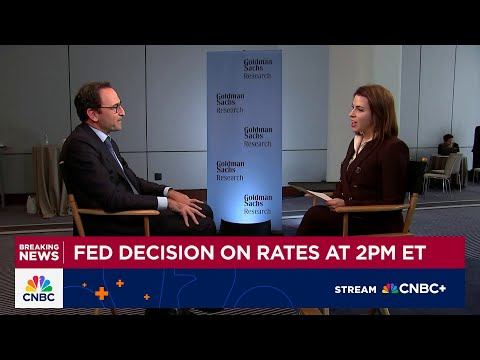
We're seeing pretty good macro environment, says Blackstone's Jonathan Gray
CNBC Television· 2025-12-10 19:20
over at Goldman's 36th annual financial services conference underway in New York City. You've seen great content from there over the past day or so. Leslie Picker is there now joined exclusively by Blackstone President and COO Jonathan Gray.Perfect timing as we're about to hear from the Fed. Leslie, over to you. >> Perfect timing indeed.Kelly. John, thank you so much for joining us. As Kelly mentioned, it's a great day to have you and get your perspective really on the macro.I'm just curious what you're see ...