量子科技

Search documents
一财主播说 | 十六条措施出台!陕西推动主业不突出国企上市公司重组 陕西国资股走强
Di Yi Cai Jing· 2025-11-27 06:37
Core Viewpoint - The news highlights the strengthening of Shaanxi state-owned stocks, particularly the surge in Xi'an Catering, following the introduction of 16 measures by the Shaanxi provincial government aimed at deepening capital market reforms to support high-quality development in the region [1] Group 1: Policy Measures - The Shaanxi provincial government has introduced 16 measures to enhance capital market reforms, focusing on supporting high-quality development [1] - Key measures include promoting major asset restructuring for state-controlled listed companies with poor operational efficiency [1] - The government aims to establish a stable, timely, and predictable cash dividend mechanism for listed companies, encouraging higher levels and frequencies of cash dividends [1] Group 2: Market Management - Listed companies are encouraged to conduct compliant market value management, utilizing share buybacks and other methods to enhance reasonable valuation levels [1] - The focus is on critical sectors such as new generation information technology, artificial intelligence, aerospace, new energy, new materials, high-end equipment, biomedicine, and quantum technology [1] - The government supports quality A-share listed companies to achieve secondary listings on the Hong Kong Stock Exchange in an "A+H" share format [1]


全球接单!竞逐量子科技,武汉优势何在
Chang Jiang Ri Bao· 2025-11-26 09:33
Core Insights - The article highlights the significance of quantum technology in China's future industrial layout, with a focus on its applications in various sectors such as electricity, finance, and healthcare [1][2]. Group 1: Quantum Technology Developments - The year 2025 is designated as the "International Year of Quantum Science and Technology" by UNESCO, marking a pivotal moment for quantum technology [1]. - Wuhan has made significant advancements in quantum computing, quantum communication, and quantum precision measurement, including the commercial application of the first domestic atomic quantum computer, "Han Yuan 1," which has secured over 40 million yuan in orders [2][3]. - The city has established a quantum secure communication metropolitan network and the world's first quantum secure communication subway line, showcasing its leadership in quantum technology [2]. Group 2: Industrial Growth and Support - Wuhan is emerging as a hub for quantum technology, with 49 related companies, including Changjiang Quantum and Zhongke Kuyuan, contributing to its rapid development [3][4]. - The city benefits from a strong foundation in the optoelectronic information industry, which supports the integration of quantum technology with existing industries [3]. - To foster the growth of the quantum technology sector, Wuhan has implemented various policies, including a three-year action plan and specific measures to support entrepreneurship and talent cultivation [4].
望城区“十四五”答卷|全区规模工业增加值年均增长8.8%以上
Chang Sha Wan Bao· 2025-11-26 08:53
Core Insights - Changsha's Wangcheng District is focusing on high-quality industrial development, with an average annual growth rate of over 8.8% in industrial added value during the 14th Five-Year Plan period [1] - The total industrial output value has surpassed 100 billion yuan, with industrial added value accounting for 32.4% of GDP and industrial tax revenue making up 37.8% of total tax revenue, reflecting significant improvements from the previous five-year plan [1] Group 1: Structural Optimization - The district is optimizing its industrial structure, with advanced manufacturing in new materials and food medicine as key sectors. The advanced manufacturing industry has exceeded 50 billion yuan, becoming a provincial-level cluster [3] - Emerging industries are thriving, with over 100 companies in the smart terminal sector, led by BYD Electronics, and a complete industrial chain in advanced energy storage represented by companies like Jinch Energy and Yongshan Lithium [3] - Wangcheng is proactively laying out future industries, establishing high-energy platforms in AI, quantum technology, and life sciences, attracting over 50 innovation projects and teams [3] Group 2: Innovation Promotion - A significant increase in innovation entities has been noted, with 3 national champions, 21 "little giant" companies, and 185 provincial-level specialized and innovative SMEs added, marking a 2.4-fold increase from the previous five-year period [4] - Numerous innovation platforms have been established, including 9 national laboratories and 13 academic workstations, alongside breakthroughs in key technologies such as 5G base station modules and large-scale energy storage [4] - The district has led the formulation of over 10 national standards and 70 industry standards, showcasing its commitment to innovation [4] Group 3: Comprehensive Transformation - Wangcheng is advancing towards intelligent, green, and international development, with a notable increase of 271 companies undergoing digital transformation since the last five-year plan [4] - The promotion of green manufacturing has led to the establishment of 22 national-level green factories, a fivefold increase from the previous period, and 72 provincial-level green factories [4] - Over 100 companies have entered international markets, with products like luxury yachts and electrical equipment being exported globally [5]

中国首个规模化专用光量子计算机制造工厂落地深圳
Zhong Guo Jing Ji Wang· 2025-11-26 07:03
Core Insights - The inauguration of China's first large-scale dedicated optical quantum computer manufacturing facility marks a significant step in the country's quantum technology development, transitioning from laboratory principles to industrial applications [1][2] - The facility, covering approximately 5,000 square meters, is capable of producing dozens of dedicated optical quantum computers annually, filling a global manufacturing gap in this field [1][3] Group 1: Technological Advancements - The team has made continuous breakthroughs in key technologies such as coherent light sources, low-loss optical paths, and high-speed measurement and control, establishing a fully autonomous optical quantum computing engineering system [2] - The successful implementation of this manufacturing facility is a physical manifestation of these technological capabilities, emphasizing that the real value lies in practical applications [2] Group 2: Collaborative Efforts - The company has engaged in deep collaborations with various partners, including Guangzhou National Laboratory, China Mobile, and Ping An Group, to validate the efficiency and quality advantages of optical quantum computers in different scenarios [2] - The supportive business environment in Shenzhen, characterized by innovation and efficiency, has encouraged the company to establish its primary manufacturing base there [2] Group 3: Manufacturing Process - The facility integrates research and development, manufacturing, and testing, aiming for engineering, standardization, and large-scale production of optical quantum computers [3] - It features a clean production area designed to maintain quantum state stability, supported by a five-layer guarantee system including personnel purification and air cleanliness [3] - The manufacturing process consists of seven major processes, 223 procedures, and over 1,000 operational steps, ensuring a highly integrated and precise assembly line for quantum computing [3]
国盾量子:拟与中科大续签5份专利实施许可合同
Zhong Guo Zheng Quan Bao· 2025-11-26 01:49
Core Viewpoint - GuoDun Quantum (国盾量子) plans to renew five expired patent licensing agreements with the University of Science and Technology of China (USTC), covering seven patents and five proprietary technologies, with varying royalty rates based on technology fields [2][4]. Group 1: Licensing Agreements - The company will pay licensing fees based on a percentage of the net profit from products produced using the licensed technologies, with rates set at 50%, 30%, and 25% depending on the technology area [2][3]. - The licensing agreements have a duration of three years and involve advanced technology fields such as cold atom interferometry, single-photon detection, and quantum computing control [2][3]. Group 2: Patent Details - The first contract involves a dual laser system for precision measurement using cold atom interferometry, with a royalty rate of 50% [3]. - The second contract pertains to a single-photon detection system with a royalty rate of 30% [3]. - The third contract covers a single-photon laser radar 3D imaging system with a royalty rate of 25% [3]. - The fourth contract relates to integrated control devices for quantum computing, also with a 25% royalty rate [3]. - The fifth contract involves a system for modulating superconducting qubit transition frequencies, with a 25% royalty rate [3]. Group 3: Company Background and Financials - USTC, a leading institution in quantum technology, holds over 5% of GuoDun Quantum's shares through its wholly-owned subsidiary, making this transaction a related party transaction [2][4]. - The company emphasizes that this transaction is part of its normal business operations and aligns with its main business and development direction, asserting it will not significantly impact its independence or financial results [4]. - In the first three quarters, GuoDun Quantum achieved a total revenue of 190 million yuan, representing a year-on-year growth of 90.27% [4].

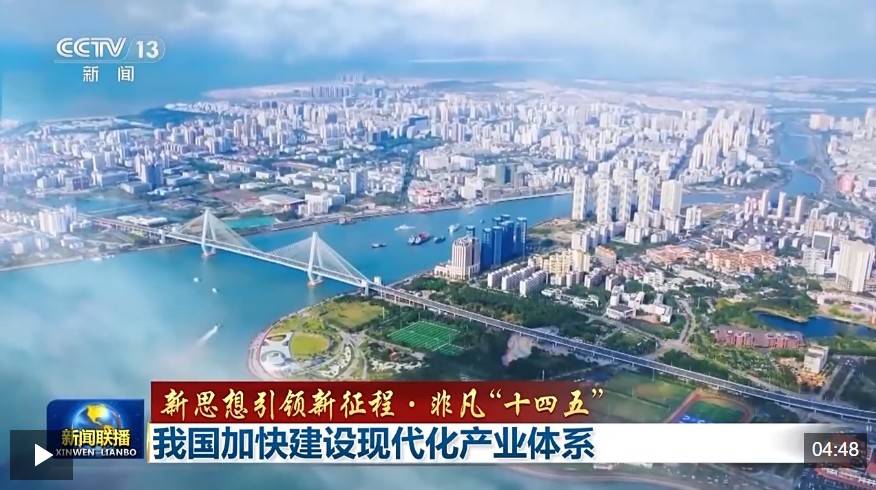
新思想引领新征程·非凡“十四五”丨我国加快建设现代化产业体系
Yang Shi Xin Wen Ke Hu Duan· 2025-11-26 01:21
Core Insights - The construction of a modern industrial system is emphasized as a material and technological foundation for a modernized nation, with a focus on the real economy to support the second centenary goal [2] - The "14th Five-Year Plan" period aims to accelerate the establishment of a modern industrial system driven by technological innovation and rooted in the real economy [2] Group 1: Industrial Development - The Yangtze River Delta's industrial internet platform processes 20,000 data sets every minute, with a refrigerator rolling off the production line every eight seconds [4] - In the eastern coastal bonded zones, cross-border data flows enable verification and customs clearance in just one second, facilitating rapid global distribution of Chinese manufacturing [6] - The Pearl River Delta's lighthouse factories offer 100,000 personalized options for customizing a car, showcasing advanced manufacturing capabilities [7] Group 2: Government Initiatives and Leadership - President Xi Jinping has consistently highlighted the importance of a modern industrial system supported by the real economy, making significant directives on its construction [9] - The modern industrial system reflects changes in industrial structure, development dynamics, and factor relationships, aligning with the context of Chinese-style modernization [11] Group 3: Progress and Achievements - In 2023, the construction of the modern industrial system has accelerated, with over 80% of steel companies establishing intelligent control centers and more than half of coal production capacity achieving digital mining [13] - The manufacturing sector remains the largest in the world, with over 10,000 provincial-level digital workshops and smart factories established, and 6,430 national-level green factories operational [14] - The first batch of leading smart factories has been announced, covering various sectors including steel and consumer goods, aiming to explore new manufacturing models [15] Group 4: Emerging Technologies and Economic Growth - In the first three quarters of the year, the value added of high-tech manufacturing increased by 9.6%, with industrial robot production rising nearly 30% and drone sales revenue growing by almost 70% [19] - The continuous optimization of industrial structure and the increasing proportion of high-tech and strategic emerging industries are driving high-quality economic development [21] Group 5: Future Planning - Regions are actively planning for the "15th Five-Year Plan," with Hunan Province allocating 50 billion yuan to support 1.89 million small and medium-sized enterprises, focusing on key industrial chains [23] - The "15th Five-Year Plan" emphasizes the construction of a modern industrial system and the strengthening of the real economy as primary strategic tasks [23]
国际固态量子计算研讨会在太湖科学城功能片区举行
Su Zhou Ri Bao· 2025-11-26 00:38
昨天(11月25日),第十二届国际固态量子计算研讨会在太湖科学城功能片区举行。 本次研讨会由南京大学、香港大学、华南师范大学、粤港澳大湾区量子科学中心联合承办。会议通 过高水平学术研讨、前沿成果分享、跨学科交流对话等形式,搭建国际化学术交流平台,构建开放协同 的全球量子计算创新生态。 作为太湖科学城功能片区建设环南大科创圈的重要组成部分,研讨会将充分发挥南京大学等高校科 研资源的优势,推动创新要素集聚融合,为太湖科学城功能片区打造量子科技产业高地奠定坚实基础, 进一步深化国际学术合作。 太湖科学城功能片区是苏州高新区创新发展的核心引擎,太湖光子中心、环南大科创圈等重大战略 部署在此落地,南京大学苏州校区、中国科学院苏州医工所等一批重量级大院大所在此集聚,海内外各 类高层次和专业人才有2万余人,国家重点人才有140人,上市公司12家,构建起从基础研究、应用开发 到产业转化的全链条创新体系。尤其在量子科技领域,该功能片区与南京大学深度携手共建狮山量子计 算与量子探测前沿实验室,吸引相关企业落地生根,形成创新要素富集、产业生态完善的良好格局。 ...
我国加快建设现代化产业体系
Yang Shi Xin Wen· 2025-11-26 00:27
今年以来,我国现代化产业体系建设跑出"加速度"、不断焕发"新活力"。传统产业高端化、智能化转型 成效显著,超过八成的钢铁企业建成智能集控中心,一半以上的煤炭产能实现数字化开采,纺织行业重 点企业的关键工序数控化率超过了60%。 就在不久前,代表我国制造业最高水准的首批领航级智能工厂培育名单正式对外公布。这份涵盖了钢 铁、石化、消费品和装备制造等多个领域的名单,将率先探索全球敏捷定制等特色制造新模式。 广袤大地,中国产业新动能处处涌动着蓬勃生机。 长三角的工业互联网平台上,每分钟2万组数据在数字孪生系统实时流动调度,平均8秒就有一台冰箱下 线奔向全国各地。 同一时刻,珠三角的灯塔工厂里,订制一辆汽车有十万种个性化选装方案、一百多个颜色实时切换。 东部沿海的保税园区,跨境数据高速奔涌,仅一秒钟就能完成一单核验通关,让中国制造沿着数字导航 快速通达全球。 习近平总书记始终高度重视以实体经济为支撑的现代化产业体系建设,多次深入工厂车间、走进生产一 线,围绕现代化产业体系建设作出一系列重要指示。他强调,要打造自主可控、安全可靠、竞争力强的 现代化产业体系;加快构建具有智能化、绿色化、融合化特征和符合完整性、先进性、安全 ...
11月26日热门路演速递 | AI革命、10亿机器人、量化择时……理想汽车千亿现金如何布局未来?
Wind万得· 2025-11-25 22:40
Group 1 - The core focus of the China Galaxy Securities annual strategy conference is the transition to new productive forces, with artificial intelligence expected to be a key driver in 2026 [2] - The conference will feature macroeconomic scholars and industry experts discussing investment themes, particularly in AI, new energy, and quantum technology [2] - The event aims to unlock wealth opportunities for the start of the 14th Five-Year Plan [2] Group 2 - The CICC Quantitative and ESG team will provide authoritative insights into the 2026 quantitative strategy outlook, focusing on timing signals and practical applications of options volatility [5] - The session will share cutting-edge quantitative timing models to help accurately gauge market rhythms [5] Group 3 - UBS's outlook for 2026 discusses the potential reality of humanoid robots once technical and regulatory barriers are removed, highlighting the implications for the industry and what investors need to know [7] - The session will feature insights from UBS's research leaders in Taiwan and China [7] Group 4 - The CITIC Construction Investment report will explore how the electric new energy, military industry, and building materials sectors will evolve in the new cycle leading into 2026 [10] - It will discuss the impact of global energy storage growth and the AI electricity revolution on the electric new energy sector, as well as military trade and digital transformation in the building materials industry [10] Group 5 - Li Auto's Q3 2025 earnings call will address challenges related to slower responses compared to competitors and the potential of the i6 electric model to set new standards in the mid-to-large 5-seat SUV market [12] - The discussion will also cover the self-developed VLA large model and driver assistance chip's role in enhancing product capabilities, alongside the company's cash reserves supporting its technology breakthroughs and international expansion strategy [12]

【公告全知道】谷歌+芯片+CPO+数据中心+算力!这家公司在数据运营商方面客户包括谷歌
财联社· 2025-11-25 15:45
Group 1 - The article highlights the importance of major announcements in the stock market, including suspensions, investments, acquisitions, performance reports, and stock splits, which are marked in red for easy identification [1] - Companies mentioned include one that serves Google as a data operator and focuses on chip technology, particularly in high-end micro-optical connections [1] - Another company is noted for its solid-state battery and energy storage solutions, having signed agreements with leading lithium battery firms to increase market share in new energy materials [1]