
关键矿产

Search documents
“刚果(金)与美国若达成矿产协议,可能触怒中国”
Guan Cha Zhe Wang· 2025-05-21 08:17
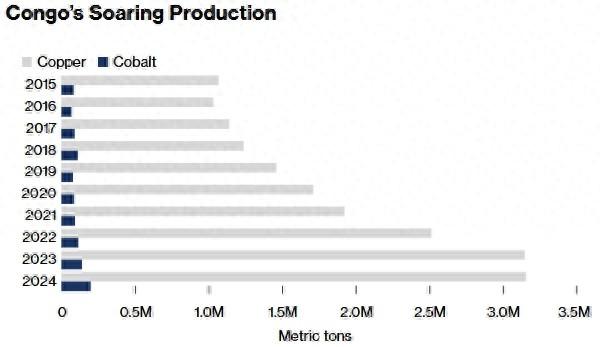
Group 1 - The Democratic Republic of the Congo (DRC) implemented a four-month cobalt export ban in late February to boost declining cobalt prices, with signals of potential further tightening of export policies as the ban nears its end [1][11] - DRC President Tshisekedi aims to transform the country from a mere commodity supplier to a key player in the strategic mineral refining value chain [1] - Analysts view Tshisekedi's strategy as a "high-risk gamble," attempting to attract external investors while maintaining relations with China, which has significant investments in DRC's mining sector [1][2] Group 2 - The U.S. has expressed interest in a mineral share deal with DRC, which could provoke China, as the DRC's copper and cobalt exports account for approximately 40% of its GDP [2] - The bilateral trade volume between China and DRC is projected to reach nearly $27 billion in 2024, while U.S.-DRC trade is only $820 million [2] - The DRC's mining sector has seen significant growth, with copper production expected to triple and cobalt production increasing similarly, largely due to Chinese investments [2][6] Group 3 - The U.S. is facing challenges in entering the DRC's mining sector, as China has established a dominant position over decades, making any U.S. attempts to penetrate the market difficult [6][7] - Chinese companies have built a comprehensive business ecosystem in DRC's copper and cobalt industries, overcoming challenges such as corruption and poor infrastructure [6][7] - The speed of Chinese enterprises in developing mining projects has outpaced Western companies, with the largest cobalt mine, Kisanfu, being operational in just over two years [7] Group 4 - DRC's cobalt export ban may be lifted in late June, but there are indications that the country may continue to tighten export policies, potentially leading to a loss of up to $400 million if the ban extends to the end of the year [11] - DRC is considering long-term price control measures, including export quotas, to ensure that the mining sector develops sustainably and benefits the local population [11]

与乌签署矿产协议的背后,美国挖空心思寻找关键矿源
Di Yi Cai Jing· 2025-05-01 14:32
Group 1 - The U.S. has a long-term reliance on imports for critical mineral resources, which has led to increased resource acquisition costs for related manufacturing due to "reciprocal tariffs" [1] - A new agreement has been signed between Ukraine and the U.S. to establish the U.S.-Ukraine Reconstruction Investment Fund, aimed at investing in mining, oil, gas projects, and related infrastructure [1] - Ukraine holds a significant position in the global mineral resource supply chain, with over 8,000 identified mineral deposits and 22 out of 50 critical minerals listed by the U.S. [2] Group 2 - The U.S. Department of Energy has included 50 types of mineral products in its critical minerals list for 2023, with a significant portion of these being heavily reliant on imports [2] - A trade investigation has been initiated by the Trump administration to assess the impact of imported critical minerals on national security, which may lead to the imposition of tariffs [3]
4月10日电,美国国务卿鲁比奥与乌兹别克斯坦外长讨论了关键矿产问题。
news flash· 2025-04-09 21:37
Core Viewpoint - The discussion between U.S. Secretary of State Rubio and the Uzbek Foreign Minister focused on critical mineral issues, highlighting the importance of these resources in geopolitical and economic contexts [1] Group 1 - The meeting emphasizes the strategic significance of critical minerals for both the U.S. and Uzbekistan [1] - The dialogue reflects ongoing efforts to strengthen bilateral relations and cooperation in resource management [1]