三位一体战略

Search documents
海尔泰国总经理:家电出海的下半场是做强品牌和中高端
21世纪经济报道· 2025-12-29 10:30
Core Viewpoint - The article highlights Haier's successful growth in the Thai market despite a challenging international trade environment, emphasizing the importance of brand recognition, local adaptation, and innovative product offerings [1][11]. Group 1: Market Performance - Haier's overseas market revenue grew by 10.5% in the first three quarters of 2025, with Southeast Asia seeing over 15% growth [1]. - In the Thai white goods market, while the overall market declined by 4.9%, Haier's white goods sales increased by 29%, making it the leading brand in Thailand [1][5]. Group 2: Strategic Development - Haier entered the Thai market in 2002, initially facing challenges due to low brand awareness and product mismatch with local needs. The turning point came in 2007 with the acquisition of Sanyo's white goods division, allowing for a localized strategy [5]. - The company has adopted a "three-in-one" localization strategy involving research, manufacturing, and marketing, which has proven successful in establishing its market position [5][12]. Group 3: Future Opportunities - There remains significant potential in the Thai market, particularly through deeper understanding of user needs and enhancing operational efficiency. Haier aims to improve its market share in retail stores and expand its service network [6][12]. - The company plans to continue focusing on high-end product lines while also penetrating lower-tier markets, ensuring comprehensive coverage across Thailand [8]. Group 4: Brand Perception - Consumer perceptions of Chinese brands are shifting from "value for money" to recognizing the technological advancements and differentiated product offerings, with Haier's brand awareness now on par with Korean brands [9]. - Haier's ability to quickly adapt and introduce new technologies gives it a competitive edge over traditional brands with longer product iteration cycles [9]. Group 5: Supply Chain and Local Adaptation - Haier's strategic investments in local manufacturing, such as the new air conditioning factory in Chonburi, enhance its supply chain resilience and ability to meet local demand [11]. - The company emphasizes the importance of being "In Thailand, For Thailand," which is crucial for establishing a strong foothold in the local market [12].



兴业期货:三位一体构建全链条客户服务体系
Qi Huo Ri Bao Wang· 2025-11-17 01:31
Core Insights - The company has participated as a designated trader in the national futures (options) trading competition for the fourth consecutive year, showcasing its unique differentiated service capabilities as a bank-affiliated futures company [1][2]. Differentiated Development Strategy - The company integrates its "banking" gene into its development framework, leveraging the resources, funding advantages, risk control systems, and research capabilities of its parent bank, creating a comprehensive service system covering various financial instruments [1]. - The company has received multiple awards, including "Most Growth-Oriented Futures Company" and "Best Financial Futures Service Award," reflecting market recognition of its professional capabilities [1]. Talent Development and Asset Management - The competition serves as a platform to connect market participants and showcase the company's comprehensive service strength, while also identifying quality investment advisory resources for its asset management business [2]. - The company has introduced an innovative "in-competition" incentive mechanism, integrating educational courses and one-on-one advisory services to enhance client engagement [3]. - A whitelist of investment advisors and connections to asset management products are established to create professional development pathways for outstanding trading talents, enriching the company's asset management capabilities [3]. Risk Management Framework - The company has developed a comprehensive risk management system aligned with banking standards, utilizing a big data risk control platform for cross-market monitoring and tailored risk management solutions for different client groups [4]. - During market fluctuations, the company emphasizes high-leverage and high-frequency trading monitoring, employing digital tools to interpret unexpected events and establish a complete risk management chain [4]. Technological Empowerment - The company has built a full-chain technology empowerment system, supporting mainstream trading interfaces and providing advanced tools such as AI research and high-speed market data [5][6]. - The company is exploring how banking technology resources can be applied in the futures sector to address long-standing efficiency challenges, transitioning from experience-driven to data-driven trading [6]. Market Trends and Future Outlook - The company anticipates a shift in the domestic futures market from scale expansion to functional deepening, with an increasing proportion of institutional investors and greater roles for AI technology in trading and risk management [7]. - The company encourages ordinary investors to leverage the comprehensive financial services of bank-affiliated futures companies, integrating futures into their overall asset allocation framework for stable returns [7].
“三位一体”战略成效显著 分拆业务焕发活力
Zheng Quan Shi Bao· 2025-09-02 12:55
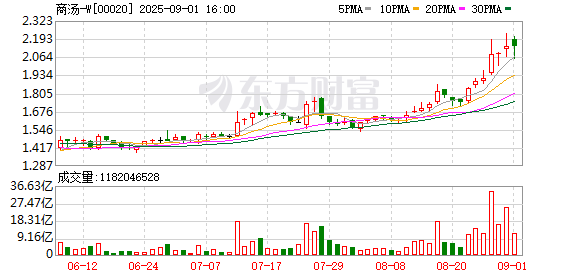
Core Viewpoint - SenseTime's generative AI business has shown significant growth, with revenue reaching approximately 1.816 billion yuan in the first half of the year, marking a year-on-year increase of 72.7% and accounting for 77% of total revenue [1][2] Group 1: Financial Performance - The company's revenue increased by 35.6% year-on-year, while the adjusted net loss decreased by 50% [2] - Generative AI's contribution to total revenue rose from 64% in 2024 to 77% in the first half of this year, indicating a strong focus on this segment [2] Group 2: Strategic Framework - SenseTime has adopted a "1+X" framework, where "1" represents core businesses like generative AI and computer vision (CV), and "X" includes potential high-growth businesses in vertical industries [3][5] - The "1+X" strategy aims to shift from a fragmented pricing model to a holistic delivery approach, enhancing customer experience and value [3] Group 3: Market Position and Competitive Advantage - SenseTime holds a leading position in the Chinese computer vision market with a 22.8% market share, marking its ninth consecutive year at the top [4] - The company has successfully exported CV technology to Japan, showcasing its technological leadership [4] Group 4: Future Outlook - The "X" businesses are expected to operate independently and may eventually seek external investment or even go public, enhancing their operational agility [5][6] - SenseTime plans to leverage its generative AI and visual AI capabilities as dual engines for growth, aiming to create sustained value for employees, customers, and shareholders [6]

11年AI长跑迎收获期!商汤“三位一体”战略成效显著|洞见价值·港股新质生产力巡礼
Zheng Quan Shi Bao· 2025-09-02 00:12
Core Viewpoint - SenseTime's generative AI business has shown significant growth, with revenue reaching approximately 1.816 billion yuan in the first half of the year, marking a year-on-year increase of 72.7% and accounting for 77% of total revenue [1][2]. Group 1: Financial Performance - The company's revenue increased by 35.6% year-on-year, while the adjusted net loss decreased by 50% [2]. - Generative AI's contribution to total revenue rose from 64% in 2024 to 77% in the first half of this year, indicating a strong focus on this segment [2]. Group 2: Strategic Framework - SenseTime has adopted a "1+X" new structure, where "1" represents core businesses like generative AI and computer vision (CV), and "X" includes potential high-growth businesses in vertical industries [3][5]. - The "three-in-one" strategy integrates large models and applications, moving away from the fragmented pricing model of the past [3]. Group 3: Market Position and Competitive Advantage - SenseTime holds a 22.8% market share in China's computer vision sector, maintaining its position as the market leader for nine consecutive years [4]. - The company has successfully exported CV technology to Japan, showcasing its international recognition [5]. Group 4: Future Outlook - The "X" businesses are expected to operate independently and seek external investment, with the potential for future IPOs [5][6]. - SenseTime aims to leverage generative AI and visual AI as dual engines for growth, focusing on creating long-term value for employees, customers, and shareholders [6].
11年AI长跑迎收获期!商汤“三位一体”战略成效显著|洞见价值·港股新质生产力巡礼
证券时报· 2025-09-02 00:05
Core Viewpoint - SenseTime has entered a harvest period in its generative AI business, achieving significant revenue growth and a higher proportion of income from this segment, indicating a strong market position and strategic focus on sustainable profitability [1][5]. Group 1: Financial Performance - In the first half of the year, SenseTime's generative AI business generated approximately 1.816 billion yuan, a year-on-year increase of 72.7%, with its revenue share rising from 60.4% to 77% [1][4]. - The overall revenue growth for SenseTime was 35.6%, while the adjusted net loss decreased by 50% compared to the previous year [5]. Group 2: Strategic Direction - SenseTime's "1+X" new structure supports its performance, where "1" represents core businesses like generative AI and computer vision (CV), and "X" includes potential high-growth businesses in vertical industries [7][11]. - The "three-in-one" strategy focuses on integrating large models and applications, moving away from fragmented pricing models to a more cohesive delivery approach [7][8]. Group 3: Market Position and Competitive Advantage - SenseTime holds a leading position in the Chinese computer vision market with a 22.8% market share, marking its ninth consecutive year at the top [8]. - The company has successfully exported its CV technology, establishing itself as a pioneer in the international market [9]. Group 4: Future Outlook - SenseTime aims to leverage both generative AI and visual AI as dual engines for growth, focusing on creating long-term value for employees, customers, and shareholders [12]. - The company is fostering a culture of entrepreneurship within its "X" businesses, encouraging innovation and independent operations while maintaining support from the parent company [11][12].

商汤11年AI长跑迎收获期 “三位一体”战略成效显著 分拆业务焕发活力
Zheng Quan Shi Bao· 2025-09-01 18:43
Core Viewpoint - SenseTime has entered a harvest period in its generative AI business, achieving significant revenue growth and a higher proportion of income from this segment, indicating a strong market position and strategic focus on sustainable profitability [2][3]. Financial Performance - In the first half of the year, SenseTime's generative AI business generated approximately 1.816 billion yuan, a year-on-year increase of 72.7%, with its revenue share rising from 60.4% to 77% [2]. - The overall revenue growth for the company was 35.6%, and the adjusted net loss decreased by 50% compared to the previous year [3]. Strategic Framework - SenseTime's performance is supported by its "1+X" new structure and the "three-in-one" strategy, which integrates large models and applications [4][5]. - The "1" in the "1+X" structure represents core businesses, including generative AI and computer vision (CV), while "X" encompasses potential high-growth businesses that may take longer to become profitable [6]. Market Position - SenseTime holds a leading position in the Chinese computer vision market with a 22.8% market share, marking its ninth consecutive year at the top [6]. - The company has successfully exported its CV technology, establishing itself as a pioneer in the field [6]. Business Model Evolution - The shift from a fragmented pricing model to a holistic delivery approach aims to enhance customer experience and control costs, aligning with the trend of integrated large model capabilities [5]. - The "X" businesses are designed to operate independently, allowing for external investment and potential future public listings, which could enhance their operational efficiency and financial performance [7]. Future Outlook - SenseTime plans to leverage both generative AI and visual AI as dual engines for growth, aiming to capitalize on the historical opportunities presented by generative AI while maintaining its leadership in visual AI [8].