三明模式

Search documents
北京大学教授李玲:发展“健康+”新范式 开启全球产业新蓝海
Zhong Guo Jing Ji Wang· 2026-01-16 07:13
Core Viewpoint - China is transitioning from a "disease-centered" approach to a "people's health-centered" model, aiming to improve public health and reduce illness [1][3]. Group 1: Health System Reform - The Chinese government is implementing systematic reforms in the healthcare service system, focusing on integrated management of rural healthcare institutions [3]. - The payment system is being reformed, with health insurance funds being allocated to "health communities," linking hospital and physician income to residents' health levels [3]. - The "health community" model, known as the "Sanming Model," is being promoted nationwide, with a goal of achieving full coverage within four years [3]. Group 2: New Development Opportunities - The health sector in China faces challenges such as an aging population but also presents new development opportunities [4]. - The country is entering a "health+" development phase, integrating various industries such as healthcare, pharmaceuticals, green food, wellness, and smart health to create a new health industry covering the entire life cycle [4]. - The demand for this new health industry is continuous and substantial, serving both domestic needs and potential global markets [4]. Group 3: Innovation and Technology - China is leveraging the integration of agriculture, industry, commerce, and information technology to drive innovation in the health sector [4]. - With the empowerment of artificial intelligence and new production capabilities, the country aims to achieve comprehensive health management through platforms like personal health codes and health information networks [4]. - The integration of systematic, informational, and intelligent approaches is expected to create a high-quality, low-cost, and scalable health system [4].

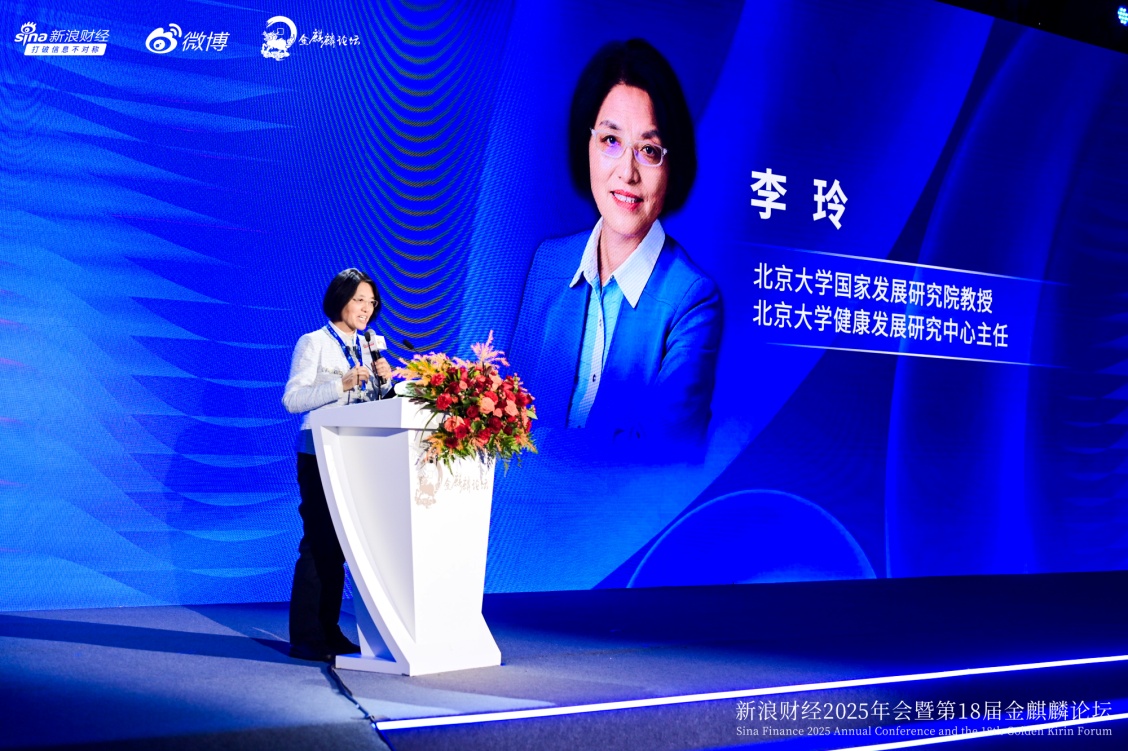
全文|北京大学国发院李玲:健康中国、智慧健康将是我国新的发展模式、新的蓝海
Xin Lang Cai Jing· 2026-01-15 08:35
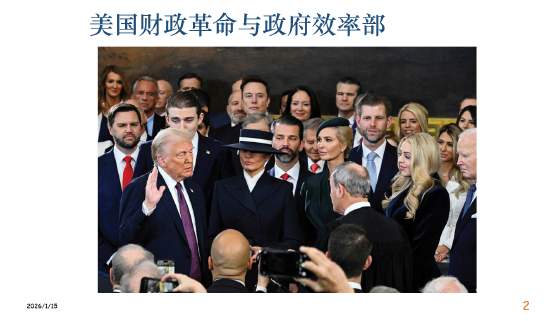
Group 1 - The forum "Sina Finance 2025 Annual Conference and the 18th Golden Unicorn Forum" will be held on January 15, 2026, in Beijing, focusing on the theme of "The 14th Five-Year Plan Starts, Economic New Voyage - Reshaping Growth Paradigms, Creating Future Prosperity" [1][31] - Li Ling, Deputy Director of the Economic Committee of the 13th National Committee of the Chinese People's Political Consultative Conference, will deliver a speech on "Pension and Health Red Power, Reform of Medical and Health Systems from a Global Comparative Perspective" [2][32] Group 2 - The U.S. national debt has exceeded $38 trillion, and the fiscal situation is deteriorating, which is a fundamental reason for the country's decline [5][36] - In 2025, U.S. fiscal revenue is projected to be $5.235 trillion, with major expenditures including Medicare and Medicaid, which together exceed $1.6 trillion, making healthcare the largest expenditure item [6][7][37] - The U.S. healthcare expenditure as a percentage of GDP has surpassed its industrial value-added percentage, indicating a decline in industrial competitiveness due to high healthcare costs [10][40] Group 3 - China's healthcare expenditure as a percentage of GDP has dropped below 7% for the first time in 2024, while industrial value-added remains high, showcasing effective healthcare reforms [13][43] - The aging population poses significant challenges, with over 300 million people aged 60 and above in China, leading to increased healthcare demands [14][43] - The "Healthy China National Strategy" prioritizes health development, shifting from a disease-centered approach to a health-centered one, emphasizing prevention and investment in health [19][48] Group 4 - The government is promoting a "Three Ming Model" for healthcare, integrating county, township, and village healthcare systems to incentivize health management rather than treatment [23][52] - The new "Health+" development paradigm aims to integrate healthcare, medicine, green food, wellness, and elderly care into a large health industry, which is expected to exceed the real estate sector in scale [25][55] - The future model of "Healthy China" will utilize AI and digital technologies for comprehensive health management throughout individuals' lifecycles [28][58] Group 5 - The integration of traditional Chinese wisdom with industrialization and information technology is seen as a unique opportunity for China to contribute to global health solutions [29][59]
李玲详解“三明模式”:让医院“老百姓越健康越赚钱”而非“病人越多越赚钱”
Xin Lang Cai Jing· 2026-01-15 04:23
Group 1 - The core theme of the "2025 Sina Finance Annual Conference and the 18th Golden Unicorn Forum" is "Fifteen Five Opening, Economic New Voyage - Reshaping Growth Paradigms, Co-creating Future Prosperity" [1][12] - Li Ling, a prominent figure in the economic committee, emphasized that China is currently the world's strongest industrialized nation and has made significant progress in healthcare reform [3][14] - The total national health expenditure for 2024 is preliminarily estimated at 90,895.5 billion yuan, with government health spending at 24.9%, social health spending at 47.6%, and personal health spending at 27.5% [3][14] Group 2 - The aging population presents a significant challenge, necessitating a shift from treating diseases to preventing them [6][17] - The "Healthy China" national strategy is prioritized as it signifies the modernization of socialism, focusing on health rather than illness [7][18] - The government is integrating health into all policies, addressing various factors affecting health, including lifestyle, environment, and healthcare systems [7][18] Group 3 - The healthcare system is transitioning to a more integrated model, promoting a "health community" approach where hospitals work collaboratively rather than independently [7][19] - The "Sanming Model" is being promoted nationwide within four years, incentivizing healthcare providers to focus on disease prevention [7][19] - The aging population also presents opportunities for a new "health+" development paradigm, merging healthcare, wellness, and technology into a large health industry [8][19] Group 4 - The future health model includes a personal health code system managed by AI, ensuring comprehensive health management throughout an individual's life [10][21] - The "Healthy China" initiative is seen as a new development model and a significant contribution to global health, leveraging China's historical wisdom and modern technology [10][21] - The challenges faced by the U.S. in healthcare present an opportunity for China to lead in health solutions, integrating various advantages to contribute to global health [10][22]

三明人均GDP居全国20个革命老区重点城市第二位
Xin Lang Cai Jing· 2025-12-19 23:34
Core Viewpoint - The news highlights the economic and social development of Sanming City during the 14th Five-Year Plan period, emphasizing its achievements in various sectors and the strategic direction for the upcoming 15th Five-Year Plan. Economic Development - During the 14th Five-Year Plan, Sanming's per capita GDP exceeded 125,000 yuan, ranking second among 20 key revolutionary old districts in China [1] - The city has been approved as the first cross-strait rural integration development experimental zone in the country [1] - Sanming's urban brand index improved to 32nd nationally, advancing 6 places since 2021 [1] Industrial Growth - Sanming has focused on revitalizing its old industrial base, with 11 city-level characteristic industrial chains and 55 specialized projects each exceeding 1 billion yuan initiated [2] - New industries, such as fluorine new materials, have maintained double-digit growth annually [2] - The city has seen a 18% reduction in energy consumption per unit of GDP since the beginning of the 14th Five-Year Plan [2] Innovation and Talent - Sanming has established a robust innovation framework supported by partnerships with universities and research institutions, including the establishment of expert teams to drive integration of innovation, industry, finance, and talent [3] - The city has signed 98 industrial project agreements with a total investment of 53.26 billion yuan through cooperation with Shanghai [3] Healthcare Reform - Sanming has implemented over 40 national and provincial reform pilot projects, with its healthcare reform experience being promoted nationally [4] - The city aims to transition from a disease treatment model to a health management model, enhancing the quality and efficiency of medical services [4] Environmental Initiatives - Sanming has pioneered the "Two Mountains" transformation path, issuing 720 million yuan in forest tickets and developing a carbon trading platform with a transaction volume of 6.8 billion yuan [5] - The city has achieved a forest coverage rate of 77.12% and has been recognized as one of the "Green Cities" in China for four consecutive years [6] Tourism and Culture - Sanming has developed its cultural and tourism sectors, with a 45.7% increase in total tourism numbers and a 55% increase in total revenue during the 14th Five-Year Plan [6] - The city has successfully promoted its unique cultural heritage, leading to the establishment of national-level cultural parks and ecological protection zones [6] Social Welfare - Sanming has completed 164 practical projects for the public, with healthcare and elderly care facilities exceeding provincial averages [7] - The city plans to leverage its unique advantages to create new hubs for cross-strait integration and high-quality development in the upcoming 15th Five-Year Plan [7]
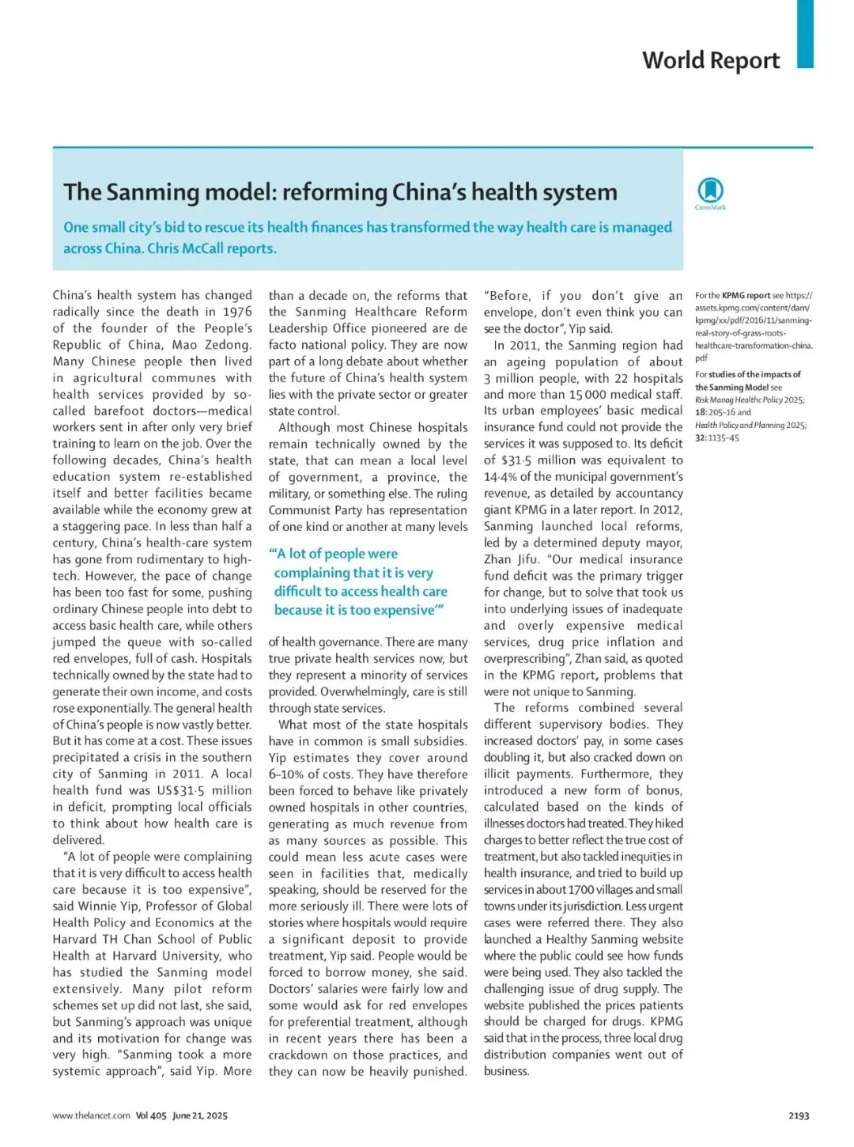
柳叶刀:三明模式正在引领中国卫生体系改革进程
Di Yi Cai Jing· 2025-07-11 00:35
Core Insights - The Sanming model serves as a successful example of healthcare reform in China, emphasizing transparency, restructuring the drug supply chain, and reforming the health insurance distribution mechanism, thus providing a "Chinese solution" for global healthcare reform [1][3][24] Healthcare System Background - China's healthcare system has evolved significantly since 1976, transitioning from rudimentary services to advanced healthcare, but rapid changes have led to increased costs and accessibility issues for ordinary citizens [4][6] - In 2011, Sanming faced a healthcare crisis with a local health fund deficit of $31.5 million, equivalent to 14.4% of the municipal government's revenue, prompting urgent reforms [10][21] Sanming Model Reforms - The Sanming reforms, initiated in 2012, aimed to address the healthcare fund deficit and underlying issues such as high medical costs and drug price inflation, leading to a systemic approach to healthcare delivery [10][11][22] - Key reforms included increasing doctors' salaries, implementing a new bonus system based on treated illnesses, and enhancing transparency through the "Healthy Sanming" website, which disclosed fund usage [11][24] Financial Outcomes - By 2015, the Sanming healthcare fund had turned from a deficit into a surplus of $19.5 million, demonstrating the effectiveness of the reforms [13][24] - The Chinese government has since recognized the Sanming model, encouraging other regions to adopt similar policies, particularly in health insurance innovation [13][24] Drug Supply Chain Transformation - The Sanming model introduced a two-invoice system for drug procurement, significantly reducing drug costs and eliminating excessive mark-ups in the supply chain, which has been replicated nationwide [15][25] - Between 2018 and 2022, the prices of 294 key drugs in China decreased by an average of 53% due to these reforms, while their quality improved [16][25] Broader Implications and Challenges - While the Sanming model has shown success in controlling costs and improving healthcare access, its applicability in larger cities like Shanghai and Beijing remains limited due to different healthcare dynamics [18][26] - Experts suggest that while some elements of the Sanming model can be adapted for densely populated areas, the overall model may not be easily transferable to all regions of China [19][20][26]