上游涨价

Search documents
纺织服装行业周报20260323:本周发布春季策略,看好上游涨价品种-20260323
Shenwan Hongyuan Securities· 2026-03-23 10:35
Core Insights - The report indicates a favorable outlook for the textile and apparel industry, particularly focusing on upstream price increases, midstream pressures, and downstream differentiation in 2026 [3][10][15] - The textile and apparel sector underperformed the market recently, with the SW textile and apparel index declining by 5.4% from March 16 to March 20, 2026, lagging behind the SW All A index by 1.3 percentage points [4][10] Industry Overview - Recent industry data shows that the retail sales of consumer goods in China reached 8.6 trillion yuan in January-February 2026, growing by 2.8% year-on-year. The retail sales of clothing, shoes, hats, and textiles totaled 283.1 billion yuan, with a year-on-year increase of 10.4% [33] - Exports of textiles and apparel from China amounted to 504.5 billion USD in January-February 2026, reflecting a year-on-year growth of 17.6%. In February alone, the export value was 224.4 billion USD, up 73.4% year-on-year [37] Upstream Market Dynamics - The report highlights a significant price increase in Australian wool, which has risen by 55% since the end of August 2025, driven by supply reductions and recovering demand. The Australian wool index was reported at 1246 cents per kilogram as of March 18, 2026 [10][45] - Domestic cotton prices showed a slight decline, with the national cotton price B index at 16,638 yuan per ton, down 0.7% for the week ending March 20, 2026. In contrast, international cotton prices increased, with the M index at 77 cents per pound, up 3.3% [42] Midstream and Downstream Insights - The midstream sports manufacturing sector is currently under pressure due to geopolitical uncertainties and demand fluctuations, but it is expected to experience new growth in the medium to long term. Key players like Nike are anticipated to initiate a new innovation cycle, benefiting the entire supply chain [11][16] - Li Ning's 2025 annual report showed a revenue increase of 3.2% to 29.6 billion yuan, driven by strong performance in professional categories. The company expects high single-digit revenue growth in 2026, with improved gross margins [12][19] Investment Recommendations - The report recommends focusing on upstream price-increasing products and the recovery of sports manufacturing. Companies such as Baolong Oriental and Shenzhou International are highlighted as potential investment opportunities [10][16] - In the apparel segment, there is a call to explore high-performance outdoor brands and social apparel, with recommendations for companies like Li Ning, Anta Sports, and Bosideng [17][19]

策略周报20251130:风格大切换,中盘蓝筹再崛起-20251130
Orient Securities· 2025-11-30 13:13
Core Viewpoints - The market is expected to remain strong towards the end of the year, but a significant style shift may occur, with mid-cap blue chips likely to rise again, presenting investment opportunities in the consumer, cyclical, and manufacturing sectors of mid-cap blue chips [3][16]. Market Analysis - The market has stabilized and rebounded, with previous adjustments deemed short-term in nature. A recent debt extension plan from a real estate company has drawn market attention, indicating a shift from "potential bottoming" to "value recovery pricing" post-extension. Future debt restructuring and debt-to-equity swaps may occur, with the bond market facing continued negative impacts. If this spreads to the stock market, risk preferences may converge towards mid-cap blue chips, highlighting their stability and growth potential. The stock market is expected to remain strong, but the focus of investment will shift towards mid-range stocks [4][17]. Industry Comparison - From March 2023 to the present, the market has consistently anticipated a tech and dividend-driven trend. Looking ahead, the end of the risk-on style is expected, with future investment opportunities in stocks with moderate risk characteristics. The mid-cap blue chip market, which has been dormant for four years, is poised for a resurgence, and market corrections may present good entry points [5][18]. Industry Allocation - Investment opportunities lie in mid-cap blue chips across three main lines: 1. The consumer sector, which has been quiet for years, is approaching a turning point. Many consumer stocks are undervalued, with supply constraints likely to drive prices up. Focus on mid-sized companies in sectors such as liquor, restaurant supply chains, snacks and beverages, home appliances, hotels, human resources, and beauty care [6][19]. 2. The cyclical sector is experiencing a revaluation driven by technological empowerment and supply constraints. Attention should be given to new materials and strategic minor metals (like antimony and rare earths), as well as industrial metals (copper and aluminum) that are seeing improved supply-demand dynamics, alongside traditional commodities like live pigs and rubber [6][19]. 3. The manufacturing sector is moving away from "dream narratives" to embrace "realization." Investment in manufacturing should shift from mere "story speculation" to verification of orders and revenues. Focus on sectors with ongoing performance verification expectations, such as communications, electronics, power equipment, and machinery [6][19]. Thematic Investments - Key areas of focus include: - **Artificial Intelligence**: Despite some skepticism about AI's future, the market's rational assessment of industry development is expected to lead to upward adjustments in investor expectations. Key areas include edge consumer electronics, robotics, computing power, and software applications [7][20]. - **Semiconductor Expansion and Domestic Substitution**: Domestic wafer fabs are expected to expand next year, and the capitalization of domestic storage chip leaders is progressing. Amid international tensions, domestic semiconductor materials are likely to accelerate development, with a focus on domestic computing power, chip manufacturers, equipment suppliers, and domestic substitutes for semiconductor materials [7][20]. - **Aerospace and Satellites**: There are differing views on the satellite industry’s progress next year. Successful launches of reusable rockets are anticipated to significantly boost industry development. Additionally, the IPO progress of industry leaders is expected to accelerate, with opportunities in satellite constellations, satellite tenders, commercial rockets, and terminal applications [7][20]. - **Solid-State Batteries**: The market remains attentive to the progress of solid-state battery projects. The acceleration of the industrialization process is evident, with the equipment/materials sector entering an order-driven phase, and demonstration vehicle timelines converging to 2025-2027. Focus on core companies in the supply chain [7][20]. - **Upstream Price Increases**: Supply constraints and structural demand growth are expected to provide price elasticity for related products, with attention on price-increasing varieties in the upstream of the new energy industry, chemicals, and non-ferrous metals [8][21].
中信建投:出口和上游涨价的持续性?
Xuan Gu Bao· 2025-08-01 00:40
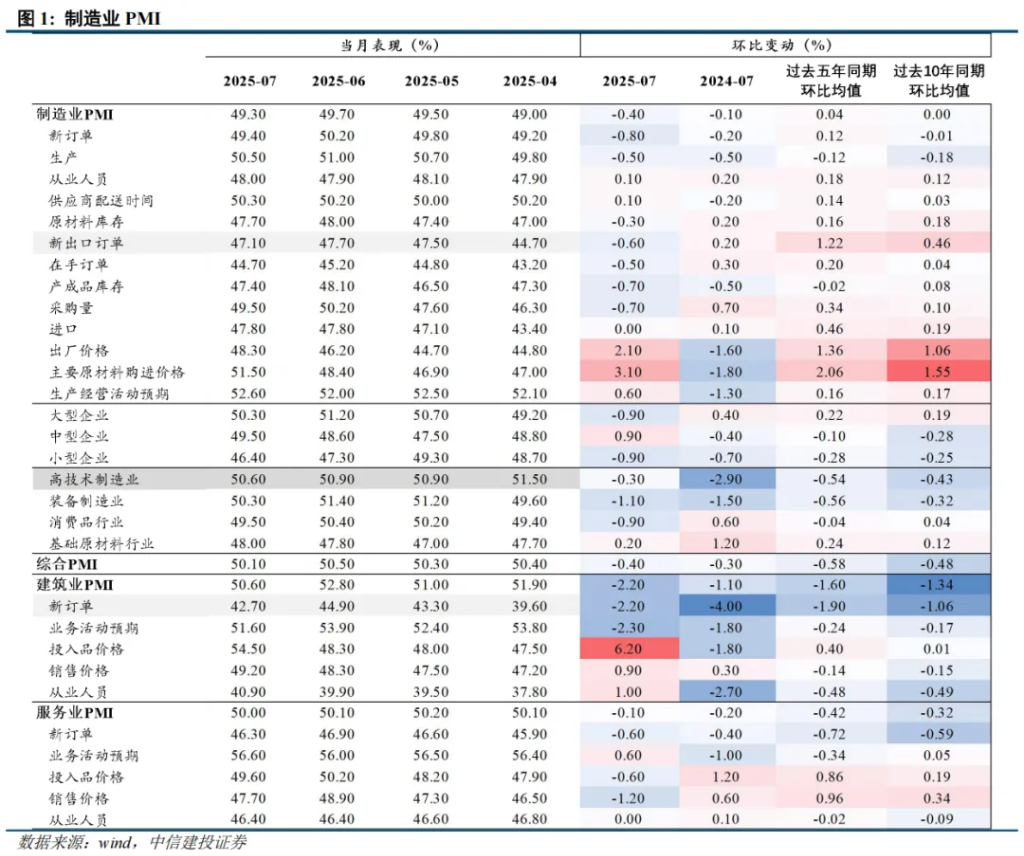
Core Insights - The manufacturing PMI for July is 49.3%, a decrease of 0.4 percentage points month-on-month, indicating a historically low level for this period [2][3] - Weak demand is the primary reason for the July PMI decline, with new orders and new export orders significantly below historical averages [3][5] - The production index remains resilient despite seasonal weaknesses caused by extreme weather conditions, holding steady at historical levels [4] Group 1: PMI Performance - The July manufacturing PMI is 49.3%, remaining below the growth line for four consecutive months, and is only higher than the figures from 2021 and 2022 [3] - The production index for July is 50.5%, slightly below the historical average, influenced by seasonal factors such as high temperatures and flooding [4] - New orders index stands at 49.4%, falling below the growth line and significantly lower than historical levels, with new export orders also declining [5] Group 2: Demand Signals - The July PMI indicates potential marginal slowdown in exports, with high-frequency data showing signs of weakening exports [7] - The import throughput at the Port of Los Angeles has decreased, reflecting a drop in shipping rates for routes to the U.S. [7] - South Korea's export data for the first 20 days of July shows a year-on-year decline of 2.2%, contrasting with a previous increase of 8.3% [7] Group 3: Price Trends - The "anti-involution" trend has led to rising price expectations in upstream markets, but the sustainability of these price increases is uncertain due to weak demand [8] - The index for major raw material purchase prices rose to 51.5%, an increase of 3.1 percentage points, surpassing the increase in factory prices [6] - Recent government policies aimed at curbing low-price competition may impact the future dynamics of production capacity and pricing in key industries [8]