下一代AI入口

Search documents
21评论|为AI撒钱,很考验技术
2 1 Shi Ji Jing Ji Bao Dao· 2026-02-10 11:37
Core Insights - The article discusses the recent "red envelope war" among major tech companies in China, highlighting their strategies to attract users and establish AI as a key component in their ecosystems [3][10][12] Group 1: User Growth and Engagement - Tencent's Yuanshao saw a daily active user (DAU) of 23.99 million on the first day of its cash red envelope campaign, a 2.1 times increase from the previous day [1] - Baidu's Qianwen achieved a DAU of 58.48 million on the first day of its "30 billion free order" campaign, marking a 7.3 times increase from the prior day [2] - The rapid user growth indicates a significant impact of these promotional activities on user engagement [7] Group 2: Strategic Approaches - Tencent aims to leverage its WeChat ecosystem to quickly expand its user base and capture the AI application entry point [4][5] - Alibaba's Qianwen focuses on essential consumer scenarios, with its "one-sentence order" feature becoming a phenomenon, indicating high user interaction with AI [5] - Baidu adopts an "embedded AI" strategy, integrating its AI capabilities into the red envelope activities to enhance user experience [6] Group 3: Competitive Landscape - The competition is not merely about cash giveaways but reflects deeper strategic moves by each company to solidify their positions in the AI landscape [3][10] - The red envelope war is seen as a pivotal moment in the transition from technical validation of AI to large-scale user acquisition [10][11] - Companies are not limiting themselves to single AI assistants but are building comprehensive ecosystems to meet user needs [13] Group 4: Future Implications - The red envelope campaigns are viewed as tools to cultivate a mindset among users to seek AI assistance in various situations [14][15] - The outcomes of these campaigns could significantly influence the AI landscape over the next decade [15]



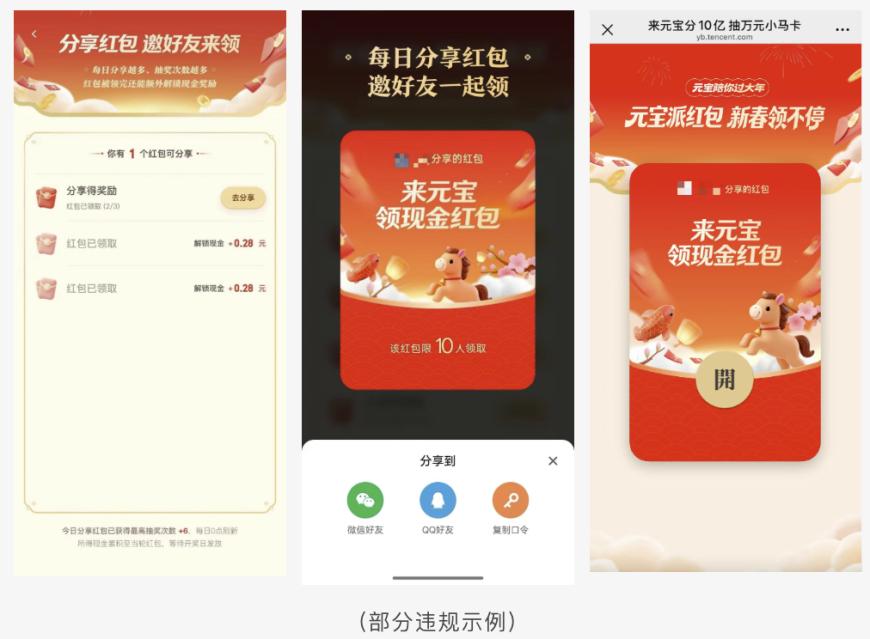
科技巨头春节AI红包大战迎新变局!微信回应"封杀"元宝红包:诱导分享干扰平台生态秩序,对用户造成实质性骚扰
Jin Rong Jie· 2026-02-04 04:22
Core Viewpoint - The sudden restriction of Tencent's AI application "Yuanbao" by WeChat highlights the challenges faced by companies in balancing marketing strategies with platform regulations, especially during the competitive "AI red envelope war" of 2026 [1][3][9] Group 1: WeChat's Response - WeChat's security center stated that the "Yuanbao" marketing campaign was inducing users to share links excessively, disrupting platform order and causing user harassment [3] - The decision to restrict "Yuanbao" links was based on user complaints and violations of WeChat's external link content management regulations [3][7] - WeChat emphasized its commitment to maintaining platform integrity, even when dealing with its own products [7] Group 2: Competitive Landscape - The "AI red envelope war" began in late January 2026, with Tencent launching "Yuanbao" and a significant marketing campaign offering up to 10 billion yuan in cash [5] - Competitors like Baidu and Alibaba quickly responded with their own substantial red envelope campaigns, with Baidu offering 500 million yuan and Alibaba 3 billion yuan [6] - The combined investment from Tencent, Alibaba, Baidu, and ByteDance exceeded 4.5 billion yuan, indicating an unprecedented scale of competition in this marketing space [6] Group 3: Market Dynamics - The incident with "Yuanbao" reflects the broader conflict in the AI red envelope market, where companies are vying for user engagement while adhering to existing platform rules [9] - Unlike the past, where innovative features like "Shake to Grab" led to success, the current challenge is to transform AI from a mere tool into an essential part of daily life for users [9]