中欧脱钩

Search documents
欧盟对华脱钩?德国外长抵京,下飞机后称和中国交流不可或缺
Sou Hu Cai Jing· 2025-12-10 05:12
Core Viewpoint - The diplomatic interactions between Europe and China highlight significant internal divisions within the EU regarding trade policies, with France advocating for potential tariffs on China while Germany emphasizes the necessity of maintaining strong economic ties [1][3][5]. Group 1: France's Position - French President Macron's strong rhetoric regarding trade deficits with China serves as a strategic negotiation tactic, suggesting that the EU may impose tariffs if the issue is not addressed soon [3]. - Macron's position reflects France's economic interests, which are less intertwined with China compared to Germany, allowing for a more politically balanced stance [3]. - Despite Macron's assertive statements, he acknowledges that his views are not fully supported by Germany, revealing the EU's internal disagreements [3][7]. Group 2: Germany's Position - German Foreign Minister Baerbock's visit to China underscores the importance of direct communication and collaboration, countering the narrative of a potential decoupling [5]. - Over 75% of German companies view China as a crucial growth market, indicating a strong economic dependency that makes decoupling impractical for Germany [5]. - Germany's economic structure, heavily reliant on manufacturing and exports, drives its preference for stable relations with China, contrasting with France's more protectionist approach [7]. Group 3: EU's Overall Stance - The EU has not formally adopted a decoupling stance but emphasizes risk reduction in sensitive sectors, distinguishing it from a complete severance of economic ties with China [9]. - China remains the EU's second-largest trading partner, with trade volumes consistently in the hundreds of billions of euros, making a complete withdrawal economically unfeasible [9]. - The long-term relationship between China and the EU is expected to be characterized by both cooperation and competition, with the potential for trade tensions but a commitment to maintaining open communication [11].

周期之王,越赚越多了
Hu Xiu· 2025-07-07 22:47
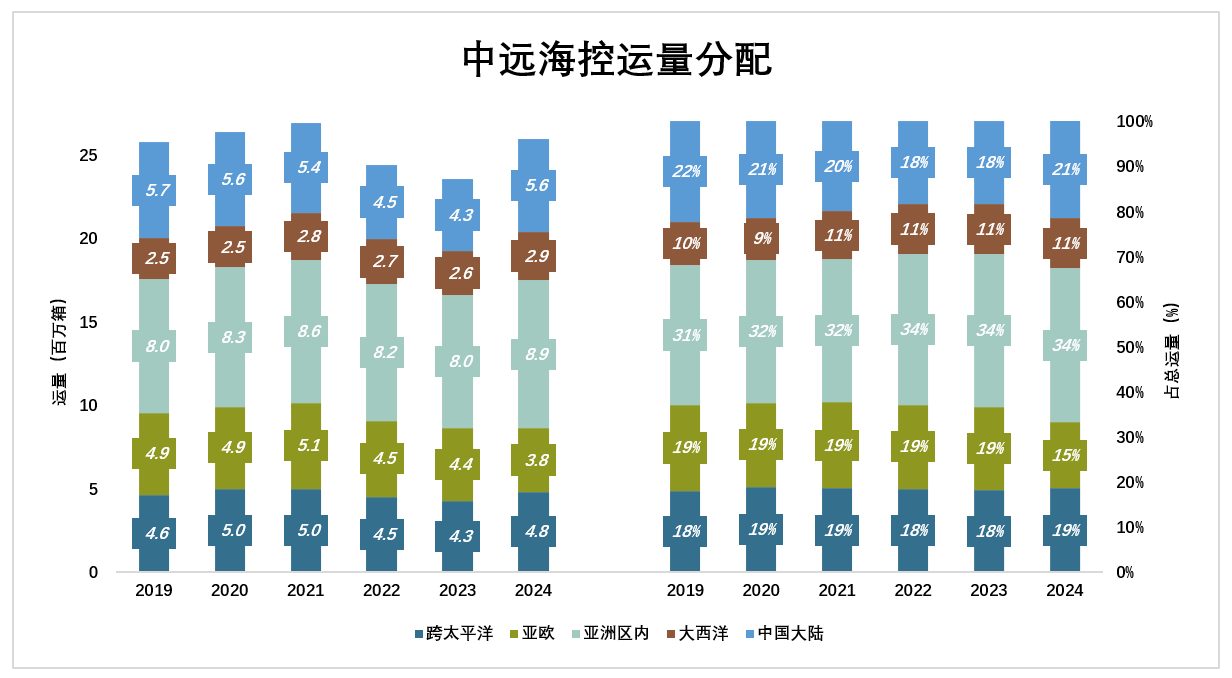
Core Viewpoint - The article highlights the strong cash returns and valuation of China COSCO Shipping Holdings (中远海控), emphasizing its resilience in the shipping industry despite concerns over trade wars and capacity expansion [1][3][4]. Group 1: Dividend and Returns - China COSCO Shipping Holdings implemented a dividend of 10.3 yuan per 10 shares for the annual report and 5.2 yuan for the interim report, resulting in a cash return of 10.29% for shareholders within a year [1]. - In contrast, Kweichow Moutai (贵州茅台) offered a lower dividend yield of 3.63% during the same period [2]. Group 2: Valuation and Market Concerns - The dividend yield of China COSCO Shipping Holdings is 2.8 times that of Kweichow Moutai, with a low dynamic price-to-earnings ratio of 5.1 times [3]. - Investor concerns stem from three main issues: trade wars leading to reduced cargo, capacity expansion causing freight rate collapse, and profit shrinkage when freight rates drop without a corresponding decrease in costs [3]. Group 3: Performance Analysis - Over the past six years, China COSCO Shipping Holdings has experienced fluctuations in performance due to the pandemic and trade wars, yet maintained an average annual net profit of 48.13 billion yuan, which is 80% of Kweichow Moutai's net profit over the same period [4]. - The shipping volume has shown stability, with only a 0.78% difference between 2019 and 2024, indicating that concerns about cargo availability may be overstated [5]. Group 4: Shipping Routes and Trends - The article discusses changes in major shipping routes, noting that the trans-Pacific route saw an increase in volume during the pandemic, while the Eurasian route has declined due to reduced purchasing power in Europe [6][9]. - The Asia-Pacific routes have shown significant growth, with a volume increase of 11.2% from 2019 to 2024, indicating a shift in trade dynamics [7][10]. Group 5: Revenue and Pricing Dynamics - Revenue from the trans-Pacific route has increased significantly despite fluctuations in shipping volume, with a revenue index of 210 in 2021 compared to 2019 [12]. - The Eurasian route has also seen a rise in revenue despite a decrease in shipping volume, with a revenue increase of 60% compared to 2019 [13]. Group 6: Cost and Profitability - The relationship between costs and prices is crucial, with shipping costs rising at a slower rate than freight rates, allowing shipping companies to maintain profitability [20][24]. - In 2024, the total cost as a percentage of revenue decreased to 65%, indicating improved profitability for China COSCO Shipping Holdings [27]. Group 7: Future Prospects - China COSCO Shipping Holdings is in discussions to acquire a stake in ports owned by Li Ka-shing, which could significantly enhance its revenue and operational capacity [32][40]. - The potential acquisition of a 25% stake in Li Ka-shing's ports could double the revenue and overseas throughput of China COSCO Shipping Holdings [40].