
主动信用管理

Search documents
从“被动督导”迈向“主动信用管理” 券商债券受托管理人迎来角色重塑
Shang Hai Zheng Quan Bao· 2026-01-18 18:15
Core Viewpoint - The recent release of the Shanghai Stock Exchange's guidelines for bond trustee management marks a significant shift from passive compliance oversight to proactive credit management, enhancing the professional standards for trustees and creating new competitive opportunities for brokers, especially smaller firms [2][3]. Group 1: Changes in Trustee Management - The traditional trustee management model, which focused on post-event compliance and risk management, is becoming inadequate due to the increasing complexity of issuer risk characteristics and transmission paths [3]. - The new guidelines emphasize the need for trustees to engage in proactive credit management throughout the bond lifecycle, including continuous monitoring of issuer credit characteristics and early intervention in risk situations [3][4]. - The shift in focus from compliance to active value management requires trustees to assist issuers in credit maintenance and enhance communication with investors, moving towards differentiated service models [4]. Group 2: Challenges in Implementation - Despite the positive direction of the new guidelines, there are significant challenges in implementing proactive credit management, particularly for smaller brokers [5]. - Active credit management requires substantial long-term investment in human resources and expertise, which may not yield immediate returns compared to traditional underwriting revenues [5]. - The need for cross-departmental collaboration and integration of resources poses additional challenges, especially for smaller firms with limited departmental structures [5][6]. Group 3: Opportunities for Smaller Brokers - While proactive credit management presents higher immediate demands, it also offers smaller brokers a chance to differentiate themselves by leveraging their agility and closer relationships with issuers [6]. - The evolving competitive landscape is pushing brokers to extend their core competencies beyond underwriting to include value creation and risk management throughout the bond lifecycle [6]. - Smaller firms can capitalize on their shorter decision-making chains and faster response times to establish deeper trust with issuers in the niche of bond lifecycle management [6]. Group 4: Required Core Competencies - Brokers need to enhance several core competencies to succeed in the new environment, including professional research capabilities to improve risk identification and warning systems [6][7]. - Data analysis capabilities must be developed to utilize technologies like big data and AI for real-time monitoring and dynamic assessment of issuer credit status [6][7]. - Strengthening communication and coordination skills with issuers, investors, and regulatory bodies is essential for timely information dissemination and conflict resolution [6][7]. - Innovation in service offerings and compliance management capabilities is also critical to meet diverse market demands and ensure legal compliance in credit management activities [7].



上交所发布公司债券受托管理指南 信用管理理念贯穿债券产品全周期
Shang Hai Zheng Quan Bao· 2025-12-24 19:15
Core Viewpoint - The Shanghai Stock Exchange (SSE) has released a guideline aimed at enhancing the proactive credit management role of trustees in corporate bond management, emphasizing the importance of credit throughout the bond lifecycle [2][3]. Group 1: Guideline Overview - The SSE's guideline integrates credit management into the entire lifecycle of bond products, highlighting that credit is essential for corporate bonds [2]. - It encourages trustees to shift from passive compliance to active credit management, detailing the roles of brokers in credit monitoring, information disclosure, and holder meetings [3][5]. Group 2: Importance of Proactive Credit Management - The guideline supports the idea that establishing a credit foundation is crucial for ongoing financing, as most bond issuers are continuous financing entities [3]. - Proactive credit management is essential for accurately reflecting, repairing, and enhancing credit during the bond's lifecycle, optimizing the long-term credit curve [3][5]. Group 3: Implementation and Case Studies - The SSE has initiated pilot programs for proactive credit management, with several brokers already implementing successful case studies that have improved issuer credit and reduced financing costs [5][6]. - For instance, Huatai United helped a bond issuer improve its credit rating by connecting them with suitable guarantee institutions, thereby enhancing investor interest [5]. Group 4: Market Activity and Future Directions - Since 2025, the SSE's corporate bond market has been active, with issuance reaching nearly 4.5 trillion yuan, a 20% increase year-on-year [7]. - The SSE aims to further enhance the quality of trustee management services and encourage brokers to develop tailored strategies, promoting a win-win situation in the bond market [7].

上交所发布公司债券受托管理指南
Zheng Quan Shi Bao· 2025-12-24 18:49
Core Viewpoint - The Shanghai Stock Exchange (SSE) has released the "Guidelines for the Management of Corporate Bonds" to enhance proactive credit management by trustees, marking the first specialized guidelines for bond trustee management in the exchange market [1] Group 1: Guidelines Overview - The guidelines integrate the concept of credit management throughout the entire lifecycle of bond products, encouraging proactive credit management efforts and transforming the role of trustees [1] - A roadmap for proactive credit management is provided, detailing monitoring, initiation, implementation, and incentives, along with a toolbox and case studies [1] - Trustees can utilize market-based tools such as bond buybacks and resale, and engage with credit enhancement entities, rating agencies, and valuation institutions to improve issuer credit [1] Group 2: Implementation and Impact - Since the second half of 2024, the SSE has initiated pilot programs encouraging brokers to implement proactive credit management, with several cases already being executed [2] - Issuers have improved their credit ratings and reduced financing costs, while investors have benefited from protected rights and stable returns [2] - The SSE plans to further enhance the quality and efficiency of trustee management services, promoting a tailored development path for brokers and rewarding those with significant proactive credit management results [2]
交易所市场首个债券受托业务专项指南在上交所发布 信用管理理念贯穿全周期
Zhong Guo Jing Ying Bao· 2025-12-24 17:13
Core Viewpoint - The Shanghai Stock Exchange (SSE) has released the "Guidelines for the Management of Corporate Bonds" to enhance proactive credit management by trustees, emphasizing the importance of credit throughout the bond lifecycle [1] Group 1: Guidelines Overview - The guidelines integrate the concept of credit management into the entire lifecycle of bond products, highlighting that credit is the lifeblood of corporate bonds [1] - A dedicated chapter encourages and supports proactive credit management, signaling a shift in the role of trustees and bringing new dynamics to the industry [1] - The guidelines provide a roadmap for proactive credit management, detailing monitoring, initiation, implementation, and incentives, along with a toolbox and case studies [1] Group 2: Industry Impact - Since the second half of 2024, the SSE has been promoting pilot programs for proactive credit management among brokers, with several pilot brokers successfully implementing these practices [1] - Issuers have improved their credit ratings and reduced financing costs, while investors have seen their rights protected and received stable returns [1] - The trustee management teams have leveraged their professional advantages, enhancing the quality and efficiency of bond business, thus fostering a positive feedback loop in the industry [1]
上交所,新动作!交易所市场首个债券受托管理指南发布
Zheng Quan Shi Bao· 2025-12-24 11:52
Core Viewpoint - The Shanghai Stock Exchange has released the first specialized guideline for bond trustee management, aiming to enhance proactive credit management by trustees throughout the bond product lifecycle, emphasizing the importance of credit as the lifeline of corporate bonds [1][3]. Group 1: Guideline Overview - The guideline outlines a roadmap for proactive credit management, detailing processes from monitoring to implementation and incentives, and provides tools and case studies for trustees [3]. - It encourages trustees to utilize market-based tools such as bond buybacks and communication with credit enhancement entities to improve issuer credit [3][4]. Group 2: Industry Impact - Since 2025, the corporate bond market has been active, with issuance reaching nearly 4.5 trillion yuan, a 20% year-on-year increase, indicating robust growth in innovative bond types [6]. - The total outstanding bonds in the Shanghai Stock Exchange market reached approximately 14 trillion yuan by the end of November 2025, making it one of the largest exchange bond markets globally [6]. Group 3: Role of Trustees - Trustees are transitioning from compliance supervisors to value discoverers, leveraging their unique advantages in identifying credit risks and opportunities [5][8]. - The guideline supports trustees in tailoring proactive credit management strategies based on the credit characteristics of different issuers [8]. Group 4: Organizational Mechanisms - The guideline encourages brokerages to develop internal business mechanisms that suit their organizational structures, with some teams located in investment banking and others in quality control [10]. - Effective incentives for proactive credit management are crucial for the transformation of traditional trustee models, with some firms considering performance-based rewards [10]. Group 5: Future Directions - The Shanghai Stock Exchange plans to further enhance the quality and efficiency of trustee management services, promoting a win-win situation for all market participants through market-oriented approaches [11].
事关14万亿元存量市场!上交所最新发布
Shang Hai Zheng Quan Bao· 2025-12-24 11:36
Core Viewpoint - The Shanghai Stock Exchange (SSE) has released the "Guidelines for the Management of Corporate Bonds" to enhance proactive credit management by trustees, emphasizing the importance of credit throughout the bond lifecycle [1][3]. Group 1: Guidelines and Proactive Management - The guidelines introduce a roadmap for proactive credit management, detailing processes from monitoring to implementation and incentives, providing tools and case studies for trustees [3]. - Trustees can utilize market tools such as bond buybacks and engage with credit enhancement entities to improve issuers' credit status, thereby preemptively addressing risks [3][4]. - The SSE has initiated pilot programs for proactive credit management, with several brokerage firms successfully implementing these practices, resulting in improved issuer credit and reduced financing costs [3][4]. Group 2: Market Activity and Growth - The SSE's corporate bond market has seen significant activity, with nearly 4.5 trillion yuan issued since 2025, marking a 20% year-on-year increase [5]. - The market has introduced innovative bond types, including high-growth industry bonds and support bonds for small and micro enterprises, with issuance growth rates exceeding 800% for the latter [5]. - As of November 2025, the outstanding scale of corporate bonds on the SSE reached nearly 14 trillion yuan, establishing it as one of the largest exchange bond markets globally [5]. Group 3: Role of Trustees - Trustees play a crucial role in monitoring credit changes, ensuring information disclosure, and verifying the use of raised funds, acting as a vital link between issuers and bondholders [6]. - Historically, there has been a tendency to prioritize underwriting over trustee responsibilities, but the new guidelines encourage trustees to take a more active role in credit management [6][7]. - The SSE aims to support trustees in transitioning from compliance overseers to value discoverers, tailoring proactive management strategies to the specific credit characteristics of issuers [6][7]. Group 4: Mechanism and Organizational Structure - The SSE encourages brokerage firms to develop internal mechanisms that suit their organizational structures for effective proactive credit management [7][8]. - Different brokerage firms have varied organizational setups for their trustee teams, impacting their operational mechanisms and credit enhancement strategies [8][9]. - Effective incentives for proactive credit management are crucial, with some firms considering performance-based rewards linked to the success of credit management initiatives [9][10].
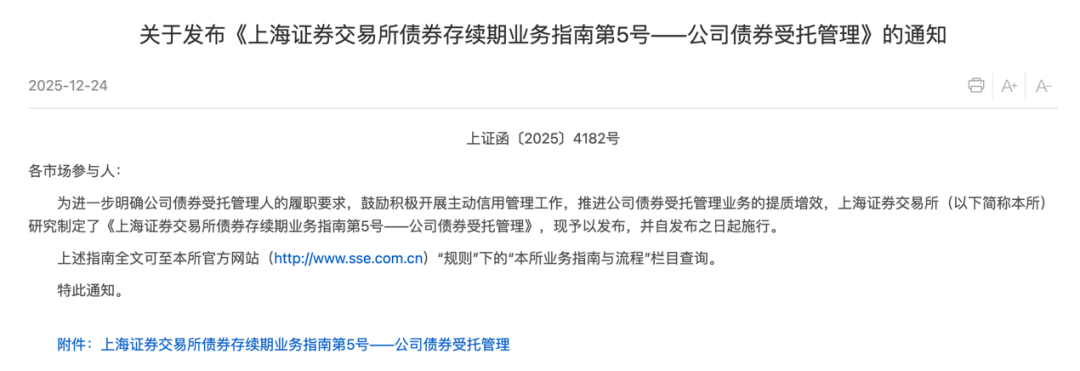
引导受托管理人发挥主动信用管理功能 上交所发布公司债券受托管理指南
Zheng Quan Shi Bao Wang· 2025-12-24 11:31
Core Viewpoint - The Shanghai Stock Exchange (SSE) has released the "Guidelines for the Management of Corporate Bonds" to enhance proactive credit management by trustees, emphasizing the importance of credit throughout the bond lifecycle and encouraging a shift in the role of trustees [1][4]. Group 1: Market Activity and Growth - Since 2025, the corporate bond market on the SSE has seen active issuance, with a total issuance scale of nearly 4.5 trillion yuan, representing a 20% year-on-year increase [2]. - The market has introduced innovative bond types, including 88 high-growth industry bonds and a more than 60% increase in sci-tech bonds, alongside an 800% increase in support bonds for small and micro enterprises [2]. - As of November 2025, the outstanding scale of corporate bonds on the SSE reached nearly 14 trillion yuan, making it one of the largest exchange bond markets globally [2]. Group 2: Importance of Proactive Credit Management - The management of bonds during their lifecycle is crucial, with a focus on accurately reflecting, repairing, and enhancing credit to optimize the long-term "credit curve" [2][3]. - Trustees play a key role in monitoring credit changes, ensuring information disclosure, and verifying the use of raised funds, thus connecting issuers and holders [3]. Group 3: Implementation of the Guidelines - The newly released guidelines provide a roadmap for proactive credit management, detailing processes from monitoring to implementation and incentives [4]. - The SSE has initiated pilot programs encouraging brokers to adopt proactive credit management, resulting in improved issuer credit and reduced financing costs [4][8]. Group 4: Organizational Structure and Mechanisms - Different brokers have varying organizational structures for their trustee teams, impacting their credit management processes [7]. - Effective incentives for proactive credit management are crucial, with some brokers considering performance-based rewards linked to the success of credit management initiatives [7]. Group 5: Future Directions - The SSE aims to further enhance the quality and efficiency of trustee management services, encouraging brokers to develop tailored strategies [8]. - Regulatory support will be directed towards brokers demonstrating significant proactive credit management results and issuers with strong credit levels, promoting a win-win scenario in the bond market [8].
上交所,新动作!交易所市场首个债券受托管理指南发布
证券时报· 2025-12-24 11:28
Core Viewpoint - The Shanghai Stock Exchange has released the first specialized guideline for bond trustee management, aiming to enhance proactive credit management by trustees throughout the bond product lifecycle, emphasizing the importance of credit as the lifeline of corporate bonds [1][3]. Group 1: Guideline Overview - The guideline provides a roadmap for proactive credit management, detailing processes from monitoring to implementation and incentives, and introduces market-based tools for trustees to enhance issuer credit [3][4]. - The guideline encourages a shift in the role of trustees from compliance oversight to value discovery, allowing them to actively manage credit risks and improve issuer creditworthiness [5][7]. Group 2: Market Context and Trends - Since 2025, the corporate bond market has seen significant activity, with issuance reaching nearly 4.5 trillion yuan, a 20% year-on-year increase, and innovative bond types like high-growth industry bonds and technology innovation bonds gaining traction [6]. - The total outstanding bonds in the Shanghai Stock Exchange's corporate bond market approached 14 trillion yuan by the end of November 2025, establishing it as one of the largest exchange bond markets globally [6]. Group 3: Case Studies and Practical Applications - Examples of proactive credit management include Huatai United's collaboration with guarantee institutions to enhance issuer credit and Everbright Securities' efforts to address discrepancies in bond pricing to improve liquidity and investor confidence [4][6]. - The guideline supports the establishment of internal business mechanisms within brokerages to adapt to different organizational structures, enhancing the effectiveness of proactive credit management initiatives [9][10].

债券受托业务“转舵”主动信用管理,多家券商已开展试点
Di Yi Cai Jing· 2025-12-24 11:06
Core Insights - The Shanghai Stock Exchange (SSE) has released a guideline to promote proactive credit management by trustees in the bond market, emphasizing the importance of credit throughout the bond lifecycle [1][3] - The guideline aims to transform the role of trustees from compliance overseers to value discoverers, encouraging tailored proactive credit management based on the credit characteristics of different issuers [3][5] Group 1: Market Activity - Since 2025, the corporate bond market on the SSE has been active, with an issuance scale of nearly 4.5 trillion yuan, representing a 20% year-on-year increase [2] - The outstanding scale of corporate bonds on the SSE reached nearly 14 trillion yuan by the end of November 2025, driven by the active primary market [2] Group 2: Proactive Credit Management - Proactive credit management is essential for maintaining long-term credit relationships and optimizing the "credit curve" during the bond's lifespan [2][3] - The SSE's guideline provides a roadmap for proactive credit management, detailing processes from monitoring to implementation and incentives [3][5] Group 3: Implementation and Case Studies - Several pilot brokers have begun implementing proactive credit management, leading to improved credit ratings and reduced financing costs for issuers [5][6] - Examples include Huatai United's collaboration with a guarantor to enhance an issuer's credit and Everbright Securities' efforts to address discrepancies in bond pricing through improved communication and valuation [5][6] Group 4: Organizational Structure and Mechanisms - Different brokers have varying organizational structures for their trustee teams, impacting their credit management processes [6] - Effective implementation of proactive credit management requires a comprehensive mechanism that includes initiation, decision-making, coordination, and incentives [6]
年内上交所公司债券发行规模近4.5万亿元 同比增长20%
Zheng Quan Ri Bao Wang· 2025-12-24 11:06
Core Viewpoint - The Shanghai Stock Exchange (SSE) is actively guiding trustees to enhance their proactive credit management functions, emphasizing the importance of credit throughout the entire lifecycle of corporate bonds with the release of the "Guidelines for Corporate Bond Trusteeship" [1][4]. Group 1: Market Activity and Growth - Since 2025, the corporate bond market on the SSE has seen active issuance, with a total issuance scale of nearly 4.5 trillion yuan, representing a year-on-year growth of 20% [2]. - The market has introduced innovative bond varieties, including 88 high-growth industry bonds and a more than 60% year-on-year increase in sci-tech bonds, alongside an 800% increase in support bonds for small and micro enterprises [2]. - As of November 2025, the outstanding scale of corporate bonds on the SSE reached nearly 14 trillion yuan, making it one of the largest exchange bond markets globally [2]. Group 2: Role of Trustees in Credit Management - The unique role of trustees in the bond market involves monitoring credit changes, ensuring information disclosure, and verifying the use of raised funds, making them essential in optimizing the "credit curve" [3]. - Historically, there has been a tendency to prioritize underwriting over trusteeship, but the new guidelines encourage trustees to take a more active role in credit management, transitioning from mere compliance to value discovery [3][4]. Group 3: Implementation of Proactive Credit Management - The guidelines provide a roadmap for proactive credit management, detailing processes from monitoring to implementation and incentives, equipping trustees with tools and case studies [4]. - Initiatives have already begun, with pilot programs allowing several brokerage firms to implement proactive credit management practices, resulting in improved credit ratings and reduced financing costs for issuers [4][5]. Group 4: Mechanism and Organizational Structure - The SSE emphasizes the importance of long-term mechanisms to support proactive credit management, encouraging brokerages to develop internal business structures that suit their specific needs [6][7]. - Different brokerages have varied organizational structures for their trustee teams, with some located in investment banking departments and others in quality control departments, leading to differences in operational mechanisms [7]. Group 5: Incentives and Future Directions - Effective incentives are crucial for the success of proactive credit management, with some brokerages considering performance-based rewards linked to the completion and effectiveness of credit management tasks [8]. - The SSE plans to further enhance the quality and efficiency of trustee management services, encouraging brokerages to find development paths that align with their unique circumstances, while also promoting a market-oriented approach to support the bond market [8].