云安全

Search documents
马化腾凌晨发声:腾讯还有一批“龙虾系”产品陆续赶来;英伟达宣布投入 260 亿美元打造开源模型;小伙手搓悬停火箭火爆全网|极客早知道
Sou Hu Cai Jing· 2026-03-12 01:25
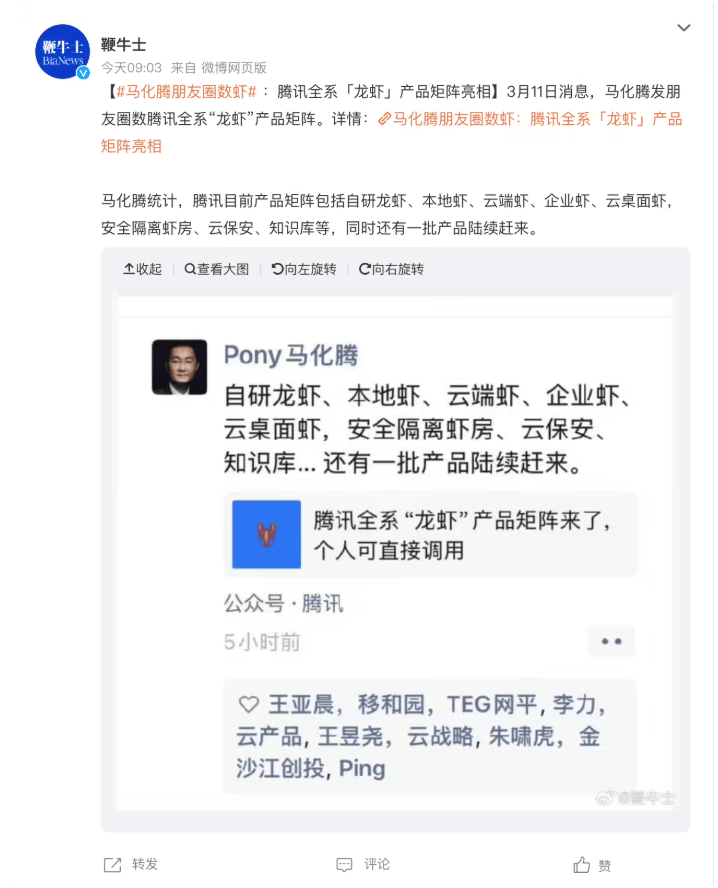
Group 1 - The core topic revolves around the rapid rise of OpenClaw, an open-source AI project, which has sparked significant interest and policy support across various regions in China [1][2] - Multiple cities, including Hefei and Shenzhen, have introduced measures to support the development of OpenClaw and one-person companies (OPC), with Hefei offering up to 10 million yuan in funding [1][2] - Concerns regarding the security of OpenClaw have been raised, highlighting its high-level permissions and the lack of strict security audits in the skill package market [2] Group 2 - Tencent has announced a series of products under the "lobster" brand, including WorkBuddy, which is fully compatible with OpenClaw and aims to enhance usability and security [3][4] - Nvidia plans to invest $26 billion over the next five years to develop open-source AI models, marking a strategic shift from being solely a chip manufacturer to becoming a leading AI laboratory [4][5][6] - The investment will cover model development, computational infrastructure, talent acquisition, and ecosystem building, with the first models expected to be released by late 2026 or early 2027 [6][8] Group 3 - Google has completed a $32 billion acquisition of Wiz, marking its largest acquisition to date, aimed at enhancing its cloud security capabilities [11][12] - The acquisition is part of Google's strategy to strengthen its position in the cloud computing and AI sectors, responding to the growing demand for secure AI infrastructure [11][12] - Wiz will continue to operate with a multi-cloud service strategy, providing its products through competitors' platforms like AWS and Azure [12] Group 4 - Xiaomi has launched its official car insurance, FaBa Tianxing, which offers competitive pricing and additional services compared to other insurance providers [18] - The insurance is currently available for renewal in Beijing, with a focus on providing enhanced services to customers [18][19] Group 5 - NIO's CEO Li Bin emphasized that the company's first quarterly profit is just a starting point, indicating a long-term competitive strategy in the automotive industry [20][21] - NIO plans to maintain a quarterly R&D investment of 2 to 2.5 billion yuan in 2026, focusing on improving efficiency and ensuring strong investment in key products and technologies [20][21]






天融信:目前腾讯元宝暂未应用到公司产品
Zheng Quan Ri Bao Wang· 2026-01-28 14:11
Group 1 - The company Tianrongxin (002212) is engaging in deep cooperation with Tencent across multiple areas including threat intelligence, large model security, cloud security, privacy computing, and smart cities [1] - Currently, Tencent's Yuanbao has not been applied to the company's products, but the company has initiated collaboration with Tencent's Hongyuan large model [1]

启明星辰:公司主营业务为网络安全产品、安全运营服务及解决方案
Zheng Quan Ri Bao Wang· 2026-01-27 10:15
Core Viewpoint - The company, Qiming Star (启明星辰), focuses on cybersecurity products, security operation services, and solutions, emphasizing areas such as AI+security, data security, cloud security, and basic network information security [1] Group 1 - The company's main business includes cybersecurity products and services [1] - The company has disclosed its operational status in regular reports, indicating no undisclosed significant matters [1]

启明星辰:公司正全力深化与中国移动的战略协同,加快布局AI安全、云安全等新赛道|焦点消息
Zheng Quan Ri Bao Wang· 2026-01-20 07:29
Core Viewpoint - The company, Qihoo 360 (启明星辰), has experienced fluctuations in performance due to changes in the external market environment and strategic R&D investments in new technology areas [2] Group 1: Company Strategy and Performance - The company is currently focusing on deepening strategic collaboration with China Mobile (中国移动) under the leadership of Chairman Yuan Jie [2] - The company aims to accelerate its layout in new sectors such as AI security and cloud security to solidify its long-term healthy development foundation [2] - As it enters the new development phase of the "14th Five-Year Plan," the company will actively respond to national strategies and closely monitor industry trends and market development opportunities [2] Group 2: Innovation and Business Optimization - The company is committed to technological innovation, optimizing its business layout, and enhancing operational quality and efficiency [2]


启明星辰:公司正全力深化与中国移动的战略协同,加快布局AI安全、云安全等新赛道
Zheng Quan Ri Bao Wang· 2026-01-20 04:45
Core Viewpoint - The company, Qihoo 360 (启明星辰), has experienced fluctuations in performance due to changes in the external market environment and strategic investments in new technology areas. The company is focusing on deepening strategic collaboration with China Mobile and accelerating its layout in AI security and cloud security sectors to ensure long-term healthy development [1]. Group 1 - The company is currently facing performance volatility influenced by external market changes and strategic R&D investments in new technology fields [1]. - Under the leadership of Chairman Yuan Jie, the company is committed to enhancing strategic collaboration with China Mobile [1]. - The company aims to accelerate its entry into new sectors such as AI security and cloud security, which are seen as essential for its long-term development [1]. Group 2 - As the company enters the "14th Five-Year Plan" phase, it plans to actively respond to national strategies and closely monitor industry trends and market opportunities [1]. - The company emphasizes the importance of technological innovation, optimizing its business layout, and improving operational efficiency [1].
云上数据泄漏险分析报告(第九期)
Lv Meng Ke Ji· 2026-01-14 14:02
Investment Rating - The report does not explicitly provide an investment rating for the industry or specific companies. Core Insights - The report highlights a new trend where AI security risks are deeply integrated with cloud infrastructure attack surfaces, indicating that attackers are leveraging vulnerabilities like SSRF to exploit AI models for accessing cloud metadata [12] - The report emphasizes the ongoing issues with credential management in DevOps environments, particularly the prevalence of hard-coded keys and supply chain poisoning, which expose significant blind spots in cloud-native asset management [12] - The analysis of ten significant data breach incidents reveals that basic web application attacks and system intrusions are the primary causes of data leaks, with lost and stolen assets also representing a significant portion of incidents [12] Summary by Sections Section 1: Global Data Breach Events Analysis - Event 1: AI startups faced severe risks due to improper cloud asset configuration, leading to the exposure of core credentials and private model data on GitHub, affecting approximately 65% of top AI companies [17] - Event 2: The React2Shell vulnerability (CVE-2025-55182) allowed unauthorized remote code execution in widely used React/Next.js applications, with a potential impact on 40% of cloud environments [26][27] - Event 3: A breach in the third-party ecosystem of Salesforce, involving Gainsight, led to the exposure of data from over 200 companies, highlighting the risks associated with third-party integrations [38][39] - Event 4: A supply chain attack on npm resulted in the leakage of over 500 GitHub usernames and tokens, affecting approximately 400,000 unique keys [50][53] - Event 5: DockerHub revealed that over 10,000 public images leaked sensitive keys, impacting more than 100 companies, including Fortune 500 firms [68][69] - Event 6: A SSRF vulnerability in ChatGPT allowed attackers to access Azure instance metadata, potentially exposing high-privilege OAuth2 tokens [77][81] Section 2: Security Recommendations - The report provides security recommendations targeting social engineering and system intrusion, as well as advice for managing lost and stolen credentials [10]

启明星辰:公司坚信网络安全产业韧性强、潜力大,长期向好的基本面不变
Zheng Quan Ri Bao Wang· 2026-01-06 14:11
Core Viewpoint - The company believes that despite short-term challenges in the cybersecurity industry, the long-term potential remains strong due to the increasing demand for innovative security capabilities integrated with information technology applications and business scenarios [1] Group 1: Industry Outlook - The cybersecurity industry is currently facing limitations in traditional business growth and pressure on products and services [1] - There is a growing demand for high-quality innovative security capabilities as cybersecurity integrates more with information technology applications and business scenarios [1] Group 2: Company Strategy - The company is deepening its strategic collaboration with China Mobile, focusing on new areas such as "AI + security," cloud security, and 5G security [1] - The company aims to enhance the quality of related transactions with China Mobile, emphasizing the value of security products and improving overall gross margin levels, even if it means sacrificing some low-margin projects [1] - Following the appointment of a new chairman, the company is committed to advancing its strategic collaboration with China Mobile and proactively exploring new opportunities in the AI security sector [1]
启明星辰:公司全力推动与中国移动的战略协同,聚焦AI安全、云安全等新赛道以培育新增长点
Zheng Quan Ri Bao· 2026-01-06 13:41
Core Viewpoint - The company is implementing systematic measures to improve short-term performance, deepen long-term strategy, and enhance investor confidence [2] Group 1: Strategic Initiatives - The company is focusing on strategic collaboration with China Mobile, emphasizing new growth areas such as AI security and cloud security to expand its customer base among individuals and families [2] - The company is actively researching and continuously evaluating plans for dividends, share buybacks, and other measures to ensure long-term benefits for all shareholders [2] Group 2: Operational Improvements - The company is strictly executing cost reduction and efficiency enhancement measures, improving accounts receivable management to enhance cash flow and optimize operations [2] - The company aims to improve its fundamental performance through these operational strategies [2]
从0到320亿美元,这家公司只用了五年
财富FORTUNE· 2025-12-14 13:05
Core Insights - The article discusses the acquisition of Wiz by Google for $32 billion, marking it as one of the largest tech mergers in a decade [1][6] - The CEO of Wiz, Asaf Rappaport, initially missed Google's acquisition interest but later engaged in negotiations that led to a significantly higher offer [2][5] Group 1: Acquisition Details - Google expressed interest in acquiring Wiz in March 2024, but the initial communication went unanswered for months due to Rappaport's busy schedule [1][2] - By May 2024, after realizing the missed opportunity, Rappaport met with Google executives, leading to a $23 billion acquisition offer, which was double Wiz's valuation at the time [4][5] - Rappaport initially rejected the offer, believing in the company's potential for an IPO, but later accepted a revised offer of $32 billion in early 2025 [5][6] Group 2: Company Growth and Strategy - Wiz achieved $350 million in annual recurring revenue within four years and became the fastest-growing startup in tech history [2][5] - The company focused on simplifying cloud security solutions, addressing significant market needs without overcomplicating their offerings [15][17] - The founders' background in elite military units and their previous experience at Microsoft contributed to their strategic approach and success [11][12][13] Group 3: Leadership and Team Dynamics - Rappaport's leadership style emphasizes collaboration and talent development, fostering a strong team culture among the founders [10][11] - The founders have a long-standing relationship, having met in the Israeli military, which has strengthened their ability to work together effectively [11][12] - Rappaport's decision-making process reflects a balance between ambition and caution, as seen in his initial rejection of the acquisition offer [5][10] Group 4: Market Context and Implications - The acquisition highlights the growing demand for cloud security solutions, particularly as businesses increasingly migrate to cloud environments [5][17] - The deal is significant not only for Wiz but also for the broader tech ecosystem, showcasing the potential for Israeli startups to achieve substantial valuations [6][17] - The article suggests that the success of Wiz may inspire other tech entrepreneurs, particularly in China, to focus on building strong teams and innovative solutions [17]

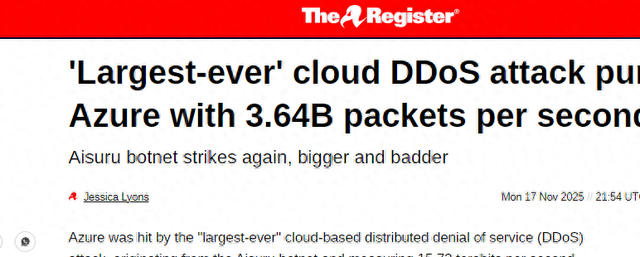
微软Azure遭遇史上最大云DDoS攻击,50万IP狂轰
Huan Qiu Wang· 2025-11-18 04:12
Core Insights - Microsoft Azure experienced the largest DDoS attack in cloud history on October 24, with peak traffic reaching 15.72 Tbps and packet peaks near 3.64 billion packets per second [1][4] - The attack was executed using large-scale UDP traffic from over 500,000 IP addresses, targeting a single public address with minimal spoofing, making traceability easier [4] - The Aisuru botnet, which emerged in August 2024, is based on the Mirai architecture and primarily infects IoT devices, showcasing an evolving threat landscape in cloud security [4][5] Company Summary - Microsoft’s DDoS protection services successfully detected and mitigated the attack automatically, preventing any disruption to customer operations, demonstrating robust emergency response capabilities [4] - The attack highlights the increasing scale of threats as attackers evolve with internet advancements, indicating a persistent risk of high-volume attacks in the future [5] Industry Summary - The emergence of the Aisuru botnet signifies a growing challenge in cloud security, as it has the potential to launch attacks exceeding 20 Tbps, indicating a trend of escalating attack capabilities [4] - The incident underscores the need for continuous improvement in cloud security measures to address the evolving nature of DDoS attacks and the sophistication of botnets [5]