
产业生态环境

Search documents
2026年各地优化营商环境有啥新打法
Xin Lang Cai Jing· 2026-01-18 22:33
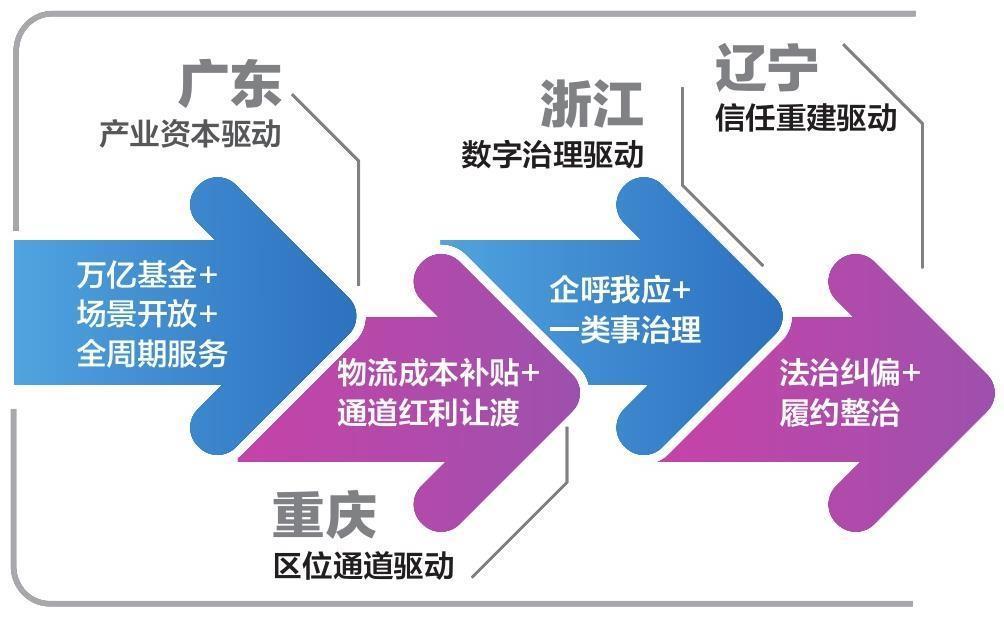
Core Insights - A competition focusing on "soft power" for future development has begun, with regions like Shanghai, Liaoning, and Fujian prioritizing the optimization of the business environment as a key initiative for the new year [5][6] Group 1: Business Environment Optimization Strategies - Regions are shifting from simple tax reductions to providing targeted "value supply" to attract businesses, emphasizing the importance of a comprehensive system of governance and value orientation [5][6] - Zhejiang has introduced a "burden reduction list" covering six areas including taxes and financing to alleviate costs for enterprises, while Shanghai has proposed a "industrial ecological environment" reform to enhance the infrastructure needed for industry development [5][6] - Liaoning aims to create a "cost lowland" by addressing core issues in energy and logistics, implementing measures like optimizing port fees to reshape investment expectations in Northeast China [6][7] Group 2: Legal and Trust Foundations - The optimization of the business environment is now a strategic action for long-term economic development, focusing on creating a sense of security and belonging for businesses [7][8] - Fujian is enhancing legal stability for private enterprises through a unified enforcement platform to eliminate redundant inspections, while Liaoning is committed to rebuilding trust by addressing government dishonesty and promoting entrepreneurial spirit [7][8] Group 3: Operational Support for Enterprises - Governments are providing unique operational services to support business growth, with Guangdong leveraging a trillion-yuan industrial fund to focus on sectors like semiconductors and new energy [8] - Liaoning is promoting financial service stations and specialized products to lower financing barriers, while also streamlining administrative processes to support enterprises [8][9] - Jiangsu excels in collaborative efforts, addressing pain points across the entire industrial chain to ensure smooth operations and minimal costs for businesses [8][9]

平台、算法、短剧、二次元,上海营商环境9.0破解新业态新问题
Di Yi Cai Jing Zi Xun· 2026-01-08 07:59
Core Viewpoint - Shanghai is prioritizing the optimization of the business environment as part of its high-quality development strategy, with the introduction of the "Action Plan for Accelerating the Creation of a World-Class Business Environment (2026)" [1] Group 1: Business Environment Optimization - The 2026 action plan includes 26 specific tasks aimed at optimizing four key environments: government service, market competition, industrial ecology, and social governance [2] - The plan addresses new demands from emerging industries, such as regulating "involution" competition and enhancing platform algorithm governance [2] - The action plan builds on previous iterations, focusing on continuous improvement in response to the evolving needs of businesses [2][3] Group 2: Support for Enterprises - The plan emphasizes enhancing support for small and medium-sized enterprises (SMEs) by improving financing services and expanding government financing guarantee coverage [5] - Specific measures include implementing credit rewards, risk compensation policies, and facilitating seamless loan renewals for businesses [5] - The action plan aims to streamline the application and approval processes for enterprise support policies, ensuring rapid access to benefits [3] Group 3: Regulatory Improvements - The action plan introduces detailed requirements for optimizing enterprise inspections, including reducing on-site checks for low-risk businesses and enhancing cross-departmental regulatory efficiency [6][7] - It aims to regulate profit-driven reporting practices while supporting legitimate consumer rights [7] - The plan also focuses on improving the fairness and transparency of the bidding process in construction projects, with measures to prevent "involution" competition [8] Group 4: Industry-Specific Initiatives - The action plan highlights the creation of a friendly industrial ecosystem, promoting tailored development in industrial parks and enhancing integrated service capabilities [4] - It encourages the use of AI technology in the bidding process and aims to allocate a significant portion of government contracts to SMEs [8]
上海加力优化营商环境服务高质量发展
Ren Min Ri Bao Hai Wai Ban· 2026-01-08 03:08
Group 1 - The core viewpoint of the article emphasizes Shanghai's commitment to creating an international first-class business environment through a comprehensive action plan with 26 initiatives covering various aspects such as government services, market competition, industrial ecology, and social governance [1] - Shanghai has introduced over 1,200 reform measures since 2018, with 22 business environment evaluation points reaching global best levels according to the World Bank [1][4] - In the first three quarters of 2025, Shanghai's GDP grew by 5.5% year-on-year, with an average of 320 technology-based companies established daily, and a total of 353,000 new enterprises added throughout the year, marking a 2.69% increase [1] Group 2 - The "Pudong Easy Access" policy service platform consolidates nearly 300 enterprise support policies from over 20 departments, significantly improving operational efficiency [2] - The time required to obtain permits for opening a convenience store in Shanghai has been reduced from 38 working days to 5 working days, showcasing the government's efforts to simplify processes [2] Group 3 - Shanghai's industrial innovation is highlighted by the successful listings of companies like Muxi Co. on the Sci-Tech Innovation Board and others on the Hong Kong Stock Exchange, attributed to precise services and policy support for innovative enterprises [3] - The new action plan for 2026 addresses evolving business environment needs, including measures against regulatory profiteering and online defamation [3] Group 4 - Shanghai's average customs clearance time for exports is 2 days and for imports is 7 days, which is lower than the East Asia and Pacific region averages, reflecting the city's commitment to enhancing efficiency [4] - The World Bank's 2025 survey indicates that Shanghai has reached global advanced levels in areas such as electronic payments, electricity access, and skills training [4] Group 5 - In the first 11 months of 2025, Shanghai established 5,767 new foreign-funded enterprises, a 4.2% increase year-on-year, with wholly foreign-owned enterprises increasing by 11.3% [5] - The actual use of foreign capital in Shanghai reached $15.125 billion, accounting for 15.6% of the national total, underscoring the city's role in attracting foreign investment [5]
上海加力优化营商环境服务高质量发展(“十五五”开好局起好步)
Ren Min Ri Bao· 2026-01-06 23:36
Core Viewpoint - Shanghai has released the "Action Plan for Accelerating the Creation of an International First-Class Business Environment (2026)", which includes 26 measures aimed at enhancing various aspects of the business environment, reflecting a commitment to high-quality development and attracting high-end resources [1]. Group 1: Business Environment Initiatives - The action plan covers areas such as government services, market competition, industrial ecology, and social governance, emphasizing the importance of a favorable business environment for enterprise survival and growth [1]. - Since 2018, Shanghai has introduced over 1,200 reform measures to optimize the business environment, with the World Bank's latest survey indicating that 22 evaluation points in Shanghai's business environment are at a global best level [1]. Group 2: Economic Performance - In the first three quarters of 2025, Shanghai's GDP grew by 5.5% year-on-year, with an average of 320 technology-based enterprises established daily, and a total of 353,000 new enterprises added throughout the year, marking a 2.69% increase [1]. - The number of enterprises per 1,000 people in Shanghai stands at 120, the highest in the country, showcasing the city's economic resilience and market vitality [1]. Group 3: Policy Simplification and Efficiency - The "Pudong Easy Access" application simplifies the process for businesses to access nearly 300 policies from over 20 departments, significantly improving operational efficiency [2]. - The time required to obtain permits for opening a convenience store in Shanghai has been reduced from 38 working days to just 5 working days, reflecting the government's commitment to enhancing service quality [2]. Group 4: Innovation and Support for Enterprises - Shanghai has seen a surge in innovative enterprises, with several companies successfully listing on stock exchanges, attributed to targeted services and policy support for high-growth companies [3]. - The new action plan addresses evolving business needs, including measures against regulatory overreach and online misinformation that harms enterprises, introducing the concept of "industrial ecological environment" for the first time [3]. Group 5: Global Standards and Foreign Investment - Shanghai's average customs clearance time for exports is 2 days and for imports is 7 days, outperforming East Asia and Pacific region averages, demonstrating the city's commitment to meeting global standards [4]. - From January to November 2025, Shanghai established 5,767 new foreign-funded enterprises, a 4.2% increase year-on-year, with actual foreign investment reaching $15.125 billion, accounting for 15.6% of the national total [4]. Group 6: Leadership Commitment - Shanghai's leadership emphasizes the importance of optimizing the business environment as a key component of high-quality development and a foundation for deepening reforms and opening up [5].
22项营商环境测评点达全球最优水平,每千人企业数全国第一 上海加力优化营商环境服务高质量发展(“十五五”开好局起好步)
Ren Min Ri Bao· 2026-01-06 23:28
Core Viewpoint - Shanghai has released the "Action Plan for Accelerating the Creation of an International First-Class Business Environment (2026)", which includes 26 measures aimed at enhancing various aspects of the business environment, reflecting a strong commitment to improving the operational landscape for enterprises [1] Group 1: Business Environment Improvement - The action plan emphasizes the importance of a favorable business environment for enterprise survival and development, aligning with national strategies to attract high-end resources [1] - Since 2018, Shanghai has introduced over 1,200 reform measures to optimize the business environment, with the World Bank ranking 22 evaluation points of Shanghai's business environment at a global best level [1] - In the first three quarters of 2025, Shanghai's GDP grew by 5.5% year-on-year, with an average of 320 technology companies established daily, and a total of 353,000 new enterprises added throughout the year, marking a 2.69% increase [1] Group 2: Policy and Service Innovations - The "Pudong Easy Access" platform consolidates nearly 300 enterprise support policies from over 20 departments, significantly improving operational efficiency and simplifying the application process for businesses [2] - The time required to obtain permits for opening a convenience store in Shanghai has been reduced from 38 working days to just 5 working days, showcasing the government's commitment to enhancing service quality [2] Group 3: Innovation and Industry Support - Shanghai has seen a surge in innovative enterprises, with several companies successfully listing on stock exchanges, attributed to targeted services and policy support for high-growth companies [3] - The new action plan addresses evolving business needs, including measures against regulatory overreach and online misinformation that harms enterprises, introducing the concept of "industrial ecological environment" [3] Group 4: Global Standards and Foreign Investment - Shanghai's average customs clearance time for exports is 2 days and for imports is 7 days, outperforming other economies in the East Asia and Pacific region [4] - From January to November 2025, Shanghai established 5,767 new foreign-funded enterprises, a 4.2% increase year-on-year, with actual foreign investment reaching $15.125 billion, accounting for 15.6% of the national total [4] Group 5: Commitment to High-Quality Development - Shanghai's leadership emphasizes the need to prioritize the optimization of the business environment as a key component of high-quality development and a foundation for deepening reforms [5]
上海首次提出“产业生态环境”,加快打造国际一流营商环境
Huan Qiu Wang· 2026-01-06 01:17
Group 1 - The core viewpoint of the article highlights Shanghai's action plan to accelerate the creation of a world-class business environment, focusing on efficient government services, fair market competition, friendly industrial ecosystems, and collaborative social governance, with a total of 26 tasks outlined [1] - The action plan emphasizes the importance of promoting industrial, spatial, and factor aggregation, aiming to create a more suitable and innovation-friendly industrial ecosystem, marking a significant direction for industrial development [1] - By 2025, Shanghai aims to implement 58 reform tasks to optimize the business environment, which is expected to significantly enhance economic resilience and structural transformation, with industrial added value in Shanghai increasing by 5% year-on-year from January to November 2025 [1] Group 2 - A global survey indicated that 79.8% of respondents find China's business environment attractive for foreign investors, reflecting a 6.1 percentage point increase over the past three years, with 72.6% viewing China as an open and competitive market [3] - The survey also revealed that 78% of respondents recognize the benefits of trading with China, with the highest approval rates from Africa (90.6%), South America (84.9%), and Oceania (78.3%) [3] - Additionally, 78% of respondents believe that China's economic risk response capability is strengthening, with 81.9% optimistic about the long-term stability of the Chinese economy, and 84.7% considering China's economy crucial for global supply chain stability [3]
产业生态环境首次写入上海营商环境9.0版 带来什么利好?
Di Yi Cai Jing· 2026-01-04 13:36
Core Viewpoint - The "Action Plan for Accelerating the Creation of a First-Class Business Environment in Shanghai (2026)" emphasizes the importance of building an industry ecosystem alongside other key environments, introducing 26 measures to enhance the business landscape in Shanghai [1][2]. Group 1: Industry Ecosystem Development - The plan highlights the need for a friendly and adaptable industry ecosystem, focusing on spatial, financial, human resources, and service aspects to foster innovation and entrepreneurship [2][3]. - It proposes measures such as exploring a land classification development system, establishing a unified financing service platform for SMEs, and creating one-stop service platforms in industrial parks [3][4]. Group 2: Regulatory Transparency and Efficiency - The action plan stresses the importance of regulatory transparency and improving approval efficiency for new business models, particularly in emerging sectors like short videos and anime [5]. - It aims to facilitate a smoother transition from unregulated growth to a more structured and quality-focused industry development [5]. Group 3: Collaboration and Communication - The establishment of a platform for regular communication between chain leaders and upstream/downstream enterprises is emphasized, recognizing the importance of collaboration in the smart technology era [6][7]. - The plan encourages the creation of benchmark cases to promote integration within the industry chain, addressing the current hesitance of larger companies to innovate [7][8]. Group 4: Business Environment as Infrastructure - The business environment in Shanghai is increasingly viewed as a new type of infrastructure, essential for supporting rapid company growth and innovation [9][11]. - Companies like Jingce Semiconductor and Xijing Technology have benefited significantly from Shanghai's favorable business conditions, enabling them to expand operations and enhance production capabilities [9][10].
产业生态环境首次写入上海营商环境9.0版,带来什么利好?
Di Yi Cai Jing· 2026-01-04 13:16
Core Viewpoint - The "Action Plan for Accelerating the Creation of a First-Class Business Environment in Shanghai (2026)" emphasizes the importance of building an industry ecosystem, marking it as one of the four key environments to be developed alongside government service, market competition, and social governance [1][2]. Group 1: Industry Ecosystem Development - The plan introduces the concept of "industry ecosystem" and outlines specific requirements for the construction of spatial carriers, financing services, human resources, and other soft and hard infrastructure necessary for industrial development [2][3]. - It aims to promote the aggregation of industries, spaces, and elements, creating a more adaptable and friendly environment for innovation and entrepreneurship [2][3]. - The plan includes measures such as exploring a land classification development system and supporting the rapid implementation of qualified industrial projects through enterprise commitments and park recommendations [3][4]. Group 2: Financing and Resource Support - A unified financing service platform for small and medium-sized enterprises, "SuiShenRong," will be established to lower entrepreneurial costs and create a youth-friendly entrepreneurial ecosystem [3][4]. - The plan shifts from "policy subsidies" to "credit empowerment" in financing support, utilizing the "SuiShenRong" platform to enhance the market-oriented financing environment for small and micro enterprises [4][5]. - It emphasizes the need for integrated human resource services and the construction of platforms for technology and talent support, reducing friction costs in recruitment and job seeking [4][5]. Group 3: Regulatory Transparency and Efficiency - The plan highlights the importance of regulatory transparency and the timeliness of approvals for new business models, particularly in emerging industries like short dramas and anime [5][6]. - It aims to refine regulatory planning to facilitate the transition of industries from chaotic growth to standardized quality improvement [5][6]. Group 4: Industry Chain Collaboration - The establishment of a platform for regular communication between chain leaders and upstream and downstream enterprises is emphasized, recognizing the importance of collaboration in the intelligent era [6][7]. - The government is encouraged to facilitate market主体交流 to enhance order acquisition and development opportunities for enterprises [7][8]. Group 5: Business Environment as Infrastructure - The business environment in Shanghai is increasingly viewed as a new type of infrastructure, essential for the growth and innovation of companies [9][11]. - Companies like Shanghai Jingce Semiconductor and Xijing Technology have benefited significantly from the favorable business environment, enabling rapid development and expansion [9][10].
上海连续九年升级营商环境,普惠政策全部“免申即享”,企业可坐等资金到账
Di Yi Cai Jing· 2026-01-04 13:15
Core Viewpoint - The Shanghai Municipal Government has launched the "2026 Action Plan for Accelerating the Creation of an International First-Class Business Environment" (9.0 version), emphasizing a business-oriented approach with 26 initiatives aimed at enhancing the business environment and supporting the city's economic development goals. Group 1: Business Environment Improvement - Shanghai has significantly improved its business environment, maintaining 22 metrics at a global best level, surpassing cities like Singapore, New York, London, and Hong Kong as of December 2025 [2] - The 9.0 version of the action plan focuses on four key environments: government service, market competition, industrial ecology, and social governance, integrating principles of fairness, inclusivity, transparency, and digitization [2][3] - The plan aims to enhance the efficiency and convenience of government services, ensure fair market competition, and foster a friendly industrial ecosystem [2][3] Group 2: Policy Implementation and Accessibility - The 9.0 version introduces a principle of "no application required" for universal policies, allowing businesses to receive funds directly without the need for applications, thus reducing administrative burdens [6][8] - By November 2025, 643 policy projects had implemented this "no application required" approach, serving over 611 million instances, with nearly 90% of funds being disbursed within 24 hours [6][8] Group 3: Addressing Business Challenges - The action plan responds to new challenges faced by businesses, such as financing difficulties and regulatory clarity for emerging industries, by proposing specific measures like a unified financing service platform for SMEs [3][9] - It emphasizes the importance of a fair competition environment and the protection of intellectual property rights, with measures to combat malicious reporting and online misinformation [9][10] Group 4: International Engagement and Data Management - The plan includes initiatives to support businesses in international expansion and to facilitate cross-border data flow, which is crucial for Shanghai's development as a global business hub [12][14] - Shanghai has implemented a negative list and operational guidelines for data export safety management, covering various industries and ensuring compliance while reducing costs for businesses [14][15][16]
《上海市加快打造国际一流营商环境行动方案(2026年)》印发
Di Yi Cai Jing· 2026-01-04 06:31
Group 1 - The Shanghai Municipal Government has issued an action plan to accelerate the creation of a world-class business environment by 2026, focusing on market-oriented, legal, and international aspects [1][2] - The plan includes 26 measures aimed at enhancing government services, market competition, industrial ecology, and social governance [2] Group 2 - The action plan emphasizes the establishment of efficient and convenient government services, including integrated services for businesses throughout their lifecycle and the optimization of approval processes [3][4] - It aims to enhance smart services through AI and digital platforms, improving the efficiency of business registration and tax declaration processes [5][6] Group 3 - The plan promotes a fair and just market competition environment by strengthening regulations against monopolistic and unfair competition practices, and enhancing transparency in bidding and procurement processes [11][12] - It includes measures to protect intellectual property rights and regulate profit-driven reporting practices [13][14] Group 4 - The action plan focuses on creating a friendly industrial ecosystem by improving land supply and financing services for small and micro enterprises, and enhancing human resource services [20][21][22] - It encourages the development of specialized industrial parks and the optimization of the industrial ecosystem to foster innovation and entrepreneurship [24][26] Group 5 - The plan aims to strengthen communication between government and enterprises, enhance grassroots service capabilities, and create vibrant urban areas to support economic activities [27][28][29] - It emphasizes the importance of collaboration with business associations and the promotion of a supportive cultural environment for entrepreneurship [30][31]