产业红利

Search documents
银河证券章俊:中国需挖掘人才、市场、产业新红利
2 1 Shi Ji Jing Ji Bao Dao· 2026-01-28 15:26
Group 1 - The core viewpoint is that China's economy faces long-term challenges due to demographic changes, necessitating the exploration of "talent dividends," "market dividends," and "industry dividends" for high-quality growth [1] - International investors' confidence in China's economic situation and reforms is recovering, driven by significant changes in export structure, with high-value-added products like electromechanical products accounting for 60% of total exports [1] - The diversification of markets has made substantial progress, with a significant increase in exports to emerging markets, effectively reducing reliance on a single market and forming new growth momentum [1] Group 2 - China has over ten million college graduates annually, a large middle-class consumer market, and the world's most complete industrial supply chain, providing a solid foundation for the economy's transition to innovation-driven growth [1] - The government is committed to creating more jobs, increasing residents' income, and optimizing public services, as indicated by the emphasis on "investing in people" in last year's government work report [1] - In the AI sector, China's advantages in population scale, industrial chain, and market size align well with the key demands of AI development, which relies heavily on computing power and resource investment [2] Group 3 - The concept of "happiness return" integrates social impact with financial returns, demonstrating that high-quality investment opportunities can be discovered even in uncertain times [2] - The transition finance is crucial for supporting the green transformation of high carbon-emitting industries under China's "dual carbon" strategy, with increasing demands for climate risk and ESG information disclosure from capital markets [2] - From 2026, all listed companies in Hong Kong will need to comply with ISSB standards for disclosure, which may increase short-term costs but is expected to drive profound changes towards sustainable development in the long run [2]
【理响中国·经视图】充分挖掘中国经济潜能
Zhong Guo Jing Ji Wang· 2026-01-13 03:18
Core Viewpoint - The article emphasizes the importance of fully tapping into China's economic potential as a fundamental guideline for current and future economic work, highlighting the need to recognize and effectively stimulate this potential to drive high-quality economic development [3]. Group 1: Importance of Economic Potential - The significance of economic potential lies in the fact that existing development advantages have not been fully utilized, indicating a broad space for future growth and progress [5]. - Stimulating potential is seen as a necessary choice to address challenges and achieve upgrades in the context of high-quality development [5]. - From the perspective of constructing a new development pattern, activating potential is crucial for leveraging domestic demand and achieving a high level of self-reliance and strength [5]. Group 2: Manifestations of Economic Potential - Economic potential is reflected in four major dividends that can be continuously released during development: - Institutional dividends, stemming from the advantages of the "socialist system with Chinese characteristics," particularly the strong organizational mobilization ability of the Communist Party of China [6]. - Market dividends, arising from the "super-large-scale market advantage," with China's market continuously expanding and diversifying [7]. - Industrial dividends, based on the "complete industrial system advantage," as China possesses the world's most comprehensive production and manufacturing system [7]. - Talent dividends, derived from the "abundant talent resource advantage," with a still ample labor supply and improving labor quality [7]. Group 3: Transforming Economic Potential into Development Momentum - The key to tapping economic potential lies in transforming the four major advantages into four dividends, which in turn create strong momentum for economic development [8]. - To enhance vitality, there is a need to accelerate the construction of a high-level socialist market economic system [8]. - Expanding space requires multi-faceted efforts to strengthen the domestic market [8]. - Strong momentum should be driven by technological innovation to promote industrial innovation [8]. - Efficiency can be improved by ensuring a positive cycle among education, technology, and talent [8]. - A strategic, systematic, and bottom-line thinking approach is essential to effectively utilize both short-term and long-term policies, as well as macro and micro policies [8].


原磊:充分挖掘中国经济潜能
Jing Ji Ri Bao· 2026-01-08 00:06
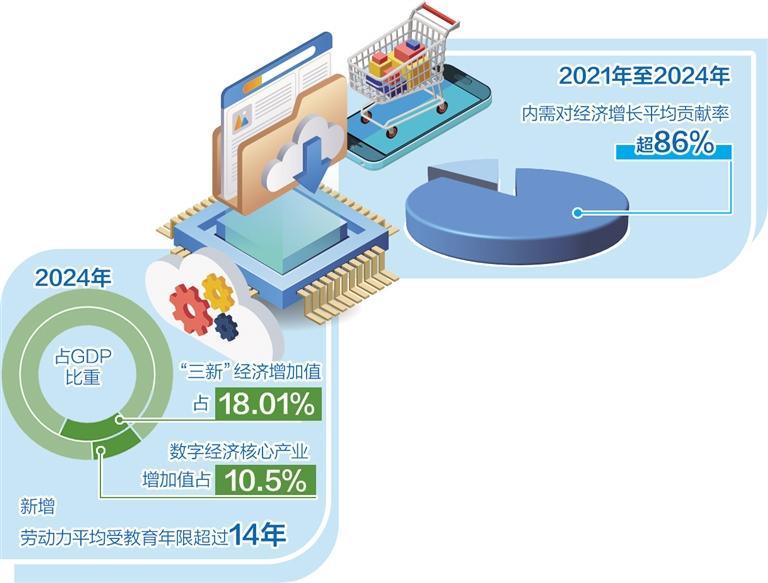
Core Viewpoint - The central economic work conference emphasizes the necessity to fully tap into economic potential as a fundamental guideline for current and future economic work, highlighting the importance of leveraging China's resilience, ample potential, and flexibility to drive high-quality economic development [1][2]. Economic Potential - China's economy is characterized by its large scale and significant untapped potential, which allows for strong internal circulation and resilience against external risks. The emphasis on "fully tapping economic potential" reflects an accurate understanding of China's economic characteristics and future development trends [2]. - The "14th Five-Year Plan" period has seen major breakthroughs in economic development, with GDP steadily increasing and expected to reach approximately 140 trillion yuan by 2025. The average contribution rate of final consumption to economic growth from 2021 to 2024 is close to 60% [3]. High-Quality Development - The transition to high-quality development necessitates tapping into potential as a means to address challenges and achieve upgrades. By 2024, per capita GDP is projected to rise to $13,445, maintaining a position among upper-middle-income countries [4]. - To achieve the goal of reaching the per capita GDP of developed countries by 2035, economic development during the "15th Five-Year Plan" period must maintain an appropriate pace, focusing on deepening the exploration of comprehensive potential in market scale, industrial systems, human resources, and innovation capabilities [4]. New Development Pattern - Tapping into economic potential is crucial for leveraging domestic demand and achieving high-level self-reliance. The new development pattern relies on China's vast market advantages, fostering domestic demand, promoting independent innovation, and optimizing industrial structure [4]. - The emphasis on resource allocation optimization and market vitality is aimed at transforming the scale advantage of the domestic market into real economic growth, providing strong support for the new development pattern [4]. Regional Development - The activation of potential must consider China's unique national conditions, utilizing effective market mechanisms and regional policies to create a new pattern of coordinated regional development. Differences in resource endowments and industrial foundations among regions present opportunities for complementary development [5]. Economic Advantages - The "15th Five-Year Plan" suggests that China's economic foundation remains stable, with numerous advantages and strong resilience, indicating that the long-term supportive conditions and basic trends have not changed [6]. - The four major dividends of economic potential include: - Institutional dividends from the advantages of the socialist system, which enable effective mobilization and coordination [7]. - Market dividends from the vast market size, with over 1.4 billion people and a growing middle-income group, leading to continuous market expansion [8]. - Industrial dividends from a complete industrial system, enhancing supply chain efficiency and promoting innovation [9]. - Talent dividends from a rich talent pool, with a labor force of approximately 860 million and increasing educational attainment [10]. Transforming Potential into Development Momentum - The key to tapping economic potential lies in transforming the four advantages into four dividends, creating strong momentum for economic development. This involves deepening institutional reforms, expanding consumption and investment, promoting industrial innovation, and ensuring a positive cycle of education and talent [11]. - Specific strategies include enhancing the socialist market economy, increasing consumer spending through income growth and social security improvements, and investing in technology and green transformation [12]. - Emphasizing technological innovation to drive industrial advancement, focusing on key areas such as integrated circuits and advanced manufacturing, is essential for fostering new economic growth points [13]. Systematic Approach - Tapping into economic potential is a systematic project that requires a comprehensive understanding of key focus points, balancing current needs with future trends, and integrating policy support with reform and innovation [14].
充分挖掘中国经济潜能
Xin Lang Cai Jing· 2026-01-07 21:21
Core Insights - The central economic work conference emphasizes the necessity to "fully tap economic potential" as a primary strategy for driving high-quality economic development in China [2][3]. Group 1: Economic Potential - China's economy is characterized by its large scale and significant untapped potential, which can enhance resilience and independence against external risks [3]. - The conference highlights the importance of recognizing and effectively stimulating this potential to transform it into robust economic growth [4]. Group 2: Economic Achievements - During the "14th Five-Year Plan" period, China's economy has made significant strides, with GDP expected to reach approximately 140 trillion yuan by 2025, following a steady increase past 110 trillion, 120 trillion, and 130 trillion yuan [4]. - The average contribution of final consumption to economic growth from 2021 to 2024 is projected to be close to 60%, indicating a strengthening role of domestic demand [4]. Group 3: Strategic Focus Areas - The need to enhance economic potential is elevated to a strategic level, particularly in light of profound changes in both domestic and international environments, including a new wave of technological revolution and industrial transformation [4]. - The transition to high-quality development necessitates a focus on deepening the integration of traditional growth drivers with new ones, leveraging market scale, industrial systems, human resources, and innovation capabilities [5]. Group 4: Advantages and Dividends - The "15th Five-Year Plan" outlines four key advantages that represent China's economic potential: institutional, market, industrial, and talent dividends [7][8][9][10]. - Institutional dividends stem from the advantages of the socialist system, which enables coordinated efforts and long-term strategic focus [7]. - Market dividends arise from China's vast market size and the growing middle-income population, which enhances consumption and innovation opportunities [8]. - Industrial dividends are linked to China's comprehensive industrial system, which supports efficiency and innovation in production [9]. - Talent dividends are derived from a large and increasingly educated labor force, which is crucial for driving technological and economic advancements [10]. Group 5: Implementation Strategies - To effectively stimulate economic potential, it is essential to focus on deepening institutional reforms, expanding consumption and investment, and promoting industrial innovation [11]. - Strategies include enhancing the domestic market through increased consumer income and investment in key sectors such as technology and green transformation [12]. - Emphasis on technological innovation is critical for driving industrial upgrades and fostering new economic growth points [13].
狂人马斯克,为什么做一件事成一件?
3 6 Ke· 2025-10-21 03:48
Group 1 - SpaceX's Starship completed its 11th test flight successfully, achieving all testing objectives, including a groundbreaking hot separation technique that defies traditional rocket logic [1][3] - Elon Musk's approach to innovation is characterized by a willingness to challenge conventional wisdom and redefine the boundaries of human exploration [3][4] - The success of Musk and SpaceX is attributed to their ability to seize historical opportunities in technology development [4][7] Group 2 - Musk's unique ability to identify and act on opportunities is highlighted as a critical factor in his success, contrasting with traditional educational systems that often fail to teach opportunity recognition [9][10] - The shift from geographical to industrial dividends is emphasized, with emerging technologies like AI and aerospace creating a divide between those who embrace new technologies and those who resist [7][8] Group 3 - Musk's innovative thinking is built on three core elements: courage to face risks, creativity to break norms, and idealism that drives action [11][20] - The concept of "first principles" is introduced as a systematic approach to problem-solving, allowing for significant performance improvements through collaborative advancements across multiple dimensions [24][26] Group 4 - Musk's entrepreneurial journey illustrates the importance of persistence and the interplay between luck and effort, as seen in the critical moments of SpaceX and Tesla's histories [29][30] - The article discusses Musk's extreme work ethic and practical business strategies, which include adapting to market feedback and integrating complementary businesses [32][33] Group 5 - The future trends identified include the transformative potential of AI for equitable service access, the globalization of Chinese manufacturing capabilities, and the maturation of online society towards credibility and trust [37][40][44] - The article suggests that education must evolve from producing compliant workers to fostering creative thinkers capable of navigating the complexities of the modern world [47][50]