产学研协作

Search documents
安徽靠啥实现国内汽车产量第一
Jing Ji Ri Bao· 2025-11-30 21:54
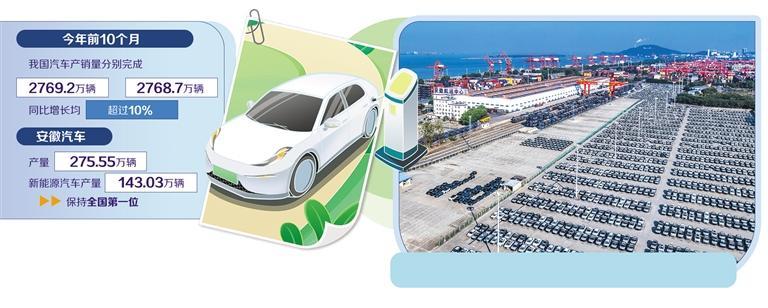
Core Insights - Anhui Province has become a leading automotive manufacturing hub in China, with a cumulative export of over 5 million vehicles by Chery Automobile and significant production growth in new energy vehicles (NEVs) [2][3] - The province's automotive production reached 2.7555 million units in the first ten months of the year, with NEV production at 1.4303 million units, maintaining the top position nationally [2] - The growth is attributed to strategic government policies and investments in the NEV sector, fostering a complete automotive industry ecosystem [3][8] Industry Development - Since the 18th National Congress, China has prioritized the development of the NEV industry, with Anhui actively implementing supportive policies and establishing a dual-core development model centered around Hefei and Wuhu [3][11] - The automotive industry in Anhui is supported by over 3,000 regulated parts manufacturers, creating a robust supply chain for NEVs [8][9] Production Capacity and Growth - Hefei's NEV production has seen exponential growth, with output increasing from 145,000 units in 2021 to an expected 1.3761 million units in 2024 [4] - Major automotive companies, including BYD and Volkswagen, have established significant production bases in Anhui, contributing to the rapid increase in NEV output [4][8] Innovation and Technology - Anhui's automotive sector benefits from numerous research institutions, enhancing its competitive edge through innovation and technology transfer [5][6] - Collaborations between automotive companies and universities have led to advancements in key technologies, such as AI-driven manufacturing and vehicle control systems [6][7] Supply Chain and Component Manufacturing - The province is focusing on attracting core component suppliers to establish local production, enhancing the efficiency and integration of the automotive supply chain [8][10] - The automotive parts industry in Xuancheng has developed a comprehensive ecosystem, with over 700 companies and projected output exceeding 85 billion yuan by 2024 [9] Chip Manufacturing and Integration - To address the shortage of automotive chips, Anhui is developing a regional IDM model centered around wafer fabrication, integrating design and manufacturing capabilities [10] - The province has successfully achieved domestic production of vehicle chips, enhancing the local supply chain for the automotive industry [10]


这一幕,科研机构更尴尬了
投资界· 2025-11-17 08:10
Core Viewpoint - The article discusses the rise of Chinese pharmaceutical companies in innovation and the challenges they face in collaborating with research institutions, highlighting a trust crisis in early-stage academic innovations [4][5][6]. Group 1: Innovation in Chinese Pharmaceutical Industry - In 2023, the total amount of new drug licensing transactions from Chinese pharmaceutical companies has exceeded $100 billion, indicating a significant rise in innovation capabilities [4]. - The market's increasing demand for innovation is leading to a more competitive international landscape for Chinese pharmaceutical companies [4]. Group 2: Challenges in Collaboration - Domestic research universities and institutions often face difficulties in industrial collaboration, with most partnerships occurring only after projects have reached advanced stages [5][6]. - There is a notable contrast with the U.S., where academic innovations are more readily supported by venture capital, reflecting a conservative approach in China towards early-stage academic innovations [5][6]. Group 3: Trust Issues and Funding - Trust issues arise when early-stage academic research fails to meet expectations, leading to terminated collaborations and a lack of investment in promising projects [7][12]. - The funding required for preclinical research ranges from 30 million to 50 million yuan, which poses a significant barrier for many projects [12]. Group 4: Need for Differentiated Investment - It is suggested that venture capital and large pharmaceutical companies allocate 5% to 10% of their R&D budgets to support early-stage, differentiated innovations, which could lead to breakthrough results [13]. - The article emphasizes the importance of nurturing both immediate and long-term innovations in the pharmaceutical industry, akin to planting seeds for future growth [13].