整车全域操作系统

Search documents
拆解车企2026新年致辞:反内卷、求质量成为集体共识
Jing Ji Guan Cha Wang· 2026-01-08 05:19
Core Insights - The automotive industry is undergoing a collective reflection on the competitive landscape, with major companies advocating against "involution" and promoting fair competition for healthy industry development [2][3] - There is a consensus that excessive price competition erodes profits and stifles innovation, prompting leading companies to shift focus from short-term market share to long-term competitiveness [2][3] - Emphasis on safety has become a key topic in the industry, with companies like Chery and GAC highlighting their commitment to exceeding safety standards and enhancing consumer trust [3][4] Group 1: Involution and Competition - Major automotive companies are calling for an end to "involution" in competition, focusing on technology, quality, brand, and user experience rather than just cost and price [2] - Geely's chairman reflects on the importance of moving away from low-price competition, marking a pivotal shift in the company's development [2] - The industry recognizes that internal competition leads to mutual deprivation in a stagnant market, hindering long-term strategic positioning [2] Group 2: Safety and Quality - Safety has emerged as a critical focus, with companies like Chery establishing stringent quality standards and receiving accolades for their commitment to safety [3][4] - GAC emphasizes that safety is a non-negotiable baseline, introducing comprehensive safety policies to address potential risks associated with electric vehicles [4][5] - Geely has expanded its safety vision to include data and software security, reflecting a broader understanding of safety beyond physical vehicle parameters [5] Group 3: Openness and Collaboration - The competitive landscape is evolving from direct confrontations among automakers to collaborative relationships across the supply chain [7][8] - Companies like SAIC and GAC are actively forming partnerships with tech firms and other industries to build a more integrated ecosystem [7][8] - Chery's initiative to create an open innovation platform with global universities illustrates a shift towards collaborative technological advancement [9] Group 4: Intelligence and Electrification - The consensus among automakers is that electrification is a prerequisite, while intelligence will determine competitive positioning in the future [11] - Companies are investing in advanced technologies, with NIO and Geely leading in the development of smart driving systems and integrated software solutions [11] - The automotive sector is transitioning towards becoming intelligent nodes within a broader digital ecosystem, enhancing user experience and connectivity [12] Group 5: Global Expansion - The trend of "going global" is increasingly seen as a critical factor for the future of automotive companies, with many emphasizing the need for a structured approach to international markets [13][14] - BYD and Dongfeng are accelerating their global strategies, focusing on localizing production and services to build sustainable competitive advantages [14][15] - The shift from mere product export to a comprehensive value chain approach is becoming essential for establishing a strong presence in overseas markets [15]

晚点独家丨李斌定调2026:继续“结硬寨,打呆仗”,没有片刻放松的资格
Xin Lang Cai Jing· 2026-01-04 01:29
Core Insights - The company achieved a record high delivery of over 326,000 new vehicles in 2025, despite not meeting the target of over 50,000 monthly deliveries in Q4 [2][15][16] - The CEO expressed optimism about the future, predicting that by 2030, the penetration rate of new energy vehicles in China will exceed 90%, with pure electric vehicles accounting for over 80% of that market [2][7][20] Company Performance - In 2025, the company delivered 67,433 vehicles in Q4, a year-on-year increase of 27.8%, with the new brand "firefly" achieving a 92.1% increase in deliveries [15][16] - The company has built 3,737 battery swap stations globally, providing over 96 million swap services, which enhances user convenience and supports vehicle sales [6][17] Strategic Focus - The CEO emphasized the need for strategic focus and operational efficiency in a highly competitive automotive market, where small efficiency differences can determine survival [4][14] - The company plans to continue investing in its 12 core technologies for smart electric vehicles and aims to launch three new models in 2026 to strengthen its market position [21] Market Trends - As of the first 11 months of 2025, pure electric vehicles accounted for 61.9% of the new energy vehicle market, significantly outpacing hybrid and plug-in models [7][20] - The company believes that the "golden age" of pure electric vehicles is approaching, driven by technological advancements and improved infrastructure [2][20]

未来钱要花在哪里?蔚来李斌:核心就在充换电基础设施领域
Xin Lang Cai Jing· 2025-12-09 11:54
Core Viewpoint - The 2025 China Entrepreneur Influence Entrepreneur Annual Conference emphasizes the theme of "Emergence·Infinity - Co-creating New Forms of Intelligent Business" and highlights the importance of technological innovation in the electric vehicle industry, as articulated by NIO's founder, Li Bin [1][6]. Group 1: Investment in R&D - NIO has invested over 65 billion RMB in research and development over the past 11 years, with a global R&D team of more than 11,000 people and nearly 10,000 project patents [3][8]. - The company maintains a quarterly R&D expenditure of approximately 3 billion RMB, with total R&D spending of 13 billion RMB last year and 13.4 billion RMB the year before, positioning it among the highest in the automotive industry [3][8]. Group 2: Technological Innovations - NIO's intelligent electric vehicles represent a systemic innovation involving three major industries, rather than isolated advancements [3][8]. - The company has developed the world's first 5-nanometer automotive-grade chip, featuring over 50 billion transistors, which was completed and integrated into vehicles ahead of NVIDIA's flagship chip [3][8]. - NIO's self-developed vehicle operating system manages all onboard chips, creating a comprehensive "nervous system" for the vehicle [3][8]. - The company has pioneered the implementation of steer-by-wire technology in its vehicles, enhancing safety and performance with the ability to make 1,000 adjustments per second [3][8]. Group 3: Charging and Battery Swap Infrastructure - NIO has invested over 18 billion RMB in building a unique "charge, swap, and upgrade" service system, with more than 3,600 battery swap stations deployed nationwide [4][9]. - The company offers a "3-minute battery swap" service, with daily swap services reaching hundreds of thousands and a cumulative total of nearly 94 million battery swaps [4][9]. Group 4: Industry Outlook - The automotive industry is identified as a strategic pillar industry, with the intelligent electric vehicle sector representing a new high point for technological innovation [4][9]. - Li Bin acknowledges the pressures facing the industry and emphasizes the need for sustained innovation and operational efficiency to rebound from current challenges [4][9].
李斌:蔚来11年在技术研发上投了很多钱,累计超650亿元
Xin Lang Cai Jing· 2025-12-09 11:54
Core Viewpoint - The 2025 China Entrepreneur Influence Entrepreneur Annual Conference emphasizes the theme of "Emergence·Infinity - Co-creating New Forms of Intelligent Business" and highlights the importance of technological innovation in the electric vehicle industry, as articulated by NIO's founder, Li Bin [1][6]. Group 1: Investment in R&D - NIO has invested over 65 billion RMB in research and development over the past 11 years, with a global R&D team of more than 11,000 people and nearly 10,000 project patents [3][8]. - The company maintains a quarterly R&D expenditure of approximately 3 billion RMB, with total R&D spending of 13 billion RMB last year and 13.4 billion RMB the year before, positioning it among the highest in the automotive industry [3][8]. Group 2: Technological Innovations - NIO's intelligent electric vehicles represent a systemic innovation involving three major industries, rather than isolated advancements [3][8]. - The company has developed the world's first 5-nanometer automotive-grade chip, featuring over 50 billion transistors, which was completed and put into production ahead of NVIDIA's flagship chip [3][8]. - NIO's self-developed vehicle operating system manages all onboard chips, creating a comprehensive "nervous system" for the vehicle [3][8]. - The company has pioneered the implementation of steer-by-wire technology in its vehicles, enhancing safety and performance with the ability to make 1,000 adjustments per second [3][8]. Group 3: Charging and Battery Swap Infrastructure - NIO has invested over 18 billion RMB in charging and battery swap infrastructure, establishing a unique service system that is "chargeable, swappable, and upgradable" [4][9]. - The company has deployed over 3,600 battery swap stations nationwide, providing a "3-minute battery swap" service that is utilized tens of thousands of times daily, with a cumulative swap service volume nearing 94 million [4][9]. Group 4: Industry Outlook - The automotive industry is identified as a strategic pillar industry, with the intelligent electric vehicle sector representing a new high point for technological innovation [4][9]. - Li Bin acknowledges the pressures facing the industry and emphasizes the need for sustained innovation and operational efficiency to rebound from current challenges [4][9].
安徽靠啥实现国内汽车产量第一
Jing Ji Ri Bao· 2025-11-30 21:54
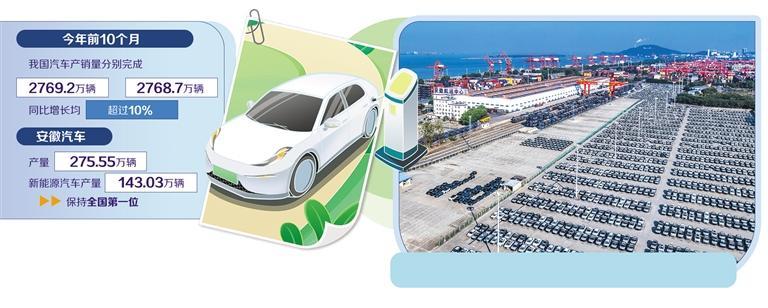
Core Insights - Anhui Province has become a leading automotive manufacturing hub in China, with a cumulative export of over 5 million vehicles by Chery Automobile and significant production growth in new energy vehicles (NEVs) [2][3] - The province's automotive production reached 2.7555 million units in the first ten months of the year, with NEV production at 1.4303 million units, maintaining the top position nationally [2] - The growth is attributed to strategic government policies and investments in the NEV sector, fostering a complete automotive industry ecosystem [3][8] Industry Development - Since the 18th National Congress, China has prioritized the development of the NEV industry, with Anhui actively implementing supportive policies and establishing a dual-core development model centered around Hefei and Wuhu [3][11] - The automotive industry in Anhui is supported by over 3,000 regulated parts manufacturers, creating a robust supply chain for NEVs [8][9] Production Capacity and Growth - Hefei's NEV production has seen exponential growth, with output increasing from 145,000 units in 2021 to an expected 1.3761 million units in 2024 [4] - Major automotive companies, including BYD and Volkswagen, have established significant production bases in Anhui, contributing to the rapid increase in NEV output [4][8] Innovation and Technology - Anhui's automotive sector benefits from numerous research institutions, enhancing its competitive edge through innovation and technology transfer [5][6] - Collaborations between automotive companies and universities have led to advancements in key technologies, such as AI-driven manufacturing and vehicle control systems [6][7] Supply Chain and Component Manufacturing - The province is focusing on attracting core component suppliers to establish local production, enhancing the efficiency and integration of the automotive supply chain [8][10] - The automotive parts industry in Xuancheng has developed a comprehensive ecosystem, with over 700 companies and projected output exceeding 85 billion yuan by 2024 [9] Chip Manufacturing and Integration - To address the shortage of automotive chips, Anhui is developing a regional IDM model centered around wafer fabrication, integrating design and manufacturing capabilities [10] - The province has successfully achieved domestic production of vehicle chips, enhancing the local supply chain for the automotive industry [10]